江阴银行

Search documents
筑牢风控合规防线 银行两大首席官密集迎新
Bei Jing Shang Bao· 2026-01-10 05:34
Core Viewpoint - The banking industry is undergoing a restructuring of risk prevention and compliance management systems, driven by stricter financial regulations and increasing complexity of industry risks, leading to an accelerated appointment of Chief Compliance Officers (CCOs) and Chief Risk Officers (CROs) [1][2] Group 1: Appointment Trends - In recent months, nearly 10 banks have intensified the hiring of CCOs and CROs, with over 20 banks and branches receiving regulatory approval for relevant positions since the beginning of 2025 [2] - The appointment of these two key positions reflects the dual drivers of industry risk prevention needs and regulatory guidance, as banks face increasing pressure from non-performing asset management and new risks associated with financial technology [2][3] Group 2: Role Differentiation - The roles of CCOs and CROs have distinct responsibilities; CCOs focus on ensuring compliance with laws and regulations, while CROs manage various operational risks such as credit and market risks [4][5] - The establishment of these roles aims to address the need for specialized governance within banks, with CCOs ensuring adherence to external rules and CROs managing uncertainties in operations [4][5] Group 3: Governance Models - Two governance models are emerging: "one person holding both positions" and "separate positions," each with its advantages and disadvantages [5][6] - The "one person" model emphasizes decision-making efficiency and is suitable for smaller banks, while the "separate" model allows for specialized oversight and is better for larger, more complex banks [6] Group 4: Talent Requirements - The effective functioning of CCOs and CROs relies on the availability of composite talent, characterized by frontline business experience, cross-regional perspectives, and professional qualifications [7][8] - The current supply of such composite risk and compliance professionals is limited, necessitating banks to develop internal training and rotation mechanisms to cultivate talent [8]
过渡期收官在即,银行业首席合规官密集就位, 如何推进从“被动遵循”到“主动治理”?
Mei Ri Jing Ji Xin Wen· 2026-01-09 10:52
Core Insights - The banking industry is undergoing a restructuring wave in risk and compliance systems due to tightening regulatory rules and a complex risk environment [1] - A surge in appointments of Chief Risk Officers (CROs) and Chief Compliance Officers (CCOs) is expected by the end of 2025 and early 2026, with over 20 banks and branches already approved for related positions since early 2025 [1] - The implementation of the "Compliance Management Measures for Financial Institutions" mandates the establishment of CCOs at the headquarters level, who will be senior management personnel directly reporting to the board [1] Group 1: Appointment Trends - Nearly 10 banks have intensified their hiring for compliance roles in the past month, with institutions like Ping An Bank and Minsheng Bank announcing relevant appointments [1] - The first approved CCO in the banking sector post-implementation of the new measures is Yang Hong from Huaxia Bank, while Zhou Wei from Shixing Dazhong Village Bank is the first CCO for a rural bank [2] Group 2: Governance Models - Two governance models are emerging: "one person holding multiple roles" and "independent separation" for CCOs and CROs [2][3] - The "one person holding multiple roles" model is prevalent among smaller banks, allowing for unified decision-making in risk and compliance management [3] - The "independent separation" model is more suitable for larger banks, enhancing professional checks and balances within risk management and compliance [3] Group 3: Talent and Recruitment - The establishment of CCO and CRO positions presents new challenges in talent acquisition, with a preference for candidates possessing a combination of frontline business experience, cross-regional vision, and professional qualifications [4] - Some banks are adopting market-based recruitment strategies for CCOs, requiring candidates to have over eight years of experience in finance or legal compliance [5] - Salary levels for CCO positions are rising, with some banks offering monthly salaries between 100,000 to 130,000 yuan [5] Group 4: Compliance Management Evolution - The number and amount of penalties in the banking sector remain high, with 6,521 penalties totaling 2.641 billion yuan in 2025, a 44.95% increase from 2024 [5] - Effective compliance management is evolving from a "cost center" to a "value protection center," crucial for mitigating credit, market, and liquidity risks [5] - Future compliance governance is expected to become more institutionalized and refined, with a focus on clear responsibilities and the need for composite compliance talents [6] Group 5: Role of Chief Compliance Officers - The role of CCOs is pivotal in the compliance system, requiring capabilities in business insight, regulatory interpretation, execution, and cross-departmental collaboration [6] - As the transition period for CCO appointments concludes, the emphasis will be on ensuring these compliance leaders effectively facilitate a shift from passive regulatory adherence to proactive compliance governance [6]
过渡期收官在即,银行业首席合规官密集就位,如何推进从“被动遵循”到“主动治理”?
Mei Ri Jing Ji Xin Wen· 2026-01-09 10:51
Core Viewpoint - The tightening of regulatory rules and the complexity of the risk environment are driving a restructuring wave in the banking industry's risk and compliance systems [1][7]. Group 1: Appointment Trends - A surge in appointments for Chief Risk Officers (CROs) and Chief Compliance Officers (CCOs) is expected from late 2025 to early 2026, with nearly 10 banks increasing related personnel configurations in the past month [1][7]. - Since the beginning of 2025, over 20 banks and branches have had relevant qualifications approved by regulators [1][7]. - The trend is influenced by the impending expiration of a one-year transition period set by the "Financial Institutions Compliance Management Measures," which requires financial institutions to establish a CCO at their headquarters [1][7]. Group 2: Governance Models - The banking sector exhibits two governance models for CCOs and CROs: "one person holding both positions" and "independent separation" [2][9]. - The "one person holding both positions" model is prevalent, particularly in smaller banks, allowing for unified decision-making in risk and compliance management [2][9]. - Conversely, the "independent separation" model is more common in larger banks, enhancing professional checks and balances within the risk control system [3][10]. Group 3: Talent Acquisition and Challenges - The demand for composite talents is rising, with banks favoring candidates with extensive experience in finance or legal compliance [11][12]. - Some banks are adopting market-based recruitment methods for CCOs, breaking traditional selection models [11]. - Salary levels for CCO positions are increasing, with some banks offering monthly salaries between 100,000 to 130,000 yuan [11]. Group 4: Compliance Management Evolution - Effective compliance management is evolving from a "cost center" to a "value guardian," playing a crucial role in mitigating credit, market, and liquidity risks [12][13]. - The future of compliance governance in the banking industry is expected to become more institutionalized and refined, with clearer responsibilities and a focus on composite compliance talents [12][13]. - The core competencies for CCOs are expected to include deep business insight, precise regulatory interpretation, efficient execution, and strong cross-departmental collaboration [13].





银行集体补位首席风险官
Bei Jing Shang Bao· 2026-01-08 15:45
岁末年初,银行密集官宣首席合规官及首席风险官的聘任进展:张家港农商行近日宣布聘任吴开为首席 合规官,在2025年的最后一个月里,郑州银行、江阴农商行、平安银行、华夏银行、兴业银行等近10家 上市银行集中加码首席合规官或首席风险官配置。拉长时间维度看,自2025年初以来,已有超20家银行 及分支机构的相关任职资格获得监管部门核准。 两大首席官岗位持续扩容,背后是行业风险防控的现实需求与监管导向的双重驱动。近年来,银行业不 良资产处置压力攀升,贷后管理难度加大,叠加金融科技快速发展背景下反洗钱、数据合规等新型风险 挑战加剧,对银行风险防控与合规体系的专业性、前瞻性提出更高要求。在此背景下,2024年12月,国 家金融监督管理总局发布《金融机构合规管理办法》,明确金融机构可根据自身经营情况单独设立首席 合规官,也可由高级管理人员、省级分支机构或者一级分支机构的高级管理人员兼任。政策落地后,多 家机构迅速响应,由董事长、行长亲自"挂帅"统筹的态势也愈发明显。 而首席风险官制度探索则更早一步,早在2006年、2007年,工商银行、建设银行、交通银行等大行就已 启动首席风险官管理机制。2016年原银监会发布的《银行业金融 ...


江南水务:公司于2025年12月收到江阴银行中期分红款
Zheng Quan Ri Bao Wang· 2026-01-08 13:13
Core Viewpoint - Jiangnan Water (601199) announced on January 8 that it will receive a mid-term dividend payment from Jiangyin Bank (002807) in December 2025 [1] Group 1 - The company confirmed the receipt of dividend payments from Jiangyin Bank, indicating a positive cash flow outlook [1]

筑牢风控合规防线,银行两大首席官密集迎新
Bei Jing Shang Bao· 2026-01-08 11:05
而首席风险官制度探索则更早一步,早在2006年、2007年,工商银行、建设银行、交通银行等大行就已启 动首席风险官管理机制。2016年原银监会发布的《银行业金融机构全面风险管理指引》提及,规模较大的 或业务复杂的银行业金融机构应当设立风险总监,即首席风险官。此后,首席风险官的设立进入快车道, 尤其是在2024年之后,增设首席风险官的银行阵营不断扩大,包括光大银行、兴业银行等在内的银行均完 成了这一岗位的人员聘任。 缘何在首席风险官后又出现了首席合规官?苏商银行特约研究员武泽伟表示,"事实上,这两个岗位的差 别很大,从核心职责来说,既有重合也有差异、各有侧重,同时设立主要是基于内部治理的专业化分工需 要"。他进一步指出,首席风险官主要负责全面管理银行在经营中面临的各类风险,其工作侧重于对信用 风险、市场风险、操作风险等具体业务风险进行识别、评估、计量、监测和控制,旨在保障银行资产安全 与业务稳定运行;而首席合规官的职责则更加聚焦于确保银行的经营管理行为和员工履职行为符合所有适 用的法律、行政法规及监管规范,其核心目标是防范因违反规则而导致的合规风险。简言之,风险官主要 应对经营中的"不确定性"可能带来的损失,而 ...

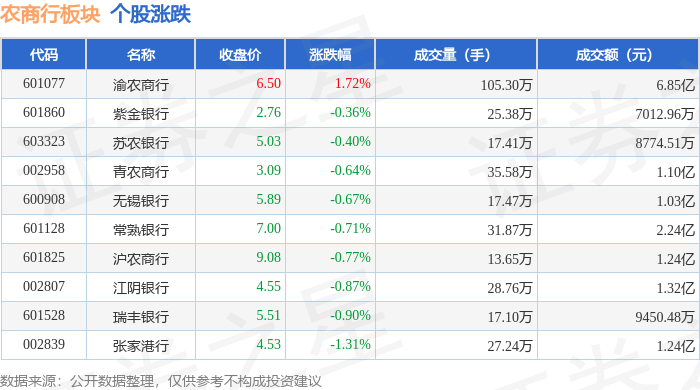
农商行板块1月8日跌0.18%,张家港行领跌,主力资金净流出3731.72万元
Zheng Xing Xing Ye Ri Bao· 2026-01-08 08:56
Core Viewpoint - The agricultural commercial bank sector experienced a slight decline of 0.18% on January 8, with Zhangjiagang Bank leading the drop [1] Group 1: Market Performance - The Shanghai Composite Index closed at 4082.98, down 0.07%, while the Shenzhen Component Index closed at 13959.48, down 0.51% [1] - The agricultural commercial bank sector's individual stock performance showed varied results, with Yunnan Agricultural Commercial Bank rising by 1.72% to a closing price of 6.50 [1] Group 2: Trading Volume and Turnover - The trading volume and turnover for various banks were reported, with Jiangyin Bank having a turnover of 1.32 billion and a trading volume of 287,600 shares [1] - The overall net outflow of main funds from the agricultural commercial bank sector was 37.32 million, while retail funds saw a net outflow of 18.16 million [1] Group 3: Fund Flow Analysis - The main fund inflow for Ruifeng Bank was 4.77 million, accounting for 5.04% of its total, while it faced a retail net outflow of 8.39 million [2] - Zhangjiagang Bank experienced a significant main fund outflow of 6.71 million, with retail investors also withdrawing 7.63 million [2]





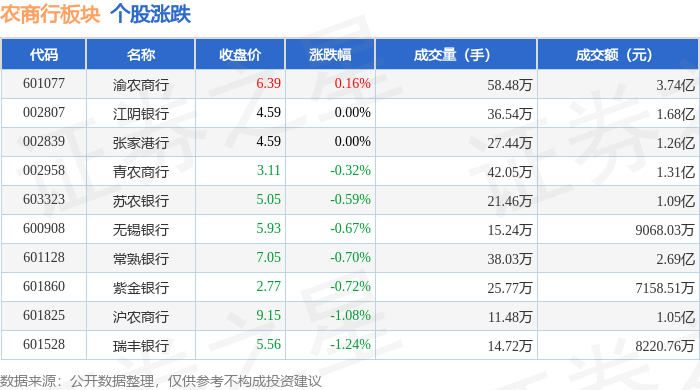
农商行板块1月7日跌0.57%,瑞丰银行领跌,主力资金净流入5042.72万元
Zheng Xing Xing Ye Ri Bao· 2026-01-07 08:58
Core Viewpoint - The rural commercial bank sector experienced a decline of 0.57% on January 7, with Ruifeng Bank leading the drop, while the Shanghai Composite Index rose by 0.05% and the Shenzhen Component Index increased by 0.06% [1] Group 1: Market Performance - The closing prices and performance of key rural commercial banks on January 7 are as follows: - Yunnan Rural Commercial Bank (601077) closed at 6.39, up by 0.16% - Jiangyin Bank (002807) closed at 4.59, unchanged - Zhangjiagang Bank (002839) closed at 4.59, unchanged - Qingnong Bank (002958) closed at 3.11, down by 0.32% - Sunan Bank (603323) closed at 5.05, down by 0.59% - Wuxi Bank (600908) closed at 5.93, down by 0.67% - Changshu Bank (601128) closed at 7.05, down by 0.70% - Zijin Bank (601860) closed at 2.77, down by 0.72% - Hunan Rural Commercial Bank (601825) closed at 9.15, down by 1.08% - Ruifeng Bank (601528) closed at 5.56, down by 1.24% [1] Group 2: Capital Flow - On January 7, the rural commercial bank sector saw a net inflow of 50.43 million yuan from main funds, while retail investors experienced a net outflow of 84.63 million yuan [1] - The capital flow for individual banks is as follows: - Zhangjiagang Bank (002839) had a main fund net inflow of 13.66 million yuan, but a retail net outflow of 13.84 million yuan - Changshu Bank (601128) had a main fund net inflow of 13.25 million yuan, with a retail net outflow of 22.78 million yuan - Qingnong Bank (002958) had a main fund net inflow of 12.24 million yuan, but a retail net outflow of 8.34 million yuan - Wuxi Bank (600908) had a main fund net inflow of 9.53 million yuan, with a retail net outflow of 6.99 million yuan [2]


已有十余家银行聘任首席合规官
Jin Rong Shi Bao· 2026-01-07 02:52
Core Viewpoint - The appointment of Chief Compliance Officers (CCOs) in banks is a response to increasing regulatory demands, aiming to enhance compliance management and integrate it into business processes [1][2]. Group 1: Appointment of Chief Compliance Officers - Zhangjiagang Rural Commercial Bank appointed Wu Kai as its Chief Compliance Officer, marking a trend where over ten banks have made similar appointments [1]. - In December 2025 alone, several banks, including Ping An Bank and Industrial Bank, approved the hiring of CCOs [1]. - The rapid appointment of CCOs aligns with the implementation of the "Financial Institutions Compliance Management Measures," which mandates the establishment of CCO positions at the headquarters of financial institutions [2]. Group 2: Responsibilities and Challenges - CCOs are expected to take on more responsibilities, including the formulation and supervision of compliance policies, ensuring that all business activities adhere to regulatory frameworks [5]. - There is a concern that an increase in executive positions may burden banks, particularly smaller financial institutions [2]. - Many currently appointed CCOs are existing senior executives, which helps mitigate potential operational burdens [3]. Group 3: Recruitment Trends - Some banks, such as Jiangxi Bank and Shangrao Bank, have publicly announced recruitment for CCO positions, indicating a proactive approach to compliance management [4].

过渡期临近,银行业首席合规官纷纷“就位”
2 1 Shi Ji Jing Ji Bao Dao· 2026-01-06 10:22
Core Viewpoint - The appointment of Chief Compliance Officers (CCOs) in Chinese banks is a response to regulatory requirements aimed at enhancing compliance systems and governance structures within the banking industry [1][3][10]. Group 1: Regulatory Framework - The Financial Regulatory Bureau issued the "Compliance Management Measures for Financial Institutions," mandating the establishment of CCOs at the headquarters of financial institutions, effective from March 1, 2025, with a one-year transition period [3][9]. - The implementation of CCOs is seen as a shift from "formal compliance" to "substantive compliance" across various types of banks, including state-owned banks, city commercial banks, and rural banks [3][7]. Group 2: Appointment Trends - A wave of appointments for CCOs has been observed, with banks like Zhangjiagang Rural Commercial Bank and others appointing existing senior management to these roles, reflecting a trend towards integrating compliance into the upper management structure [1][6][8]. - Different banks are adopting varied models for appointing CCOs, with many choosing to have existing senior executives, such as vice presidents or assistants to the president, take on these responsibilities [8][9]. Group 3: Compliance Needs and Challenges - Compliance pressures differ among banks of varying sizes, with larger banks facing more significant challenges due to their complex structures and global operations, while smaller banks focus on high-risk areas like credit and anti-money laundering [7][8]. - The need for a systematic and intelligent compliance framework is emphasized for larger banks, while smaller banks prioritize practical compliance integration into business processes [8][9]. Group 4: Qualifications and Responsibilities - CCOs must meet specific qualifications, including a minimum of eight years in financial work and three years in legal compliance, or equivalent experience, to ensure they can effectively manage compliance risks [9][10]. - The role of CCOs is crucial for establishing a robust compliance governance system, transitioning banks from reactive to proactive risk management [10][11]. Group 5: Future Trends - The future development of the CCO role is expected to trend towards systematization and technological integration, with compliance becoming a core part of risk management and corporate governance [10][11]. - There is potential for collaboration between CCOs and other roles such as Chief Risk Officers and Chief Technology Officers, expanding the scope of compliance from local to global standards [11].