Databricks

Search documents
纳斯达克首席经济学家:2026年或成为IPO市场具有里程碑意义的一年!
Sou Hu Cai Jing· 2026-01-23 06:02
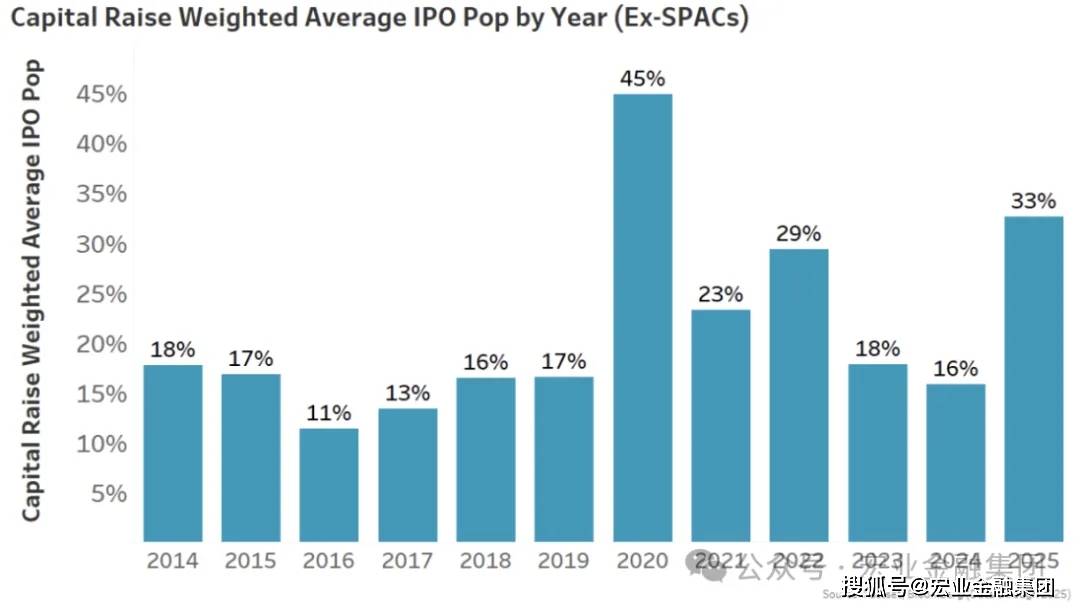
Group 1 - The core viewpoint of the article highlights that 2025 was one of the best years for IPO performance since 2014, with a total of 353 IPOs in the U.S., including 210 operating company IPOs, raising a total of $70 billion [1][4] - The average first-day return for IPOs in 2025 was 33%, marking the second-best performance since 2014, indicating a resurgence in investor appetite for IPOs [4][10] - The average age of companies going public in 2025 was 12 years, slightly improved from 14 years in 2024, and the second-highest average since 2009 [4][8] Group 2 - The trend shows that companies are waiting longer to go public, with the average age at IPO increasing significantly over the past 25 years, which has implications for market dynamics [5][8] - The article discusses the benefits of IPOs for companies, investors, and the economy, including a 25% reduction in credit spreads and lower borrowing costs for companies that go public [8][10] - Proposed reforms by Nasdaq aim to lower the costs of going public, such as adjusting disclosure requirements based on company size and simplifying reporting processes, which could facilitate more companies to list [9][18] Group 3 - The Nasdaq IPO Pulse index indicates a rebound in IPO activity, with expectations for continued growth into 2026, supported by a favorable market outlook [10][15] - The article notes that the U.S. and Stockholm IPO markets are both experiencing upward trends, with predictions of significant IPO activity in 2026, including companies with a total market value of $3 trillion [19][20] - The increase in private capital has allowed companies to remain private longer, impacting the number of IPOs and the overall market landscape [12][18]


全球最大IPO要来了?SpaceX选定高盛等四大投行承销
Hua Er Jie Jian Wen· 2026-01-23 01:42
Core Viewpoint - SpaceX is preparing for a potentially record-breaking IPO, having selected four major Wall Street banks as lead underwriters [1][2] Group 1: IPO Preparation - SpaceX executives have recently met with bankers from Bank of America, Goldman Sachs, JPMorgan Chase, and Morgan Stanley to discuss the IPO, which could occur as early as this year [1] - The company’s internal stock price was set at $421 per share in December, leading to a valuation of $800 billion, positioning it to potentially achieve the largest IPO in history [1][2] - The IPO is expected to raise over $30 billion, surpassing the previous record of $29 billion set by Saudi Aramco in 2019 [2] Group 2: Market Context - The IPO preparation coincides with a wave of large tech company IPOs anticipated in the U.S. market [3] - Other companies preparing for IPOs include OpenAI and Anthropic, with expectations that these transactions could collectively raise more than the total amount raised by U.S. IPOs last year [4] - Notable private companies planning to go public this year include Databricks, valued at $134 billion, and Canva, valued at $42 billion [4] Group 3: Market Dynamics - Despite optimistic prospects, market volatility could disrupt these IPO plans, as seen with previous delays caused by tariff policies [5] - The IPO market has recently regained momentum, supported by rising stock prices and the advancement of long-delayed listings [5]
独家专访伦交所集团CEO施维默:全面融入AI革命,强力看好私募市场
第一财经· 2026-01-22 12:14
Core Viewpoint - The London Stock Exchange Group (LSEG) is transitioning from a traditional exchange to a diversified global financial market infrastructure and data services company, with a strong focus on data and analytics, which now accounts for approximately 50% of its £9 billion revenue [4][7]. Group 1: Transformation and Strategy - LSEG's CEO, David Schwimmer, emphasizes the importance of AI as a revolutionary opportunity for the financial industry, planning to integrate AI through three core strategies: enhancing product offerings, adapting data for AI compatibility, and implementing an "intelligent enterprise" strategy [4][11]. - The company has significantly increased its investment in private markets, launching the PISCES system to facilitate trading of private company equity, reflecting a shift in focus from public market IPOs to private capital [4][14][15]. Group 2: Market Insights and Growth - LSEG's team in China has grown to approximately 1,200 employees, actively engaging in data services, indices, and foreign exchange trading, with a positive outlook on the Chinese market due to improved geopolitical stability and market activity [5][6]. - The company is closely monitoring China's financial market reforms, such as the introduction of the Futures and Derivatives Law, which enhances the attractiveness of China's derivatives market to international participants [5][6]. Group 3: Revenue Structure and Business Model - LSEG's revenue structure is diversified, with 50% from data and analytics, 30% from trading and clearing services, and 20% from indices and risk insight services, indicating a departure from traditional exchange operations [7][8]. - The company aims to provide comprehensive services across the trading lifecycle, integrating market infrastructure with data and analytics to enhance client offerings [9][10]. Group 4: AI Integration and Competitive Advantage - LSEG is leveraging its data resources and partnerships with AI model providers to enhance its service offerings, allowing clients to access data through their preferred AI models [11][12]. - The integration of AI is seen as a unique advantage, enabling LSEG to reach traditional and new clients through innovative channels [13]. Group 5: Private Market Focus and PISCES System - The PISCES system allows private companies to trade equity while maintaining confidentiality and minimizing disclosure obligations, catering to the needs of firms that wish to protect sensitive information [15][17]. - This system is designed to facilitate flexible trading windows, enabling companies to connect with global institutional investors without the need for prior buyer identification [16][17].

2026 年数据与人工智能的 7 项预测
3 6 Ke· 2026-01-22 05:52
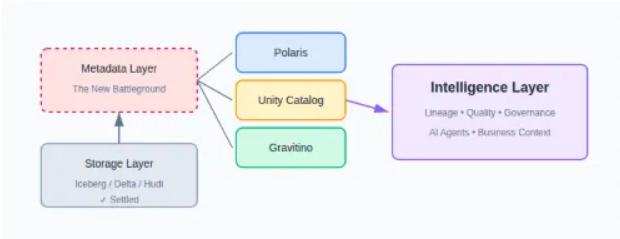
Core Insights - The infrastructure supporting artificial intelligence is undergoing a significant transformation, driven by the convergence of open formats, AI capabilities, and the unsustainable costs of integrating numerous tools [1][2]. Group 1: Importance of Fundamentals - Basic skills remain crucial as architecture changes can disrupt pipelines, and data quality issues continue to plague organizations, costing an average of $12.9 million annually due to poor data quality [2][11]. - The key challenge by 2026 will not be the existence of these issues but the speed and method of their detection and resolution [2]. Group 2: Metadata Layer as a Battleground - The storage layer competition has concluded with Iceberg, Delta Lake, and Hudi emerging as winners, while Parquet has become the common language for data storage [3][6]. - The focus is shifting upstream to the metadata layer, which is becoming the operational backbone of data management, encompassing data lineage, quality rules, access policies, and business context [6][20]. Group 3: Simplification of Data Stacks - Organizations are experiencing tool fatigue, managing an average of 15 to 30 different tools across various data functions, which is unsustainable [7][9]. - By 2026, the integration process will accelerate, with platforms like Snowflake and Databricks consolidating functionalities to streamline data operations [10]. Group 4: Data Quality as a Business Function - Data quality metrics will shift from engineering-focused indicators to business outcomes, with organizations increasingly linking data pipeline failures to revenue impacts [11][12]. - By 2026, 80% of organizations are expected to deploy AI/ML-driven data quality solutions, emphasizing the need for accountability through data contracts between producers and consumers [12]. Group 5: AI Agents Replacing Dashboards - The traditional model of data observability through dashboards is becoming obsolete, with AI agents expected to take over operational responsibilities by 2026 [13][15]. - These AI agents will be capable of understanding business context, automatically tracing issues, and applying fixes, fundamentally changing the approach to data observability [15]. Group 6: AI Reshaping Data Infrastructure - The initial design of data stacks was for dashboard services, not AI workloads, but AI is now a primary user of data [16]. - By 2026, two types of companies will emerge: AI-native architectures designed for AI workloads and traditional stacks with AI capabilities added later [16]. Group 7: The Rise of Semantic Layers - Semantic layers, previously seen as optional, are becoming essential for AI applications, providing necessary context for data interpretation and ensuring data quality [17]. - These layers serve as a bridge between technical data and business meaning, crucial for AI agents to function effectively [17]. Group 8: Common Theme - A common theme across the predictions is the shift from passive to proactive data infrastructure, where systems will not only store and visualize data but also understand, reason, and act based on interactions [18][19].

速递|估值翻倍破150亿美元:AI数据库新贵ClickHouse融资4亿美元,挑战Snowflake与Databricks
Z Potentials· 2026-01-19 03:02
Core Insights - ClickHouse, a database technology startup, raised $400 million in a new funding round, achieving a valuation of $15 billion, more than doubling its valuation from less than a year ago [1] - The funding signals investor interest in AI application support companies, which are competing with firms like Databricks and Snowflake [1] - The company plans to use the funds to accelerate product development and enhance sales and marketing efforts [1] Funding and Valuation - The latest funding round was led by Dragoneer Investment Group, with participation from several notable investors including Bessemer Venture Partners, GIC, Index Ventures, Khosla Ventures, Lightspeed, T. Rowe Price, and WCM Investment Management [1] - Since May, when ClickHouse was valued at $6.35 billion, its valuation has increased by several billion dollars [1] Acquisitions and Product Development - ClickHouse is acquiring German startup Langfuse GmbH, which develops open-source products to ensure the accuracy and safety of AI system outputs [2] - The company emphasizes the growing concern among tech firms regarding the safety of AI outputs [2] Clientele and Market Focus - ClickHouse's clients include major companies such as Meta Platforms, Tesla, and Anthropic, and it has recently expanded partnerships with startups Lovable and Polymarket [3] - The company has a unique market position, with over half of its clients, revenue, and employees located outside North America, allowing it to focus on international markets [3] Leadership and Financial Status - ClickHouse appointed Jimmy Sexton as CFO, who has experience in investor relations and IPO processes from his time at Snowflake [3] - The company is currently not prepared for an IPO, as it is still in a loss-making phase while making forward-looking investments, with annual recurring revenue reaching "hundreds of millions" [3] Historical Context and Competitive Landscape - ClickHouse originated as a database management system for Yandex in 2009 and became independent after Yandex sold its Russian business [4] - Dragoneer has been researching ClickHouse for several months, believing it has significant opportunities in the AI infrastructure space, and noted its superior real-time analytics capabilities compared to competitors [4][5]

Space X, OpenAI Dominate Speculation About $3 Trillion IPO Geyser
Yahoo Finance· 2026-01-18 05:01
Core Insights - The potential IPO of SpaceX is estimated to range from $800 billion to over $1 trillion, which would make it the largest offering in history and could position its founder, Elon Musk, as the world's first trillionaire [1] - SpaceX has transformed from a launch services company into a global aerospace and communications platform, significantly tied to the AI revolution, with its Starlink satellite network generating recurring revenue and providing strategic geopolitical infrastructure [2] - The IPO market is expected to reopen in 2026, driven by a small number of mega-cap private companies, which could absorb substantial institutional capital and reshape the market landscape [4][7] SpaceX and Other Major Players - SpaceX is viewed as the most significant potential IPO among large private companies, with its listing likely to redefine the IPO cycle [3] - OpenAI is also positioned as a major player in the upcoming IPO landscape, with market estimates for its public value ranging from hundreds of billions to over $1 trillion [8] - Anthropic, another AI systems developer, is seen as a credible candidate for an IPO, with an estimated valuation of around $350 billion [9] Market Dynamics and Trends - The IPO market has been historically stalled due to rising interest rates, volatile equity markets, and regulatory uncertainties, leading to a backlog of mature private companies ready for public listings [6] - The upcoming IPO wave is expected to be characterized by capital concentration, where a few mega-cap companies dominate the market, potentially sidelining smaller IPOs [4][13] - The success of a few large IPOs may determine the overall market conditions for smaller companies looking to go public [14] Other Notable Companies - Databricks, valued at over $130 billion, is considered a strong candidate for an IPO due to its well-understood business model in data analytics and AI infrastructure [15] - Stripe, with an estimated valuation between $90 billion and $120 billion, is another durable fintech IPO prospect, deeply embedded in global digital commerce [16] - Companies like Revolut, Canva, and Strava are also part of the conversation for potential IPOs in 2026, indicating a renewed interest in consumer-facing tech [17] Investor Sentiment and Market Readiness - There is a growing appetite for IPOs, with evidence of renewed momentum as investor demand for private companies has doubled year over year [19] - The recent filing of Bob's Discount Furniture for an IPO signals a broader belief in market stability and investor willingness to underwrite cyclical risks [22] - The overall sentiment suggests that the IPO pipeline is becoming more imminent, with the potential to redefine the market landscape if these listings succeed [25]
Snowflake, Databricks challenger ClickHouse hits $15B valuation
Yahoo Finance· 2026-01-16 22:05
Group 1 - ClickHouse secured $400 million at a $15 billion valuation, representing a 2.5x increase from its previous valuation of $6.35 billion last May [1] - The funding round was led by Dragoneer Investment Group, with participation from notable investors including Bessemer Venture Partners, GIC, Index Ventures, Khosla Ventures, and Lightspeed Venture Partners [1] - ClickHouse, which spun out from Yandex in 2021, develops database software for processing large datasets required by AI agents, competing with companies like Snowflake and Databricks [2] Group 2 - The company announced the acquisition of Langfuse, a startup that helps developers track and evaluate AI agent performance, which competes with LangSmith [2] - ClickHouse's database is open-sourced, generating revenue through managed cloud services, with annual recurring revenue (ARR) growing by over 250% year-over-year [3] - Key customers of ClickHouse include Meta, Tesla, Capital One, Lovable, Decagon, and Polymarket [3]
Morningstar’s New Generative AI Index Could Unlock Opportunities in OpenAI and Anthropic for Everyday ETF Investors
Yahoo Finance· 2026-01-16 19:30
Core Insights - The Morningstar PitchBook GenAI 20 Index launched on January 15, 2026, is expected to lead to the emergence of related ETFs, highlighting the growing interest in AI-focused investment products [1][3]. Group 1: Index Characteristics - Morningstar has created a "perpetual benchmark" that connects private tech companies with the public stock market, distinguishing it from traditional indexes [3]. - The index is designed to include private companies even after they go public, which is a unique feature compared to other indexes [6]. - The index specifically excludes hardware companies, focusing solely on software and models, thus omitting major players like Nvidia and Taiwan Semiconductor [6]. Group 2: Major Holdings - The index is heavily weighted towards four private companies, referred to as the "Big Four," which include Anthropic (19% of index assets), Databricks (21% of assets), and OpenAI (19% of assets) [3][4][5]. - Anthropic is in discussions to raise $10 billion at a valuation of $350 billion, with plans for an IPO in late 2026 [3]. - Databricks has raised $4 billion at a valuation of $134 billion, with a revenue growth of approximately 55% over the past year, and is also expected to go public this year [4].
摩根大通一线调研:微软领先所有人至少10光年,生态整合能力非常强大!
Hua Er Jie Jian Wen· 2026-01-15 16:22
Group 1 - Microsoft has established a significant advantage in cloud ecosystem integration, described by respondents as "leading all others by at least 10 light years" [1][2] - The comprehensive and collaborative product system of Microsoft is becoming the preferred platform for enterprises to scale AI and digital transformation [1][2] - Key trends in the software market over the next 12-18 months include a shift in AI project budgets from pilot scales of $250,000-$500,000 to production-level investments of $2.5 million-$5 million [1][2] Group 2 - IT spending decision-making has shifted from Chief Information Officers (CIOs) to Chief Financial Officers (CFOs), with a greater focus on measurable returns and investment cycles [1][4] - Data infrastructure companies like Databricks, Snowflake, and Datadog are benefiting from this transformation process [1][2] - The report highlights structural challenges in the industry, including scrutiny of reasoning costs and the need for repeatable, standardized use cases for AI project scaling [3][4] Group 3 - IT budgets are expected to stabilize without explosive growth by 2026, with a healthy pipeline noted [4] - Clients are increasingly focused on shorter cycles, ROI, and cash returns, marking a shift in IT spending review from CIOs to CFOs [4] - Investment in data infrastructure remains active, with clients recognizing the importance of data modernization and responding to existing gaps [4]

Information Services Group (NasdaqGM:III) Update / briefing Transcript
2026-01-15 15:02
Summary of ISG Global Index Call - Q4 2025 Company and Industry Overview - The call was hosted by Information Services Group (ISG), focusing on the IT and business services industry, which influences $200 billion of technology spending annually [5][11] - The ISG Index measures the health and growth of the technology industry, including managed services and cloud-based software and infrastructure services [11] Key Insights and Arguments Market Performance - The Americas led market growth in 2025, crossing $23 billion in managed services ACV for the first time, driven by strong ITO activity and a rebound in BFSI [12] - EMEA saw a 20% increase in ACV for engineering services, with cloud demand accelerating and deal sizes expanding [13] - The global combined market reached $34.3 billion in ACV in Q4 2025, marking a 16% year-over-year increase and the fourth consecutive quarter above $30 billion [14] - The as-a-service market grew 29% globally in 2025, while managed services grew only 1.3% [14][15] Segment Performance - SaaS accounted for 66% of the total combined market, with significant growth in cloud, software, and consumption-based services [15] - Managed services faced constraints due to fewer mega-deals and pricing pressure, with a slight decline in Q4 2025 [15][16] - Engineering services were the fastest-growing segment, with a 35% increase in ACV year-over-year, driven by large integrated multinational providers [21] - BPO generated over $2 billion in ACV in Q4 2025, up 13% year-over-year, but faced annual declines [24][25] Regional Insights - The Americas generated $23.5 billion in managed services ACV in 2025, up 9% from 2024, while EMEA's managed services ACV totaled $16.7 billion, down 1.4% [28][30] - Asia Pacific struggled, with managed services ACV down 27% year-over-year, primarily due to a decline in the smallest deal category [31] Future Outlook - For 2026, managed services growth is forecasted at 2.1%, while as-a-service is expected to grow by 20% [54] - Enterprises are navigating macroeconomic uncertainties, but investments in AI and cloud infrastructure are expected to continue [54] - The demand for AI-driven outcomes and flexible commercial models will shape the future of the outsourcing market [55] Additional Important Insights - The engineering segment showed strong growth across various sectors, with EMEA leading in ER&D spend, up 86% for the year [22] - AI is now a dominant driver of growth, with hyperscaler investments significantly impacting the market [13][41] - The BPO market is in a reset mode, with uneven growth concentrated in specific functions and industries, particularly industry-specific BPO [26][84] - The call highlighted the importance of AI in transforming traditional outsourcing models, with a focus on hyper-personalization and domain-led transformation [84] This summary encapsulates the key points discussed during the ISG Global Index call, providing insights into market performance, segment growth, regional dynamics, and future outlooks in the IT and business services industry.