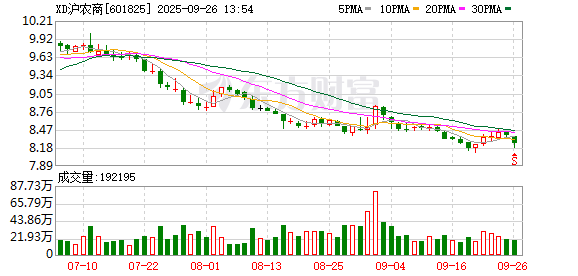
沪农商行

Search documents
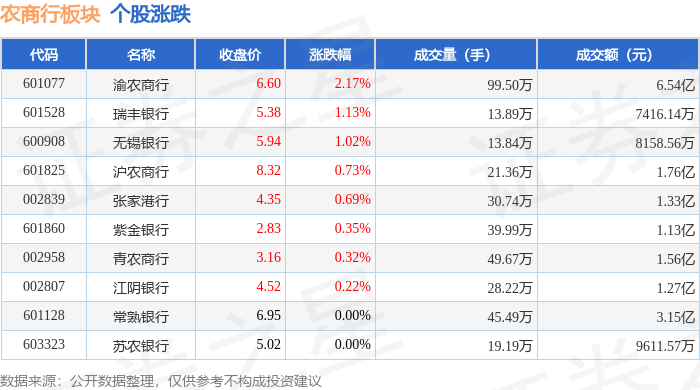
农商行板块9月29日涨0.94%,渝农商行领涨,主力资金净流出6645.88万元
Zheng Xing Xing Ye Ri Bao· 2025-09-29 08:45
Market Performance - The rural commercial bank sector increased by 0.94% on September 29, with Yunnan Rural Commercial Bank leading the gains [1] - The Shanghai Composite Index closed at 3862.53, up 0.9%, while the Shenzhen Component Index closed at 13479.43, up 2.05% [1] Individual Stock Performance - Yunnan Rural Commercial Bank (601077) closed at 6.60, with a rise of 2.17% and a trading volume of 995,000 shares, amounting to a transaction value of 654 million [1] - Other notable performers include Ruifeng Bank (601528) with a 1.13% increase, Wuxi Bank (600908) with a 1.02% increase, and Shanghai Rural Commercial Bank (601825) with a 0.73% increase [1] Capital Flow Analysis - The rural commercial bank sector experienced a net outflow of 66.4588 million from institutional investors, while retail investors saw a net inflow of 22.9898 million [1] - Specific stocks like Qingnong Bank (002958) had a net inflow of 9.1251 million from institutional investors, while Su Nong Bank (603323) had a net inflow of 613.43 million [2] Detailed Capital Flow for Selected Stocks - Yunnan Rural Commercial Bank had a significant net outflow of 50.7024 million from institutional investors, but a net inflow of 54.2507 million from retail investors [2] - Common trends show that while some banks like Zhangjiagang Bank (002839) attracted retail inflows, others like Changshu Bank (601128) faced substantial outflows from institutional investors [2]


一年前“掐点”成立 多只基金无缘“翻倍基”
Zheng Quan Shi Bao· 2025-09-28 18:35
Core Viewpoint - The A-share market has seen a significant rise, leading to a collective increase in the net value of actively managed equity funds, but few have achieved "doubling" status due to cautious positioning and heavy investment in underperforming dividend sectors [1][3]. Fund Performance - 49 funds were established around the market low point, with an average return of 35.94% since inception, benefiting from the market's recovery [2]. - Specific funds like Yongying Rong'an achieved a return of 89%, while others like Allianz China Select and Dongwu Technology Innovation exceeded 70% [2]. Cautious Positioning - Despite strong performance, many funds adopted a cautious investment strategy, focusing on dividend and value stocks, which limited their ability to capitalize on the market's rapid growth [3][4]. - Funds that maintained lower positions, such as Dongwu Technology Innovation, struggled to achieve significant returns due to their conservative approach [5]. Dividend Sector Outlook - The dividend sector has shown resilience, with expectations for increased dividend payouts as companies move past capital expenditure peaks [6]. - Analysts suggest a shift towards a "dividend+" era, where dividend stocks remain attractive due to their stable cash flows and defensive characteristics amid market volatility [7].
上市银行“十四五回望”之资负结构与息差变迁
CMS· 2025-09-28 15:09
Investment Rating - The report maintains a recommendation for the banking industry [3] Core Insights - The report provides a comprehensive analysis of the asset-liability structure and interest margin changes of 42 A-share listed banks during the "14th Five-Year Plan" period, highlighting a shift towards corporate loans on the asset side and a stronger retail focus on the liability side [12][14] - The asset-liability structure indicates a significant increase in the proportion of corporate loans, rising from 57.02% to 63.22% from the end of 2020 to mid-2025, while the proportion of demand deposits decreased from 41.94% to 30% [12][14] - The report notes a decline in both asset yield and interest margin, with the yield on interest-earning assets dropping from 4.43% to 3.32% and the net interest margin decreasing from 2.23% to 1.53% during the same period [14][15] Summary by Sections Overall Asset-Liability Structure and Interest Margin Changes - The asset-liability structure shows an increase in loan-to-earning asset ratio from 54.19% to 56.49%, with corporate loans making up a larger share of total loans [14][15] - The average yield on interest-earning assets decreased significantly, with the loan yield falling from 5.34% to 3.82% [15] - The net interest margin for listed banks remains higher than that of commercial banks, despite a decline [14][15] Changes in Each Banking Sector's Asset-Liability Structure and Interest Margin - City commercial banks experienced a more significant increase in the proportion of corporate loans, with their interest margin narrowing less compared to other banks [18] - The report highlights that the proportion of deposits in interest-bearing liabilities for state-owned banks decreased, while it increased for rural commercial banks [18] - The decline in interest-bearing liabilities' cost rate was most pronounced in city commercial banks, leading to a smaller reduction in their interest margin [18]






货币政策例会强调政策执行
Xiangcai Securities· 2025-09-28 13:06
Investment Rating - The industry rating is maintained at "Overweight" [6][31] Core Insights - The third quarter monetary policy meeting emphasized the execution of policies and the release of effects, acknowledging steady economic progress while focusing on insufficient domestic demand and low price levels [6][28] - The meeting highlighted the importance of ensuring that monetary policy measures effectively reach the real economy, with a focus on enhancing the transmission mechanism [6][29] - Support will be targeted towards key areas such as "small and micro enterprises" and "stabilizing foreign trade," with a flexible approach to incremental policy adjustments based on economic needs [6][29] - The banking sector is expected to see a relief in asset-side interest rate pressure, with a decline in deposit costs and narrowing interest margin drops, leading to relatively stable growth in bank performance [7][8] Summary by Sections Market Review - The banking index fell by 0.48% during the period from September 22 to September 26, 2025, underperforming the CSI 300 index by 1.55 percentage points [10] - The performance of major banks varied, with large banks, joint-stock banks, city commercial banks, and rural commercial banks showing slight declines [10] Industry and Company Dynamics - The third quarter monetary policy meeting acknowledged the need for effective execution of policies to support economic recovery, particularly in the context of weak credit demand [28][29] - Large banks are expected to play a crucial role in financing the real economy, with enhanced capital strength following previous capital injections [7][29] Investment Recommendations - The report suggests focusing on state-owned banks for their stable high dividend yield and potential valuation recovery opportunities for joint-stock and regional banks amid improving economic expectations [8][31] - Recommended banks include CITIC Bank, Jiangsu Bank, Chengdu Bank, Shanghai Rural Commercial Bank, Chongqing Rural Commercial Bank, Changshu Bank, and Suzhou Bank [8][31]
精准成立,却跑输大盘!两大因素无缘“翻倍基”
证券时报· 2025-09-28 07:26
Core Viewpoint - Since September 24 of last year, the A-share market has experienced significant growth, with funds established around that time achieving notable returns [1][4]. Group 1: Fund Performance - Funds established at low points have not produced "doubling funds" this year, with average returns lagging behind the Shanghai and Shenzhen stock indices [2][8]. - Nearly 50 actively managed equity funds were "precisely established" during this period, with all included funds showing positive performance and an average return rate of 35.94% [5][6]. Group 2: Market Dynamics - The investment logic in the A-share market has shifted, with sectors like innovative pharmaceuticals and artificial intelligence leading the charge, resulting in several funds performing exceptionally well [4]. - The issuance of new equity funds was significantly impacted by market conditions, with only 50 billion units issued in July and August 2024, compared to 355 billion and 472 billion units in the same months this year [4]. Group 3: Fund Strategy and Holdings - Many funds that were established during low market conditions adopted a cautious investment strategy, focusing on high-dividend and value stocks, which limited their ability to capitalize on the subsequent market rally [8][9]. - For instance, the Allianz China Select fund initially invested in high-dividend stocks but later shifted to high-growth stocks to capture better returns [8]. Group 4: Dividend Resilience - Despite the recent market adjustments, high-dividend stocks have shown resilience, with expectations for increased dividend payouts as companies move past capital expenditure peaks [11][12]. - The long-term outlook for dividend assets remains positive, with a focus on stable cash flow companies that can provide consistent returns to investors [12].

精准成立,却跑输大盘!两大因素无缘“翻倍基”
券商中国· 2025-09-28 05:17
Core Viewpoint - Since September 24 of last year, the A-share market has experienced significant growth, with funds established around that time achieving notable returns [1][3]. Fund Performance - Nearly 50 actively managed equity funds were "precisely established" during this period, with an average return of 35.94% across all funds, despite the challenging market conditions at the time of their launch [4][5]. - Specific funds such as Yongying Rong'an A and Allianz China Select A have seen returns of 89.09% and 74.96%, respectively, since their establishment [4][5]. Investment Strategy and Challenges - Many of the funds established during the low market point adopted a cautious investment strategy, focusing on dividend and value stocks, which led to underperformance compared to the broader market [2][6][8]. - The cautious positioning resulted in these funds missing out on the rapid market recovery, with some funds maintaining low exposure to high-growth sectors like technology [7][9]. Dividend Stocks Resilience - Despite the shift towards growth sectors, dividend-paying stocks have shown resilience, with expectations for increased dividend payouts as companies move past capital expenditure peaks [11][12]. - The long-term outlook for dividend assets remains positive, with a focus on stable cash flow companies that can provide consistent returns to investors [12].

队伍扩充!又有2家上市银行中期分红落地,六大行派发超2000亿
Xin Lang Cai Jing· 2025-09-28 00:38
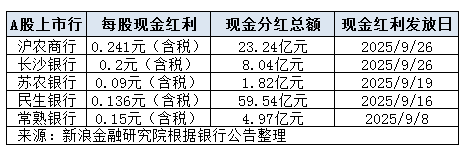
Core Viewpoint - A-share listed banks are actively implementing their 2025 interim dividend distribution plans, with significant cash dividends being announced and distributed by multiple banks in September 2023 [1][4]. Summary by Category Dividend Distribution - As of now, 17 A-share listed banks have announced their 2025 interim profit distribution plans, with six major state-owned banks collectively distributing a total of 204.657 billion yuan in cash dividends [1][4]. - Bank of Communications leads with a cash dividend of 50.396 billion yuan, followed by Agricultural Bank of China with 41.823 billion yuan, and China Construction Bank with 48.605 billion yuan [4]. Specific Bank Announcements - Shanghai Rural Commercial Bank announced a cash dividend of 0.241 yuan per share, totaling 2.324 billion yuan, distributed on September 26, 2025 [2][3]. - Changsha Bank declared a cash dividend of 0.20 yuan per share, amounting to 804 million yuan, also distributed on September 26, 2025 [2][3]. - Other banks such as Suzhou Rural Commercial Bank, Minsheng Bank, and Changshu Bank have also completed their 2025 interim dividend distributions [1][2]. New Dividend Policies - Several banks, including China Merchants Bank, Changshu Bank, and Ningbo Bank, have confirmed the implementation of interim dividends for the first time [6][7]. - Jiangyin Bank's board has approved its 2025 interim dividend plan, while other banks like Wuxi Bank and Xiamen Bank are considering their dividend distribution methods [7]. Non-Dividend Announcements - Some banks, such as Zhengzhou Bank, have explicitly stated they will not distribute cash dividends for the first half of 2025 [8]. - The trend of increasing dividend frequency is seen as beneficial for investor confidence and stock price stability [8]. Market Context - The overall dividend distribution in 2024 exceeded 630 billion yuan, with major banks like ICBC and CCB leading the way with over 100 billion yuan each [9][10]. - Regulatory changes have encouraged companies to enhance their dividend policies, aiming for more frequent and higher dividend payouts [10].

五大行同日官宣!银行监事会“谢幕”
Guo Ji Jin Rong Bao· 2025-09-26 13:10
Core Viewpoint - The major state-owned banks in China are abolishing their supervisory boards, transitioning to a governance structure led by audit committees, which is expected to enhance management professionalism and independence [1][2][3]. Group 1: Announcement of Supervisory Board Abolishment - On September 25, five major state-owned banks, including Industrial and Commercial Bank of China, China Construction Bank, Agricultural Bank of China, Bank of China, and Bank of Communications, announced the receipt of regulatory approval to abolish their supervisory boards [2]. - This decision has been in the works for some time, with proposals to eliminate supervisory boards appearing in board resolutions as early as April 29 [2]. - Other banks, such as Shanghai Rural Commercial Bank and China Merchants Bank, are also expected to follow suit, with nearly 20 institutions planning to abolish their supervisory boards this year [1][3]. Group 2: Legal and Regulatory Framework - The new Company Law allows limited liability companies to establish audit committees within the board of directors to exercise the functions of supervisory boards, providing a legal basis for banks to abolish their supervisory boards [3]. - The National Financial Regulatory Administration has indicated that financial institutions can choose to replace supervisory boards with audit committees, aligning regulatory policies with legal revisions [3][4]. Group 3: Internal Governance Structure Post-Abolishment - The banks will adopt a single-tier governance structure led by audit committees, which will be composed mainly of independent directors, enhancing supervisory efficiency through professional division of labor [4]. - The transition to audit committees is expected to improve the professionalism and independence of oversight functions, although it will depend on the effective operation of these committees [5].
农商行板块9月26日跌0.74%,XD沪农商领跌,主力资金净流出3021.09万元
Zheng Xing Xing Ye Ri Bao· 2025-09-26 08:48
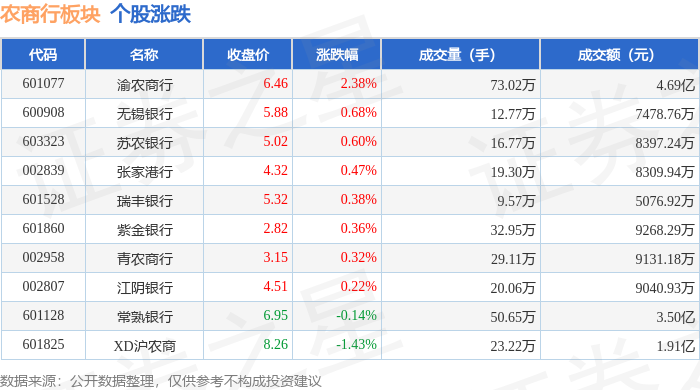
Market Overview - On September 26, the rural commercial bank sector declined by 0.74% compared to the previous trading day, with XD Hu Nong leading the decline [1] - The Shanghai Composite Index closed at 3828.11, down 0.65%, while the Shenzhen Component Index closed at 13209.0, down 1.76% [1] Individual Stock Performance - The following stocks in the rural commercial bank sector showed varying performance: - Chongqing Rural Commercial Bank (601077) closed at 6.46, up 2.38% with a trading volume of 730,200 shares [1] - Wuxi Bank (600908) closed at 5.88, up 0.68% with a trading volume of 127,700 shares [1] - Su Nong Bank (603323) closed at 5.02, up 0.60% with a trading volume of 167,700 shares [1] - Zhangjiagang Bank (002839) closed at 4.32, up 0.47% with a trading volume of 193,000 shares [1] - Ruifeng Bank (601528) closed at 5.32, up 0.38% with a trading volume of 95,700 shares [1] - Other banks like Jiangyin Bank (002807) and Changshu Bank (601128) showed minor fluctuations [1] Capital Flow Analysis - The rural commercial bank sector experienced a net outflow of 30.21 million yuan from institutional investors and 22.38 million yuan from retail investors, while retail investors saw a net inflow of 52.59 million yuan [1] - Specific capital flows for individual banks include: - Changshu Bank (601128) had a net inflow of 8.26 million yuan from institutional investors but a net outflow of 34.30 million yuan from retail investors [2] - Zijin Bank (601860) saw a net inflow of 7.99 million yuan from institutional investors [2] - Other banks like Su Nong Bank (603323) and Zhangjiagang Bank (002839) experienced significant net outflows from institutional investors [2]

舞动金秋、唱响重阳,上海农商银行开启敬老月系列活动
Xin Hua Cai Jing· 2025-09-26 05:54
Core Points - Shanghai Rural Commercial Bank, in collaboration with various organizations, is hosting the 2025 Shanghai Urban Amateur League "Heart Home Cup" Community Square Dance Series, marking the beginning of the bank's Elderly Month activities [2] - The series includes six competition zones, attracting nearly 130 teams and over 1,800 participants, providing a professional platform for square dance enthusiasts [2] - The bank has initiated various community activities to enrich cultural life, including K-song competitions and local dialect courses, aimed at enhancing urban aesthetic vitality and building cultural bridges [2] Community Engagement - During the Elderly Month, Shanghai Rural Commercial Bank will launch a series of services themed around "Legal Protection for the Elderly, Quality Elderly Care, Active Aging, Cultural Enjoyment for the Elderly, and Financial Assistance for the Elderly" [3] - The bank plans to organize over a thousand financial knowledge and legal classes to raise awareness among the elderly about fraud prevention [3] - Collaborations with Shanghai Open University will provide elderly individuals with access to quality courses and learning experiences [3] Social Responsibility - Shanghai Rural Commercial Bank has established over 1,000 "Heart Home" public service stations, achieving full coverage across 216 streets and towns in the city [4] - The bank is committed to the mission of "Inclusive Finance to Enhance Citizens' Quality of Life" and aims to create an elderly-friendly society by integrating various resources [4]