
苏州银行

Search documents
服务消费领域信贷支持加强
Xiangcai Securities· 2025-09-21 10:02
Investment Rating - The industry investment rating is maintained at "Overweight" [6][8][32] Core Viewpoints - The report highlights the strengthening of credit support in the service consumption sector, with the People's Bank of China implementing structural monetary policies to guide financial institutions in increasing credit allocation to key service consumption areas [6][27][30] - A total of 500 billion yuan has been allocated for "service consumption and elderly re-loans" to support credit for sectors such as accommodation, catering, cultural and entertainment, education, resident services, tourism, and elderly care [6][27][30] - The report indicates that as of the end of July, the loan balance in key service consumption areas reached 2.79 trillion yuan, reflecting a year-on-year growth of 5.3% [6][29][30] Summary by Sections 1. Market Review - The banking index fell by 4.21% during the period from September 15 to September 21, 2025, underperforming the CSI 300 index by 3.77 percentage points [10] - Among different bank types, rural commercial banks showed relatively better performance [10] 2. Funding Market - The central bank's net injection in the open market was 1.1923 trillion yuan, indicating a tightening of the funding environment [17] - The average issuance rates for 1-year interbank certificates of deposit for various bank types showed slight changes, with state-owned banks at 1.67% [20] 3. Industry and Company Dynamics - The report emphasizes the collaborative efforts between the People's Bank of China and local business departments to address the financial needs of private and small to medium-sized enterprises in the service consumption sector [30] - Financial institutions have reported nearly 60 billion yuan in applications for "service consumption and elderly re-loans" [29] 4. Investment Recommendations - The report suggests that with the ongoing implementation of fiscal interest subsidies, bank credit demand is expected to improve, and the performance of bank stocks is anticipated to remain relatively stable [8][32] - Specific banks recommended for investment include CITIC Bank, Jiangsu Bank, Chengdu Bank, and others, highlighting their potential for absolute return investment value [8][32]
银行板块高位回调超11%,揭秘后续走势
第一财经· 2025-09-19 15:12
Core Viewpoint - The banking sector has experienced a significant correction after a strong performance earlier in the year, with a cumulative decline of 11.46% since July 10, while other major indices have risen significantly [3][5]. Group 1: Recent Performance and Market Trends - After a period of continuous decline, the banking sector saw a slight recovery on September 19, with a marginal increase of 0.08% [3]. - The banking stocks have been under pressure due to a shift in market sentiment, with funds moving towards high-growth sectors, leading to a withdrawal of capital from the banking sector [3][5]. - From the beginning of the year until July 10, the banking sector had an impressive gain of over 21%, outperforming the CSI 300 index [5]. Group 2: Factors Influencing the Decline - The recent downturn in banking stocks is attributed to three main factors: profit-taking after a strong rally, seasonal dividend-related selling, and potential shareholder sell-offs [7]. - The banking sector has seen a significant adjustment, with share prices of various banks dropping over 10%, and some, like Everbright Bank and Beijing Bank, experiencing declines exceeding 20% [6][7]. Group 3: Shareholder and Management Support - In response to the declining stock prices, several banks have announced share buybacks by major shareholders, indicating confidence in their future growth [9][10]. - Notable examples include Everbright Bank and Chengdu Bank, where significant share purchases were made by their respective major shareholders [9]. Group 4: Future Outlook - Analysts suggest that the banking sector's high dividend yield and low volatility make it an attractive option for risk-averse investors, especially if market risk appetite decreases [10]. - The banking industry is expected to shift from a growth-driven model to one focused on quality, enhancing profitability and making it a valuable asset class for long-term investment [10].


银行板块已高位回调超11%,揭秘后续走势
Di Yi Cai Jing· 2025-09-19 14:25
Core Viewpoint - The banking sector has experienced a significant correction over the past two months, with a cumulative decline of 11.46% since July 10, despite a strong performance earlier in the year, where the sector rose over 21% by July 10 [1][2]. Group 1: Market Performance - After a five-day decline, the banking sector saw a slight increase of 0.08% on September 19, but major banks like Industrial and Agricultural Bank of China faced notable declines, with the former dropping 1.23% and the latter 1.77% [1]. - The banking sector's performance contrasts sharply with other major indices, such as the CSI 300, which rose over 12.79% during the same period [1]. - The banking sector had previously been a focal point of market attention, with 17 bank stocks reaching historical highs before the recent downturn [2]. Group 2: Factors Influencing the Decline - The recent downturn in bank stocks is attributed to several factors, including a shift in market risk appetite, profit-taking behavior, and the seasonal impact of dividend distributions [4]. - The adjustment period has seen the largest declines in joint-stock banks, with a drop exceeding 15%, while regional banks fell over 11% and state-owned banks decreased by over 4% [3]. Group 3: Shareholder and Management Support - In response to the declining stock prices, several bank shareholders have announced plans to increase their holdings, reflecting confidence in the banks' future growth [6]. - Notable examples include Everbright Bank and Chengdu Bank, where significant share purchases were made by major shareholders [6]. - Additionally, bank executives and board members have also committed to buying shares, indicating a strong belief in the banks' long-term value [7]. Group 4: Future Outlook - Analysts suggest that the current high dividend yields and low valuations of bank stocks may attract risk-averse investors, positioning the banking sector as a stabilizing force in the market [7]. - The banking industry is expected to transition from a growth-driven model to one focused on quality, enhancing profitability and resilience [7]. - Historical trends indicate that the banking sector often experiences a second wave of growth following periods of strong performance in growth stocks, suggesting potential for future recovery [7].
国有资本持续增持 南京银行股权格局优化进行时
Jing Ji Guan Cha Wang· 2025-09-19 10:14
Core Viewpoint - Nanjing Bank has experienced significant shareholder increases in 2023, reflecting a strategic move by state-owned capital to optimize asset allocation and recognize the value of regional banks [1][6]. Shareholder Increases - Nanjing Gaoke increased its stake in Nanjing Bank from 9.00% to 9.99% by acquiring 123 million shares between August 7 and September 18 [1][2]. - Other shareholders, including Zijin Investment Group and Jiangsu Transportation Holding, have also increased their holdings, indicating a trend of state-owned capital investing in Nanjing Bank [2][6]. - The cumulative effect of these increases has led to significant ownership stakes, with Zijin Group and Zijin Trust holding a combined 13.02% and Jiangsu Transportation holding 14.01% [2][4]. Market Perspective - Shareholder increases are generally viewed as a positive signal regarding a company's valuation, especially in the context of the banking sector facing challenges such as narrowing net interest margins [3][8]. - The ongoing purchases by major shareholders suggest confidence in Nanjing Bank's asset quality and future strategic direction [3][8]. Shareholding Structure Changes - Jiangsu Transportation's recent transfer of shares from its subsidiary to itself increased its direct ownership in Nanjing Bank to 14.01%, enhancing its influence in corporate governance [4][5]. - This internal adjustment reflects a strategic intent to consolidate control and improve decision-making efficiency within the company [4][5]. Trends in State-Owned Capital - The increase in stakes by state-owned enterprises in Nanjing Bank is part of a broader trend where regional banks are gaining favor among state capital, indicating a long-term bet on the economic potential of the Yangtze River Delta region [6][8]. - Other regional banks, such as Suzhou Bank and Qingdao Bank, have also seen similar increases in state-owned capital, highlighting a growing trend in the sector [7][8]. Capital Operation Logic - The motivations behind shareholder increases include the attractiveness of long-term dividend yields from quality financial assets and the strategic value of bank shares for financing and investment [8]. - The recent changes in shareholding at Nanjing Bank represent a re-evaluation of the value of regional financial institutions and a dynamic adjustment in governance structures [8].


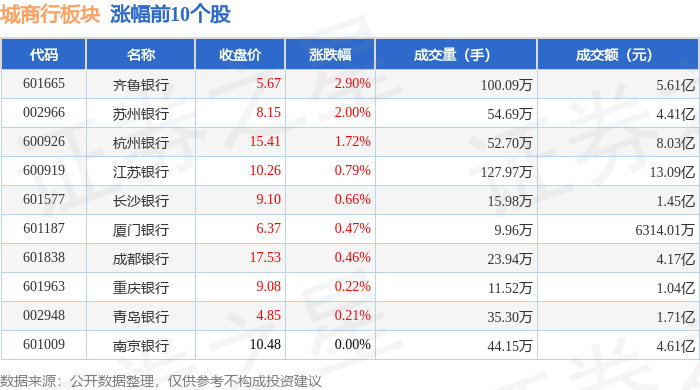
城商行板块9月19日涨0.39%,齐鲁银行领涨,主力资金净流入2.68亿元
Zheng Xing Xing Ye Ri Bao· 2025-09-19 08:54
Market Performance - The city commercial bank sector increased by 0.39% on September 19, with Qilu Bank leading the gains [1] - The Shanghai Composite Index closed at 3820.09, down 0.3%, while the Shenzhen Component Index closed at 13070.86, down 0.04% [1] Individual Stock Performance - Qilu Bank's closing price was 5.67, up 2.90%, with a trading volume of 1,000,900 shares and a transaction value of 561 million [1] - Suzhou Bank closed at 8.15, up 2.00%, with a trading volume of 546,900 shares and a transaction value of 441 million [1] - Hangzhou Bank closed at 15.41, up 1.72%, with a trading volume of 527,000 shares and a transaction value of 803 million [1] - Jiangsu Bank closed at 10.26, up 0.79%, with a trading volume of 1,279,700 shares and a transaction value of 1.309 billion [1] - Other notable performances include: - Changsha Bank: 9.10, up 0.66% - Xiamen Bank: 6.37, up 0.47% - Chengdu Bank: 17.53, up 0.46% - Chongqing Bank: 9.08, up 0.22% - Qingdao Bank: 4.85, up 0.21% - Nanjing Bank: 10.48, unchanged [1] Capital Flow Analysis - The city commercial bank sector saw a net inflow of 268 million from institutional investors, while retail investors contributed a net inflow of 122 million [2] - The sector experienced a net outflow of 390 million from speculative funds [2] Individual Stock Capital Flow - Qilu Bank had a net inflow of 87.58 million from institutional investors, while it faced a net outflow of 69.65 million from speculative funds [3] - Ningbo Bank saw a net inflow of 65.53 million from institutional investors, with a net outflow of 71.36 million from speculative funds [3] - Suzhou Bank experienced a net inflow of 54.95 million from institutional investors, alongside a net outflow of 49.77 million from speculative funds [3] - Jiangsu Bank had a net inflow of 39.48 million from institutional investors, with a significant net outflow of 118 million from speculative funds [3]



苏州银行涨2.00%,成交额3.06亿元,主力资金净流入3137.18万元
Xin Lang Cai Jing· 2025-09-19 06:12
Group 1 - The core viewpoint of the news is that Suzhou Bank's stock has shown fluctuations in price and trading volume, with a recent increase of 2.00% on September 19, 2023, reaching a price of 8.15 yuan per share and a total market capitalization of 36.436 billion yuan [1] - As of July 31, 2023, Suzhou Bank had a total of 60,300 shareholders, an increase of 3.64% from the previous period, with an average of 72,836 circulating shares per shareholder, a decrease of 3.51% [1] - The bank's revenue for the first half of 2025 is reported to be 0.00 yuan, while the net profit attributable to shareholders is 3.134 billion yuan, reflecting a year-on-year growth of 6.15% [1] Group 2 - Since its A-share listing, Suzhou Bank has distributed a total of 6.687 billion yuan in dividends, with 4.287 billion yuan distributed over the past three years [2] - As of June 30, 2025, Hong Kong Central Clearing Limited is the sixth-largest circulating shareholder with 119 million shares, a decrease of 17.3596 million shares from the previous period [2] - Southern CSI 500 ETF ranks as the ninth-largest circulating shareholder with 66.4013 million shares, an increase of 9.4466 million shares from the previous period [2]
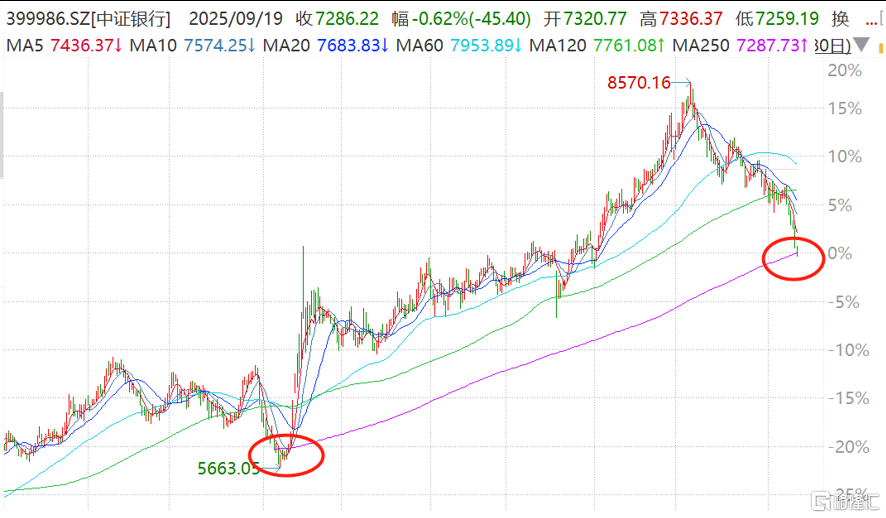
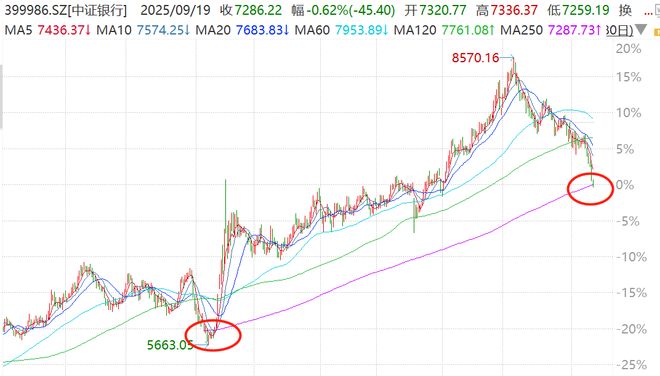
银行股探底回升,中证银行指数盘中回踩年线,工行一度跌超2%!资金连续4日增仓银行AH优选ETF(517900)
Ge Long Hui· 2025-09-19 04:16
Core Viewpoint - The banking sector is experiencing a significant decline, with major banks like Industrial and Commercial Bank of China (ICBC) and Agricultural Bank of China seeing stock prices drop over 2%, marking a notable downturn in the market [1][5]. Group 1: Market Performance - Bank stocks have seen a sharp decline, with the China Securities Bank Index falling to its annual line for the first time in a year [1]. - The AH Bank Index's dividend yield has increased to 4.6%, indicating a growing attractiveness for investors [5]. - The Bank AH Preferred ETF (517900) has shown signs of recovery after an initial drop, reflecting a potential bottoming out [3]. Group 2: Investor Sentiment - Several banks, including Everbright Bank and Nanjing Bank, have announced share buybacks, demonstrating confidence in their future prospects and long-term investment value [6]. - Social security funds have increased their holdings in the banking sector, with the proportion of bank holdings rising to 51.71%, up by 2.48 percentage points from the previous quarter [6]. - The Bank AH Preferred ETF has seen a net inflow of 20.87 million yuan over the past four days, indicating renewed interest from market participants [6]. Group 3: Institutional Investment - Insurance funds have made 11 significant investments in listed banks this year, primarily in H-shares, highlighting the sector's appeal due to its low valuations and stable dividends [6]. - The banking sector's low valuation, stable dividends, and minimal earnings volatility make it attractive for long-term institutional investors seeking steady returns [6].
银行股探底回升,中证银行指数盘中回踩年线,工行一度跌超2%!资金连续4日“加仓”银行AH优选ETF(517900)
2 1 Shi Ji Jing Ji Bao Dao· 2025-09-19 03:40
Group 1 - Bank stocks experienced a significant decline on September 19, with Industrial and Commercial Bank of China dropping over 2%, marking the first time in a year that it fell below the six-month moving average [1] - Agricultural Bank of China, China CITIC Bank, and Bank of China also saw declines close to 2%, leading the CSI Bank Index to drop to the annual line for the first time in a year [1] Group 2 - The bank AH index currently has a dividend yield of 4.70%, indicating a strong income potential for investors [3] - Various stakeholders, including bank shareholders and executives, have been actively increasing their holdings in the banking sector, with announcements from banks like Everbright Bank and Nanjing Bank highlighting their confidence in future growth [3][5] - Social security funds have increased their allocation to the banking sector, with the proportion of bank holdings rising to 51.71% in Q2, up by 2.48 percentage points from the previous quarter [5] Group 3 - Insurance capital has made 11 bids for listed banks this year, with 10 of those being for H-shares, reflecting the attractiveness of the dividend yield [6] - The banking sector is characterized by low valuations, stable dividends, and minimal earnings volatility, making it appealing for insurance capital seeking stable returns and long-term assessments [6]
多家银行被“加仓”,透露什么信号?
Jin Rong Shi Bao· 2025-09-19 02:19
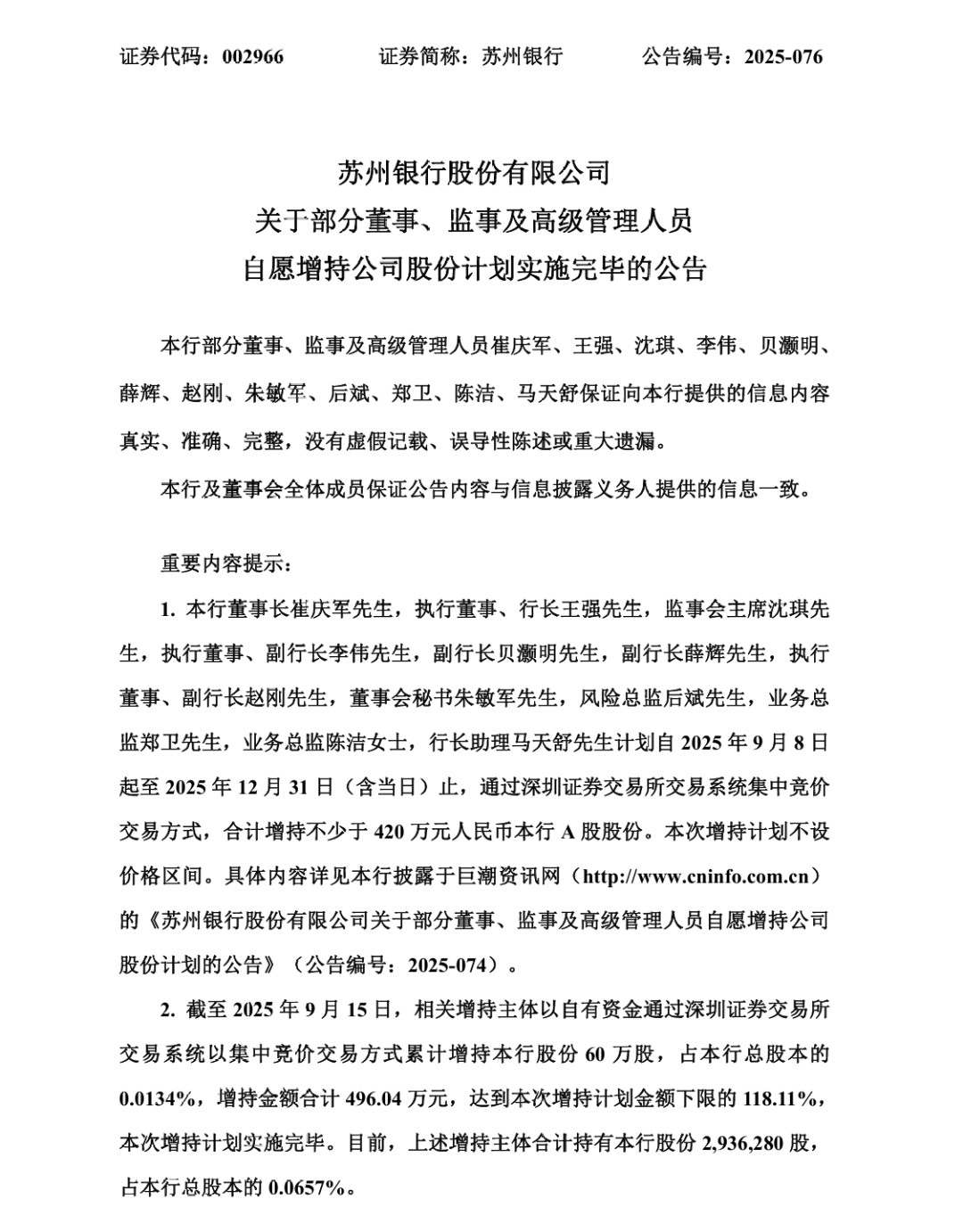
Core Viewpoint - Recent surge in bank stock purchases by executives and major shareholders indicates strong confidence in the banks' future value and strategic direction [1][8] Group 1: Executive and Major Shareholder Purchases - Suzhou Bank's executives, including the chairman and president, collectively purchased 600,000 shares, amounting to approximately 4.96 million yuan, representing 0.0134% of the total shares [2] - Qilu Bank announced a plan for its executives to voluntarily purchase at least 3.5 million yuan worth of shares between September 16, 2025, and December 31, 2025 [3] - Huaxia Bank's executives purchased 4.23 million shares for about 31.9 million yuan, reflecting a proactive approach to bolster confidence in the bank's value [4] Group 2: Major Shareholder Support - Everbright Bank's major shareholder increased its stake by 13.97 million shares, worth approximately 51.66 million yuan, representing 0.02% of the total shares [9] - Nanjing Bank's major shareholder's subsidiary acquired 56.78 million shares, increasing the total holding from 12.56% to 13.02% [9] - Chengdu Bank's major shareholders purchased a total of 9.66 million shares, with investments of approximately 87 million yuan and 79.59 million yuan respectively [9] Group 3: Market Implications - The concentrated buying activity from bank executives and major shareholders signals a positive outlook for the banking sector, potentially alleviating investor concerns regarding business models and asset quality [10] - The current low price-to-book ratios and high dividend yields of bank stocks make them attractive for long-term investment [10] - Analysts suggest that the shift from defensive to proactive market management reflects expectations of economic recovery and stable interest margins, enhancing the banks' valuation [10]


A股昨放量下跌 超4300只个股下挫
Sou Hu Cai Jing· 2025-09-18 23:06
Market Overview - On September 18, A-shares experienced a significant downturn, with all three major indices falling over 1%: the ChiNext Index dropped 1.64%, the Shanghai Composite Index fell 1.15%, and the Shenzhen Component Index decreased by 1.06% [1] - The total trading volume in A-shares reached 3.17 trillion yuan, an increase of 763.7 billion yuan compared to the previous day, with over 4,300 stocks declining [1] Sector Performance - The robotics sector continued to show strength, with Shoukai Co. hitting the daily limit for the 12th time in 11 days, driven by the Yushu Technology concept [1] - Low-priced stocks were active, with Shanghai Construction Engineering achieving five consecutive limit-ups [1] - In the semiconductor sector, stocks like Northern Huachuang, SMIC, and Haiguang Information saw price increases, with some reaching historical highs during the session [1] - The tourism and hotel sectors had notable gains, while sectors such as non-ferrous metals, securities, pork, film and television, real estate, and coal experienced significant declines [1] Banking Sector - The banking sector faced continuous adjustments, with major banks like Changshu Bank dropping 3.17% and other state-owned banks declining over 2% [4] - Since reaching a historical high on July 11, the banking AH index and the CSI Bank Index have both fallen over 13%, breaking below the 120-day moving average for the first time in a year [4] - Despite the downturn, several listed banks have reported shareholder buybacks, indicating confidence in their future development and long-term investment value [4] Economic Outlook - Analysts suggest that the recent market correction is not due to substantial negative news but rather a reaction to rapid price increases and profit-taking following the Federal Reserve's interest rate cut [5] - Historical trends indicate that supportive policies and improved market liquidity often drive significant bull markets, and the current policy environment is seen as positive [5] - Expectations of a global central bank rate cut wave may provide further support for the A-share market, with potential for a second upward trend if monetary easing continues [5]