通威股份

Search documents
通威股份(600438) - 通威股份有限公司关于可转换公司债券转股结果暨股份变动的公告
2026-01-06 10:02
股票代码:600438 股票简称:通威股份 公告编号:2026-002 债券代码:110085 债券简称:通 22 转债 通威股份有限公司 未转股可转债情况:截至 2025 年 12 月 31 日,尚未转股的"通 22 转债" 金额为人民币 11,983,121,000 元,占"通 22 转债"发行总额的比例为 99.85934%。 本季度转股情况:2025 年 10 月 1 日至 2025 年 12 月 31 日,合计有 90 张"通 22 转债"转为本公司 A 股股票,合计转股金额 9,000 元,合计转股股数 252 股。 一、"通 22 转债"发行上市概况 经中国证券监督管理委员会证监许可[2021]4028 号文核准,公司于 2022 年 2 月 24 日公开发行了 12,000 万张可转换公司债券,每张面值 100 元,共计 120 亿 元。本次可转债期限 6 年,自 2022 年 2 月 24 日起至 2028 年 2 月 23 日止,票面 利率为第一年 0.20%、第二年 0.40%、第三年 0.60%、第四年 1.50%、第五年 1.80%、 第六年 2.00%。 经上海证券交易所自律监管决 ...

通威股份(600438) - 通威股份有限公司关于对外提供担保的进展公告
2026-01-06 09:45
股票代码:600438 股票简称:通威股份 公告编号:2026-001 债券代码:110085 债券简称:通 22 转债 通威股份有限公司 关于对外提供担保的进展公告 公司董事会及全体董事保证本公告内容不存在任何虚假记载、误导性陈述或者重 大遗漏,并对其内容的真实性、准确性和完整性承担法律责任。 重要内容提示: 被担保人名称: 2025 年 12 月 1 日—2025 年 12 月 31 日期间(以下简称"本次期间")公司担保事项 被担保人均为非上市公司关联人。被担保人如下:公司下属 10 家全资子公司:通威农 业发展有限公司、通威太阳能(南通)有限公司、通威太阳能(眉山)有限公司、通 威太阳能(成都)有限公司、淄博汇祥新能源有限公司、通威渔光科技(海安)有限 公司、东营通裕新能源有限公司、越南通威有限责任公司、和平通威有限责任公司、 通威太阳能(德国)有限责任公司;公司下属 5 家控股子公司:四川永祥能源科技有 限公司、宾阳县晶创新能源有限公司、越南天邦饲料有限公司、通威(海南)水产食 品有限公司、海南莱克食品有限公司;公司部分客户。 本次期间担保金额及已实际为其提供的担保余额: 本次期间,公司及下属子公司 ...
通威股份:“通22转债”转股结果及股份变动情况公告
Xin Lang Cai Jing· 2026-01-06 09:30
Core Viewpoint - Tongwei Co., Ltd. announced the conversion status of its "Tong 22 Convertible Bonds," indicating a low conversion rate and a significant amount of unconverted bonds remaining [1] Group 1: Conversion Details - As of December 31, 2025, a total of 168,790 bonds have been converted into A-shares, amounting to 16.879 million yuan and resulting in 441,905 shares, which represents 0.00982% of the company's total shares before conversion [1] - In the current quarter (October 1 to December 31, 2025), 90 bonds were converted, with a conversion amount of 9,000 yuan and 252 shares issued [1] Group 2: Remaining Bonds - The remaining unconverted amount of "Tong 22 Convertible Bonds" is 11.983 billion yuan, which constitutes 99.85934% of the total issuance [1] - The total share capital of the company increased from 4,501,989,837 shares on September 30, 2025, to 4,501,990,089 shares [1]
江松科技冲刺IPO:光伏“反内卷”中的设备突围
Cai Jing Wang· 2026-01-06 06:36
Core Viewpoint - The article highlights the competitive challenges in the global photovoltaic (PV) industry, particularly the phenomenon of "involution," characterized by price wars and homogenized products. Wuxi Jiangsong Technology Co., Ltd. (referred to as "Jiangsong Technology"), currently in the IPO stage, exemplifies a "counter-involution" trend through its innovative and differentiated approach in the PV battery automation equipment sector [1]. Group 1: Technological Innovation - The essence of the PV industry's involution is the homogenization of technology, leading to price wars as the primary competitive strategy. Jiangsong Technology focuses on technological innovation to break this deadlock by developing advanced automation equipment for PV battery production [2]. - The company has successfully developed automation equipment for various processes in PV battery manufacturing, including diffusion annealing, PECVD, etching, texturing, and alkali etching, making it one of the few domestic manufacturers capable of providing comprehensive production solutions [2]. - Jiangsong Technology's automation equipment features high operational efficiency, precision, low breakage rates, and customization capabilities, enabling smart production and data collection for clients' digital factories [2]. Group 2: Market Position and Growth - Jiangsong Technology's diffusion annealing automation equipment achieves a capacity of 13,500 wafers per hour with a breakage rate as low as 0.01%, outperforming both domestic and international competitors [3]. - The company's PECVD automation equipment has increased production capacity from 4,500-6,000 wafers per hour to 8,500 wafers per hour, significantly aiding in cost reduction and efficiency improvement in PV battery production [3]. - Jiangsong Technology ranks first among PV battery automation equipment manufacturers according to the China Photovoltaic Industry Association's 2022-2023 annual report, with a compound annual growth rate of 58.15% in revenue from 2022 to 2024, indicating strong market recognition [3]. Group 3: Industry Dynamics and Future Outlook - Equipment manufacturers play a crucial role in the PV industry's value chain, influencing production efficiency, quality, and costs. Jiangsong Technology's focus on N-type battery technology positions it well to meet new market demands and facilitate the transition to advanced technologies [4]. - The global PV industry continues to grow, with 2023 witnessing a record 390 GW of new installations, including 216.88 GW in China. This growth is expected to drive demand for equipment manufacturers like Jiangsong Technology [5]. - Jiangsong Technology's IPO funding aims to expand production capacity, enhance product offerings, and strengthen R&D capabilities, reflecting a strategic shift in the Chinese PV industry towards high-end equipment and innovative technologies [5].
政策护航光伏产业破内卷,光伏ETF嘉实(159123)布局光伏产业链投资机遇
Xin Lang Cai Jing· 2026-01-06 05:44
Group 1 - The core viewpoint of the news is the positive impact of government policies aimed at enhancing intellectual property protection in the photovoltaic industry, which is expected to promote healthy development and mitigate "involution" competition [1] - The China Securities Index for the photovoltaic industry rose by 2.42%, with significant gains from key stocks such as GoodWe (up 12.10%), Sungrow (up 11.89%), and Aotaiwei (up 9.07%) [1] - The National Intellectual Property Administration and the Ministry of Industry and Information Technology have issued opinions focusing on strengthening intellectual property protection in key areas of the photovoltaic industry chain [1] Group 2 - By 2027, significant results are anticipated from the intellectual property initiatives aimed at fostering healthy development in the photovoltaic sector [1] - Zheshang Securities indicates that the photovoltaic equipment industry will benefit from the gradual implementation of "anti-involution" policies and the trend towards second-price parity in solar storage, leading to a return to reasonable profit levels [1] - The demand for upstream materials such as silicon carbide substrates and monocrystalline silicon for etching is expected to rise due to increased needs in the electric equipment sector, driven by the growth of new energy vehicles and AI servers [1] Group 3 - As of December 31, 2025, the top ten weighted stocks in the China Securities Index for the photovoltaic industry include TBEA, LONGi Green Energy, and Sungrow, collectively accounting for 55.11% of the index [2] - The photovoltaic ETF managed by Harvest (159123) serves as a convenient tool for investing across the entire photovoltaic industry chain [3] - Investors can also access the photovoltaic ETF through an off-market connection (014605) to capitalize on investment opportunities within the photovoltaic sector [4]
为智能化工厂提供一个“超级充电宝”
Xin Lang Cai Jing· 2026-01-05 20:49
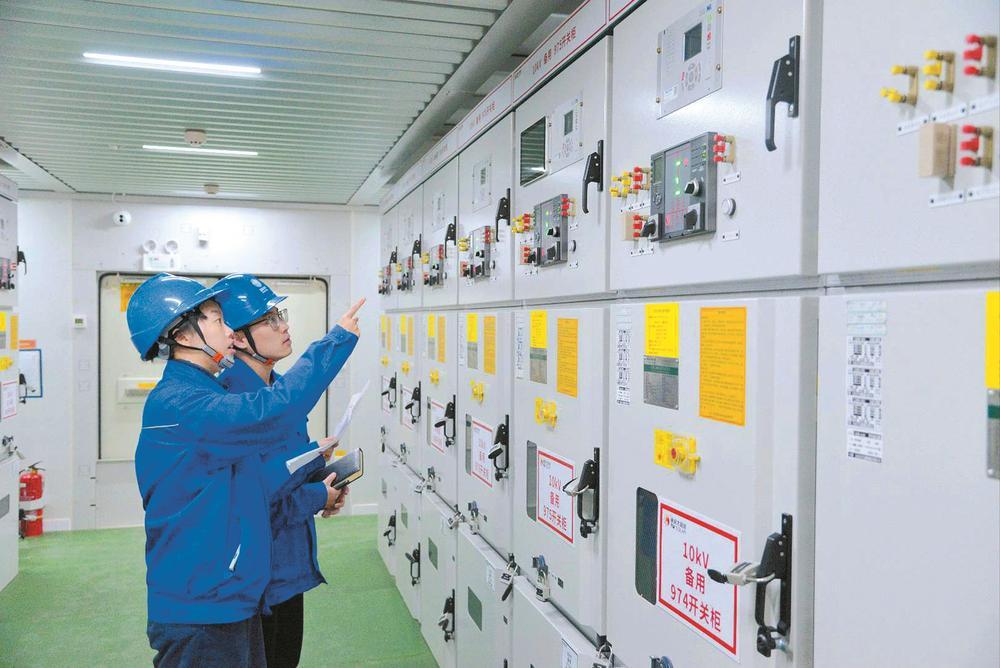
Core Viewpoint - The largest customer-side energy storage project in Chengdu has officially commenced trial operations, providing a significant boost to the local manufacturing sector by ensuring stable power supply and supporting the "dual carbon" goals [3][5]. Group 1: Project Overview - The energy storage system, located in the Sichuan Jintang Economic Development Zone, has a total power capacity of 25 megawatts and a battery capacity of 50 megawatt-hours, capable of storing up to 50,000 kilowatt-hours of electricity, which can meet the company's power needs for 0.2 days [4]. - The project utilizes lithium iron phosphate battery storage technology, known for its high charge and discharge efficiency and stable operation [4]. Group 2: Economic Impact - The energy storage system is expected to achieve an annual charging capacity of up to 30 million kilowatt-hours, potentially saving the company nearly 10 million yuan in electricity costs each year [4]. - The project adopts an intelligent operation strategy of "two charges and two discharges," charging during off-peak hours and discharging during peak hours, thus optimizing energy costs [4]. Group 3: Industry Development - The successful implementation of this energy storage project expands the application scenarios for user-side energy storage in Chengdu and injects new momentum into the exploration of the "source-network-load-storage" collaborative development model [5]. - The Jintang Economic Development Zone has already seen three energy storage projects operational, with plans for a 100MW/200MWh shared energy storage project to further support local enterprises [7].

储锂需求景气延续-商业航天带来新催化
2026-01-05 15:42
Summary of Key Points from Conference Call Records Industry Overview - **Industry Focus**: The records primarily discuss the energy storage, lithium battery, wind energy, photovoltaic, and electric power equipment industries, highlighting their growth and investment opportunities [1][2][3][4][5][6][25]. Core Insights and Arguments - **Capacity Pricing Policies and Clean Energy Demand**: The refinement of capacity pricing policies in northern regions and Google's acquisition of a clean energy company indicate a strong emphasis on clean energy, providing demand support for related industries [1]. - **Emerging Industries Driving Telecom Sector**: Emerging sectors such as space photovoltaics, commercial aerospace, and wind energy are expected to drive growth in the telecom sector by 2026, creating incremental demand [1][4]. - **Storage Market Growth**: The storage market is experiencing unexpected growth, with significant installations in the U.S. (13.1 GW from January to October) and Australia (4 GWh in Q3) [1][5]. - **Battery Cell Price Trends**: Battery cell prices have risen significantly for spot orders, while long-term prices have seen limited increases, indicating cost pressures being transmitted to the system level [1][10][11]. - **Lithium Battery Material Dynamics**: December saw a slight year-on-year decline in sales for key companies, but new policies are expected to improve production expectations for automakers [1][13][14]. - **Wind Energy Sector Growth**: Onshore wind energy tenders have decreased, while offshore wind tenders have increased, indicating a structural growth trend in the offshore segment [1][19]. Additional Important Insights - **Investment Recommendations**: Investors are advised to focus on specific companies within the storage, lithium battery, wind energy, electric power equipment, and robotics sectors, highlighting firms like CATL, Gotion, Goldwind, and Longi [6][25]. - **U.S. Market Outlook**: The U.S. market shows strong demand and project planning, with a significant number of projects expected to come online in 2026 and 2027 [8]. - **Australia and France Market Highlights**: Australia has seen a substantial increase in new projects, while France's installation growth is also notable, particularly in large storage systems [9]. - **Battery Cost Impact on Profitability**: Rising battery costs are expected to have a manageable impact on profitability, with a gradual transmission of cost increases to downstream customers [17]. - **Focus on Sodium-Ion Batteries**: The rise in lithium carbonate prices has led to increased interest in sodium-ion batteries, indicating a potential area for investment [18]. - **Electric Power Equipment Export Highlights**: The export of AI-related transformers and AIDC projects is notable, with significant contracts signed, indicating growth opportunities in these areas [2][23]. Conclusion - **Overall Investment Landscape**: The energy storage and lithium battery sectors are highlighted as high-priority investment areas, with wind energy and electric power equipment also showing structural advantages. Emerging sectors like robotics and AIDC are recommended for future focus due to their promising growth prospects [25].
从拥硅为王到去银为王,谁将成为新一轮光伏周期的王者?
Tai Mei Ti A P P· 2026-01-05 10:18
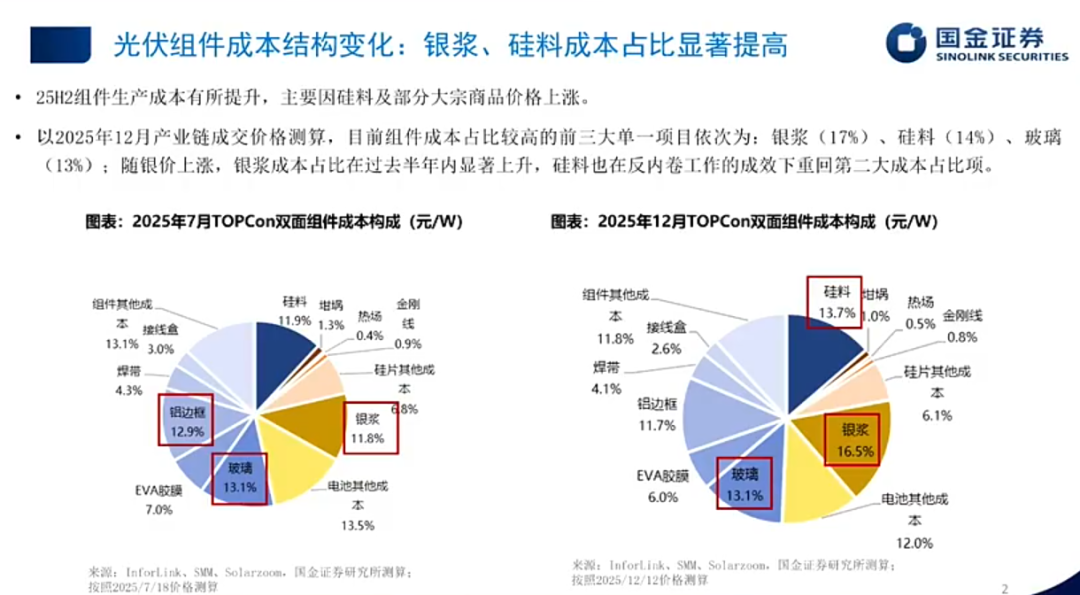
Core Viewpoint - The photovoltaic (PV) industry is undergoing a structural change in its cost dynamics, with silver paste replacing silicon material as the primary cost variable from 2024 to 2026, significantly impacting the competitive landscape and survival of companies in the sector [1][2]. Cost Structure Changes - In January 2024, silicon material's cost share decreased to approximately 10%-12%, while silver paste's share rose to 10.5%, marking a shift in cost dominance [2]. - By January 2025, silver paste's cost share surged to 14.2%, surpassing silicon material at 11.3%, indicating a reversal in cost structure [3]. - In January 2026, silver paste's share increased to 16%-17%, while silicon material's share fell to 9.9%, solidifying silver paste's dominance in cost structure [4][7]. Supply and Demand Dynamics - The global supply of silicon material is projected to exceed demand significantly in 2026, leading to a price drop to around 46,000-53,000 yuan per ton, which is below the cost line for many second and third-tier companies [8]. - The technological maturity in silicon material and wafer production has reached a plateau, limiting further cost reductions [9][10]. Silver's Unique Position - Silver's cost dynamics are driven by industrial demand rather than its traditional roles, with the industrial sector accounting for nearly 60% of silver demand in 2024 [15]. - The photovoltaic sector represents only 25%-30% of global industrial silver demand, indicating that it cannot dictate silver prices [18]. - The supply of silver is largely dependent on the production of other metals, making it less responsive to price changes [19]. Technological Innovations - The industry is witnessing a shift towards silver reduction technologies, with three main approaches emerging: gradual silver reduction, silver-coated copper paste, and copper plating [25][31][36]. - Silver-coated copper paste is expected to become the mainstream solution by 2026, offering significant cost advantages [31]. - Copper plating technology is anticipated to lead the industry by 2027, providing a complete alternative to silver and significantly reducing costs [36][47]. Future Outlook - The silver price is expected to remain high and volatile through 2026-2027, driven by supply-demand imbalances and industrial demand growth [50]. - Companies that can effectively implement silver reduction technologies will gain a competitive edge, as the ability to manage silver costs becomes a critical survival factor [52][53].




通威邢国强:技术创新助力破除光伏内卷|能动天下④
2 1 Shi Ji Jing Ji Bao Dao· 2026-01-05 09:57
Core Viewpoint - The article emphasizes the importance of technological innovation for Tongwei Co., Ltd. to navigate the challenges of homogenization in the photovoltaic industry, particularly through the establishment of a global innovation research and development center set to be operational by June 2024 [3]. Group 1: Company Strategy - Tongwei has initiated the construction of a global innovation R&D center to serve as a guiding point for direction, risk management, positioning, and technological expansion [3]. - The company adopts a "saturation strike" approach in its technology route selection, indicating a commitment to extensive research and development without budget limits [5]. - Tongwei currently has a production capacity of 100GW for TOPCon technology and plans to increase R&D efforts in this area [5]. Group 2: Industry Context - The photovoltaic industry is experiencing a cyclical downturn and intense competition, which Tongwei views as an opportunity for technological innovation to break through the current challenges [5]. - Despite the harsh market environment, the company maintains a high level of confidence in the industry's development, believing that a diversified technological reserve will ensure stability and longevity [5].
通威邢国强:技术创新助力破除光伏内卷
2 1 Shi Ji Jing Ji Bao Dao· 2026-01-05 09:44
Core Viewpoint - The article discusses the strategic importance of technological innovation for Tongwei Co., Ltd. in overcoming challenges in the photovoltaic (PV) industry, particularly amid homogenized competition and market uncertainties [2][4]. Group 1: Company Initiatives - Tongwei Co., Ltd. has initiated the construction of a global innovation research and development center, set to be operational by June 2024, which aims to guide the company in direction, risk management, positioning, and technology expansion [2]. - The company emphasizes a "saturation strike" approach in its technology route selection, indicating a commitment to extensive research and development without budget limits [5]. Group 2: Industry Context - The photovoltaic industry is currently experiencing a cyclical downturn and intense competition, referred to as "involution," where technological innovation is viewed as a key method to break through these challenges [5]. - Despite the harsh market environment, the company maintains a strong confidence in the industry's long-term growth, describing the development of the PV sector as a "spiral upward" trend [5].