
银河通用

Search documents
南山智尚+均胜电子,携手开启人形机器人零部件研发新时代!“全市场唯一两百亿规模”机器人ETF(562500) 早盘震荡整理
Xin Lang Cai Jing· 2025-11-05 02:23
Group 1: Market Performance - The Robot ETF (562500) experienced a slight decline of approximately 0.9%, with the latest price at 0.992 yuan, following a brief surge to 0.998 yuan at the opening [1] - Among the 73 constituent stocks, 25 stocks rose while 48 fell, indicating significant structural differentiation, with Guomao Co., Weichuang Electric, and Stone Technology showing resilience with gains exceeding 2% [1] - The ETF saw a net inflow of approximately 376 million yuan in the previous trading day, continuing a strong trend of capital attraction [1] Group 2: Company Developments - Nanshan Zhishang announced a collaboration with Junsheng Electronics to develop key components for humanoid robots and supply high-performance new materials [2] - The humanoid robot market is set to begin mass deliveries this year, with domestic robot orders exceeding 3 billion yuan, corresponding to nearly 20,000 humanoid robots [2] - Major companies like Ubtech, Galaxy General, and Zhiyuan have publicly disclosed order sizes exceeding 630 million, 700 million, and 100 million yuan respectively, indicating initial revenue contributions from core component companies [2] Group 3: Industry Overview - The Robot ETF (562500) is the only robot-themed ETF in the market with a scale exceeding 20 billion yuan, covering various segments including humanoid robots, industrial robots, and service robots [3] - The ETF provides investors with a streamlined way to invest in the upstream and downstream supply chains of the robotics industry [3]

中沙企业界人士对中国—中东合作前景充满信心
Ren Min Ri Bao Hai Wai Ban· 2025-11-05 01:45
Group 1 - The 9th "Future Investment Initiative" conference in Riyadh highlighted the accelerating cooperation between China and Middle Eastern countries, driven by digital technology [4] - The conference attracted over 8,000 representatives globally and focused on themes of growth and innovation [4] - Lenovo announced plans to establish a regional headquarters in Riyadh, emphasizing the integration of AI across its business segments, which is expected to drive growth [4] Group 2 - Chinese technology company Galaxy General is advancing embodied intelligence and humanoid robots in retail and healthcare, showcasing their durability and replicability [4] - JD Logistics has established an integrated self-operated network in the Middle East since entering Saudi Arabia in 2021, enhancing logistics and supply chain connections [5] - The "Future Investment Initiative" conference serves as a vital platform for capital, technology, and industry ecosystems, facilitating collaboration opportunities [5] Group 3 - Major engineering projects are enhancing mutual trust between China and Middle Eastern partners, with Chinese firms positioning themselves as collaborative partners in regional development [6] - The focus on sustainable development and voluntary carbon markets is expected to deepen cooperation between China and Saudi Arabia, contributing to climate action efforts [5][6] - The increasing attention from China towards the Middle East is seen as a significant factor in promoting economic diversification in the region [6]

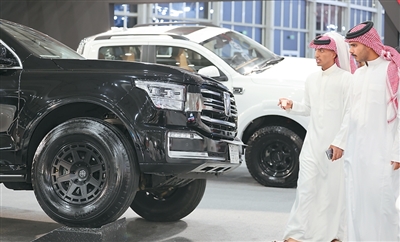
综述|中沙企业界人士对中国—中东合作前景充满信心
Xin Hua Wang· 2025-11-02 02:10
Group 1 - The "Future Investment Initiative" conference in Riyadh highlighted the accelerating cooperation between China and Middle Eastern countries, driven by advancements in digital technology and artificial intelligence (AI) [1][2] - Lenovo plans to establish a regional headquarters in Riyadh, emphasizing the integration of AI across its business segments, which is expected to drive growth in personal computers, enterprise servers, and services [1] - The logistics and supply chain sectors are identified as critical connections between China and the Middle East, with significant collaboration potential, as demonstrated by JD Logistics' establishment of an integrated self-operated network in Saudi Arabia [2] Group 2 - The conference serves as a vital platform for enhancing communication and cooperation between China and Saudi Arabia, providing global enterprises with opportunities for in-depth exchanges [3] - There is an expectation for deeper collaboration in the voluntary carbon market and sustainable development between China and Saudi Arabia, contributing to climate action efforts in developing countries [3] - Major engineering projects are enhancing mutual trust between Chinese and Middle Eastern partners, with the Jeddah Airport hangar expected to become a key regional hub for aviation maintenance and research [3]
芯驰科技与银河通用签署战略合作:聚焦具身智能机器人芯片与系统创新
Huan Qiu Wang· 2025-11-01 10:09
Core Viewpoint - The strategic partnership between chip manufacturer Chipsea Technology and humanoid robot company Galaxy General aims to advance the development of next-generation embodied intelligent robot chips and control systems, facilitating the large-scale implementation of embodied intelligence [1][3]. Group 1: Partnership Details - The agreement involves joint definition and development of next-generation embodied intelligent robot chips, focusing on key metrics such as computing power, storage, and peripherals [3]. - Both companies will collaboratively build a high-end toolchain for robot chips, aiming to shorten the algorithm model migration cycle and establish a stable, controllable, and sustainable supply chain ecosystem [3]. Group 2: Industry Implications - This collaboration signifies a deep cross-industry integration between automotive chips and embodied intelligent robots, leveraging Chipsea's experience in automotive chip development and supply chain capabilities [3]. - The technical architecture of embodied intelligence and automotive electronics shares deep commonalities, requiring high-performance, reliable, and secure underlying chips to handle complex AI tasks while ensuring real-time performance and safety [3]. Group 3: Company Background - Chipsea Technology has achieved over 8 million units in mass production, covering more than 100 mainstream vehicle models, with its products validated in core scenarios such as intelligent cockpits and vehicle control [3]. - Galaxy General has developed a billion-level robot training dataset, with technology spanning operations and navigation, and its products are widely implemented in industrial, retail, and medical sectors [3].

天奇股份(002009):汽车智能装备领先制造商 牵手人形机器人龙头打造新增长曲线
Xin Lang Cai Jing· 2025-10-30 00:37
Core Viewpoint - The company is undergoing a business transformation focusing on intelligent equipment, lithium battery recycling, and robotics, with a notable partnership in humanoid robotics to enhance its market position [1][2]. Group 1: Business Performance - In the first half of 2025, the company achieved revenue of 1.247 billion yuan, a year-on-year decrease of 4.92%, while net profit attributable to shareholders reached 56 million yuan, an increase of 171.11% [1]. - The company has a robust order backlog of 1.32 billion yuan, with 54% of this coming from overseas projects, indicating strong international business growth [1]. Group 2: Robotics and Intelligent Equipment - The company entered the industrial robotics sector in 2020 and partnered with Ubtech in 2023 to explore humanoid robotics, signing a cooperation agreement with Galaxy General in 2025 to focus on humanoid robot models and data collection [1][2]. - The company is collaborating with leading firms like Galaxy General and Ubtech to provide application solutions for various robotic products in industrial manufacturing scenarios [2]. Group 3: Lithium Battery Recycling - The company is building a domestic and international lithium battery recycling industry alliance, with the revenue contribution from this segment reaching 11% in the first half of 2025, and a gross margin turning positive at 0.79% [2]. - The lithium battery recycling business is gradually stabilizing as material prices recover, with expectations of moving towards profitability [2]. Group 4: Profit Forecast - The company forecasts net profits attributable to shareholders for 2025, 2026, and 2027 to be 110 million, 240 million, and 330 million yuan respectively, with corresponding price-to-earnings ratios of 58, 27, and 20 times [3].

宇树王兴兴,获上交所聘任
Mei Ri Jing Ji Xin Wen· 2025-10-28 09:50
每经编辑|许绍航 10月27日晚,上交所发布消息称,已聘任第三届科技创新咨询委员会(以下简称咨询委)委员,并向社会公布。 名单显示,第三届咨询委由60名委员组成,主要来自科研院所、链主企业、国家部委机关等,以连任委员为主,并在此基础上增补人工智能、机器人、商 业航天、低空经济等未来产业领域专家。 其中,"杭州六小龙"中的宇树科技CEO王兴兴、强脑科技CEO韩璧丞均位列委员会成员。 智元机器人联合创始人兼CTO彭志辉,银河通用创始人兼CTO王鹤也在本次委员会委员之列。 据悉,上交所科技创新咨询委员会为交易所设立的专家机构。咨询委委员将按照《上海证券交易所科技创新咨询委员会工作规则》要求,以个人专家身份 兼职参与咨询委工作,主要就发行上市审核工作中的企业科创属性、业务与技术相关事项等提供咨询意见,为上交所板块建设和相关规则制定提供政策建 议。 编辑|许绍航 杜恒峰 此外,多名来自航空航天、机器人等行业的专家学者也入选新一届咨询委委员候选人,包括清华大学航天航空学院航空宇航工程系主任王兆魁、北京航空 航天大学机器人研究所副所长文力、哈尔滨工业大学机器人研究所副所长李瑞峰、北京航空航天大学航空科学与工程学院科研副院长 ...
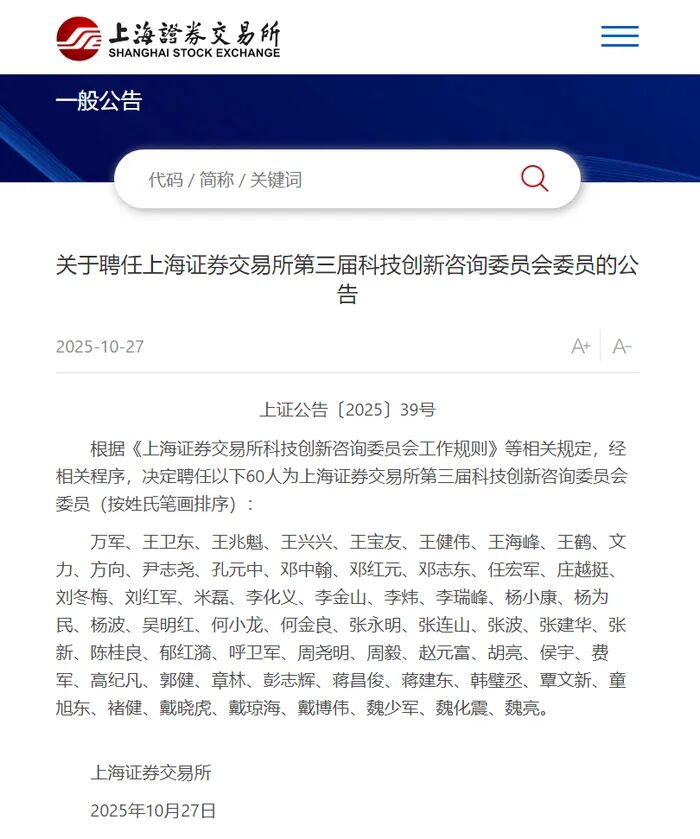
宇树王兴兴、智元彭志辉 担任上交所科技创新咨询委员会委员
2 1 Shi Ji Jing Ji Bao Dao· 2025-10-28 04:49
Core Viewpoint - The Shanghai Stock Exchange (SSE) has announced the appointment of the third session of its Technology Innovation Advisory Committee, consisting of 60 members from various sectors, including research institutions and leading enterprises, with a focus on future industries such as artificial intelligence and robotics [4]. Group 1: Committee Composition - The third advisory committee includes 60 members, primarily consisting of reappointed members from previous sessions [4]. - New members include experts from future industries such as artificial intelligence, robotics, commercial aerospace, and low-altitude economy [4][5]. - Notable new members include Wang Xingxing, CEO of Yushu Technology, and Peng Zhihui, co-founder and CTO of Zhiyuan Robotics [4]. Group 2: Industry Representation - There is a significant increase in the representation of experts from the integrated circuit and chip industries within the committee [6]. - New members from the integrated circuit sector include He Xiaolong, chairman of China Resources Microelectronics, and Zhang Xin, chairman and president of the National Integrated Circuit Industry Investment Fund [6]. Group 3: Committee Responsibilities - The SSE Technology Innovation Advisory Committee serves as an expert body to provide professional opinions for the construction and development of the Sci-Tech Innovation Board [6]. - The committee will advise on the positioning of the Sci-Tech Innovation Board and assess whether issuers possess technological innovation attributes [6].
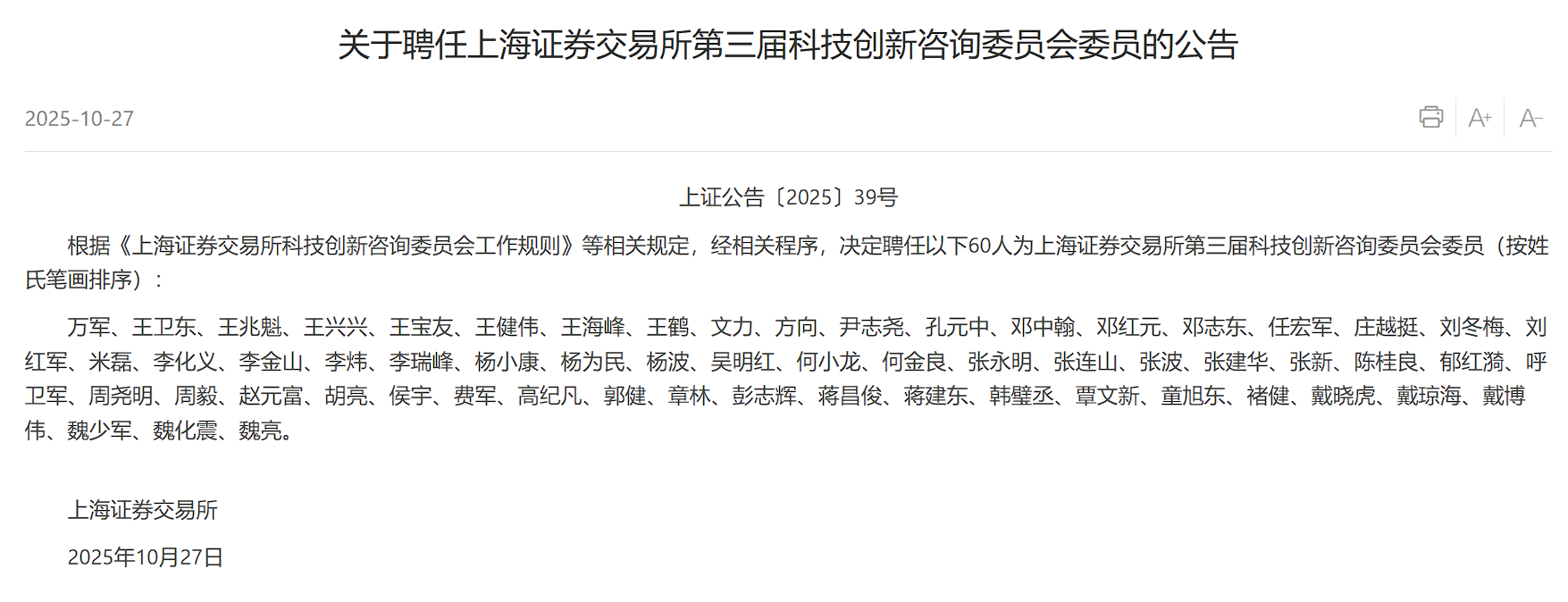
宇树王兴兴、智元彭志辉,担任上交所科技创新咨询委员会委员
2 1 Shi Ji Jing Ji Bao Dao· 2025-10-28 03:37
Group 1 - The Shanghai Stock Exchange (SSE) announced the appointment of the third Technology Innovation Advisory Committee, consisting of 60 members primarily from research institutions, leading enterprises, and government agencies, with a focus on continuity among members [1][2] - The committee includes experts from future industries such as artificial intelligence, robotics, commercial aerospace, and low-altitude economy, indicating a broad and representative source of members [2][3] - Notable new members include Wang Xingxing, CEO of Yushu Technology, and other leaders from AI and robotics sectors, highlighting the committee's emphasis on technological innovation [2][3] Group 2 - The representation of experts from the integrated circuit and chip industries has significantly increased in the third committee, with key figures such as He Xiaolong from China Resources Microelectronics and Yin Zhiyao from Zhongwei Company continuing their roles [4] - The SSE Technology Innovation Advisory Committee serves as an expert body to provide professional opinions on the construction and development of the Sci-Tech Innovation Board, focusing on the technological innovation attributes of issuers and relevant issues in their application documents [4]
谁说教授不能创业?附:2025最具投资潜力的10家科学家创业公司|北京科学家创业团
Sou Hu Cai Jing· 2025-10-27 07:05
Core Insights - The article discusses the contrasting views on scientist entrepreneurship, highlighting high failure rates alongside successful cases in hard technology sectors [1][2] - It emphasizes the importance of aligning technological value with market demand for successful commercialization [1] - The Chinese government's focus on emerging industries and high-tech sectors provides favorable policies and market opportunities for scientist-led startups [1] Group 1: Challenges in Scientist Entrepreneurship - High failure rates of scientist-led startups, with data indicating a 96%-97% failure rate among U.S. university professors [1] - Notable cases of investors facing setbacks due to over-reliance on professors' promises of commercialization [1] Group 2: Successful Cases in Hard Technology - Some teams have successfully developed AI technologies that break foreign monopolies, and others have introduced products in clean energy that fill domestic gaps [1] - Medical technology companies are leveraging both technological strength and commercial viability to attract continuous investment [1] Group 3: Policy Support and Market Opportunities - The 20th National Congress of the Communist Party of China has set goals for nurturing emerging industries and high-tech sectors, including renewable energy and quantum technology [1] - This policy direction creates a conducive environment for scientist entrepreneurship, aligning with national strategic objectives [1] Group 4: Investment Potential - The Beijing Scientist Entrepreneurship Group released a list of the "Top 10 Most Investable Scientist Startups for 2025," covering sectors like AI, clean energy, and high-end medical technology [2] - The selection criteria focus on disruptive technology, potential company scale, and preference for founders with academic backgrounds [2] Group 5: Notable Companies - Kesheng Technology, led by Professor Jin Jianxiang from Zhejiang University, has achieved a valuation of 5 billion yuan, marking a significant breakthrough in clean energy [5] - Micron Star, under Professor Wu Shufan from Shanghai Jiao Tong University, has established a valuation exceeding 7 billion yuan by innovating satellite manufacturing processes [8] - Zhimai Biotechnology has developed a full-chain self-research capability in gene sequencing, achieving a valuation of 4 billion yuan [10] - Wuhanshi Sensory Technology, led by Professor Sun Chengliang, has become a pioneer in domestic high-end BAW filters, with a valuation doubling over three years [17]


11月,迎接机器人主升浪
2025-10-27 00:31
Summary of the Conference Call on the Robotics Sector Industry Overview - The robotics sector has experienced a correction of 20%-25% due to negative news, but this is viewed as a healthy adjustment within an upward trend, indicating a potential bottoming signal [1][2] - Historical data shows that the robotics sector typically benefits from a performance vacuum period around late October to early November, often leading to upward trends during this time [1][2] Key Points and Arguments - **Catalysts for Growth**: - Tesla's production capacity planning aims for 1 million units by the end of next year, with a supply chain adjustment to produce 10,000 units weekly [1][2] - Upcoming Tesla shareholder meetings and new order expectations are anticipated to drive the robotics sector upward [1][2] - **Investment Strategy**: - Investors should follow the principle of "certainty in the ladder chain and scarcity in the domestic chain," focusing on companies with confirmed orders in Tesla's supply chain and those in scarce domestic segments [1][5] - **Production Timeline**: - 2025 is identified as the year for initial production, primarily for internal testing and data collection, while 2026 is expected to be the year of commercialization, requiring stable performance and extensive training of the robots' "brains" [1][6] - **Technological Advancements**: - Tesla employs the "Seem to Real" method, combining real and virtual data to train robot brains, significantly accelerating training speed and enhancing AI control capabilities [1][10] Additional Important Insights - **Challenges in Brain Training**: - The main challenge in brain training is achieving a high success rate in actions, with current success rates dropping significantly when visual focus is lost [9][10] - **Commercialization Levels**: - Commercialization does not require achieving Level 4 autonomy; Tesla has demonstrated that Level 2 and Level 3 can suffice for commercial viability [11] - **Supplier Selection**: - Suppliers in Tesla's chain can be categorized into a three-tier pyramid, with the first tier consisting of companies that have secured orders, indicating higher certainty [12] - **Potential for Excess Returns**: - Investors can achieve excess returns by targeting second-tier companies that have potential to move up to the first tier, thus capturing alpha and beta returns [13] Notable Companies and Their Advantages - **Star Companies**: - Companies like Star泉股份, 斯菱股份, and 浙江龙泰 are highlighted for their potential to move into the first tier due to recent developments and order acquisitions [14][15][16] - **Focus on "Brain" Technology**: - The "brain" of robots, or the intelligent control system, is deemed the most critical technology, with companies like 品茗科技 and 北京通智科技 leading in this area [19][20][22] - **Market Impact of Collaborations**: - The partnership between 品茗科技 and 北京通智科技 is expected to enhance competitiveness in brain technology, potentially leading to significant market interest and investment [23][24] Recommendations for Future Development - Emphasize both certainty and scarcity in investment choices, focusing on companies that have entered production and secured orders, particularly in the brain technology segment [25]
