
Blue Owl

Search documents
美国软件业贷款坏账激增,一场“软件-PE”死亡循环正上演
Hua Er Jie Jian Wen· 2026-02-05 00:55
Core Insights - The U.S. software industry is facing a credit crisis triggered by concerns over AI disrupting traditional software business models [1][2] - The crisis, referred to as the "SaaS apocalypse," has led to a significant increase in bad debt within the tech sector, reaching approximately $46.9 billion, the highest level since October 2022 [1] - The impact of this crisis is spreading from the stock market to the private credit sector, with a notable percentage of leveraged loans exposed to the tech industry [1][3] Group 1: Debt Deterioration - Over the past four weeks, $17.7 billion in tech company loans have fallen into bad debt, primarily within the Software as a Service (SaaS) sector [2] - Bad loans are defined as those yielding more than 10 percentage points above the benchmark Secured Overnight Financing Rate (SOFR) [2] - Many software company loans are nearing distress levels, with specific examples including Dayforce and Calabrio, which are approaching crisis thresholds [2] Group 2: Private Credit Market Challenges - The software industry's troubles are transmitting shockwaves to the private credit market, with alternative lenders' stock prices plummeting in tandem with software companies [3] - Analysts indicate that software represents one of the largest industry exposures for Business Development Companies (BDCs), potentially higher than reported due to misclassification of loans [3] - The logic behind lending to software companies has collapsed, as the predictability of subscription revenue is now questioned due to the risk of obsolescence [3][4] Group 3: Market Dynamics - The appeal of private credit is diminishing as public market yields rise, making the promised "liquidity premium" less attractive [4] - The current market environment is characterized by panic selling, with no signs of stabilization, leading to a "death spiral" for software companies [5] - A dangerous feedback loop is forming, where falling software equity valuations pressure private credit institutions to reassess their balance sheets, tightening credit conditions further [5]
美股“SaaS末日”来临:“软件-PE”陷入“死亡循环”
华尔街见闻· 2026-02-04 11:56
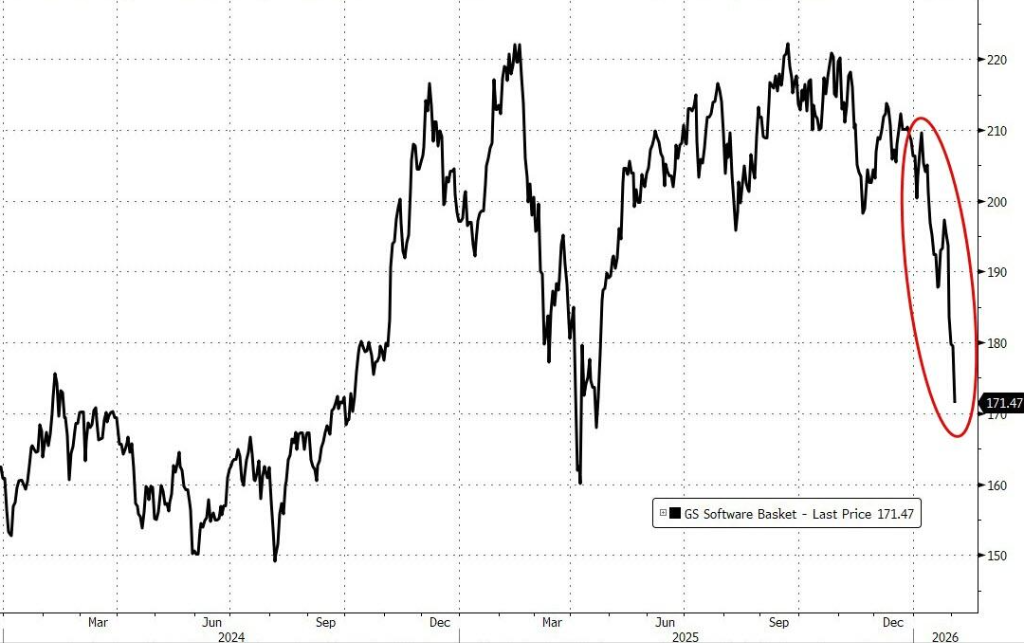
Core Viewpoint - The software industry is experiencing a significant downturn, with the S&P North American Software Index dropping 15% in January, marking the largest monthly decline since October 2008. This decline is exacerbated by fears surrounding AI advancements that threaten traditional software companies' market positions and pricing power [1][6]. Group 1: Market Sentiment and Trends - The current market sentiment is characterized by panic selling, described as a "get me out" mentality, with no signs of stabilization [3]. - The release of Anthropic's productivity tool for corporate lawyers has intensified fears, leading to a sharp decline in legal software and publishing company stocks [1][6]. - There is a stark divide in the market, with semiconductor companies viewed as beneficiaries of the AI supercycle, while software companies are seen as major losers [6]. Group 2: Impact on Private Credit and BDCs - The software sector's decline is impacting private credit markets, with software companies representing about 20% of Business Development Companies' (BDCs) portfolios, totaling approximately $100 billion [4][9]. - As software valuations plummet, BDCs like Blue Owl, Blackstone, and Ares are experiencing stock price declines due to concerns over potential contagion effects [10]. - The risk exposure of BDCs to software loans is significant, with Morgan Stanley reporting that software loans account for about 16% of their tracked BDC loan portfolios, totaling around $70 billion [12]. Group 3: Potential Losses and Stress Testing - Stress tests conducted by JPMorgan indicate that if 33% of software companies default, BDCs could face losses of $22 billion, reducing net asset values by 11%. In a more severe scenario with a 75% default rate, cumulative losses could approach $50 billion, diluting book values by 24% [14]. - Specific software loans are already showing signs of pressure, with secondary market prices significantly lower than BDC book valuations, indicating a disconnect between market perceptions and reported values [15][16]. Group 4: Future Outlook and Investor Sentiment - There is a prevailing view that the software industry could face a fate similar to that of print media or department stores, leading to uncertainty in growth projections and valuations [7]. - Despite potential long-term buying opportunities, current investor confidence remains low, complicating the assessment of what constitutes a "cheap" investment in the software sector [7].


美股“SaaS末日”来临:“软件-PE”陷入“死亡循环”
美股IPO· 2026-02-04 01:02
Core Viewpoint - The software industry is facing a "doomsday crisis" due to the impact of AI, with the S&P North American Software Index experiencing a 15% drop in January, the largest monthly decline since 2008, leading to panic selling among investors [1][2][3]. Group 1: Market Impact - The S&P North American Software Index has seen a continuous decline for three weeks, with a significant drop of 15% in January, marking the largest monthly decline since October 2008 [2]. - The panic intensified after AI startup Anthropic released a productivity tool for corporate lawyers, causing stock prices of legal software and publishing companies to plummet [2][7]. - The software sector's crisis is not limited to the stock market but is also affecting the private credit market, with software companies representing about 20% of the portfolios of Business Development Companies (BDCs), totaling approximately $100 billion [3][10]. Group 2: Private Credit Risks - The collapse of the SaaS sector poses risks not only to the equity market but also to the debt market, with BDCs being particularly sensitive to declines in software stock and credit valuations [10]. - As software company valuations plummet, BDCs face asset impairment pressures, leading to potential credit tightening that could further squeeze the growth space of already struggling software companies, creating a "death spiral" [6][12]. - Analysts warn that if AI causes significant disruption to corporate borrowers, the default rate in U.S. private credit could soar to 13% [13]. Group 3: Stress Testing and Asset Valuation - JPMorgan conducted stress tests on BDC portfolios, indicating that under a scenario where 33% of companies default, the tracked BDCs could face losses of $22 billion, reducing net asset value by 11% [14]. - In a more severe scenario with a 75% default rate, cumulative net losses could approach $50 billion, diluting book value by 24% [14]. - Specific loan assets are already showing signs of pressure, with significant discrepancies between secondary market prices and BDC book valuations for software loans [15][18].

美股“SaaS末日”来临:“软件-PE”陷入“死亡循环”
Hua Er Jie Jian Wen· 2026-02-04 00:40
Core Viewpoint - The software industry is experiencing a significant downturn, with the S&P North American Software Index dropping for three consecutive weeks and a 15% decline in January, marking the largest monthly drop since October 2008 [1][3]. Group 1: Market Sentiment and Impact - The current market sentiment is characterized by panic selling, described as a "get me out" mentality, with no signs of stabilization [3]. - The release of Anthropic's productivity tool for corporate lawyers has intensified fears, leading to a sharp decline in legal software and publishing company stocks [1][7]. - There is a growing concern that advancements in AI technology may erode the competitive advantages of traditional software companies, leading to fears of being completely replaced [7]. Group 2: Private Credit Exposure - The software sector's decline poses risks not only to the stock market but also to the private credit market, with software companies representing about 20% of the portfolios of Business Development Companies (BDCs), totaling approximately $100 billion [3][9]. - As software company valuations plummet, private credit institutions face pressure to reassess their balance sheets, potentially tightening credit availability, which could further squeeze struggling software companies [5][10]. Group 3: Financial Analysis and Projections - Morgan Stanley's analysis indicates that if AI disrupts corporate borrowers aggressively, the default rate in U.S. private credit could soar to 13% [12]. - Stress tests conducted by Morgan Stanley suggest that under a scenario where 33% of companies default, tracked BDCs could face losses of $22 billion, reducing net asset value by 11% [13]. - In a more severe scenario with a 75% default rate, cumulative net losses could approach $50 billion, diluting book value by 24% [13]. Group 4: Market Dynamics and Valuation Challenges - The divergence in market performance is stark, with semiconductor companies benefiting from the AI supercycle while software companies are viewed as major losers [5]. - Despite some companies passing earnings tests, the overall pass rate is declining, indicating a harsh competitive environment within the industry [7]. - The market is struggling to assign reasonable valuations to software companies due to the uncertainty brought by AI, complicating the identification of attractive buying opportunities [7].
Software Slump Drags Down Private-Fund Managers
WSJ· 2026-02-03 19:04
Core Viewpoint - Shares of private-asset managers, including Ares, Apollo, Blue Owl, and Blackstone, experienced a significant decline on Tuesday [1] Group 1: Company Impact - Ares and Apollo, two major players in the private-asset management sector, saw their stock prices drop sharply [1] - Blue Owl and Blackstone also faced similar declines, indicating a broader trend affecting the private-asset management industry [1] Group 2: Industry Trends - The downturn in share prices reflects growing concerns within the private-asset management industry, potentially signaling shifts in investor sentiment [1] - The decline may impact future fundraising and investment strategies for these firms, as market confidence appears to wane [1]


Stock Market Today, Feb. 3: AI startup Anthropic blindsides software, tech stocks with big announcement
Yahoo Finance· 2026-02-03 18:14
This live blog is refreshed periodically throughout the day with the latest updates from the market.To find the latest Stock Market Today threads, click here. Happy Tuesday. This is TheStreet’s Stock Market Today for Feb. 3, 2026. You can follow the latest updates on the market here in our daily live blog Update: 4:00 p.m. ET Closing Bell Time to wrap it up. The market is now closed. Though it was a rough day for the large cap indexes, things finished out in better shape than we saw intraday. The Nasdaq ...
2025年下半年全球基金银行业展望影响私人市场的趋势(英)
硅谷银行· 2026-02-03 02:45
Investment Rating - The report does not explicitly provide an investment rating for the industry. Core Insights - The focus in private markets has shifted from interest rates and inflation to tariffs and trade policies, which have reached levels not seen in a century, increasing operational and investment risks for funds [4][33] - Fundraising sentiment is stable but demanding, with capital flowing towards large platforms or niche managers, while those in the middle face tougher conditions [5] - AI adoption in private markets has accelerated, with nearly all firms exploring AI tools, although governance and clear policies are still lacking [6][116] Macro - The federal funds rate is expected to decrease, with market pricing indicating two cuts by year-end and another two next year, although inflation concerns may affect borrowing costs [19][21] - The effective US tariff rate has risen significantly, impacting private markets and leading funds to manage FX risk through increased hedging [33][36] Private Market Trends - Fundraising has returned to pre-pandemic levels, but there is a split in capital flow, with large and niche funds performing better than mid-sized funds [5][52] - Investors expect moderate growth in AUM, with nearly 70% anticipating an increase of 10% or more over the next 12 months [62] - The fundraising environment is characterized by a bifurcation, where large funds are aggregating capital while niche funds succeed through sectoral expertise [63] Spotlight: AI and Firm Operations - The era of AI hesitation has ended, with most firms now exploring AI tools, although implementation remains a challenge [116] - Firms are focusing on building data infrastructure to maximize the benefits of AI, as many lack the necessary data foundation [117][118] - AI tools are primarily being used in areas where junior staff work, but hiring for junior positions remains strong as firms view AI as a complement rather than a replacement [129][130]
Is Trouble Brewing in the Private Credit BDC Space?
Yahoo Finance· 2026-01-28 18:43
Core Insights - The private credit sector is experiencing isolated issues that may slow fundraising and increase redemption requests, but these are not indicative of widespread problems [2] - Interest in private credit has surged, with the global market growing from $2 trillion in 2020 to $3 trillion at the start of last year, and projected to reach $5 trillion by 2029 [3] Fundraising and Investment Trends - In the wealth channel, semiliquid BDCs and interval funds have become popular, raising $167 billion and $126 billion respectively by the end of Q3 2025, with private credit being the most favored asset class [4] - Despite the popularity, there are signs of risk in private credit, including lighter loan covenants and interest rate volatility, leading to a 200% increase in redemption requests in Q4 2025, totaling $2.9 billion [4] Company-Specific Developments - BlackRock TCP Capital Corp. reported a 19% reduction in NAV due to writedowns from bad loans in Q4 2025 [5] - Blue Owl canceled a merger plan for its unlisted private credit BDC due to market conditions, as investors were concerned about potential markdowns and liquidity issues [6]
12 Investment Must Reads for This Week (Jan. 27, 2026)
Yahoo Finance· 2026-01-27 16:04
You can find original article here WealthManagement. Subscribe to our free daily WealthManagement newsletters. 4 Reasons Why Market Volatility Could Be Different This Time “The transformations we’re witnessing in the US economy are not minor tweaks; they are significant restructurings with potentially long-lasting consequences. We’ve seen substantial job losses in various sectors, and simultaneously, critical government institutions have faced significant budget cuts and personnel reductions.” (Morningstar ...
XA Investments Reports Record Growth in 2025 in its Fourth Quarter 2025 Market Update
Globenewswire· 2026-01-15 17:25
Core Insights - The interval and tender offer fund market has reached a new peak with 308 funds and $233 billion in net assets, indicating a growing popularity in recent years [2][4] - The market is expected to maintain strong growth into 2026, driven by increased demand for evergreen products and greater investor accessibility [4] Market Overview - The non-listed closed-end fund (CEF) market includes 158 interval funds, which account for 57% of total managed assets at $156.1 billion, and 150 tender offer funds, comprising 43% with $119.9 billion in total managed assets [4] - In 2025, 67 new funds entered the market, an increase of 17 compared to 50 funds launched in 2024, with market-wide net assets rising by $61 billion [4][5] Fund Sponsorship and Diversity - There are 159 unique fund sponsors in the interval and tender offer fund space, an increase of 13 from 146 at the end of 2024, with 36% of the funds launched in 2025 sponsored by new entrants [5] - The number of funds in the SEC registration process decreased from 53 at the end of 2024 to 50 at the end of 2025, indicating consistent market momentum [6] Fund Performance and Recognition - Many interval and tender offer funds showed strong results in 2025, with notable net flows and asset growth, including the Cliffwater Corporate Lending Fund and the StepStone Private Credit Income Fund [8] - The new XAI Interval Fund Awards recognized innovative offerings and top-performing funds, providing valuable insights into the growth and performance of the interval fund market [9][8]
