Databricks

Search documents
再募 150 亿美元,拿走全美 18%的风投资金,3 万字长文聊聊 a16z 是怎么运转的?
Founder Park· 2026-01-15 13:04
Core Insights - a16z has raised over $15 billion, capturing more than 18% of all VC funds raised in the U.S. in 2025 [2][10] - The firm has invested in 56 unicorns over the past decade, more than any other venture capital institution, and has backed 10 out of the top 15 private companies by valuation [3][15] - a16z is characterized as a "Firm" rather than a "Fund," focusing on building a long-term competitive advantage system that strengthens with scale [4][41] Fundraising and Market Position - In 2025, a16z's fundraising of $15 billion surpassed the combined total of its closest competitors, Lightspeed ($9 billion) and Founders Fund ($5.6 billion) [10] - a16z's fundraising success occurred in a challenging environment, where the average fund took 16 months to close, while a16z completed its fundraising in just over three months [10] - The firm has four independent funds that ranked in the top 10 for total capital raised in 2025, with its Late Stage Venture Fund II ranking second [12] Investment Strategy and Philosophy - a16z has led early-stage financing for 31 companies that eventually surpassed a valuation of $5 billion, outperforming its closest competitors by over 50% [16] - The firm holds 44% of the total valuation of all AI unicorns in its portfolio, indicating a strong position in the AI sector [16] - a16z's investment philosophy emphasizes identifying and backing the ultimate winners in their respective categories, often providing more capital than initially requested [26][34] Historical Context and Evolution - Since its inception, a16z has evolved through two distinct eras, focusing first on recognizing undervalued software companies and later on the increasing scale of successful tech firms [63][72] - The first era (2009-2017) was marked by a willingness to pay premium prices for high-potential companies, while the second era (2018-2024) focused on raising larger funds to maintain meaningful ownership in increasingly larger winners [66][72] - a16z's approach has been to build operational infrastructure that supports portfolio companies, a strategy that was initially viewed as unnecessary by peers [67] Notable Investments - a16z has invested in major companies such as OpenAI, SpaceX, and Databricks, which are among the top private companies by valuation [14][16] - Databricks exemplifies a16z's investment model, showcasing the firm's commitment to supporting founders and believing in their long-term vision [25][40] - The firm has consistently backed Databricks through multiple funding rounds, contributing to its growth into a $134 billion company [24][40]

只用到 1% 的 AI,却把 ARR 做到 2 亿美元:Glean 赢法在哪
3 6 Ke· 2026-01-14 09:08
Core Insights - Glean's success is attributed to its pragmatic approach in leveraging only 1% of AI capabilities to generate significant business value, rather than focusing solely on model performance [1][2][28] - The company emphasizes the importance of organizational adaptability and the ability to translate complex technology into practical productivity [1][28] Group 1: AI Capability Utilization - Glean has only utilized 1% of its AI capabilities, which is not a technical limitation but a challenge in practical implementation [5][6] - The company believes that even without further model iterations, existing AI capabilities can achieve tenfold growth in five years [6][8] - Glean focuses on creating tools that enable employees to effectively use AI, rather than developing complex models [8][10] Group 2: Challenges in AI Implementation - A significant reason for AI project failures is the misconception that automation is a simple solution; real-world applications require careful integration and understanding of organizational rules [11][12] - Glean's attempts to implement AI for task prioritization failed, highlighting the complexity of accurately defining priorities [11][12] - The company acknowledges that 95% of AI projects failing is a normal expectation, emphasizing the need for rapid learning from failures [12][14] Group 3: Organizational Culture and Adaptability - Glean promotes a culture of code deletion to stay agile and responsive to rapid technological changes [15][18] - The company believes that the true competitive advantage lies in the speed of organizational evolution rather than the technology itself [19][28] - Glean's approach is to focus on practical applications of AI that can be quickly adapted to meet client needs [19][28] Group 4: Growth and Management Challenges - Glean's rapid growth from a small team to over 1,000 employees has led to challenges in maintaining direction and coherence across the organization [20][21] - The CEO expresses a sense of urgency and responsibility in ensuring that the organization operates effectively as it scales [20][22] - The transition from a small, agile team to a larger organization requires new management practices and clearer communication [22][25] Group 5: Key Takeaways - Glean's ability to generate $200 million in annual recurring revenue (ARR) with minimal AI usage demonstrates the importance of practical application over theoretical capabilities [2][28] - The company has successfully navigated challenges by focusing on usable AI, accepting failure as part of the process, and maintaining organizational agility [28]
WTW Radar integrates with Databricks to simplify and fast-track data sharing
Globenewswire· 2026-01-12 13:13
Core Insights - WTW has launched the Radar Connector for Databricks, enhancing its insurance analytics and pricing platform by enabling secure data integration and analysis [1][2]. Group 1: Integration Benefits - The integration allows Radar users to access data directly from the Databricks Data Intelligence Platform, streamlining the data retrieval process [2]. - Users can transfer analysis results back into Databricks, facilitating automated processes and improving overall efficiency [2][3]. - The total turnaround time for data updates has been reduced to minutes, significantly increasing operational efficiency [3]. Group 2: Expert Commentary - Chris Halliday from WTW emphasized that the integration provides a more efficient experience for insurers, leveraging Databricks' machine learning capabilities [4]. - Marcela Granados from Databricks highlighted that the integration enables insurers to unify their data into a governed environment, leading to actionable insights and faster decision-making [4]. Group 3: Radar Overview - Radar is a comprehensive analytics and model deployment solution tailored for insurers, featuring proprietary machine learning algorithms and real-time decision-making capabilities [5]. - It is part of WTW's Insurance Consulting and Technology business, which aims to innovate and transform the insurance sector [6]. Group 4: Company Profile - WTW operates globally, serving over 1,000 client companies across six continents, and employs more than 1,700 professionals in 35 markets [7]. - The company provides data-driven solutions in people, risk, and capital, helping organizations enhance performance and resilience [8].


a16z 的投资收益如何,其定位 Firm 的逻辑以及独特的投资策略
投资实习所· 2026-01-12 10:05
Core Viewpoint - a16z has successfully raised $15 billion and continues to demonstrate strong investment returns, particularly from its early funds, countering concerns about diminishing returns due to increased fund size [1][2]. Fund Performance - a16z's early funds have shown exceptional performance, returning a total of $25 billion to LPs since 2009, with notable returns from its cryptocurrency funds, such as CNK I, which has delivered a net DPI of 5.4x [2]. - The performance metrics of various funds include: - Fund I (2009): Net TVPI of 6.9x, Net DPI of 6.0x - Fund II (2010): Net TVPI of 3.7x, Net DPI of 3.5x - Fund III (2012): Net TVPI of 11.3x, Net DPI of 5.5x - Fund IV (2014): Net TVPI of 4.1x, Net DPI of 3.0x - Fund V (2017): Net TVPI of 3.1x, Net DPI of 0.3x [3][6]. - The growth funds (LSV) also performed well, with LSV I achieving a net TVPI of 3.3x, placing it in the top 5% of its cohort [5]. Key Investments - Significant contributions to a16z's returns come from top-performing companies, with Databricks representing 23% of the NAV across all funds and Coinbase generating $7 billion in total distribution for LPs [5]. - a16z has invested in 56 unicorns over the past decade, more than any other institution, and is a backer of 10 out of the 15 highest-valued private companies globally, including OpenAI and SpaceX [5]. Investment Philosophy - a16z is evolving from a traditional VC model to a technology-focused firm, emphasizing the need for scalability to match the rapid growth of technology [9][10]. - The founders, Marc Andreessen and Ben Horowitz, initially aimed to disrupt established VCs and have since recognized the potential of the VC market, advocating for a focus on market dynamics as a key to success [11][14]. - The firm's investment logic is rooted in a belief that technology will increasingly permeate all industries, leading to greater opportunities for investment [17][18].
a16z 募资 150 亿美金不再是一家纯 VC,华人学生做的 AI 检测工具 ARR 突破 2400 万美金
投资实习所· 2026-01-11 11:33
Core Insights - a16z has successfully raised a new fund of $15 billion, exceeding initial expectations of $10 billion, bringing its total assets under management to $90 billion [1][2] - The new fund represents 18% of all VC fundraising in the U.S. for 2025, surpassing Lightspeed's $9 billion raised last December [2] - Despite 2025 being projected as a low year for VC fundraising, a16z completed its fundraising in just three months, indicating strong confidence from limited partners (LPs) [3] Fund Allocation - The allocation of the new $15 billion fund is as follows: - American Dynamism: $1.176 billion - Apps: $1.7 billion - Bio+Health: $700 million - Infrastructure: $1.7 billion - Growth: $6.75 billion - Other strategies: $3 billion [6] Investment Philosophy - a16z emphasizes long-term impact and technological leadership rather than short-term financial returns, positioning itself as a firm focused on shaping the future of technology [8] - The firm believes in providing not just capital but also legitimacy, sales networks, and talent resources to its portfolio companies [8] - a16z's investment strategy includes making large bets on potential winners and continuously supporting them with additional resources [10] Notable Investments - a16z has invested in many of the highest-valued private companies, including OpenAI, SpaceX, and Databricks, holding a significant share of the AI unicorn market [3] - The firm’s early investment in Databricks, which started as an open-source project, exemplifies its commitment to backing transformative technologies [11][12] Cultural and Strategic Positioning - a16z's culture is built around a strong belief in the future and the importance of giving opportunities to individuals from diverse backgrounds [5][7] - The firm differentiates itself from traditional VCs by focusing on creating lasting competitive advantages and shaping future market needs rather than merely following trends [8]

700亿,一笔巨额投资被取消
投中网· 2026-01-11 07:12
Core Viewpoint - The article discusses Blue Owl Capital's decision to withdraw a $10 billion investment plan in Oracle due to concerns over Oracle's excessive debt related to its artificial intelligence business, highlighting the risks associated with investing in companies heavily leveraged in the AI sector [4][16][18]. Group 1: Investment Landscape - Harry Stebbings, a prominent figure in venture capital, suggested that only companies associated with "artificial intelligence" will create attractive returns, indicating a shift in investment focus within the industry [2][3]. - The rapid growth of companies like OpenAI and Anthropic has set a high bar for investment, leading to a consensus among investors that not investing in these firms could be seen as shortsighted [2][3]. Group 2: Blue Owl Capital's Background - Blue Owl Capital, established in May 2021, emerged from a combination of three entities, focusing on merger and acquisition strategies during a time of market volatility [8][10]. - The firm has successfully expanded its asset management to over $192 billion, positioning itself as a significant player in the investment landscape [11]. Group 3: Oracle's Financial Health - Oracle's stock price has been highly volatile, influenced by its AI business performance, with a notable 40% increase in September due to significant contracts with major clients, followed by a 50% drop in December due to disappointing growth [6][16]. - As of November, Oracle's net debt reached approximately $105 billion, a significant increase from the previous year, raising concerns about its financial stability [16][18]. Group 4: Withdrawal of Investment - Blue Owl Capital's decision to cancel the $10 billion investment was driven by concerns over Oracle's mounting debt and the potential for default, leading to a breakdown in negotiations over lease and debt terms [17][18]. - The withdrawal has sparked anxiety about the sustainability of the AI investment bubble, especially as Blue Owl, a well-capitalized firm, expressed hesitation [18][19].


下一个万亿AI赛道,上下文图谱,才是AI创业的真正机会
3 6 Ke· 2026-01-09 12:39
Core Argument - The debate in Silicon Valley centers around whether AI, particularly Agents, will replace SaaS systems. Jamin Ball argues that Agents will not eliminate traditional Systems of Record but will increase the demand for accurate underlying data [1][2][7]. Group 1: Context Graph as a Valuable Asset - The concept of a Context Graph is introduced as the "second asset" of companies in the AI era, capturing decision traces that traditional Systems of Record fail to document [5][9]. - Traditional enterprise software created a trillion-dollar ecosystem by managing authoritative data and workflows, but the focus is now shifting to how these systems can survive the transition to AI Agents [6][7]. - The key distinction is made between rules that guide Agents and decision traces that provide context for specific cases, highlighting the need for Agents to access both [8][10]. Group 2: Limitations of Existing Systems - Existing Systems of Record often fail to capture critical decision-making processes, leading to a lack of context that Agents require to function effectively [10][11]. - Examples of unrecorded decision-making include exceptions known only to employees, past precedents, and cross-system judgments that are not documented in existing systems [10][11]. - The inability of current SaaS giants to capture the full context of decisions limits their ability to evolve into the next generation of systems that can leverage AI effectively [16][18]. Group 3: Opportunities for Startups - Startups in the Agent system space have structural advantages as they operate on the orchestration layer, capturing decision-making processes in real-time [20][22]. - Three paths for startups are identified: replacing existing record systems, targeting specific workflows, or creating entirely new record systems that capture decision traces [24][25][26]. - The emergence of observability for Agents is highlighted as a new infrastructure, allowing companies to monitor Agent behavior and decision quality [27][28]. Group 4: Signals for Entrepreneurs - Entrepreneurs should look for signals indicating high human input and high variability in decision-making processes as opportunities for automation through Agents [29]. - The existence of roles like RevOps and DevOps indicates a gap in current software ecosystems, suggesting a need for solutions that can capture cross-functional context [29][30]. - The ultimate question remains whether the next trillion-dollar platform will be built by simply adding AI to existing data or by capturing actionable decision traces [31].


20VC x SaaStr Is Back!!: Nvidia’s $20B Groq Grab, Meta’s $2.5B Manus Play, and Why “Invisible Unemployment” Will Define 2026
SaaStr· 2026-01-08 17:21
20VC x SaaStr Is Back!!: Nvidia’s $20B Groq Grab, Meta’s $2.5B Manus Play, and Why “Invisible Unemployment” Will Define 2026 The latest from the 20VC x SaaStr collaboration with Harry Stebbings, Jason Lemkin, and Rory O’DriscollJensen Huang wanted the deal done before Christmas. He got it in two weeks. Nvidia just dropped $20 billion on Groq—a company doing sub-$50 million in revenue—because when you’re protecting a $3.5 trillion market cap, 1% is a rounding error.Meanwhile, Meta paid $2.5 billion for Manu ...


2025全球十大风云新潮商
Sou Hu Cai Jing· 2026-01-08 06:36
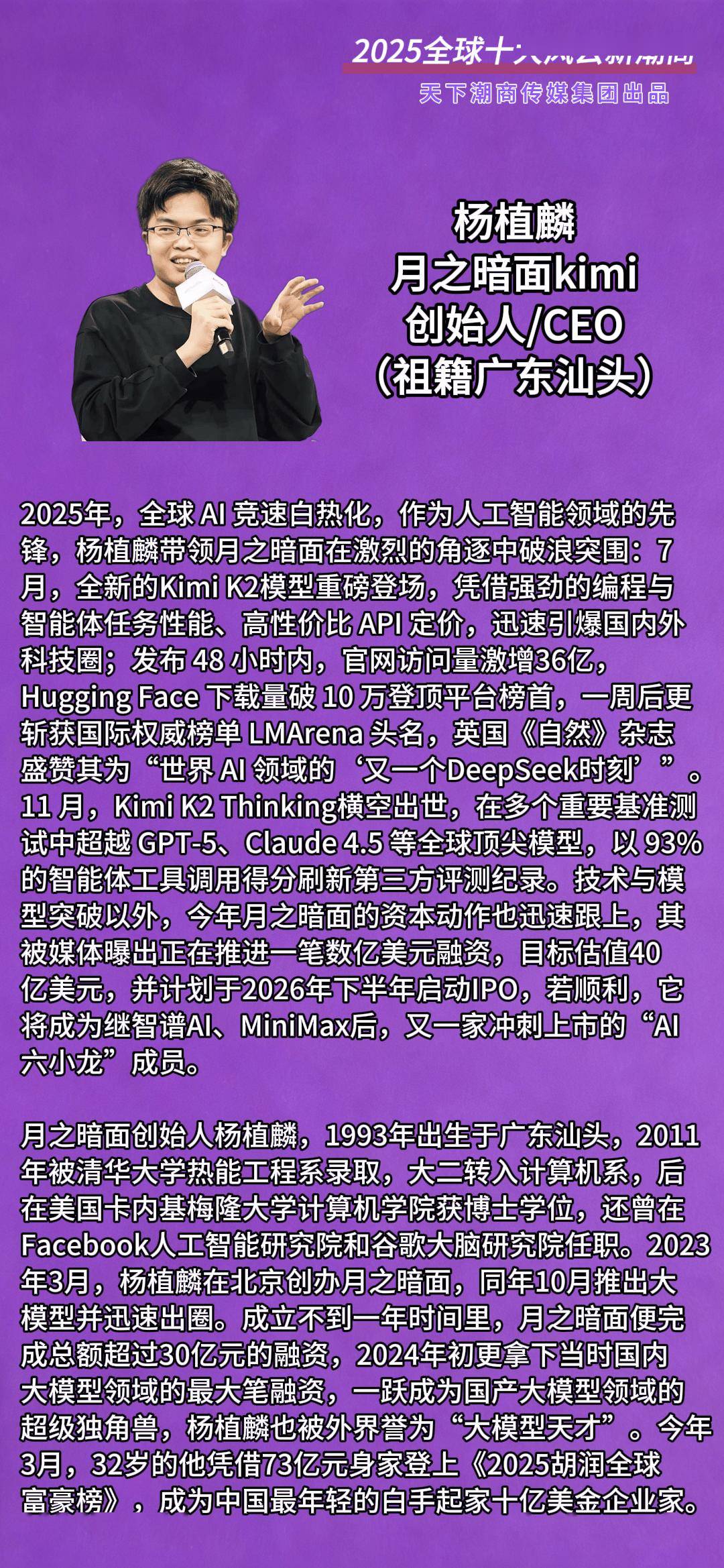
Group 1 - The article highlights the emergence of a new generation of潮商 (Chao merchants) who are blending traditional business foundations with innovative and pioneering spirits, driving transformation in the business world [1] - The "2025 Global Top Ten Emerging潮商" list was released, showcasing outstanding young潮商 who have achieved remarkable success in their respective fields [1] - The rise of these潮商 is not only a personal achievement but also a vivid representation of the vitality and innovative spirit of the潮商 community [1] Group 2 - Yang Zhilin, founder of "月之暗面," has become a significant player in the AI sector, raising over 30 billion yuan in funding and achieving a valuation of 73 billion yuan, making him one of the youngest self-made billionaires in China [3] - Hong Shizhe, a 24-year-old prodigy, founded Axiom Math, which raised $64 million in its first round of funding and achieved a post-investment valuation of over $300 million [6] - Lu Mengwu, co-founder of "高彻智能," secured significant funding and launched innovative products, establishing the company as a key player in the AI industry [10] Group 3 - Databricks, co-founded by a潮商, completed over $4 billion in funding, achieving a valuation of $134 billion, making it one of the largest tech unicorns globally [12] - Cloud Whale, another潮商 company, has seen rapid growth, with a market share of 16.2% in the domestic market and expansion into over 50 countries [16] - The article discusses the strategic moves of TikTok's CEO, who is navigating complex regulatory environments while maintaining control over the company's core operations in the U.S. [18][19] Group 4 - Shenzhen-based Intelligent派科技, led by 洪英盛, transitioned from cross-border e-commerce to becoming a leading manufacturer of consumer-grade 3D printers, with projected revenues exceeding 2.5 billion yuan in 2025 [23][24] - 镁伽科技, founded by 黄瑜清, has made significant advancements in life sciences and automation, with a projected revenue growth of 50% to 930 million yuan in 2024 [25][26] - 奥比中光, led by 黄源浩, has established itself as a leader in 3D vision technology, achieving a revenue of 714 million yuan in the first three quarters of 2025 [30][31]
软银投资:9成未上市,AI股影响成败
3 6 Ke· 2026-01-08 04:17
Group 1 - SoftBank Group plans to invest in OpenAI through its second fund starting September 2024, with an additional investment of $22.5 billion expected in 2025 [2][3] - The second fund's investment targets have increased from 157 companies to 279 over four years, with AI-related investments in the corporate services sector rising from 35 to 84 companies [3] - The total size of the second fund has been expanded from $67.8 billion to $101.8 billion, reflecting a strategic shift towards AI investments [3] Group 2 - OpenAI's valuation is projected to grow significantly, from $150 billion in September 2024 to $500 billion by October 2025, with a potential IPO in 2026 that could reach a valuation of $1 trillion [3] - The second fund primarily invests in unlisted AI companies, with Databricks expected to become a "Hectocorn" valued over $100 billion [5] - Among the IPOs in 2025, three fintech companies have performed poorly, with significant losses reported, highlighting the challenges faced by the fund [6] Group 3 - PayPay, a major smartphone payment company, is expected to go public in 2026, which could be crucial for SoftBank's second fund amid ongoing funding needs for AI investments [6]