春秋航空

Search documents
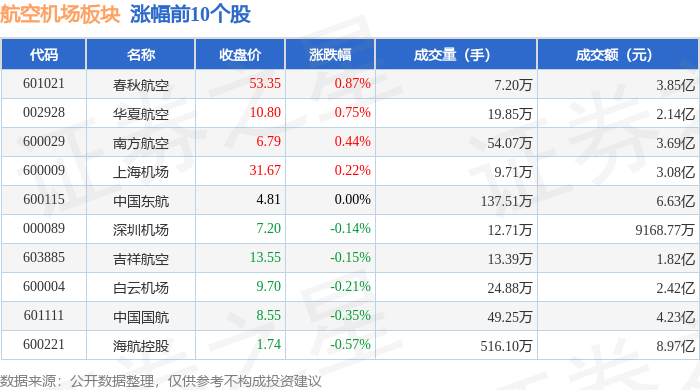
航空机场板块10月30日跌0.01%,厦门空港领跌,主力资金净流出2.97亿元
Zheng Xing Xing Ye Ri Bao· 2025-10-30 08:40
Core Insights - The aviation and airport sector experienced a slight decline of 0.01% on October 30, with Xiamen Airport leading the drop [1] - The Shanghai Composite Index closed at 3986.9, down 0.73%, while the Shenzhen Component Index closed at 13532.13, down 1.16% [1] Stock Performance - Xiamen Airport (600897) closed at 16.62, down 2.35% with a trading volume of 186,900 shares and a transaction value of 312 million yuan [2] - Other notable stocks include: - Spring Airlines (601021) at 53.35, up 0.87% [1] - China Eastern Airlines (600115) at 4.81, unchanged [2] - China Southern Airlines (600029) at 6.79, up 0.44% [2] Capital Flow - The aviation and airport sector saw a net outflow of 297 million yuan from institutional investors, while retail investors contributed a net inflow of 183 million yuan [2] - The capital flow for individual stocks includes: - Xiamen Airport with a net outflow of 21.42 million yuan from institutional investors [3] - China Southern Airlines with a net inflow of 21.88 million yuan from retail investors [3] - China National Aviation (601111) with a net outflow of 12.95 million yuan from institutional investors [3]







春秋航空:第三季度净利润11.67亿元,同比下降6.17%
Zheng Quan Shi Bao Wang· 2025-10-30 08:35
Core Insights - Spring Airlines (601021) reported its Q3 2025 financial results, showing a revenue of 6.469 billion yuan, which represents a year-on-year increase of 6.01% [1] - The net profit for Q3 2025 was 1.167 billion yuan, reflecting a year-on-year decline of 6.17% [1] - For the first three quarters of 2025, the total revenue reached 16.773 billion yuan, marking a year-on-year growth of 4.98% [1] - The net profit for the first three quarters was 2.336 billion yuan, indicating a year-on-year decrease of 10.32% [1]
春秋航空(601021) - 2025 Q3 - 季度财报
2025-10-30 08:30
Financial Performance - Operating revenue for Q3 2025 reached CNY 6,468,504,607, an increase of 6.01% compared to the same period last year[5] - Total profit for the quarter was CNY 1,538,402,231, a decrease of 5.21% year-over-year[5] - Net profit attributable to shareholders was CNY 1,166,888,153, down 6.17% from the previous year[5] - Basic earnings per share for the quarter were CNY 1.20, reflecting a decline of 5.51% compared to the same period last year[6] - Total operating revenue for the first three quarters of 2025 reached CNY 16.77 billion, a 5% increase from CNY 15.98 billion in the same period of 2024[16] - Net profit for the first three quarters of 2025 was CNY 2.34 billion, down 10.3% from CNY 2.60 billion in 2024[16] - Operating profit for the first three quarters of 2025 was CNY 3.09 billion, slightly down from CNY 3.12 billion in 2024[16] - The company reported a decrease in comprehensive income to CNY 2.28 billion in 2025 from CNY 2.69 billion in 2024[17] - Basic and diluted earnings per share for the first three quarters of 2025 were CNY 2.40, down from CNY 2.67 in 2024[17] Assets and Liabilities - Total assets at the end of the quarter amounted to CNY 46,526,995,587, representing a 6.14% increase from the end of the previous year[6] - As of September 30, 2025, the total assets of Spring Airlines amounted to RMB 46.53 billion, an increase from RMB 43.84 billion as of December 31, 2024, representing a growth of approximately 6.3%[12] - The total liabilities increased to RMB 28.35 billion from RMB 26.45 billion, reflecting a rise of approximately 7.2%[13] - The current liabilities totaled RMB 10.30 billion, up from RMB 9.05 billion, marking an increase of about 13.8%[13] - The company's total equity attributable to shareholders increased to RMB 18.18 billion from RMB 17.38 billion, a growth of approximately 4.6%[14] Cash Flow and Investments - Cash flow from operating activities for the year-to-date was CNY 5,541,634,283, showing a slight increase of 0.51%[5] - Cash flow from operating activities for the first three quarters of 2025 was CNY 5.54 billion, a marginal increase from CNY 5.51 billion in 2024[18] - The company experienced a net cash outflow from investing activities of CNY 3.82 billion in 2025, an improvement from a net outflow of CNY 5.68 billion in 2024[19] Shareholder Information - The total number of common shareholders at the end of the reporting period was 30,164[10] - The largest shareholder, Shanghai Spring Airlines International Travel Agency, holds 51.52% of the shares, with 33,600,000 shares pledged[10] Other Financial Metrics - The weighted average return on equity decreased to 6.50%, down 0.79 percentage points year-over-year[6] - Government subsidies recognized during the quarter amounted to CNY 15,277,342, contributing to the overall financial performance[8] - The company's cash and cash equivalents decreased to RMB 8.97 billion from RMB 10.22 billion, a decline of about 12.2%[12] - The retained earnings rose to RMB 9.30 billion from RMB 8.18 billion, indicating an increase of about 13.6%[14] - The fixed assets increased to RMB 26.74 billion from RMB 24.92 billion, representing a growth of approximately 7.3%[13] - The company reported a significant increase in prepayments, which rose to RMB 897.41 million from RMB 399.31 million, a growth of approximately 125%[12] - The total non-current assets reached RMB 35.47 billion, up from RMB 31.82 billion, reflecting an increase of about 11.5%[13] - The company's short-term borrowings decreased to RMB 460.25 million from RMB 628.93 million, a decline of approximately 26.8%[13] - Research and development expenses for the first three quarters of 2025 amounted to CNY 123 million, up from CNY 118 million in 2024[16] - Total operating costs for the first three quarters of 2025 were CNY 14.62 billion, an increase of 7% from CNY 13.65 billion in 2024[16]
春秋航空招40岁“空嫂”,“最抠门”航司怎么突然温情了?
Zhong Guo Zheng Quan Bao· 2025-10-30 04:48
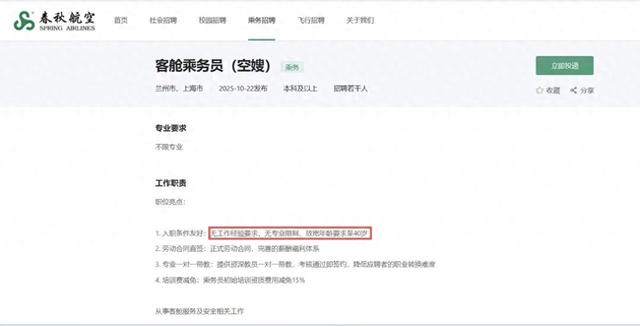
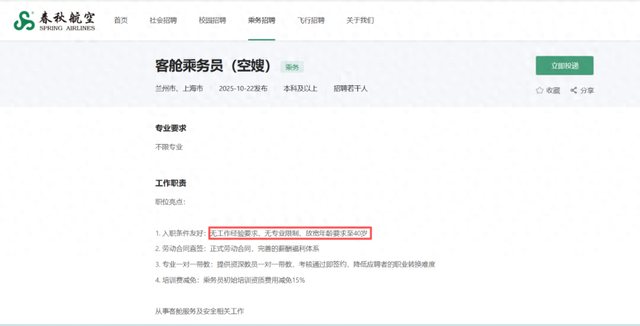
Core Viewpoint - Spring Airlines has launched a special recruitment for "air sisters" (experienced female flight attendants), targeting married women up to 40 years old, marking a shift from the industry's typical focus on youth and beauty [1][4][10]. Group 1: Recruitment Strategy - The recruitment aims to leverage the natural advantages of experienced women, such as strong interpersonal skills and the ability to handle children and passenger emotions effectively [9][10]. - This move is seen as a progressive step in breaking the industry's "youth filter," providing more job opportunities for mature women [10][12]. - The recruitment is strategically focused on key hubs like Lanzhou and Shanghai, aligning with the company's expansion plans for new routes [18][20]. Group 2: Cost Efficiency and Service Quality - Spring Airlines maintains its cost-saving philosophy, viewing the recruitment as a way to optimize training investments and reduce turnover costs associated with younger flight attendants [18][21]. - The experienced "air sisters" are expected to enhance service quality, leading to fewer complaints and lower operational risks, ultimately saving costs for the airline [18][24]. - The company has demonstrated strong financial performance, with a revenue of 10.304 billion and a net profit of 1.169 billion in the first half of 2025, outperforming competitors [24][25]. Group 3: Market Positioning - Spring Airlines is positioned as a low-cost carrier that successfully combines cost efficiency with high service quality, challenging the notion that service upgrades require significant spending [28][29]. - The airline's approach has resonated with consumers, as evidenced by a 22.87% year-on-year increase in passenger turnover in September, indicating a strong market presence [28]. - The company's strategy reflects a broader trend in the low-cost airline market, which is still underdeveloped in China compared to the U.S., suggesting significant growth potential [28].
航空机场板块10月29日涨0.71%,海航控股领涨,主力资金净流入1.34亿元
Zheng Xing Xing Ye Ri Bao· 2025-10-29 08:41
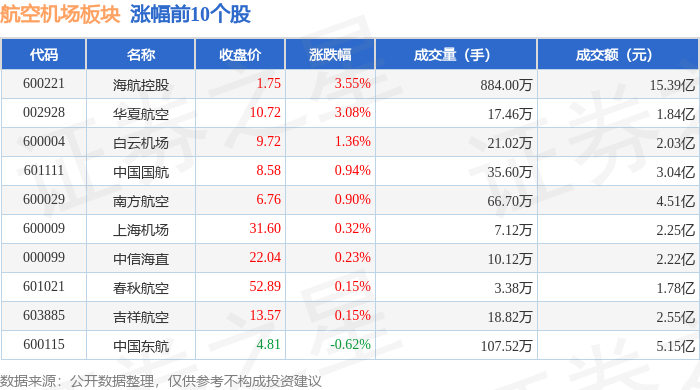
Market Overview - The aviation and airport sector increased by 0.71% on October 29, with HNA Holding leading the gains [1] - The Shanghai Composite Index closed at 4016.33, up 0.7%, while the Shenzhen Component Index closed at 13691.38, up 1.95% [1] Stock Performance - HNA Holding (600221) closed at 1.75, up 3.55% with a trading volume of 8.84 million shares [1] - Xiamen Airport (600897) saw a decline of 3.30%, closing at 17.02 with a trading volume of 326,800 shares [2] - China Eastern Airlines (600115) decreased by 0.62%, closing at 4.81 with a trading volume of 1.0752 million shares [2] Capital Flow - The aviation and airport sector experienced a net inflow of 134 million yuan from institutional investors, while retail investors saw a net outflow of 26.71 million yuan [2] - HNA Holding had a net inflow of 195 million yuan from institutional investors, but a net outflow of 108 million yuan from retail investors [3] Individual Stock Analysis - China Southern Airlines (600029) had a net outflow of 8.09 million yuan from institutional investors, but a net inflow of 19.41 million yuan from retail investors [3] - Spring Airlines (601021) experienced a net outflow of 2.76 million yuan from institutional investors, while retail investors contributed a net inflow of 16.35 million yuan [3]




春秋航空招已婚已育空嫂,年龄放宽到40岁!
2 1 Shi Ji Jing Ji Bao Dao· 2025-10-29 06:14
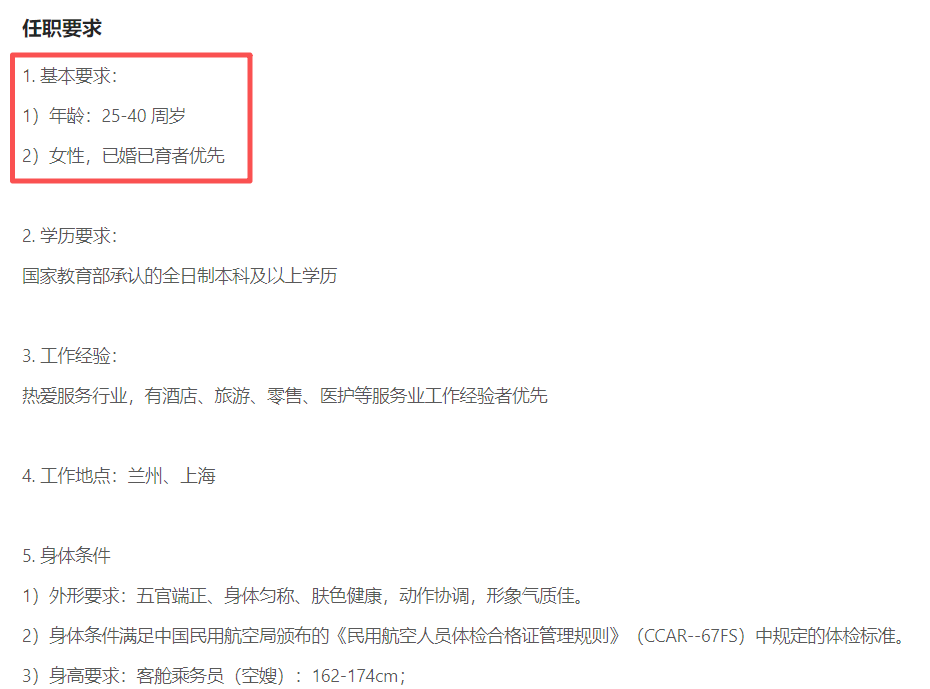
Core Viewpoint - Spring Airlines has launched a special recruitment plan for "air hostesses" in Lanzhou, targeting married women with children, with no work experience required and open to all majors, and has relaxed the age limit to 40 years old [2] Group 1 - The recruitment plan specifically aims at married women, indicating a focus on diversifying the workforce [2] - There are no requirements for prior work experience, which may attract a broader range of applicants [2] - The age limit has been extended to 40 years, reflecting a more inclusive hiring approach [2]

放宽至40岁,春秋航空开招“空嫂”,最新回应:选拔核心标准是能力,非年龄或婚育状况!专家:年龄成熟度带来稳定性,打法难以复制
Mei Ri Jing Ji Xin Wen· 2025-10-29 05:00
Core Viewpoint - Spring Airlines has initiated a specialized recruitment program for "air sisters" targeting married women, aiming to break traditional age barriers in flight attendant hiring and enhance its brand image as a low-cost airline [1][5]. Recruitment Strategy - The recruitment plan allows for candidates aged up to 40, with a minimum education requirement of a full-time bachelor's degree, and no prior work experience necessary. The company plans to hire between 30 to 60 individuals, with training starting in early 2026 [1][4]. - This initiative is a response to the growing demand for talent due to the expansion of western flight routes, leveraging the life experience of "air sisters" to improve customer service and team cohesion [2][8]. Brand Logic - The recruitment aligns with Spring Airlines' low-cost brand positioning, aiming to reduce non-core costs while enhancing its employer brand as practical and inclusive [5][7]. - The strategy is expected to increase brand value by embedding local, mature employees into the community, enhancing customer relations through familiarity and warmth [7][8]. Performance Metrics - Spring Airlines has shown strong financial performance, reporting a net profit of 22.57 billion in 2023 and 22.73 billion in 2024, with a continued profit of 11.69 billion in the first half of 2025 [8]. - The airline's operational metrics include a total transport turnover of 24.1 billion ton-kilometers and a passenger turnover of 265.3 billion person-kilometers, reflecting year-on-year increases of 8.9% and 8.5%, respectively [8]. Competitive Advantage - The "air sisters" program is expected to reduce employee turnover rates, as older employees tend to have lower attrition, thus enhancing service reliability and reducing training costs [8][9]. - Other airlines may find it challenging to replicate this model due to structural differences in their operations and brand positioning [9].

从“空姐”到“空嫂”,变化或许才刚刚开始
Nan Fang Du Shi Bao· 2025-10-29 01:15
Core Viewpoint - Spring Airlines' recent recruitment initiative targeting married women and expanding the age limit to 40 years signifies a shift in the airline industry's traditional hiring practices, reflecting a more inclusive and mature approach to talent acquisition [1][2]. Group 1: Recruitment Strategy - Spring Airlines has launched a specialized recruitment plan for cabin crew in the Lanzhou region, specifically aimed at married women, with no prior work experience required [1]. - The airline's previous recruitment of 88 "air sisters" resulted in 74% advancing to management positions, indicating the potential for career development within this demographic [1]. Group 2: Industry Trends - The relaxation of age restrictions in recruitment highlights deeper societal and labor market changes, driven by the decline of the demographic dividend, aging population, and decreasing birth rates [2]. - The core competencies required for cabin crew roles, such as service awareness and emergency handling, are not inherently linked to gender, age, or marital status, suggesting a need for a broader evaluation of labor resources [2]. Group 3: Social Implications - The emphasis on hiring experienced mothers for their ability to manage various passenger needs reflects a recognition of the soft skills gained through motherhood, which are valuable in service roles [2]. - The potential risk of reinforcing stereotypes about women's roles in caregiving and service positions raises questions about the implications for gender division in the workplace [3]. Group 4: Future Considerations - The shift from "air hostess" to "air sister" may be just the beginning of a broader transformation in the labor market, advocating for a more equitable assessment of individuals based on their skills and contributions rather than age, gender, or marital status [3].
从“空姐”到“空嫂”,改变的不止称呼
Bei Jing Ri Bao Ke Hu Duan· 2025-10-28 15:12
Core Viewpoint - The recruitment of "air sisters" by Spring Airlines, which has relaxed age and experience requirements, reflects a shift in the evaluation of women's core competencies in the workplace, emphasizing skills over age and marital status [1][3]. Group 1: Recruitment Changes - Spring Airlines has introduced a recruitment policy for "air sisters" that does not require work experience, has no professional restrictions, and has raised the age limit to 40 years, prioritizing married individuals [1][2]. - The term "air sister" is used to distinguish from unmarried candidates, although the job responsibilities remain the same as those of flight attendants [2][3]. Group 2: Shifting Competency Evaluation - The change from "flight attendants" to "air sisters" signifies a broader change in how women's workplace competencies are assessed, moving away from age and marital status as barriers to career advancement [3]. - A significant percentage (74%) of the 88 air sisters hired over the past decade have been promoted to management positions, indicating that age and marital status do not hinder professional development [3]. Group 3: Service Philosophy and User Needs - The demand from passengers is shifting towards safety and comfort rather than mere aesthetics, highlighting the need for mature and empathetic flight attendants [4]. - The experience of married women in parenting provides valuable skills such as empathy, communication, and crisis management, which are increasingly necessary in contemporary airline service [4]. - The recruitment strategy adjustment reflects a deeper understanding of consumer needs and a commitment to a people-oriented service philosophy, marking a significant transformation in the service industry [4].
“空嫂”上岗,以包容性招聘让职业价值回归专业本身
Zhong Guo Qing Nian Bao· 2025-10-28 14:51
Core Viewpoint - Spring Airlines' recent recruitment of "air sisters" has sparked significant public discussion, reflecting a shift towards focusing on core responsibilities in the airline industry [1][2]. Recruitment Details - The recruitment announcement specifies that candidates must be aged between 25 and 40, with a preference for those who are married and have children. A full-time bachelor's degree is required, and there are no restrictions on work experience [1]. - This recruitment is not a new initiative but a continuation of previous hiring practices dating back to 2010, adjusted for new business needs related to upcoming routes [1]. Public Reaction - The announcement quickly became a trending topic on social media, with supporters arguing it helps break the stereotype of "youthful beauty" in the flight attendant profession. However, some critics raised concerns about potential employment discrimination due to the preference for married candidates [1][2]. - Spring Airlines clarified that unmarried and childless applicants can apply through other recruitment channels, emphasizing that the term "air sister" is a historical reference rather than a distinction in job roles [1]. Industry Trends - The focus on "youthful beauty" has historically overshadowed the core responsibilities of flight attendants, which include ensuring passenger safety and providing quality service [4]. - Recent changes in the industry, such as relaxed dress codes and age limits for hiring, indicate a trend towards valuing service capabilities over superficial attributes [4][5]. Employment Landscape - The topic of "full-time mothers re-entering the workforce" has gained traction, with many women sharing their challenges in overcoming biases after taking time off for family [5]. - Spring Airlines has seen success stories from its "air sister" program, with 74% of current air sisters having advanced to management positions, demonstrating that age and marital status do not hinder professional capabilities [5]. Future Outlook - Despite progress, the airline industry still faces implicit biases regarding appearance and personal circumstances, indicating a need for continued efforts towards a more inclusive and fair employment market [6].