宁波银行

Search documents
上市公司注意!2026年治理大限,监事会即将集体“下岗”?| 青岛财税合规公司推荐
Sou Hu Cai Jing· 2026-01-06 03:28
一份来自监管层的过渡期安排,正在悄然改写数千家上市公司的治理结构。 2024年12月底,中国上市公司协会发布《关于新〈公司法〉配套制度规则实施相关过渡期安排》的公 告。这份文件明确要求:上市公司应当在2026年1月1日前,完成公司内部监督机构的调整。 就在新规过渡期即将结束之际,宁波银行发布公告称,公司收到金融监管局批复,自2025年12月31日起 不再设立监事会。这家城商行领先者的动作,或许预示着上市公司治理结构改革已进入实质性阶段。 01 制度变革 上市公司在过渡期面临多重实操挑战,需要谨慎应对,平衡好改革要求与公司稳定。 新《公司法》的实施,标志着我国公司治理结构的一次重大调整。根据过渡期安排,上市公司需在董事 会中设审计委员会,行使《公司法》规定的监事会的职权,不设监事会或者监事。 这一变革并非简单机构撤并,而是公司内部监督机制的重构。审计委员会将承担起原监事会的监督职 能,同时发挥其在财务合规和风险控制方面的专业优势。 对申请首发上市的企业,监管要求更加明确。自2026年1月1日起,申请首发上市的企业仍设有监事会或 监事的,应当制定调整计划,确保于上市前完成内部监督机构调整。 这意味着,未来资本市场 ...

2025这一年,银行股走出独立行情
Da Zhong Ri Bao· 2026-01-06 01:57
Core Viewpoint - In 2025, bank stocks in the A-share market experienced a significant independent rally, with the saying "it's better to buy banks than to deposit in banks" gaining traction [2] Group 1: Stock Performance - Among 42 A-share listed banks, 21 saw their stock prices increase by over 10% in 2025, with Agricultural Bank of China leading at a 52.66% annual increase, followed by Xiamen Bank at 35.78% [2] - China Merchants Bank, known as the "banking leader," maintained the highest stock price among listed banks, closing at 42.1 yuan per share with an annual increase of 11.76% by December 31, 2025 [2] Group 2: Market Capitalization - Agricultural Bank of China reached a historic market capitalization of 2.55 trillion yuan on September 4, 2025, surpassing Industrial and Commercial Bank of China (ICBC) for the first time, although ICBC ended the year with a market cap of 2.63 trillion yuan, slightly ahead of Agricultural Bank's 2.61 trillion yuan [3] - Agricultural Bank became the only bank in the A-share market with a price-to-book (PB) ratio exceeding 1, indicating a significant valuation recovery in the banking sector [3] Group 3: Industry Dynamics - The banking sector in 2025 witnessed notable changes, including a reshuffling among leading banks, a significant restructuring of village and town banks, and a divergence among city commercial banks [3][4] - Jiangsu Bank emerged as the new leader among city commercial banks, surpassing Beijing Bank in profitability and market capitalization [4] - The "trillion club" expanded to nine city commercial banks as Chongqing Bank's total assets exceeded 1 trillion yuan in 2025 [4] - A total of 368 banks were either merged or dissolved by regulatory approval in 2025, surpassing the total for the entire year of 2024, with village banks accounting for 176 of these closures [4]


双融日报-20260106
Huaxin Securities· 2026-01-06 01:34
Market Sentiment - The current market sentiment score is 93, indicating an "overheated" market condition [4][6][19] - Historical trends show that when sentiment is below or close to 30, the market tends to find support, while levels above 70 indicate resistance [6] Hot Themes Tracking - **Robotics Theme**: The establishment of a national standard organization for humanoid robots and embodied intelligence marks a shift from "technical exploration" to "industrial collaboration" and "scale deployment," which is expected to accelerate technology implementation and ecosystem formation. Related stocks include Sanhua Intelligent Control (002050) and Wolong Electric Drive (600580) [4] - **Banking Theme**: Bank stocks exhibit high dividend characteristics, with the CSI Bank Index yielding 6.02%, significantly higher than the 10-year government bond yield. In a slowing economy with increased market volatility, bank stocks become important investment targets for long-term funds like insurance and social security. Related stocks include Agricultural Bank of China (601288) and Ningbo Bank (002142) [4] - **Brain-Computer Interface Theme**: Neuralink plans to begin large-scale production of brain-computer interface devices in 2026, with a projected global market size of $12.4 billion by 2034 and a CAGR of 17% from 2025 to 2034. Related stocks include Apogee Medical (300753) and Maipu Medical (301033) [4] Capital Flow Analysis - The top ten stocks with the highest net inflow include Shenghong Technology (300476) with a net inflow of 200.75 million, followed by Tianji Co. (002759) with 87.06 million [7] - The top ten stocks with the highest net outflow include Aerospace Development (000547) with a net outflow of -164.86 million, followed by Xinyi Technology (300502) with -116.18 million [11] - The top ten industries with the highest net inflow include SW Nonferrous Metals and SW Basic Chemicals, while SW Communication and SW Automotive show the highest net outflow [14][20]
宁波银行股份有限公司关于 公司章程修订获核准及不再设立 监事会的公告
Zhong Guo Zheng Quan Bao - Zhong Zheng Wang· 2026-01-05 16:51
证券代码:002142 证券简称:宁波银行 公告编号:2026-001 优先股代码:140001 优先股简称:宁行优01 登录新浪财经APP 搜索【信披】查看更多考评等级 宁波银行股份有限公司关于 公司章程修订获核准及不再设立 监事会的公告 近日,公司收到《宁波金融监管局关于宁波银行修改公司章程的批复》(甬金复〔2025〕330号)。宁 波金融监管局已核准公司修订后的公司章程。修订后的公司章程全文详见巨潮资讯网 (http://www.cninfo.com.cn)。 自2025年12月31日起,公司不再设立监事会,由董事会审计委员会承接法律法规规定的原监事会职权。 监事会下设各专门委员会同步撤销,《宁波银行股份有限公司监事会议事规则》等监事会相关公司治理 文件相应废止。丁元耀先生、鲍明伟先生、俞德昌先生、周士捷先生、庄晔女士、陈锦晓先生不再担任 公司监事,其均已确认与公司无不同意见,亦无任何其他相关事项需知会公司股东及债权人。公司对各 位监事在任职期间作出的贡献给予高度评价并致以衷心的感谢。 特此公告。 宁波银行股份有限公司董事会 2026年1月5日 本公司及董事会全体成员保证信息披露内容的真实、准确和完整, ...
19家上市银行加码财富管理赛道,2026年战略布局将提速
Di Yi Cai Jing· 2026-01-05 12:50
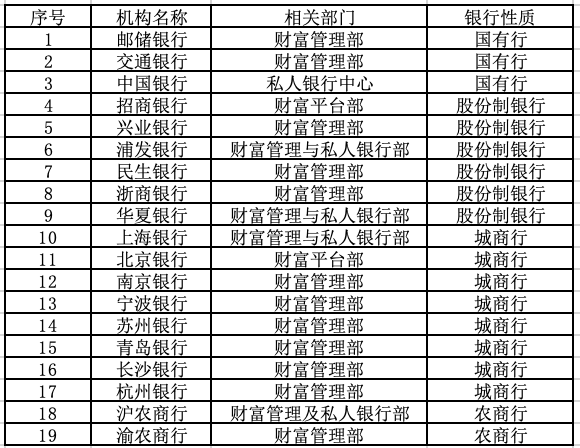
Core Insights - The rapid expansion of high-net-worth client groups is prompting domestic listed banks to accelerate the establishment of dedicated wealth management departments, shifting their retail banking strategy from "product sales" to "full lifecycle asset allocation" [1][2] - By the end of 2025, 19 listed banks are expected to have established or adjusted their wealth management-related departments, including 3 state-owned banks, 6 joint-stock banks, 8 city commercial banks, and 2 rural commercial banks [2][3] Group 1: Wealth Management Department Establishment - State-owned banks like Postal Savings Bank, Bank of China, and Bank of Communications are completing wealth management business integration at the head office level by 2025 [1][4] - Joint-stock banks and city commercial banks are adopting a model that integrates wealth management with private banking, with several banks like Shanghai Bank and Hangzhou Bank establishing new wealth management departments [5][6] Group 2: Strategic Shifts and Market Positioning - The establishment of wealth management departments reflects a strategic shift towards enhancing professional capabilities and resource integration, aiming to upgrade wealth management as a core strategy for banks [7][8] - Compared to state-owned banks, joint-stock banks and city commercial banks focus on precise market positioning, with banks like China Merchants Bank prioritizing wealth management as a core capability [7][8] Group 3: Growth and Performance Metrics - As of Q3 2025, the wealth management AUM of listed banks continues to expand, with Postal Savings Bank reaching 17.89 trillion yuan and significant growth rates reported by other banks [9] - The future of wealth management business is expected to accelerate due to the continuous accumulation of resident wealth and the diversification of high-net-worth client needs, with strategic investments and organizational adjustments being crucial for competitive positioning [9]

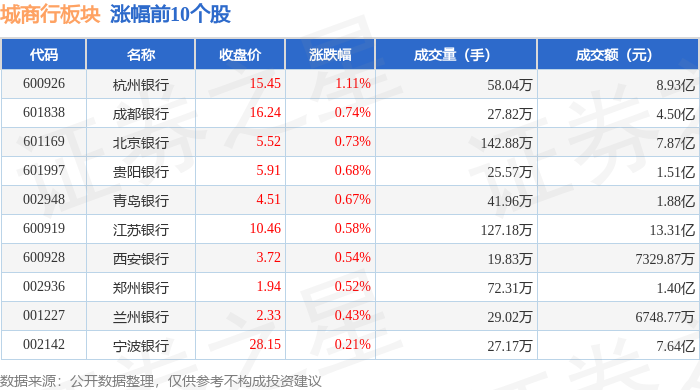
城商行板块1月5日涨0.26%,杭州银行领涨,主力资金净流入3.8亿元
Zheng Xing Xing Ye Ri Bao· 2026-01-05 09:09
Market Overview - The city commercial bank sector increased by 0.26% on January 5, with Hangzhou Bank leading the gains [1] - The Shanghai Composite Index closed at 4023.42, up by 1.38%, while the Shenzhen Component Index closed at 13828.63, up by 2.24% [1] Individual Bank Performance - Hangzhou Bank (600926) closed at 15.45, with a rise of 1.11% and a trading volume of 580,400 shares, amounting to a transaction value of 893 million yuan [1] - Chengdu Bank (601838) closed at 16.24, up by 0.74%, with a trading volume of 278,200 shares and a transaction value of 450 million yuan [1] - Beijing Bank (601169) closed at 5.52, increasing by 0.73%, with a trading volume of 1,428,800 shares and a transaction value of 787 million yuan [1] - Guizhou Bank (601997) closed at 5.91, up by 0.68%, with a trading volume of 255,700 shares and a transaction value of 151 million yuan [1] - Qindao Bank (002948) closed at 4.51, increasing by 0.67%, with a trading volume of 419,600 shares and a transaction value of 188 million yuan [1] - Jiangsu Bank (616009) closed at 10.46, up by 0.58%, with a trading volume of 1,271,800 shares and a transaction value of 1.331 billion yuan [1] - Xian Bank (600928) closed at 3.72, increasing by 0.54%, with a trading volume of 198,300 shares and a transaction value of 73.3 million yuan [1] - Zhengzhou Bank (002936) closed at 1.94, up by 0.52%, with a trading volume of 723,100 shares and a transaction value of 140 million yuan [1] - Lanzhou Bank (001227) closed at 2.33, increasing by 0.43%, with a trading volume of 290,200 shares and a transaction value of 67.5 million yuan [1] - Ningbo Bank (002142) closed at 28.15, up by 0.21%, with a trading volume of 271,700 shares and a transaction value of 764 million yuan [1] Capital Flow Analysis - The city commercial bank sector saw a net inflow of 380 million yuan from main funds, while retail funds experienced a net outflow of 134 million yuan [2] - The main funds' net inflow and outflow for individual banks include: - Jiangsu Bank (600919) had a net inflow of 10.4 million yuan, with a 7.78% share of main funds [3] - Shanghai Bank (601229) had a net inflow of 87.04 million yuan, with a 13.64% share of main funds [3] - Hangzhou Bank (600926) had a net inflow of 79.04 million yuan, with an 8.86% share of main funds [3] - Nanjing Bank (600000) had a net inflow of 67.86 million yuan, with a 9.68% share of main funds [3] - Ningbo Bank (002142) had a net inflow of 58.14 million yuan, with a 7.61% share of main funds [3] - Qilu Bank (601665) had a net inflow of 57.72 million yuan, with a 14.60% share of main funds [3] - Qingdao Bank (002948) had a net inflow of 22.18 million yuan, with an 11.82% share of main funds [3] - Suzhou Bank (002966) had a net inflow of 6.29 million yuan, with a 2.71% share of main funds [3] - Xiamen Bank (601187) had a net inflow of 520,450 yuan, with a 5.25% share of main funds [3] - Xian Bank (600928) had a net inflow of 287,550 yuan, with a 3.92% share of main funds [3]


密集落地!6家银行,敲定首席合规官!
券商中国· 2026-01-05 04:43
Core Viewpoint - The establishment of Chief Compliance Officer (CCO) positions in Chinese banks has intensified in 2025, driven by regulatory requirements aimed at enhancing compliance management within financial institutions [2][4]. Group 1: Regulatory Background - In March 2025, the Financial Regulatory Administration implemented the "Compliance Management Measures for Financial Institutions," mandating that financial institutions appoint a CCO at their headquarters, who must be a senior management member [2][4]. - The year 2025 serves as a critical transitional period for compliance management, with many banks already appointing CCOs and obtaining regulatory approval for their qualifications [8]. Group 2: Appointment Trends - Several banks, including Jiangyin Bank, Ping An Bank, and Minsheng Bank, have recently appointed CCOs, with many of these positions filled by existing senior executives such as presidents or vice presidents [4][5][6]. - The trend shows that many banks are opting for current executives to take on the CCO role, which may help mitigate internal communication costs associated with having too many specialized positions [4][7]. Group 3: Compliance Management Practices - The unique nature of financial institutions necessitates a higher standard of compliance management compared to general enterprises, emphasizing the need for a robust compliance culture [4]. - The "Compliance Management Measures" also allow for the CCO to concurrently hold other executive roles, which is particularly beneficial for smaller banks [4][8]. Group 4: Recruitment Initiatives - Some regional banks, such as Jiangxi Bank and Shangrao Bank, have actively sought to recruit CCOs, indicating a proactive approach to compliance management [9]. - Recruitment criteria for these positions often prioritize candidates with judicial experience or previous roles in compliance departments of major banks [9].

前瞻预测:2026年,谁将会成为上市银行的十大牛股?
Sou Hu Cai Jing· 2026-01-05 04:16
Core Viewpoint - The A-share banking sector concluded 2025 with a structural rise, with 35 out of 42 listed banks experiencing gains, and the banking index rising by 12.04%, indicating strong defensive and allocation value [2][3]. Group 1: 2025 Banking Sector Performance - The banking sector exhibited significant structural differentiation, with the top ten stocks including Agricultural Bank (52.66%), Xiamen Bank (35.78%), and others showing gains over 20% [3][4]. - The market's focus shifted towards "certainty of returns" and "growth cost-effectiveness" amid an "asset shortage" backdrop, leading to a preference for certain banks [3][4]. Group 2: Core Drivers of 2025 Bull Stocks - Three main factors drove the performance of bull stocks: high dividends and low valuations supporting state-owned banks, regional economic vitality empowering small and medium banks, and asset structure optimization promoting value reassessment [4][5]. - Agricultural Bank led with a dividend yield above 5% and a price-to-book ratio exceeding 1, breaking the long-standing trend of state-owned banks trading below book value [4][5]. Group 3: 2026 Bull Stock Predictions - The banking sector is expected to maintain a "steady progress" operational trend in 2026, with key dimensions for identifying bull stocks including net interest margin improvement, business transformation growth, and stable asset quality [5][6]. - The predicted top ten bull stocks for 2026 include Agricultural Bank, China Merchants Bank, and Ningbo Bank, among others, with each having specific growth drivers [7][8]. Group 4: Key Factors for 2026 Predictions - Agricultural Bank is expected to continue its strong performance due to its county-level business advantages and low liability costs [7]. - China Merchants Bank is anticipated to see dual growth in performance and valuation, driven by its wealth management transformation and strong asset quality [8]. - Ningbo Bank is positioned to benefit from regional economic vitality and diversified non-interest income growth [8][9]. Group 5: Structural Trends and Risks - The banking sector is likely to experience a dual rise in performance and valuation, supported by improved net interest margins and robust asset quality [12][13]. - However, structural differentiation risks may intensify, with some smaller banks facing challenges due to high regional economic dependency and single customer structures [12][13].


分红“蔚然成风”,深市上市公司2025年分红超5000亿
Sou Hu Cai Jing· 2026-01-05 03:17
Core Insights - In 2025, Shenzhen Stock Exchange listed companies distributed a total cash dividend of 547.56 billion yuan, maintaining a level above 500 billion yuan [2] - The trend of mid-term dividends is emerging, with 533 companies implementing mid-term dividends totaling 132.93 billion yuan, a year-on-year increase of 25.98% [2][5] Group 1: Policy and Governance - Policy guidance, improved profitability, and enhanced governance are key factors driving the increase in dividends among Shenzhen listed companies in 2025 [3] - The new "National Nine Articles" strengthens cash dividend regulation and incentivizes high-quality dividend-paying companies [3] - The China Securities Regulatory Commission (CSRC) has issued guidelines to encourage cash dividends and support companies in establishing stable dividend policies [3][4] Group 2: Financial Performance - The overall profitability of Shenzhen companies has steadily improved, with total operating revenue reaching 15.72 trillion yuan in the first three quarters of 2025, a year-on-year growth of 4.31% [3] - Net profit attributable to shareholders reached 903.02 billion yuan, up 9.69% year-on-year, with 2,169 companies reporting profits, accounting for 75.34% of the total [3] Group 3: Dividend Structure and Trends - The dividend scale and rhythm have shown positive changes, with a total cash dividend of 547.56 billion yuan in 2025, contributing to a cumulative dividend of over 2 trillion yuan during the "14th Five-Year Plan" period [5] - Nearly 60% of companies that implemented mid-term dividends had a payout ratio exceeding 20%, with 105 companies exceeding 50% [5] - In 2025, 166 companies had a dividend yield exceeding 1%, and 108 companies had a yield exceeding 1.34%, attracting more long-term investments [5] Group 4: Sector Highlights - Leading companies in the consumer and financial sectors are actively fulfilling their dividend responsibilities, with notable distributions such as Wuliangye's mid-term dividend of 10.78 yuan per share totaling 10.01 billion yuan [6] - In the advanced manufacturing sector, companies like CITIC Special Steel and Weichai Power also announced significant mid-term dividends [7] - The trend of stable dividends is expected to enhance shareholder recognition and market acceptance, supporting the high-quality development of the capital market [7]

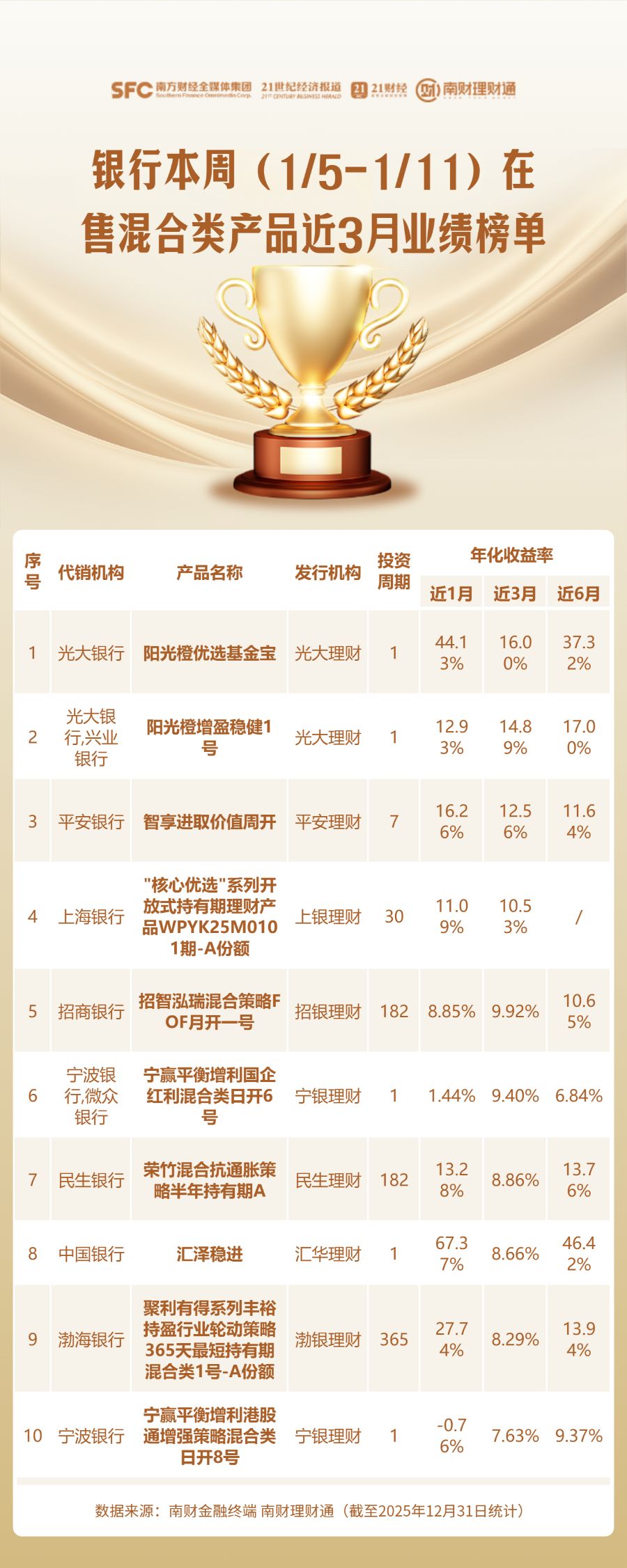
混合类理财收益表现分化!股份行代销产品收益居前
2 1 Shi Ji Jing Ji Bao Dao· 2026-01-05 01:26
Core Insights - The report focuses on mixed-asset products issued by wealth management companies, highlighting superior-performing products available for investors through distribution channels [1] - A ranking of products is provided based on their annualized performance over the past month, three months, and six months, with a specific emphasis on the three-month annualized yield to reflect their performance amid recent market fluctuations [1] Group 1: Product Performance - The ranking includes products from 28 distribution institutions, such as major banks like Industrial and Commercial Bank of China, Bank of China, Agricultural Bank of China, and others [1] - The report emphasizes that the assessment of products being "on sale" is based on their investment cycle, but actual availability may vary due to factors like sold-out quotas or differences in product listings for different clients [1] Group 2: Recommendations and Limitations - Investors are advised to refer to the actual listings displayed on the distribution bank's app for accurate product availability [1] - The report aims for objectivity but does not guarantee the authenticity, completeness, or accuracy of the ranking information, which is intended for reference only [1]