成都银行

Search documents
A股上市银行上半年人均薪酬揭晓,五家银行月薪超4.5万元
Guan Cha Zhe Wang· 2025-09-03 07:48
【文/羽扇观金工作室】 具体而言,招商银行以人均月薪5.05万元位居榜首,南京银行紧随其后,为4.82万元。宁波银行、兴业 银行和北京银行人均月薪也均超过4.5万元,分别为4.54万元、4.54万元和4.52万元。此外,中信银行、 浙商银行、江苏银行、上海银行、成都银行和平安银行上半年人均月薪也均在4万元以上。 国有六大行方面,中国银行以2.82万元的人均月薪位列第一,交通银行为2.75万元,工商银行和建设银 行分别为2.63万元和2.62万元,农业银行和邮储银行则分别为2.52万元和2.49万元。 值得关注的是,农业银行和工商银行等大型国有银行在年报中明确提出,将优化薪酬结构并向基层员工 倾斜。农业银行强调加强对县域基层员工的薪酬激励,工商银行也表示将"加强薪酬资源向基层员工倾 斜",以增强一线网点的经营活力与服务韧性。 本文系观察者网独家稿件,未经授权,不得转载。 随着A股上市银行2025年半年报全部披露完毕,42家银行、约260万员工的薪酬水平也随之浮出水面。 整体来看,今年上半年银行业的薪酬总额同比略有上升,人均半年薪酬较去年同期增长约1300元,平均 月薪达3.02万元,较上年同期月薪水平上涨约21 ...
年内9家银行股东宣布增持
21世纪经济报道· 2025-09-03 07:32
Core Viewpoint - The article highlights a trend of bank shareholders and executives increasing their stakes in their respective banks, indicating confidence in the long-term value and growth potential of these institutions [1][3][6]. Group 1: Shareholder Actions - Qingdao Bank announced that its shareholder Guoxin Chanquan Holdings plans to increase its stake to between 19.00% and 19.99%, with a minimum of 233 million shares and a maximum of 291 million shares to be acquired within six months [1]. - Nanjing Bank's major shareholder, Nanjing Gaoke, increased its stake from 8.94% to 9.00% by acquiring 7.5077 million shares, reflecting confidence in the bank's future [3]. - Shanghai Bank reported that ten executives purchased a total of 440,000 shares at prices ranging from 10.46 to 10.70 yuan per share, committing to lock these shares for two years [5]. Group 2: Broader Market Trends - A total of nine banks have disclosed shareholder or executive buyback plans this year, indicating a broader trend in the banking sector [2]. - Other banks, including Jiangsu Bank and Suzhou Bank, have also reported significant share buybacks, with Jiangsu Bank's buyback amounting to 21.648 million shares valued at approximately 24.2782 million yuan [6]. - The article notes that many buyback plans are announced when bank stock valuations are at historical lows, suggesting a strategic move to signal confidence in long-term value [6]. Group 3: Adjustments to Buyback Plans - Chengdu Bank adjusted its buyback plan due to its stock price exceeding the original upper limit, proposing a new range of 700 million to 1.4 billion yuan without a price cap [7]. - Huaxia Bank announced a plan for executives to voluntarily increase their holdings by at least 30 million yuan, although the implementation has been delayed due to market conditions [9]. Group 4: Market Outlook - Analysts suggest that the banking sector is showing signs of recovery, with improved profitability and stable asset quality, indicating potential for upward earnings growth [9]. - The article emphasizes that the current environment presents a significant opportunity for long-term investment in bank stocks, given their defensive attributes and relatively high dividend yields [6][9].



股东拟增持青岛银行2.33亿股 年内已有9家银行发布增持报告
2 1 Shi Ji Jing Ji Bao Dao· 2025-09-03 05:39
Group 1 - Qingdao Bank announced that its shareholder Guoxin Chanquan Holdings plans to increase its stake through secondary market transactions, aiming for a total holding of 19.00% to 19.99% after the increase, with a minimum of 233 million shares and a maximum of 291 million shares to be acquired within six months [1] - Nanjing Bank's major shareholder, Nanjing Gaoke, increased its stake by 7.51 million shares, raising its holding from 8.94% to 9.00%, reflecting confidence in the bank's future development [2] - Shanghai Bank reported that ten directors and senior management purchased a total of 440,000 shares, with a total investment estimated between 4.60 million to 4.70 million yuan, indicating strong internal confidence in the bank's value [3] Group 2 - Suzhou Bank's major shareholder, Guofazhong Group, completed its share increase plan, acquiring 118 million shares for a total investment of 856 million yuan, based on confidence in the bank's long-term value [4] - Chengdu Bank adjusted its share increase plan due to rising stock prices, with a new plan to invest between 700 million to 1.4 billion yuan without a price cap, reflecting ongoing confidence in the bank's future [5] - Huaxia Bank announced a plan for its directors and senior management to voluntarily increase their holdings by at least 30 million yuan, demonstrating confidence in the bank's long-term investment value [6] Group 3 - The trend of share increases among banks is concentrated when valuations are at historical lows, indicating a strong internal belief in long-term value [4] - Analysts noted that the banking sector's profitability is stabilizing, with expectations for continued growth in earnings, suggesting a favorable investment environment for bank stocks [6]


A股银行股普跌,宁波银行、青农商行跌超2%
Ge Long Hui A P P· 2025-09-03 03:49
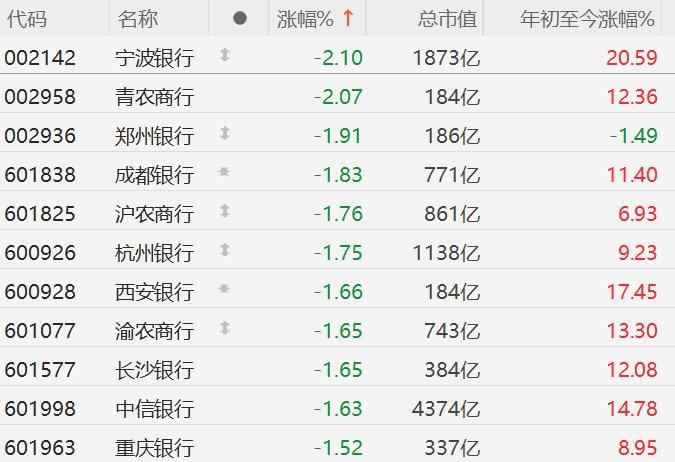
Group 1 - The A-share market experienced a widespread decline in bank stocks, with several banks falling over 2% and others dropping more than 1% [1][2] - Notable declines included Ningbo Bank and Qingnong Commercial Bank, which fell by 2.10% and 2.07% respectively, while Zhengzhou Bank and Chengdu Bank also saw significant decreases [2] - The total market capitalization of Ningbo Bank is 187.3 billion, and Qingnong Commercial Bank stands at 18.4 billion, indicating their substantial presence in the market despite recent declines [2] Group 2 - Year-to-date performance shows that Ningbo Bank has increased by 20.59%, while Qingnong Commercial Bank has risen by 12.36%, suggesting a strong performance prior to the recent downturn [2] - Other banks such as Hu'nong Commercial Bank and Hangzhou Bank have also shown positive year-to-date growth, with increases of 6.93% and 9.23% respectively [2] - The overall trend indicates a challenging environment for bank stocks in the A-share market, with multiple institutions facing downward pressure [1][2]





库克、俞敏洪等纷纷打卡,我也来一探究竟→
Jin Rong Shi Bao· 2025-09-02 12:41
Group 1 - The "Night Tour of Jinjiang" has become a new landmark for nighttime tourism in Chengdu, featuring a 20-kilometer waterway and 10 major docks that connect various commercial, cultural, and tourism activities [1] - The project has attracted significant attention, with over 1.5 million viewers participating in a live-streamed tour led by prominent figures, showcasing its popularity and cultural significance [1] - Since its launch, the project has received approximately 2.9 million visitors and generated revenue of about 24.88 million yuan, indicating strong consumer interest and engagement [1] Group 2 - The Tiexiang Temple Water Street in Chengdu has emerged as another new landmark for cultural tourism, designed as a social and artistic space that integrates traditional architectural styles with local cultural elements [2] - The water street has attracted 92 well-known brands across various sectors, contributing to a diverse consumer landscape and enhancing local leisure consumption [2] - Financial institutions in Sichuan are actively promoting consumption through innovative initiatives, such as offering discounts and incentives, which have significantly boosted consumer spending [2]
红利低波ETF(512890)成交额4.84亿同类夺冠 规模超205亿!中长期资金净流入26亿显配置价值
Xin Lang Ji Jin· 2025-09-02 09:23
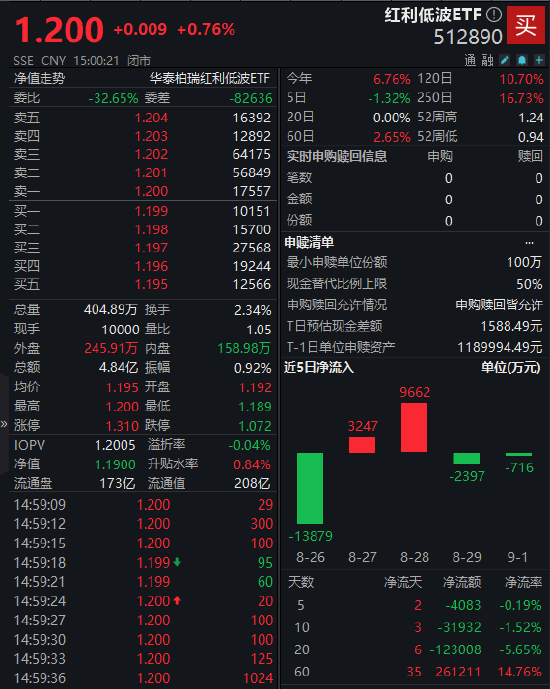
Core Viewpoint - The Hongli Low Volatility ETF (512890) has shown a positive performance with a closing price of 1.200 CNY, reflecting a 0.76% increase, and it leads its category in terms of trading volume and net inflow over the long term [1][8]. Fund Performance - As of September 1, 2025, the ETF's circulating scale reached 20.597 billion CNY, indicating strong investor interest [1]. - The ETF experienced net outflows of 40.83 million CNY, 319 million CNY, and 1.23 billion CNY over the last 5, 10, and 20 days, respectively, but still achieved a net inflow of 2.612 billion CNY over the last 60 trading days [1][8]. Holdings Composition - The top ten holdings of the ETF are primarily concentrated in the banking sector, including Chengdu Bank, Industrial Bank, and CITIC Bank, reflecting a strategy focused on high dividends and low volatility [3][4]. - The banking sector's assets dominate the portfolio, with significant contributions from infrastructure-related stocks like Sichuan Road and Bridge and Daqin Railway [3]. Banking Sector Performance - In the first half of 2025, listed banks saw a positive shift in non-interest income contributing to net profits, with notable performances from institutions like China Merchants Bank and CITIC Bank in wealth management and investment returns [5]. - The improvement in bank performance is attributed to loan growth driving interest income and effective cost management on the liability side, supported by regulatory measures from the central bank [5][6]. Investment Strategy - High dividend strategies are gaining traction, with bank stocks becoming a preferred choice for long-term funds such as insurance and pension funds, particularly regional banks showing strong profit growth [6][8]. - The Hongli Low Volatility ETF has achieved a cumulative return of 138.00% since its inception in December 2018, outperforming its benchmark and ranking 63rd among 502 similar products [8].
周报 | 权益理财破净率创今年新低,固收理财近一周收益企稳
2 1 Shi Ji Jing Ji Bao Dao· 2025-09-02 09:09
Market Overview - The bond market experienced fluctuations with an overall balanced and loose funding environment, as indicated by a DR007 weighted average of 1.516% and a 10-year government bond yield of 1.84% [2] - The stock market focused on technology, with the ChiNext Index, STAR 50 Index, and Shenzhen Component Index showing weekly gains of 7.74%, 7.49%, and 4.36% respectively, led by the communication, non-ferrous metals, and electronics sectors [2] Product Performance - The number of underperforming wealth management products remains low, with 25,659 public wealth management products in existence as of August 31, 2025, and a comprehensive underperformance rate of 1.22% [3] - The underperformance rates for equity and mixed wealth management products have significantly decreased to 25% and 3.92% respectively, while fixed income products have an underperformance rate of 1.05% [3] - Fixed income products with 1-2 year and over 3-year terms have slightly higher underperformance rates of 2.13% and 2.22%, while products with a term of less than one month have a very low underperformance rate of 0.02% [3] New Product Issuance - A total of 448 wealth management products were issued by 32 companies from August 25 to August 29, with the highest issuance from joint-stock banks, including 41 from Xinyin Wealth Management, 39 from Huaxia Wealth Management, and 33 from Ping An Wealth Management [4] - New products primarily consist of R2 (medium-low risk), closed-end net value type, and fixed income public products, with only 11 mixed products (2.4% of total) and 2 equity products launched [4] - Pricing trends show a decline in most product terms, with 1-3 month products dropping to 2.55%, while 3-year and longer products saw a significant rebound to 2.38% [4] Product Strategy - In response to improved market sentiment and rising indices, wealth management companies are increasing the issuance of mixed products, such as the "Zhaoying Ruihe (Diverse Selection) Day Open 14-Month Holding 1" product, which has a substantial fundraising scale of 867 million yuan [5] - This product employs a strategy that includes 60%-80% in bonds and 20%-40% in equities, with a performance benchmark based on various indices and a 14-month investment period [5] Yield Performance - Fixed income wealth management products saw an average net value growth rate of 0.072% over the past week, while mixed and equity products had higher growth rates of 0.3216% and 2.0102% respectively [6] - The highest net value growth rate among fixed income products was for those with a 2-3 year term at 0.1321%, while products with a term of less than one month had the lowest growth rate of 0.0573% [6] Cash Management Products - The average annualized yield for cash public wealth management products in RMB, USD, and AUD was 1.335%, 3.901%, and 2.71% respectively [7] - The proportion of negative yield products decreased, with 8.89% of RMB public wealth management products reporting negative returns over the past week [7] - Among fixed income products, 15.2% of those with a 1-2 year term reported negative returns, with a significant portion being closed-end products [7] Industry Trends - The personal pension wealth management sector is expanding, with the release of the ninth batch of personal pension wealth management products, bringing the total to 37 products from 6 companies [8] - Three banks in Sichuan are planning to jointly establish a wealth management company, indicating a trend of collaboration within the industry [9] - Among 23 wealth management companies that disclosed their mid-year performance, a total net profit of 15.286 billion yuan was reported, with 14 companies achieving positive growth [10] - Eight companies saw net profit growth exceeding 10%, and four companies reported growth rates above 20% [10]
金工定期报告20250902:预期高股息组合跟踪
Soochow Securities· 2025-09-02 09:04
Quantitative Models and Construction Methods - **Model Name**: Expected High Dividend Portfolio **Model Construction Idea**: The model aims to construct a portfolio with high expected dividend yield by leveraging historical dividend data, fundamental indicators, and short-term factors like reversal and profitability[5][10][16] **Model Construction Process**: 1. **Dividend Yield Calculation**: - Phase 1: Calculate dividend yield based on annual report profit distribution announcements - Phase 2: Predict and calculate dividend yield using historical dividend data and fundamental indicators[5][10] 2. **Screening Process**: - Exclude suspended and limit-up stocks from the CSI 300 constituents[15] - Remove the top 20% of stocks with the highest short-term momentum (21-day cumulative return)[15] - Exclude stocks with declining profitability (quarterly net profit YoY growth < 0)[15] 3. **Final Selection**: - Rank the remaining stocks by expected dividend yield - Select the top 30 stocks with the highest expected dividend yield and construct an equally weighted portfolio[11] **Model Evaluation**: The model demonstrates strong historical performance with significant excess returns and controlled drawdowns, making it a robust strategy for high-dividend stock selection[13] Model Backtesting Results - **Expected High Dividend Portfolio**: - Cumulative Return: 358.90% - Cumulative Excess Return (vs CSI 300 Total Return Index): 107.44% - Annualized Excess Return: 8.87% - Maximum Rolling 1-Year Drawdown of Excess Return: 12.26% - Monthly Excess Win Rate: 60.19%[13] Quantitative Factors and Construction Methods - **Factor Name**: Expected Dividend Yield Factor **Factor Construction Idea**: Predict future dividend yield by combining historical dividend data, fundamental indicators, and short-term influencing factors[5][16] **Factor Construction Process**: 1. Calculate historical dividend yield based on profit distribution announcements[5][10] 2. Predict future dividend yield using fundamental indicators and historical dividend patterns[5][10] 3. Incorporate two short-term factors: - **Reversal Factor**: Accounts for short-term price reversals - **Profitability Factor**: Reflects the company's earnings performance[5][16] **Factor Evaluation**: The factor effectively identifies high-dividend stocks and serves as a reliable input for portfolio construction[16] - **Factor Name**: Red Dividend Timing Framework (Composite Signal) **Factor Construction Idea**: Combines multiple single-factor signals to assess the market's outlook on dividend stocks[25][28] **Factor Construction Process**: 1. Evaluate five single-factor signals: - **Inflation**: PPI YoY (High/Low) - **Liquidity**: M2 YoY (High/Low) - **M1-M2 Gap**: Scissors Difference (High/Low) - **Interest Rate**: US 10-Year Treasury Yield (High/Low) - **Market Sentiment**: Dividend Stock Turnover Ratio (Up/Down)[28] 2. Assign binary signals (1 for bullish, 0 for bearish) to each factor 3. Aggregate the signals into a composite indicator[28] **Factor Evaluation**: The framework provides a systematic approach to timing dividend stock investments, though the September 2025 signal suggests a cautious stance[25][28] Factor Backtesting Results - **Expected Dividend Yield Factor**: - August 2025 Portfolio Average Return: 5.69% - Excess Return (vs CSI 300 Index): -4.80% - Excess Return (vs CSI Dividend Index): +4.70%[5][16] - **Red Dividend Timing Framework (Composite Signal)**: - Latest Signal (September 2025): 0 (Neutral)[25][28]





城商行的二十年:展望“十五五”,谁是未来大赢家?
NORTHEAST SECURITIES· 2025-09-02 09:02
Investment Rating - The report rates the industry as "Outperforming the Market" [4] Core Insights - The report emphasizes that the evolution of local government financing behavior and regulatory adjustments over the past two decades have significantly influenced the financial sector. It predicts that the proportion of bank credit in local government debt will increase from 38% to 42% during the "14th Five-Year Plan" period, with an annual growth rate fluctuating between 10% and 17% [1][18][19] - City commercial banks (CCBs) have played a crucial role in supporting local government debt resolution, with their credit growth in government-related loans outpacing that of other banks. The report identifies a complementary relationship between CCBs' government-related loan growth and the issuance of urban investment bonds [1][2] - The report forecasts that CCBs will take on greater responsibilities in the future, driven by increasing state ownership, leadership changes reflecting regulatory attributes, and strong local government relationships. This will enhance local market competitiveness and provide growth opportunities for CCBs [2][18] Summary by Sections 1. Changes in Local Government Financing Structure - The report outlines the historical evolution of local government debt and financing needs, highlighting the significant role of regulatory and policy adjustments in shaping the financial sector [14][18] - It provides a detailed analysis of local government debt structure changes from 2008 to 2025, noting the shift from bank loans to urban investment bonds and shadow banking during various phases [19][24] 2. CCBs' Role in Debt Resolution - CCBs have shown proactive engagement in local government debt resolution, with their government-related loan growth significantly higher than that of other banks. The report indicates that CCBs have effectively supplied funds during periods of heightened repayment pressure [1][2][19] 3. Future Prospects for CCBs - The report identifies several CCBs, including Chongqing Bank, Xiamen Bank, and Shanghai Bank, as potential winners during the "14th Five-Year Plan" period, expecting them to achieve faster expansion and higher returns for investors [2][3] - It predicts that the overall valuation of CCBs will have substantial room for improvement, estimating a price-to-book (PB) ratio of 0.7x by the end of 2026 and 1.22x by the end of 2030 [2][3] 4. Investment Recommendations - The report recommends focusing on specific CCBs such as Chongqing Bank, Xiamen Bank, Shanghai Bank, Qilu Bank, and Chengdu Bank for potential investment opportunities [3][6]
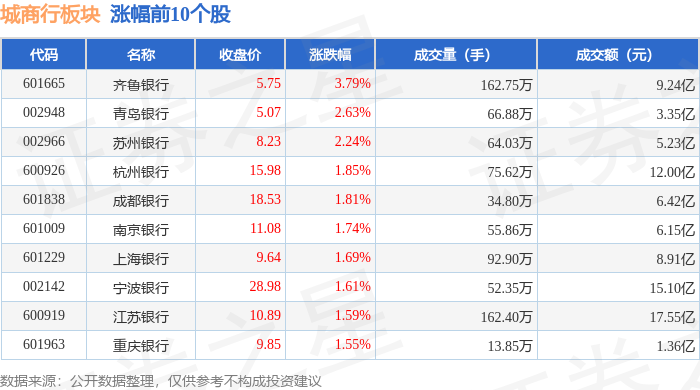
城商行板块9月2日涨1.65%,齐鲁银行领涨,主力资金净流入3.41亿元
Zheng Xing Xing Ye Ri Bao· 2025-09-02 08:59
Group 1 - The city commercial bank sector increased by 1.65% on September 2, with Qilu Bank leading the gains [1] - The Shanghai Composite Index closed at 3858.13, down 0.45%, while the Shenzhen Component Index closed at 12553.84, down 2.14% [1] - Qilu Bank's closing price was 5.75, reflecting a 3.79% increase, with a trading volume of 1.6275 million shares and a transaction value of 924 million [1] Group 2 - The city commercial bank sector saw a net inflow of 341 million from main funds, while retail funds experienced a net outflow of 138 million [2] - Jiangsu Bank had a net inflow of 140 million from main funds, but a net outflow of 90.16 million from speculative funds [3] - The overall trading activity in the city commercial bank sector indicates a mixed sentiment among different types of investors, with main funds showing positive interest while retail and speculative funds withdrew [2][3]