
方正证券

Search documents
今年以来新增超400人,券商分析师数量创历史新高
Zheng Quan Shi Bao· 2025-09-22 00:48
Core Insights - The number of securities analysts in China has reached a historical high, surpassing 6,000, with significant growth observed in recent years [2][3] - Despite the increase in analysts, the market environment is challenging, with a decline in commission income due to public fund fee reforms, necessitating a transformation in brokerage research departments [8] Analyst Growth - As of September 19, 2023, there are 6,162 analysts, with over 400 new additions this year [3] - The analyst count has shown rapid expansion, crossing 3,000 in 2018 and 4,000 in 2022, with projections indicating over 5,000 by 2024 [3] - The growth is attributed to the expansion of institutional investors and a significant talent gap in brokerage research, leading to large-scale recruitment, especially from recent graduates [3][5] Structural Changes in Recruitment - Large brokerages primarily focus on internal growth, while smaller firms are combining internal development with external recruitment [5] - Among firms with over 150 analysts, notable growth is seen in companies like CITIC Securities and Industrial Securities, with a majority of new analysts being internally trained [5][6] - Smaller firms like Guojin Securities and Dongfang Fortune Securities have also seen significant external recruitment, with many analysts transferring from other brokerages [6][7] Revenue Challenges and Strategic Shifts - The brokerage research environment is under pressure, with commission income dropping over 30% in the first half of 2023, highlighting the need for diversification in revenue sources [8] - Brokerages are exploring new profit growth points, including collaborations with local governments and expanding international and fintech operations [8] - Some firms are shifting towards comprehensive research models, balancing external revenue generation with internal services [8] Trends in Analyst Employment - The pace of recruitment among top brokerages has slowed, with firms like CICC and CITIC Securities showing minimal growth in analyst numbers this year compared to previous years [9] - A trend of experienced analysts moving to buy-side institutions or other sectors is emerging, indicating a rebalancing of talent within the industry [9]




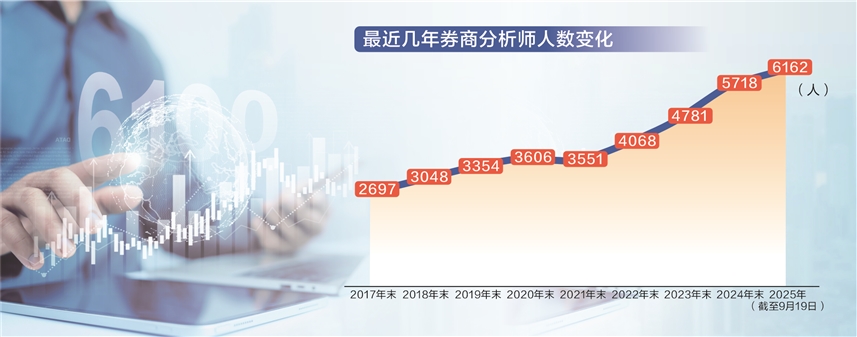
突破6000人!券商分析师,创历史新高
Zheng Quan Shi Bao· 2025-09-22 00:03
Core Insights - The number of securities analysts in China has reached a historical high of 6,162, marking a significant increase in the past two years [1][2] - The expansion of analyst numbers is driven by the rapid growth of institutional investors and the need for talent in the securities industry, particularly before the implementation of the public fund fee reform [2][4] - Despite the increase in analyst numbers, the revenue from commission income has declined by over 30% in the first half of 2025, prompting a need for transformation and diversification of income sources within brokerage research departments [1][7] Analyst Growth - As of September 19, 2023, the number of analysts has surpassed 6,000, with a notable increase from 3,000 in 2018 to over 5,000 in less than two years [2] - Major firms like CICC lead with 344 analysts, followed by Guotai Junan and CITIC Securities, both exceeding 300 analysts [2][3] - The growth structure shows that large firms primarily rely on internal talent development, while smaller firms are increasingly hiring externally to fill gaps [4][5] Revenue Challenges - The brokerage research departments are facing significant revenue challenges due to the impact of public fund fee reforms, with commission income dropping to 4.458 billion yuan in the first half of 2025 [7] - Firms are exploring new profit growth points, including expanding non-public client resources and enhancing international business and fintech initiatives [7] Recruitment Trends - The pace of recruitment among top brokerage firms has slowed, with CICC experiencing a decrease in analyst numbers this year [8] - Some analysts are transitioning to buy-side roles or other industries, indicating a shift in career paths within the sector [8]
突破6000人!券商分析师,创历史新高!
券商中国· 2025-09-21 23:36
Core Insights - The number of securities analysts in China has surpassed 6,000, reaching a historical high of 6,162 as of September 19, 2023, indicating rapid expansion in the analyst workforce [2][4][10] - The growth in analyst numbers is driven by the increasing demand from institutional investors and the need for talent in the face of regulatory changes affecting commission income [4][10] - Despite the increase in analyst numbers, the industry is facing significant revenue challenges due to a more than 30% decline in commission income from the public fund sector [2][10] Analyst Growth - The analyst workforce has seen a rapid increase, with the number surpassing 3,000 in 2018 and crossing 4,000 in 2022, now exceeding 6,000 in less than two years [4] - Major firms like CITIC Securities and CICC lead in analyst numbers, with CICC having 344 analysts and CITIC Securities surpassing 300 [4][5] - The growth is characterized by a mix of internal promotions and external hiring, particularly among smaller firms seeking to enhance their research capabilities [6][8] Structural Changes in Hiring - Large firms primarily rely on internal growth for expanding their analyst teams, while smaller firms are increasingly hiring externally to fill gaps [6][8] - For instance, CITIC Securities registered 62 new analysts this year, with 59 being internal promotions, while smaller firms like Guojin Securities have seen significant external hiring [6][8] Industry Challenges and Transformation - The research environment is changing, with a notable decline in income from commission-based models, prompting firms to seek new revenue streams [10] - Firms are focusing on diversifying their income sources, including expanding into non-public fund clients and exploring international business opportunities [10] - Some leading firms have slowed their hiring pace, with CICC reporting a decrease in analyst numbers this year, indicating a potential shift in strategy [11]

券商分析师数量已突破6000大关 创历史新高
Zheng Quan Shi Bao· 2025-09-21 23:13
Core Insights - The number of securities analysts in China has reached a historical high, surpassing 6,000, indicating significant growth in the industry [1][2] - Despite the increase in analysts, the market is contracting, with commission income from public funds dropping over 30% in the first half of the year, necessitating a transformation in brokerage research departments [1][7] Analyst Growth - As of September 19, 2023, there are 6,162 analysts, with over 400 new additions this year [1] - The analyst count has shown rapid expansion, crossing 3,000 in 2018 and 4,000 in 2022, with projections indicating over 5,000 by 2024 [1] - The growth is attributed to a talent gap due to the rapid expansion of institutional investors and aggressive recruitment by smaller firms [2] Structural Changes in Recruitment - Large brokerages primarily rely on internal growth, while smaller firms combine internal development with external recruitment [4] - Among firms with over 150 analysts, notable growth is seen in companies like CITIC Securities and Industrial Securities, with a majority of new analysts being internally trained [4] - Smaller firms like Guojin Securities and Dongfang Fortune Securities have significantly increased their analyst counts through external recruitment [5][6] Revenue Challenges and Strategic Shifts - The revenue environment for brokerage research departments is changing, with a reported 30% decline in commission income [7] - Major firms are exploring new profit growth points, including collaborations with local governments and expanding international business [7] - Some firms are shifting towards comprehensive research models, balancing various revenue sources and client types [7] Slowdown in Hiring at Major Firms - The pace of hiring at leading brokerages has noticeably slowed, with firms like CICC and CITIC Securities reporting minimal increases in analyst numbers this year compared to previous years [8] - There is a trend of experienced analysts moving to other sectors, including buy-side institutions and educational roles, reflecting a rebalancing in the talent market after rapid growth [8]
机构研究周报:恒生科技利率敏感性高,美联储年内或再降息两次
Wind万得· 2025-09-21 22:36
Core Insights - The article highlights the increasing preference for Hong Kong's technology sector, particularly the Hang Seng Tech Index, due to its high sensitivity to interest rates and the anticipated further rate cuts by the Federal Reserve [1][3]. Group 1: Monetary Policy and Market Impact - The Federal Reserve has lowered the federal funds rate by 25 basis points to a range of 4.00%-4.25%, marking the first rate cut in nine months [3]. - The Fed's dot plot indicates a downward revision in the long-term federal funds rate expectations for 2025-2028, suggesting a more accommodative monetary policy environment [3]. - The anticipated weakening of the US dollar and the release of global liquidity may lead to a reallocation of funds towards Chinese capital markets, benefiting RMB assets [3]. Group 2: Equity Market Trends - Recent market performance shows a divergence between stock market strength and weak economic data, with a few tech stocks driving significant index gains [5]. - The market is expected to transition from extreme differentiation to a more balanced rotation, focusing on sectors with strong industrial trends such as internet, innovative pharmaceuticals, and new energy [6]. - The Hong Kong stock market has seen significant gains due to rate cut expectations and positive sentiment around the AI industry, with the Hang Seng Index reaching its highest level since 2021 [7]. Group 3: Industry Research - The AI sector is rapidly advancing, with domestic capabilities in AI hardware and models narrowing the gap with international standards, creating investment opportunities in related industries [9]. - The Chinese AI chip market is projected to reach nearly $50 billion, with increasing domestic demand for local chips as international supply becomes constrained [10]. - The Hang Seng Tech Index is particularly favored by foreign capital due to its offshore characteristics and relatively low valuations, making it a key area for investment during the current rate cut cycle [11]. Group 4: Macro and Fixed Income - Morgan Asset Management suggests a higher probability of two additional rate cuts by the Federal Reserve this year, which may enhance the appeal of long-duration government bonds [13]. - The ongoing dual expansion of fiscal and monetary policy is expected to continue, with a focus on sectors like digital economy and green transition [14]. - The macroeconomic environment is likely to remain accommodative, with expectations of increased monetary policy easing, which could provide better entry points for domestic bond markets [15].

券商分析师数量创历史新高规模扩容遭遇市场“降温”冲击
Zheng Quan Shi Bao· 2025-09-21 18:03
Core Insights - The number of securities analysts in China has reached a historical high, surpassing 6,162, with over 400 new analysts added this year [1][2] - Despite the growth in analyst numbers, the market for brokerage firms is contracting, with commission income from public funds dropping over 30% in the first half of the year [1][7] - The industry is facing pressure to diversify revenue sources and seek new business growth points due to declining commission income [7][8] Analyst Growth - The rapid increase in analysts is attributed to the expansion of institutional investors and a significant talent gap in brokerage research departments [2][4] - As of September 19, three brokerage firms have more than 300 analysts, with China International Capital Corporation (CICC) leading at 344 analysts [2][3] - The growth structure varies, with large firms focusing on internal development while smaller firms are increasingly hiring externally [4][5] Revenue Challenges - The decline in commission income is evident, with major firms like CICC and Guotai Junan experiencing drops of 53.70% and 41.94% respectively in the first half of 2025 [7][8] - Brokerage firms are exploring new profit growth areas, including partnerships with local governments and expanding international business [7][8] Talent Movement - The pace of hiring at leading brokerage firms has slowed, with CICC reporting a decrease in analyst numbers this year [8] - Experienced analysts are transitioning to other sectors, including buy-side institutions and educational roles, indicating a talent rebalancing trend in the industry [8]
券商分析师数量创历史新高 规模扩容遭遇市场“降温”冲击
Zheng Quan Shi Bao· 2025-09-21 17:41
Core Insights - The number of securities analysts in China has reached a historical high, surpassing 6,000, indicating significant growth in the industry [1][2] - Despite the increase in analyst numbers, the market is contracting, with commission income from public funds dropping over 30% in the first half of the year, necessitating a transformation in brokerage research departments [1][6] Analyst Growth - As of September 19, 2023, there are 6,162 analysts, with over 400 new additions this year [2] - The analyst count has rapidly expanded in the last two years, with significant growth attributed to the increasing demand from institutional investors and the recruitment of fresh graduates [2][3] - Major firms like CICC, Guotai Junan, and CITIC Securities lead in analyst numbers, with CICC having 344 analysts [2][3] Recruitment Structure - Large brokerages primarily focus on internal growth, while smaller firms often recruit externally to fill talent gaps [3][4] - Notable recruitment includes analysts moving from other firms, such as the transfer of a chief strategist from CITIC Securities to Dongfang Caifu [4][5] - Smaller firms like Guojin Securities have seen significant external recruitment, with over 30 analysts coming from other brokerages [3][4] Industry Transformation - The brokerage research environment is changing due to the impact of public fund fee reforms, leading to a decline in income [6][7] - In the first half of 2025, commission income fell to 4.458 billion yuan, with major firms experiencing significant drops in revenue [6] - Brokerages are exploring new revenue streams, including partnerships with local governments and expanding international business [6][7] Analyst Retention and Movement - The pace of recruitment among top brokerages has slowed, with some firms like CICC seeing a decrease in total analysts this year [6][7] - Experienced analysts are transitioning to other sectors, including buy-side institutions and educational roles, reflecting a talent rebalancing trend in the industry [7]
调研丨两融新开户数超去年!三大维度解析交易活跃度
Zheng Quan Shi Bao Wang· 2025-09-21 06:29
Core Insights - The number of new margin trading accounts has exceeded last year's figures as of August, indicating a strong interest in the market from both new and existing investors [1][2] - The total margin trading balance reached 2.4 trillion yuan, accounting for 2.54% of the A-share market capitalization, with trading volume also showing significant activity [6][7] Group 1: New Account Openings - As of August, the number of new margin trading accounts has increased compared to the same period last year, with both new and existing clients contributing funds [1][2] - Major brokerage firms reported substantial growth in new margin trading accounts, with some firms like Guotai Junan and CITIC Securities seeing increases of 61% in new clients [2][3] Group 2: Investor Profitability - Over half of individual investors in the A-share market have achieved profitability this year, with some brokerage firms reporting up to 70% of their clients in profit [4] - Increased investor engagement is noted, with a 30% rise in inquiries and consultations since August [4] Group 3: Trading Activity and Volume - The margin trading balance has reached historical highs, surpassing levels seen in 2015, with a notable increase in trading activity [6][7] - As of September 18, the margin trading transaction volume accounted for 11.8% of the total A-share trading volume, reflecting a growing trend in margin trading participation [6][7]
调研|两融新开户数超去年!三大维度解析交易活跃度
券商中国· 2025-09-21 05:16
Core Viewpoint - The article highlights a significant increase in new margin trading accounts in the A-share market, indicating a growing interest from both new and existing investors, with a notable influx of funds from existing clients [1][4]. Group 1: New Account Openings - As of the end of August, the number of new margin trading accounts has surpassed that of the same period last year, with both new and existing investors contributing funds [1][4]. - By September 18, the number of individual margin trading investors reached 7.67 million, while institutional investors numbered 50,059, with 1.81 million investors holding margin debt [2][11]. - Several brokerage firms reported substantial growth in new margin trading accounts, with Guojin Securities reporting a 3.59% increase in credit account openings to 10.92 million by the end of June [4][5]. Group 2: Margin Trading Activity - The margin trading balance reached 2.4 trillion yuan, accounting for 2.54% of the A-share market's circulating market value as of September 18 [2][12]. - On the same day, the margin trading transaction volume was 373.54 billion yuan, representing 11.8% of the total A-share trading volume [2][12]. - The proportion of margin trading transactions has been steadily increasing, rising from around 8% to approximately 12% of total A-share transactions, although it has not yet reached the peak levels seen in 2015 [12]. Group 3: Investor Profitability - As of the end of August, over half of individual investors in the A-share market have achieved profitability this year, with some brokerage firms reporting that up to 70% of their clients are profitable [9]. - Increased investor engagement is noted, with a 30% rise in inquiries and consultations at brokerage firms since August [9].

方正证券:年末多为行情出现转折的重要时点 涨幅靠前行业反转概率较大
智通财经网· 2025-09-20 12:20
Group 1 - The core viewpoint is that year-end often marks a significant turning point in market trends, driven by performance evaluations and the potential for "valuation switching" as next year's earnings expectations come into focus [1] - Investors with strong performance may take profits at high levels, while underperformers seek low-priced stocks with potential for recovery, creating a motivation for portfolio adjustments [1] - Historical data from 2010 to 2024 indicates that industries with strong performance in the first three quarters tend to reverse in the fourth quarter, with 73.3% of the time showing a median ranking in the lower half for the fourth quarter [1] Group 2 - The likelihood of reversal for previously high-performing industries at year-end is significant, while the probability of weaker sectors recovering is not as pronounced [2]
