华能国际

Search documents
疏解非首都功能 首批两家央企总部正式迁驻雄安新区
Yang Shi Xin Wen· 2025-10-09 04:17
Core Points - China Huaneng Group and Sinochem Holdings officially relocated to Xiong'an New Area, marking a significant milestone in their development and a key progress in the relocation of non-capital functions from Beijing [1][3] - Over 1,000 employees from China Huaneng and nearly 1,000 employees from Sinochem have begun regular work and life in Xiong'an New Area [3] Group 1 - The relocation of these two central enterprises will drive the aggregation of related upstream and downstream companies to Xiong'an, promoting the optimization and upgrading of the industrial structure in the area [3] - The large-scale settlement of central enterprise employees will bring talent and technology resources to Xiong'an, enhancing urban functions and vitality [3] Group 2 - Xiong'an New Area is committed to supporting the relocation of non-capital functions from Beijing, providing comprehensive support and guarantees for the development of central enterprises [3] - The successful relocation and normalization of operations for China Huaneng and Sinochem demonstrate the effective service and support capabilities of the New Area, accumulating valuable experience for the future relocation of more central enterprises [3]



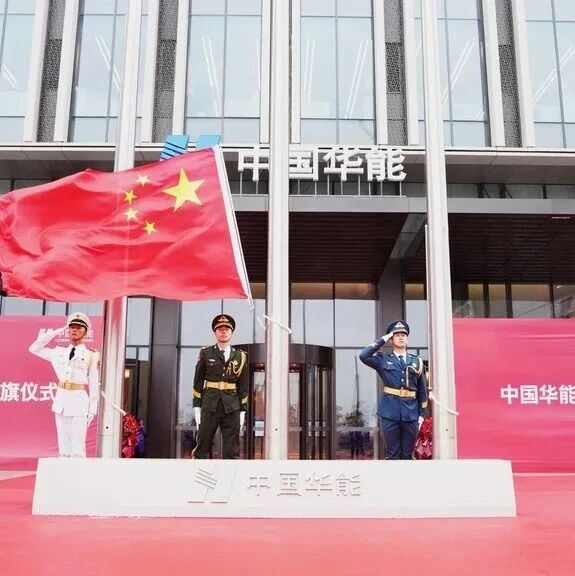
中国华能、中国中化!迁驻雄安
券商中国· 2025-10-09 03:43
Core Viewpoint - The relocation of China Huaneng Group and China Sinochem Holdings to Xiong'an New Area marks a significant step in the central enterprises' efforts to support the development of the region and implement national strategies [1][3]. Group 1: Relocation and Operational Status - China Huaneng and China Sinochem have officially moved to Xiong'an New Area, with over 1,000 employees from China Huaneng and nearly 1,000 from China Sinochem now operating in a normalized work environment [1][2]. - The successful transition of these enterprises demonstrates the Xiong'an New Area's effective support and coordination in facilitating the relocation of central enterprises [2]. Group 2: Strategic Importance and Future Plans - China Huaneng aims to leverage its industrial advantages to contribute to the high-level technological self-reliance and the construction of a modern industrial system in Xiong'an [2]. - China Sinochem views its relocation as a historical opportunity to integrate into national strategies and plans to utilize its strengths in technology innovation and green transformation to support the development of Xiong'an [3]. Group 3: Impact on Xiong'an New Area - The establishment of these central enterprises in Xiong'an is expected to attract related upstream and downstream industries, enhancing the region's industrial structure and promoting high-quality development [4]. - The influx of employees from these enterprises will bring valuable talent and technology resources to Xiong'an, improving urban functions and vitality [4].

中国华能、中国中化正式迁驻雄安新区
中国能源报· 2025-10-09 02:50
Core Viewpoint - The relocation of China Huaneng Group and China Sinochem Holdings to Xiong'an New Area marks a significant step in the central enterprises' efforts to alleviate non-capital functions from Beijing, contributing to the development of the new area [1][4]. Group 1: Company Overview - China Huaneng is a state-owned enterprise with a registered capital of 20 billion RMB, focusing on power development, investment, construction, and management, as well as related industries such as finance, coal, transportation, new energy, and environmental protection [3]. - The headquarters of China Huaneng covers an area of approximately 111,100 square meters, featuring a 26-story tower with a height of 130 meters, and includes offices, meeting rooms, and service facilities [3]. - China Sinochem, formed from the merger of China Sinochem Group and China National Chemical Corporation, is a major state-owned enterprise with 220,000 employees, operating in eight sectors including life sciences, materials science, petrochemicals, and urban operations [3]. Group 2: Development in Xiong'an New Area - The Xiong'an New Area is currently undergoing large-scale construction and is in the process of accommodating the non-capital functions of Beijing [4]. - In addition to China Huaneng and China Sinochem, China Satellite Network Group has also moved into the Xiong'an headquarters building, while China Mineral Resources Group's headquarters project is under construction and has entered the finishing stage [4].
电力 电改深化,电价体系的复盘与展望
2025-10-09 02:00
Summary of Key Points from the Conference Call on China's Electricity Market Reform Industry Overview - The conference call focuses on the **electricity industry** in China, specifically discussing the ongoing reforms in the electricity market and their implications for various energy sources and companies involved in the sector [1][4][8]. Core Insights and Arguments - **Market Reform Progress**: Significant advancements have been made in the market-oriented reform of the electricity sector, with thermal power pricing fully entering the market and nuclear power pricing reaching 50% market participation. By 2025, all new energy projects are expected to enter the market [1][4]. - **Electricity Pricing Mechanism**: The reform aims to reflect the true value of each segment in the electricity supply chain, including energy value, green value, transmission and distribution costs, and system operation fees. This is intended to guide high-quality industry development and optimize resource allocation [1][6][7]. - **Future Directions**: The future of electricity reform is expected to focus on ensuring reasonable returns for each segment through a scientifically sound pricing mechanism, promoting the development of a new, efficient, and clean energy system [1][6][14]. - **Investment Opportunities**: The electricity sector presents diverse investment opportunities, particularly in companies with quality wind and solar resources, coal power companies benefiting from declining coal prices, and competitive hydro and nuclear power firms [3][20][21]. Important but Overlooked Content - **Challenges in Reform**: The reform process faces challenges, including rising overall system costs due to the shift towards cleaner energy and the need to balance supply and demand effectively. The current pricing mechanism has not fully adapted to these changes [2][5][14]. - **Historical Context**: The electricity reform in China began in 2002, with significant milestones in 2015 that emphasized market competition in generation and sales while maintaining state control over transmission and distribution [8][9]. - **Regulatory Changes**: Recent policies have aimed to enhance competition in the coal-fired power market, allowing prices to fluctuate based on supply and demand, which is crucial for achieving a more efficient and fair resource allocation [9][10][11]. - **Regional Market Development**: The development of regional and national electricity trading markets is progressing, with the southern region already implementing spot market operations, which will influence overall pricing and system efficiency [17][18]. Conclusion - The ongoing reforms in China's electricity market are set to reshape the industry landscape, creating new investment opportunities while addressing existing challenges. The focus on market-driven pricing and the integration of various energy sources will be critical for the sector's future growth and stability [1][3][20][21].



能源早新闻丨大渡河梯级电站+1,首投成功!
中国能源报· 2025-10-08 22:33
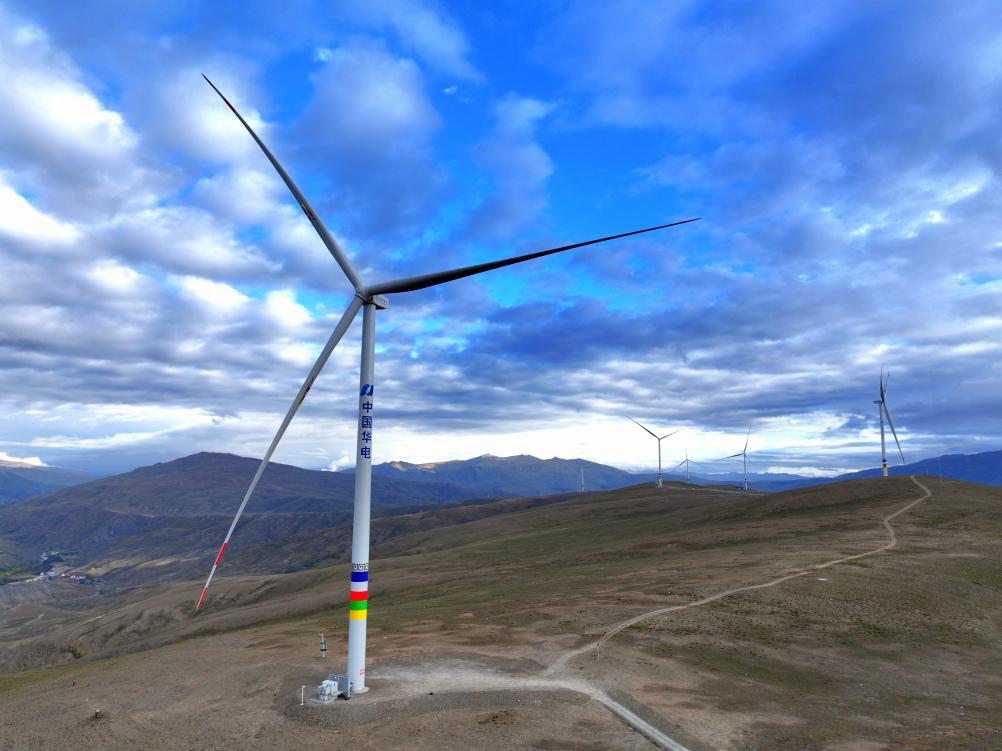
News Focus - The National Development and Reform Commission and the National Energy Administration issued the "Energy Planning Management Measures," which serve as important guidelines for national and regional energy development, major project layout, public resource allocation, and policy formulation [2] Domestic News - The BEST project in Anhui has achieved a key breakthrough with the successful development and installation of the Dewar base, marking a new phase in the construction of the compact fusion energy experimental device [2] - The world's first "dual-tower one machine" solar thermal energy storage power station has entered full system trial operation, providing a new technical path for stable power supply from large-scale wind and solar energy bases in China [2] - China's charging infrastructure has seen significant development, with rapid advancements in charging technology and a gradually完善的标准体系 [3] - The Daqin Railway has commenced its autumn maintenance work, which will last for 20 days, involving the replacement of 107.438 kilometers of rails and 15,700 sleepers, among other maintenance tasks [3] - The Guangxi Qinzhou pumped storage power station has completed the main channel construction, expected to be operational by 2029, capable of absorbing 2.16 billion kilowatt-hours of clean energy annually, reducing CO2 emissions by 1.6 million tons [3] - The operational scale of pumped storage power stations in the Guangdong-Hong Kong-Macao Greater Bay Area has surpassed 10 million kilowatts following the commissioning of the second unit at Meizhou pumped storage power station [4] - The Tianwan Nuclear Power Base has surpassed 500 billion kilowatt-hours of safe power generation, equivalent to saving 150 million tons of standard coal and reducing CO2 emissions by approximately 400 million tons [4] - Chinese researchers have solved the interface contact issue in all-solid-state lithium metal batteries, providing key technical support for practical applications [4] International News - Japan has officially started the dismantling of the reactor at the Hamaoka Nuclear Power Station Unit 1, marking the second commercial nuclear reactor in Japan to enter the actual dismantling phase [5] - Major oil-producing countries have announced plans to maintain production increases in November, with an average daily increase of 137,000 barrels of crude oil [5] - ExxonMobil announced a global layoff of approximately 2,000 positions as part of its long-term restructuring plan [5] Corporate News - The Shaping First Hydropower Station has successfully completed its first unit's trial operation and is now officially generating power, with a total installed capacity of 360,000 kilowatts [6] - Huaneng has successfully installed the first wind turbine at its wind power project in Tibet, with a total investment of 527 million yuan and an installed capacity of 80 megawatts [6]
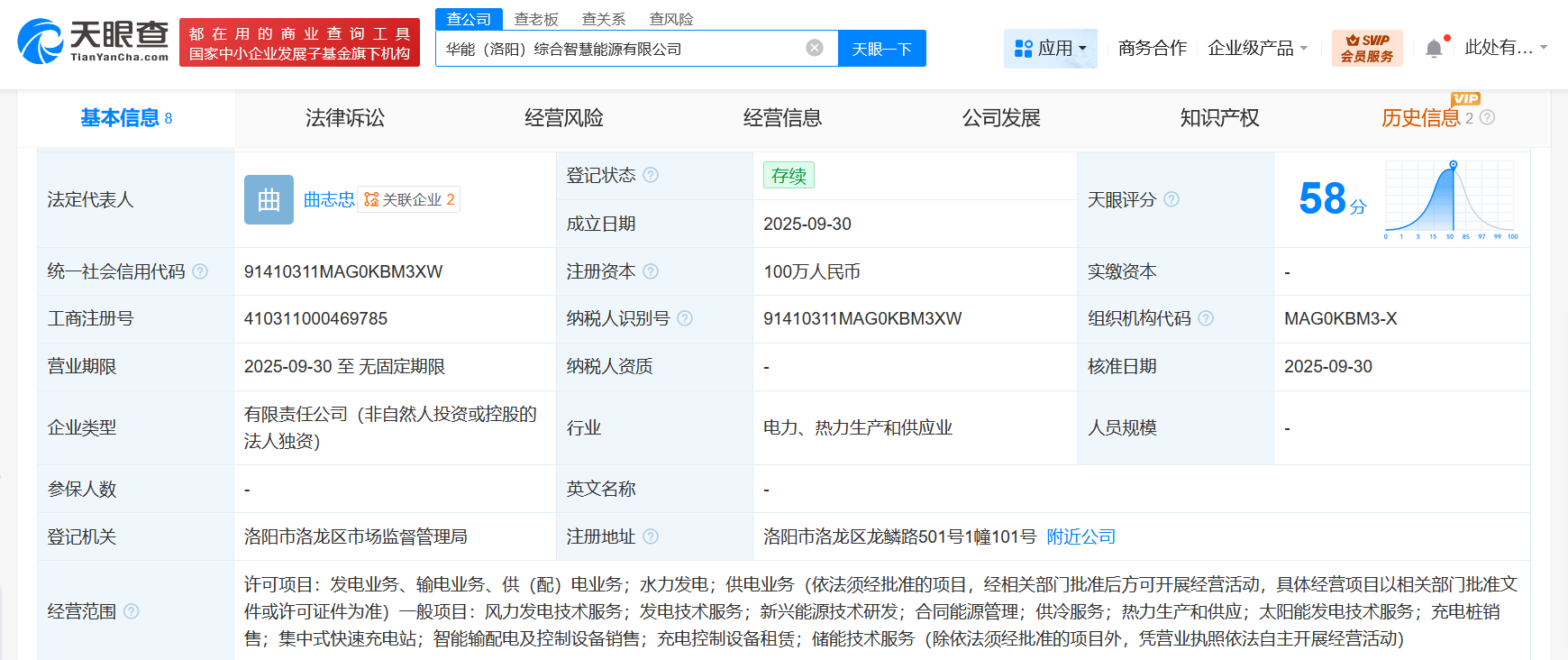
华能国际在洛阳成立综合智慧能源公司
2 1 Shi Ji Jing Ji Bao Dao· 2025-10-08 03:47
Core Viewpoint - Huaneng (Luoyang) Comprehensive Smart Energy Co., Ltd. has been established with a registered capital of 1 million RMB, focusing on various energy-related services including power generation and transmission [1] Group 1: Company Information - The legal representative of the company is Qu Zhizhong [1] - The company is wholly owned by Huaneng International (600011) [1] - The registered address is located at Longlin Road, Luolong District, Luoyang City [2] Group 2: Business Scope - The business scope includes power generation, transmission, distribution, hydropower generation, wind power technology services, and emerging energy technology research and development [1] - The company is classified under the electricity and heat production and supply industry [2] Group 3: Registration Details - The company was registered on September 30, 2025, and has an indefinite business term [2] - The unified social credit code is 91410311MAG0KBM3XW [2]
能源局推进,14家央企加入,“AI+光伏”大有可为!
Sou Hu Cai Jing· 2025-10-08 03:26
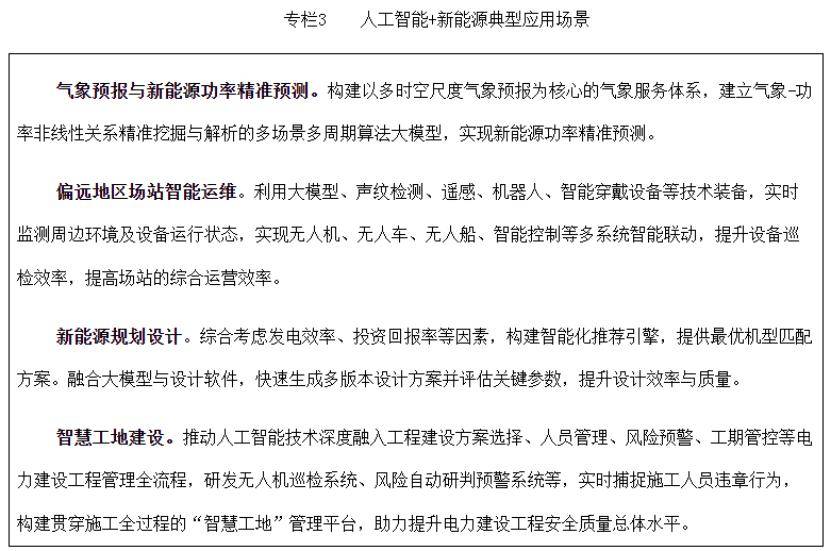
Core Insights - The Chinese government is promoting the integration of artificial intelligence (AI) with renewable energy to enhance the quality of energy development, focusing on applications like power prediction and smart operations [1][2]. Group 1: Government Initiatives - The National Development and Reform Commission and the National Energy Administration issued guidelines to advance "AI + Energy" applications, emphasizing the need for high-precision power forecasting and smart operations in renewable energy [1]. - The government aims to support the stable supply of renewable energy through an integrated model combining weather forecasting, power prediction, smart trading, and intelligent operations [1]. Group 2: Corporate Adoption of AI - Major state-owned energy companies, including State Grid, China Southern Power Grid, and China Energy Group, have begun integrating the DeepSeek AI model into their operations [2][3]. - China Huaneng and China Datang have localized the DeepSeek model to enhance their AI capabilities in various business applications, including financial systems and operational management [3][4][9]. Group 3: Specific Implementations - Longyuan Power has deployed the DeepSeek-R1 model on its digital platform, enabling efficient AI services for its subsidiaries and enhancing decision-making in renewable energy operations [5][6]. - China Huaneng launched the "Smart Little Energy" AI assistant and integrated it with its mobile portal, marking a significant step in its AI application efforts [9]. - China Huadian's "Huadian Ruisi" digital platform has integrated DeepSeek to improve intelligent Q&A and document analysis capabilities [12]. Group 4: Technological Advancements - The DeepSeek-R1 model features multi-modal processing and dynamic attention mechanisms, allowing it to efficiently integrate various data types for enhanced operational support [5]. - China Energy Construction has completed the full integration of DeepSeek models, significantly boosting its digital transformation efforts [17]. Group 5: Future Directions - Longyuan Power plans to deepen the integration of its digital platform with the DeepSeek model across six key business areas, aiming for a comprehensive AI development platform [6]. - China National Nuclear Corporation is set to enhance its AI capabilities by integrating DeepSeek with its existing models, focusing on sustainable development and intelligent upgrades [19][20].


决胜“十四五” 打好收官战|绿电照高原——西藏奋力推进国家清洁能源基地建设
Xin Hua Wang· 2025-10-07 07:58
Core Insights - Tibet has successfully initiated its first cross-regional green electricity transaction with Shanghai, delivering 7.85 million kilowatt-hours, which is expected to reduce coal consumption by 24,100 tons and cut CO2 emissions by 60,100 tons [1] - The development of renewable energy in Tibet has accelerated, with a target for renewable energy capacity to exceed 50% by the end of 2024, establishing a clean energy system dominated by renewables [1] Renewable Energy Development - Since the 14th Five-Year Plan, Tibet has focused on developing hydropower, solar, and wind energy, effectively alleviating electricity shortages during winter and spring [1] - The Batong Hydropower Station, with a total capacity of 750,000 kilowatts, has an average annual generation of 3.375 billion kilowatt-hours, sufficient to power 1.75 million households for a year [2] - The largest solar-storage power station in Tibet, Huaneng Jiawa Phase I, has a capacity of 250,000 kilowatts and a storage system that can output 200,000 kilowatt-hours for 4 hours at night [2] Wind Power Projects - The Huadian Qusong Duosui Wind Power Project has a total capacity of 40 megawatts and is expected to reduce CO2 emissions by approximately 74,400 tons annually [3] - The Aizhu 100-megawatt wind power project, located at an average altitude of 5,050 meters, aims to meet the electricity needs of about 230,000 people annually [3] Grid Infrastructure and Reliability - The completion of the Ali interconnected project in December 2020 has improved the reliability of electricity supply in Tibet to 99.6% [4] - The 500 kV transmission and transformation project in Lhasa, set to be operational by December 2024, will enhance the high-voltage grid structure [5] - The Qinghai-Tibet DC Phase II expansion has doubled the transmission capacity between Qinghai and Tibet to 1.2 million kilowatts, addressing winter electricity shortages [5] Electricity Consumption Growth - In the first seven months of 2025, Tibet's total electricity consumption reached 9.773 billion kilowatt-hours, marking a year-on-year increase of 13.33%, the highest growth rate in the country [5]
2025年1-8月中国发电量产量为64193.3亿千瓦时 累计增长1.5%
Chan Ye Xin Xi Wang· 2025-10-07 02:06
上市企业:华能国际(600011),大唐发电(601991),国电电力(600795),华电国际(600027),长江电 力(600900),国投电力(600886),川投能源(600674),桂冠电力(600236),内蒙华电(600863),浙 能电力(600023) 相关报告:智研咨询发布的《2026-2032年中国海上风力发电行业市场调研分析及发展规模预测报告》 根据国家统计局数据显示:2025年8月中国发电量产量为9363亿千瓦时,同比增长1.6%;2025年1-8月中 国发电量累计产量为64193.3亿千瓦时,累计增长1.5%。 2020-2025年1-8月中国发电量产量统计图 数据来源:国家统计局,智研咨询整理 知前沿,问智研。智研咨询是中国一流产业咨询机构,十数年持续深耕产业研究领域,提供深度产业研 究报告、商业计划书、可行性研究报告及定制服务等一站式产业咨询服务。专业的角度、品质化的服 务、敏锐的市场洞察力,专注于提供完善的产业解决方案,为您的投资决策赋能。 ...

绿电照高原——西藏奋力推进国家清洁能源基地建设
Xin Hua Wang· 2025-10-04 21:30
Core Insights - Tibet has successfully initiated its first cross-regional green electricity transaction with Shanghai, delivering 7.85 million kilowatt-hours of electricity, which is expected to reduce coal consumption by 24,100 tons and cut carbon dioxide emissions by 60,100 tons [1] - The region is rapidly advancing its clean energy base construction, focusing on hydropower, solar, and wind energy, with a target for renewable energy to account for over 50% of installed capacity by the end of 2024 [1][6] - The completion of significant projects like the Batong Hydropower Station and the largest solar-storage power station in Tibet marks a substantial step in enhancing energy supply and reliability [2][5] Renewable Energy Development - The Batong Hydropower Station has a total installed capacity of 750,000 kilowatts and an average annual generation of 3.375 billion kilowatt-hours, sufficient to power 1.75 million households for a year [2] - The Huaneng Jiawa Phase I solar-storage power station has an installed capacity of 250,000 kilowatts and a storage system capable of storing excess energy for nighttime use [2] - The Huadian Quxiong Wind Power Project, with a total capacity of 40 megawatts, is expected to reduce carbon emissions by approximately 74,400 tons annually [5] Grid Infrastructure and Connectivity - The construction of the unified power grid in Tibet has achieved a reliability rate of 99.6%, significantly improving electricity supply across the region [8] - The Qinghai-Tibet DC Phase II expansion has doubled the transmission capacity between Qinghai and Tibet to 1.2 million kilowatts, addressing winter electricity shortages [9] - The completion of multiple "electricity highways" has enhanced the connectivity of Tibet's power grid, facilitating increased electricity consumption and economic growth [9] Economic Impact - In the first seven months of 2025, Tibet's total electricity consumption reached 9.773 billion kilowatt-hours, reflecting a year-on-year growth of 13.33%, the highest growth rate in the country [9] - The average per capita electricity consumption in Tibet is projected to reach 4,404.8 kilowatt-hours by 2024, a 162.89% increase since 2012 [8]