传音控股

Search documents
传音控股股价跌5.09%,摩根士丹利基金旗下1只基金重仓,持有15.85万股浮亏损失70.68万元
Xin Lang Cai Jing· 2025-10-13 04:08
Core Viewpoint - Transsion Holdings has experienced a significant decline in stock price, dropping 5.09% on October 13, with a cumulative decrease of 15.05% over the past five days, indicating potential concerns regarding the company's market performance and investor sentiment [1] Company Overview - Transsion Holdings, established on August 21, 2013, and listed on September 30, 2019, is based in Shenzhen, Guangdong Province. The company focuses on the design, research and development, production, sales, and brand operation of smart terminals, primarily mobile phones [1] - The revenue composition of Transsion Holdings is as follows: smartphones account for 83.91%, other products for 10.22%, and feature phones for 5.86% [1] Fund Holdings - Morgan Stanley's fund has a significant position in Transsion Holdings, with the "Morgan Stanley Leading Advantage Mixed Fund" (233006) being the fourth largest holding. The fund reduced its holdings by 36,100 shares in the second quarter, now holding 158,500 shares, which represents 4.07% of the fund's net value [2] - The fund has incurred a floating loss of approximately 706,800 yuan today and a total floating loss of 2,461,100 yuan during the five-day decline [2] Fund Manager Performance - The fund manager Wang Weiming has been in position for 328 days, with a total fund size of 437 million yuan, achieving a best return of 14.42% and a worst return of 5.39% during his tenure [3] - Co-manager Miao Donghang has been managing the fund for 8 years and 264 days, with a total fund size of 1.338 billion yuan, achieving a best return of 84.32% and a worst return of -23.01% during his tenure [3]

半导体产业生态博览会开幕,科创信息技术ETF(588100)盘中涨超1%,成分股华虹公司涨13.54%
Sou Hu Cai Jing· 2025-10-13 03:47
Core Viewpoint - The semiconductor industry in China is poised for strategic advancements through high-profile events, enhancing international competitiveness and innovation efficiency [2]. Group 1: Market Performance - As of October 10, 2025, the STAR Market New Generation Information Technology Index has increased by 0.37%, with notable gains from companies like Huahong Semiconductor (up 13.54%) and Kingsoft Office [1]. - The STAR Information Technology ETF (588100) has risen by 0.20%, with a one-month cumulative increase of 10.86% as of October 10, 2025 [1]. - The STAR Information Technology ETF has seen a net value increase of 143.41% over the past three years, ranking 29th out of 1883 index equity funds [1]. Group 2: Industry Events - The 2025 Bay Area Semiconductor Industry Ecological Expo will gather key decision-makers from the global semiconductor industry to outline new development strategies [1]. - The concurrent International Third-Generation Semiconductor Innovation and Entrepreneurship Competition will focus on cutting-edge technologies in the third-generation semiconductor field [1]. Group 3: Investment Insights - Huaxi Securities suggests that such high-level industry events will provide strategic leverage for China's semiconductor industry amid global value chain restructuring [2]. - CITIC Securities indicates that the market remains focused on technology, particularly in the semiconductor sector, with a strong emphasis on upcoming technology releases and product iterations in the second half of the year [2]. - As of September 30, 2025, the top ten weighted stocks in the STAR Market New Generation Information Technology Index account for 57.93% of the index, with companies like Haiguang Information and SMIC leading the list [2].





近4个交易日净流入13.08亿元,科创板50ETF(588080)备受关注
Xin Lang Cai Jing· 2025-10-13 03:09
Group 1 - The Shanghai Stock Exchange Sci-Tech Innovation Board 50 Index (000688) has shown a slight increase of 0.16% as of October 13, 2025, with notable gains from stocks such as Kingsoft Office (688111) up 10.92% and Teru Technology (688278) up 7.61% [1] - The Sci-Tech Innovation Board 50 ETF (588080) has experienced a decrease of 0.27%, with the latest price at 1.49 yuan, while it has accumulated a rise of 0.33% over the past two weeks [1] - The trading volume for the Sci-Tech Innovation Board 50 ETF reached 1.42% turnover with a total transaction value of 1.077 billion yuan, and the average daily transaction value over the past week was 2.362 billion yuan, ranking it among the top two comparable funds [1] Group 2 - As of September 30, 2025, the top ten weighted stocks in the Sci-Tech Innovation Board 50 Index accounted for 58.07% of the index, including companies like SMIC (688981) and Cambricon Technologies (688256) [2] - The recent Nobel Prize in Physics was awarded for the discovery of observable quantum effects at a macroscopic scale, which lays a theoretical foundation for the development of superconducting quantum computing [2][3] - The Transmon-type superconducting qubit, based on Josephson junctions, has become a mainstream technology, with institutions like Google and the University of Science and Technology of China launching high-performance superconducting quantum chips, indicating rapid industry development [3] Group 3 - The Sci-Tech Innovation Board 50 ETF (588080) tracks the performance of 50 large-cap, liquid stocks on the Sci-Tech Innovation Board, reflecting the overall performance of representative tech enterprises [4]
谁将是下一个劈开海外万亿市场的中国黑马?
Hu Xiu· 2025-10-12 08:19
Core Insights - The narrative of Chinese companies going global has evolved significantly, moving from being silent manufacturers to active players in the global market [1][3][26] - In the first half of 2025, Chinese overseas mergers and acquisitions surged by 79% to $19.6 billion, while new contracts for foreign engineering projects increased by 12.4% to $129.9 billion, indicating a robust expansion of Chinese enterprises abroad [2] Historical Phases of Chinese Companies Going Global - **Phase 1: "Manufacturing Outbound" Era** This period is characterized by OEM/ODM models where Chinese companies lacked brand ownership and consumer engagement, relying solely on low-cost labor and large production capacity [5][6][7][8] - **Phase 2: "Brand Outbound" Awakening Era** Triggered by the global financial crisis, this phase saw Chinese companies realizing the importance of branding. They began to innovate and offer products that could compete with international brands, exemplified by companies like Huawei and Xiaomi [9][10][11][12][15] - **Phase 3: "Ecosystem Outbound" Era** The current phase focuses on creating comprehensive systems and models rather than just selling products. Companies are now looking to establish brand matrices and cultural connections, as seen with brands like Anker and Pop Mart [16][19][20][21][29] Emerging Strategies - **Category "Exploders"** These companies aim to create standout products in specific niches and replicate their success across various verticals, leveraging technology and consumer insights [17][19] - **Cultural "Alchemists"** This strategy involves modernizing and globalizing Chinese cultural elements to resonate with international audiences, creating a new aesthetic that appeals to global youth [20] - **Ecosystem "Creators"** Companies are now exporting operational efficiencies and business models developed in China to global markets, focusing on platforms and infrastructure rather than direct consumer sales [21] - **"Gold Diggers" in Emerging Markets** With increasing competition in mature markets, many Chinese firms are targeting emerging markets like Southeast Asia and Africa, leveraging their established business models and supply chain advantages [22][23][25] Conclusion - The evolution of Chinese companies from labor-intensive manufacturers to sophisticated global players reflects a significant shift in strategy and ambition. The next generation of successful companies will likely be those that can integrate into global ecosystems and redefine market standards [26][30][31]
消费电子板块10月10日跌4.26%,歌尔股份领跌,主力资金净流出112亿元
Zheng Xing Xing Ye Ri Bao· 2025-10-10 08:45
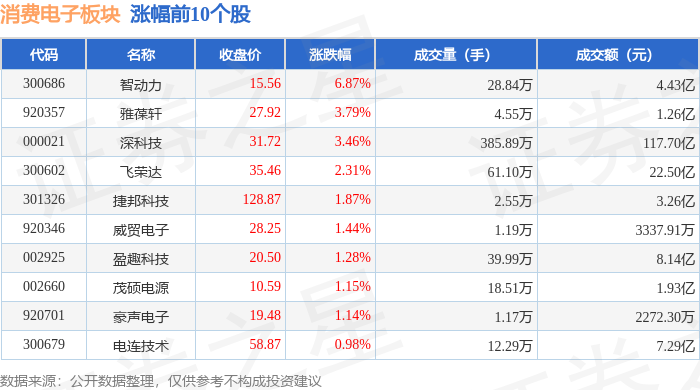
Core Viewpoint - The consumer electronics sector experienced a significant decline of 4.26% on October 10, with major stocks like GoerTek leading the drop, reflecting broader market trends as the Shanghai Composite Index fell by 0.94% and the Shenzhen Component Index decreased by 2.7% [1][3]. Market Performance - The consumer electronics sector saw a net outflow of 11.2 billion yuan from major funds, while retail investors contributed a net inflow of 8.05 billion yuan [3][4]. - Key stocks in the sector included: - GoerTek (002241) closed at 35.87 yuan, down 9.40% with a trading volume of 2.06 million shares [3]. - Longying Precision (300115) closed at 37.40 yuan, down 9.22% with a trading volume of 1.86 million shares [3]. - Luxshare Precision (002475) closed at 60.80 yuan, down 6.89% with a trading volume of 2.61 million shares [3]. Individual Stock Highlights - Notable gainers included: - Zhihui Technology (300686) with a closing price of 15.56 yuan, up 6.87% [1]. - Yabo Xuan (920357) closed at 27.92 yuan, up 3.79% [1]. - Conversely, significant losers included: - Huqin Technology (603296) down 8.76% [3]. - Lingyi Technology (002600) down 6.64% [3]. ETF Insights - The Consumer Electronics ETF (product code: 159732) tracks the Guozheng Consumer Electronics Theme Index, with a recent market performance showing a decrease of 56 million shares to a total of 3.77 billion shares, and a net inflow of 11.12 million yuan [6].




传音控股股价跌5.01%,鹏华基金旗下1只基金重仓,持有35.46万股浮亏损失166.68万元
Xin Lang Cai Jing· 2025-10-10 03:09
Group 1 - The core viewpoint of the news is that Transsion Holdings has experienced a significant decline in its stock price, dropping 5.01% on October 10, with a cumulative decline of 9.11% over four consecutive days [1] - As of the report, Transsion Holdings' stock price is at 89.10 yuan per share, with a trading volume of 9.55 billion yuan and a turnover rate of 0.93%, leading to a total market capitalization of 1016.05 billion yuan [1] - The company, founded on August 21, 2013, and listed on September 30, 2019, primarily focuses on the design, research and development, production, sales, and brand operation of smart terminals, with 83.91% of its revenue coming from smartphones [1] Group 2 - From the perspective of major fund holdings, Penghua Fund has a significant position in Transsion Holdings, with its Penghua Sci-Tech Innovation ETF holding 354,600 shares, accounting for 1.31% of the fund's net value, making it the ninth-largest holding [2] - The estimated floating loss for the fund due to the recent decline in Transsion Holdings' stock is approximately 166.68 million yuan today, with a total floating loss of 333.36 million yuan over the four-day decline [2] Group 3 - The Penghua Sci-Tech Innovation ETF was established on February 26, 2025, with a current size of 21.62 billion yuan and a cumulative return of 37.26% since inception [3] - The fund manager, Su Junjie, has been in position for 7 years and 255 days, overseeing a total fund asset size of 197.79 billion yuan, with the best and worst returns during his tenure being 87.57% and -21.6%, respectively [3]
8小时众筹百万美元 华强北商家观望智能戒指
Shen Zhen Shang Bao· 2025-10-09 23:10
Group 1 - Shenzhen JiuZhi Technology's RingConn Gen 2 raised over $4 million on Kickstarter, setting a record for the category within 8 hours [1] - The smart ring market is gaining attention, but there are limited retailers in Shenzhen, with fewer than 4 specialized sellers [1] - The monthly shipment of smart rings has reached around 80,000 to 90,000 units, nearing the monthly shipment of smartwatches [1] Group 2 - Most smart rings available are "white label" products focused on health monitoring, with prices ranging from 100 to 200 yuan [1] - The current smart rings are generally thick and lack aesthetic appeal, but there is a trend towards customization services [2] - The international smart ring market is becoming competitive, with companies like Oura and Samsung offering advanced features and personalized experiences [2] Group 3 - Domestic manufacturers, including JiuZhi Technology, Huami, and Transsion, are accelerating their product development in the smart ring sector [2] - White label manufacturers need to enhance product quality and brand image while exploring market opportunities through affordability and customization [2] - Strengthening copyright protection and patent applications will be crucial for manufacturers to tackle market challenges [2]
OPPO高层调整
21世纪经济报道· 2025-10-09 13:21
Core Insights - The Chinese smartphone market is entering a bottleneck phase, prompting manufacturers to focus on overseas markets [1][2] - OPPO is increasing its investment in overseas markets, with key personnel adjustments to strengthen this focus [1] Group 1: Company Strategy - OPPO's Chief Product Officer, Liu Zuohua, will oversee overseas markets, while Senior Vice President Duan Yaohui will manage the headquarters marketing team [1] - Liu Zuohua has a history of success in the overseas high-end market with OnePlus, indicating a strategic shift for OPPO towards high-end segments [5] - OPPO's overseas revenue now accounts for over 60%, highlighting the importance of international markets in the current competitive landscape [1] Group 2: Market Conditions - The Chinese smartphone market has seen a decline in sales, with a 2% drop in the first eight weeks of the third quarter, while the mid-range market remains strong [4] - Counterpoint's statistics show that OPPO faced demand slowdowns in China but stable demand in Southeast Asia and the Middle East [4] - The global high-end smartphone market is projected to reach historical highs by mid-2025, making it a critical area for competition [4]

OPPO高层调整,加码海外市场
2 1 Shi Ji Jing Ji Bao Dao· 2025-10-09 12:21
Core Insights - The Chinese smartphone market is facing a bottleneck, prompting manufacturers like OPPO to focus on expanding their overseas presence [1][2] - OPPO has made significant personnel adjustments to enhance its overseas market strategy, with key executives taking on new roles [1] - The company's overseas revenue now accounts for over 60%, indicating a strategic shift to better navigate current market challenges [1] Group 1: Market Dynamics - The Chinese smartphone market has transitioned from growth to decline, with a projected slight decrease in Q3 sales [3] - OPPO experienced a slowdown in domestic demand but maintained stable demand in Southeast Asia and the Middle East [3] - Despite a 2% decline in overall Chinese market sales, the mid-range smartphone segment performed strongly, benefiting OPPO and Huawei [3] Group 2: Competitive Landscape - The global smartphone market is increasingly competitive, with every sale becoming crucial [4] - The uncertainty in the global trade environment is expected to impact the low-end smartphone market, making high-end market penetration essential [5] - Counterpoint forecasts that high-end smartphone sales will reach a historical high in the first half of 2025, highlighting the importance of this segment [5] Group 3: Strategic Adjustments - OPPO's recent executive changes reflect a commitment to strengthening its overseas market strategy, particularly in high-end segments [1][5] - Liu Zuohua's experience with OnePlus in the high-end market suggests a strategic focus on capturing this lucrative segment [5]
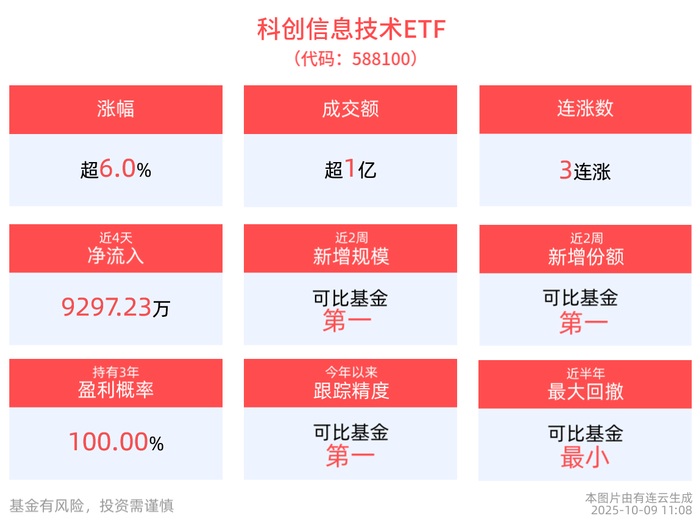
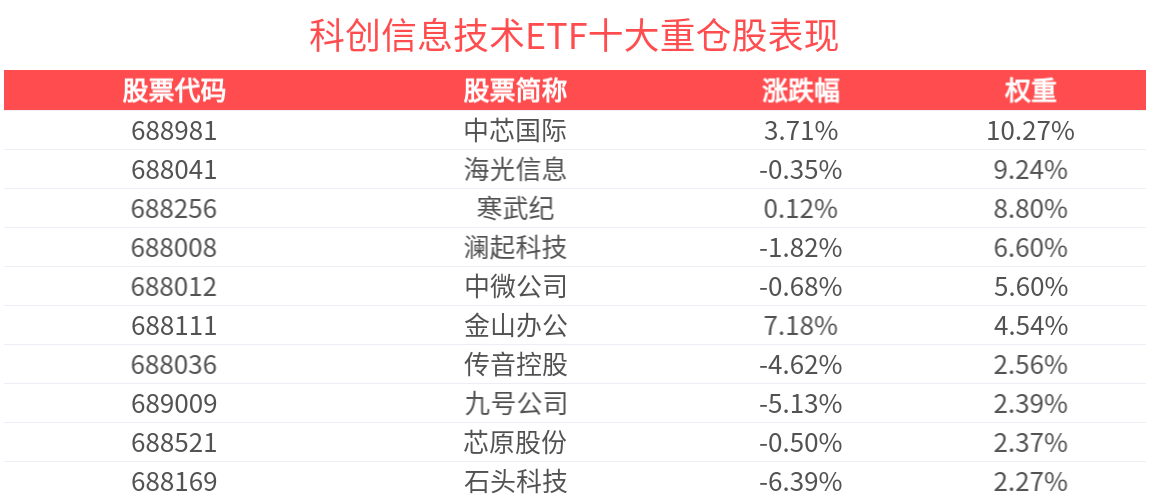
科创信息技术ETF(588100)盘中涨超6%,冲击3连涨,机构:AI基础设施投资增速或将维持高位
Xin Lang Cai Jing· 2025-10-09 05:16
Core Insights - The Shanghai Stock Exchange's Sci-Tech Innovation Board New Generation Information Technology Index has surged by 5.98%, with significant gains in component stocks such as Huahong Semiconductor (up 20.00%) and Hush Silicon Industry (up 15.50%) [1][3] - The Sci-Tech Information Technology ETF (588100) has also increased by 6.07%, marking its third consecutive rise [1] - The ETF has shown strong trading activity with a turnover rate of 32.69% and a transaction volume of 1.18 billion yuan, indicating a vibrant market [3] Market Performance - As of September 30, the Sci-Tech Information Technology ETF has achieved a net value increase of 136.63% over the past three years, ranking 37th out of 1883 index equity funds [3] - The ETF's highest single-month return since inception was 32.25%, with the longest consecutive monthly gains reaching four months and an overall increase of 63.37% [3] AI and Semiconductor Demand - The demand for AI computing power is rapidly expanding, driven by applications like Sora and collaborations between OpenAI and AMD, leading to increased storage needs and a recovery in NAND prices [3][4] - Trendforce forecasts a comprehensive price increase of 5% to 10% for NAND Flash products in Q4 2025 [3] - China's wafer fabrication capacity is expected to grow at a CAGR of 8.1% from 2024 to 2028, with mainstream nodes (22nm-40nm) projected to grow at a CAGR of 26.5%, potentially capturing 42% of global capacity by 2028 [3] Industry Insights - Domestic wafer foundry capabilities are advancing in both quantity and quality, supported by major companies like Deepseek, Alibaba, and Tencent increasing their reliance on domestic computing power [4] - The commercialization of AI is still in its early stages, with significant demand for computing power across various applications such as AI video, AI agents, autonomous driving, and robotics [4] Top Holdings - As of September 30, the top ten weighted stocks in the Sci-Tech Innovation Board New Generation Information Technology Index include Haiguang Information, SMIC, and Cambricon, collectively accounting for 57.93% of the index [5] - The performance of key stocks includes SMIC (up 7.10%), Haiguang Information (up 6.98%), and Cambricon (up 4.15%) [7] Investment Focus - The Sci-Tech Information Technology Index focuses on sectors such as chips, software, cloud computing, big data, and artificial intelligence, providing a comprehensive exposure to AI hardware, algorithms, models, and applications [7]