
万丰奥威

Search documents
涨幅回落,通用航空ETF基金(159230)连续8天净流入2.37亿元
Sou Hu Cai Jing· 2026-01-09 06:21
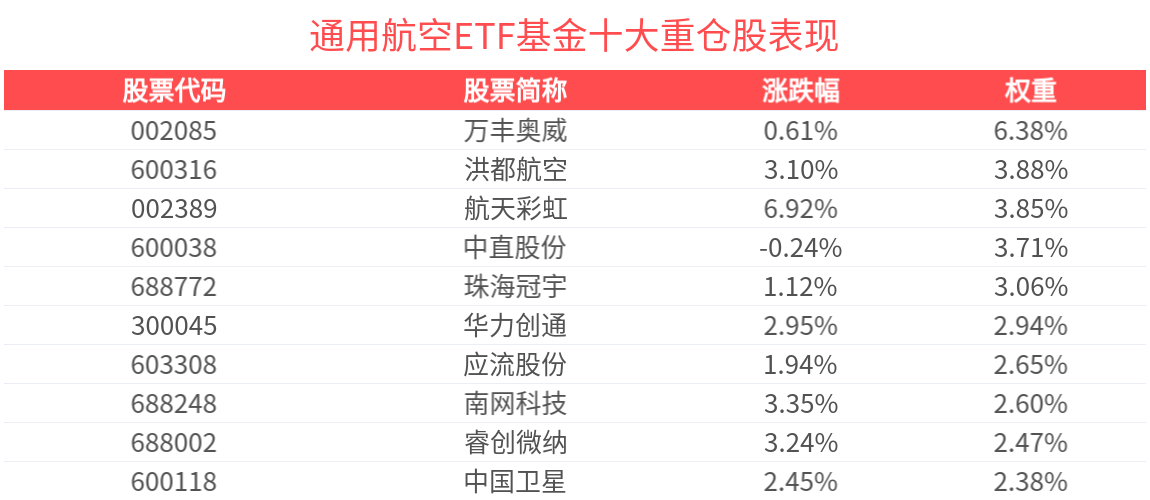
Core Viewpoint - The general aviation industry is experiencing significant growth, as indicated by the rise in the National General Aviation Industry Index and the General Aviation ETF Fund, driven by increased investment and the expansion of low-altitude economic applications [1][2]. Group 1: Market Performance - As of January 9, 2026, the National General Aviation Industry Index (980076) increased by 2.09%, while the General Aviation ETF Fund (159230) saw a narrower gain of 2.10% [1]. - The General Aviation ETF Fund recorded a trading volume of 1.00 billion yuan, with a turnover rate of 31.08%, indicating active market participation [1]. - The fund has experienced continuous net inflows over the past eight days, totaling 237 million yuan, with the latest share count reaching 226 million and a total fund size of 313 million yuan, marking a new high since its inception [1]. Group 2: Investment and Development - The National Development and Reform Commission has emphasized the need for greater investment stability and has organized the early release of construction project lists and central budget investment plans for 2026, focusing on expanding low-altitude economic applications [1][2]. - Various departments and local governments are actively exploring low-altitude economic application scenarios, with mature use cases in agricultural operations and inspection applications, while logistics, urban governance, and emergency rescue scenarios show significant growth potential [2]. Group 3: Index Composition - As of December 31, 2025, the top ten weighted stocks in the National General Aviation Industry Index include Wan Feng Ao Wei, Aerospace Rainbow, and China Satellite, collectively accounting for 33.92% of the index [2]. - The detailed performance of selected stocks includes Wan Feng Ao Wei at 0.61% increase, Hongdu Aviation at 3.10% increase, and Aerospace Rainbow at 6.92% increase, among others [4].

2025年全球电动航空产业回顾:分化加剧 蓄势待发
Xin Lang Cai Jing· 2026-01-09 04:20
Core Insights - The global electric aviation industry is transitioning from a conceptual phase to a new development stage focused on solving real-world problems, with significant capital flowing into leading startups in China and the U.S. despite a drop in overall funding compared to 2021-2022 [4] - The industry is entering a consolidation phase, similar to early 20th-century aviation and the past 15 years of electric vehicle integration, where weaker startups are likely to be eliminated, and operational maturity will be crucial for global competition [4] Group 1: Market Dynamics - The U.S. holds nearly 40% of the global eVTOL market share, bolstered by a strong capital market and traditional aviation advantages [5] - Key regulatory developments in the U.S. include the FAA's special regulations and the "Unleashing American Drone Dominance" executive order, which support eVTOL integration and establish a national airspace system [5] - Companies like Joby, Archer, and Beta plan to achieve airworthiness certification within two years, with Archer set to provide air taxi services during the 2028 Los Angeles Olympics, marking a significant industry milestone [5] Group 2: Regional Developments - European eVTOL development faces challenges, with notable companies like Lilium and Volocopter filing for bankruptcy, while others struggle with financing and R&D [6] - In contrast, China's eVTOL industry is rapidly advancing due to supportive policies, with over 40 domestic manufacturers and total financing exceeding 100 billion RMB [7] - China's leading battery industry, with a production capacity of 1,170 GWh and a global supply share exceeding 75%, is a core advantage for eVTOL manufacturers [7] Group 3: Technological and Regulatory Trends - The U.S. has outlined a three-step plan for low-altitude airspace management, emphasizing the need for private investment in infrastructure and the use of automation and data exchange to address challenges [9] - Battery performance remains a key bottleneck, with current energy densities limiting eVTOL range, although advancements are expected in the next five years [9] - Companies are exploring hybrid and hydrogen-powered eVTOLs, with Joby and Archer leading initiatives in this area [10] Group 4: Public Perception and Future Outlook - Public acceptance of eVTOLs has improved, but concerns about safety, noise, cost, and privacy persist, alongside lagging infrastructure development [11] - The next two years are critical for commercialization, with the potential for eVTOLs to become as ubiquitous as buses and taxis, fundamentally changing transportation [11]
通用航空市场稳步发展,低空运营未来可期
Zhong Guo Neng Yuan Wang· 2026-01-09 02:37
Core Viewpoint - The general aviation market is experiencing steady growth, with annual deliveries exceeding 4,000 aircraft for two consecutive years, and projected deliveries for 2024 are 4,197 units with a total value of $31.9 billion [1][3]. Global Market Overview - North America accounts for 70.4% of global deliveries, while the Asia-Pacific region shows the fastest growth [1][3]. - Fixed-wing aircraft dominate the market, representing 75.3% of global deliveries, with a trend towards higher-value models [1][3]. - According to Global Market Insights, the global general aviation market is expected to reach $40.2 billion by 2029, with a compound annual growth rate (CAGR) of 4.72% [1][3]. Industry Dynamics - Traditional general aviation aircraft manufacturing is currently led by companies in Europe and the United States, with a high market concentration exceeding 50% for fixed-wing aircraft and helicopters [3]. - The top three manufacturers of fixed-wing aircraft in 2024 are Cirrus Aircraft, Textron Aviation, and Piper Aircraft [3]. - Chinese companies are increasingly participating in the international market through acquisitions, such as Wan Feng Aviation's acquisition of Diamond Aircraft and Aviation Industry Corporation of China's acquisition of Cirrus Aircraft, yielding positive results [3]. Low-altitude Application Expansion - The low-altitude application scenarios are gradually expanding, with high entry barriers and significant Matthew effects, focusing on maritime transport, port piloting, and logistics delivery in the short term [4]. - General aviation operations are positioned in the midstream of the general aviation value chain, characterized by significant business differentiation and complex operational environments, which require high safety standards and present substantial financial, technical, and operational barriers [4]. - The development path for low-altitude applications in China is clear: starting with cargo operations before moving to passenger transport, and initially focusing on remote areas before integrating urban operations [4]. - As new aircraft technologies mature, reductions in acquisition, energy, personnel, and operational costs are expected to enhance the commercial viability of low-altitude operations [4]. - Compared to the U.S. industry, China's general aviation sector has immense growth potential, with significant gaps in infrastructure, aircraft numbers, and flight usage structures [4].
国信证券:通用航空市场稳步发展 低空运营未来可期
智通财经网· 2026-01-09 01:50
Core Insights - The report by Guosen Securities highlights the growth potential of the general aviation sector in China, particularly in the areas of unmanned aerial vehicles (UAVs) and electric vertical takeoff and landing (eVTOL) aircraft, characterized by intelligence, automation, and environmental sustainability [1] Group 1: Market Overview - General aviation encompasses all flight activities excluding military and commercial passenger and cargo flights, characterized by flexibility and a wide range of applications [1] - The global general aviation market is experiencing growth, with annual deliveries exceeding 4,000 aircraft for two consecutive years, projected to reach 4,197 units in 2024, valued at $31.9 billion [3] - Fixed-wing aircraft dominate the market, accounting for 75.3% of global deliveries, with a shift towards higher-value models anticipated [3] Group 2: Development Drivers - The growth of general aviation in China is driven by policy changes, technological advancements, and market expansion, with low-altitude economy becoming a national strategy [2] - Chinese companies are actively participating in the research and development of general aviation aircraft, achieving global leadership in UAV and eVTOL certification [2] Group 3: Competitive Landscape - The traditional general aviation aircraft manufacturing sector is dominated by European and American companies, with a market concentration exceeding 50% for fixed-wing aircraft and helicopters [4] - Major players in the fixed-wing aircraft market include Cirrus Aircraft, Textron Aviation, and Piper Aircraft, with Chinese firms like Wan Feng Aowei and Aviation Industry Corporation of China making significant international acquisitions [4] Group 4: Application Scenarios - The low-altitude application scenarios are expanding, focusing on maritime transport, port piloting, and logistics delivery, with high entry barriers due to safety, funding, and technical management requirements [5] - The development path for low-altitude applications in China is clear, prioritizing cargo transport before passenger transport and gradually integrating urban operations [5] Group 5: Comparative Analysis - Compared to the U.S., China's general aviation industry has significant growth potential, with the number of general airports in the U.S. being approximately 40 times that of China, and the number of general aviation aircraft being about 65 times greater [6] - The flight hours in the U.S. general aviation sector are approximately 19 times those in China, indicating substantial room for growth in short-distance transport and high-value segments in the Chinese market [6]

深度 | 低空经济行业专题四:通用航空市场稳步发展,低空运营未来可期【国信汽车】
车中旭霞· 2026-01-08 23:33
Core Viewpoints - General aviation is characterized by flexibility and personalized services, covering a wide range of civil applications, with traditional aircraft primarily being fixed-wing planes and helicopters, while emerging aircraft like drones and eVTOLs represent a shift towards intelligent, unmanned, and green technologies [2][3][17]. Industry Overview - The general aviation industry is experiencing new development opportunities driven by policy, technology, and marketization [3]. - The global general aviation market has maintained growth, with annual deliveries exceeding 4,000 aircraft for two consecutive years [4]. - In 2024, the global delivery volume of general aviation aircraft is projected to be 4,197 units, with a delivery value of $31.9 billion, where North America accounts for 70.4% of the global delivery volume [5][35]. Market Trends - The global general aviation aircraft market is expected to reach $40.2 billion by 2029, with a compound annual growth rate (CAGR) of 4.72% [5]. - The market is increasingly leaning towards high-value models, with fixed-wing aircraft making up 75.3% of the total deliveries in 2024 [36]. - The delivery value of fixed-wing aircraft is expected to rise from $23.4 billion in 2023 to $26.7 billion in 2024, reflecting a growth of 14.1% [35]. Competitive Landscape - The traditional general aviation aircraft manufacturing is dominated by European and American companies, with a high market concentration [6][38]. - The top three fixed-wing aircraft manufacturers in 2024 are Cirrus Aircraft, Textron Aviation, and Piper Aircraft, collectively holding over 50% of the market share [7][38]. Operational Landscape - General aviation operations face high entry barriers due to significant capital, technical management, and operational qualification requirements [8][45]. - The operational focus is expected to shift towards high-value, specialized applications in maritime transport, port piloting, and logistics delivery [8][46]. Comparative Analysis - The U.S. general aviation industry serves as a global benchmark, with significant disparities in infrastructure scale, aircraft numbers, and flight usage structures compared to China [9][10]. - As of 2024, the U.S. has approximately 40 times more registered general aviation airports than China, indicating substantial growth potential for China's general aviation sector [10][50]. New Opportunities - The rise of low-altitude economy as a national strategy is creating favorable conditions for the development of general aviation, supported by policy reforms and technological advancements [65][70]. - The low-altitude economy market in China is projected to reach ¥859.17 billion by 2025, with general aviation as a key component [65].

万丰奥威:2026年第一次临时股东会决议公告
Zheng Quan Ri Bao· 2026-01-08 14:12
(文章来源:证券日报) 证券日报网讯 1月8日,万丰奥威发布公告称,公司2026年第一次临时股东会审议通过《关于2026年度 日常关联交易预计的议案》。 ...

万丰奥威(002085) - 2026年第一次临时股东会决议公告
2026-01-08 10:30
股票代码:002085 股票简称:万丰奥威 公告编号:2026-001 2、本次股东会不涉及变更以往股东会已通过的决议。 一、会议召开情况 1、会议通知情况 公司董事会于2025年12月23日在《证券时报》及巨潮资讯网(www.cninfo.com.cn) 上披露了召开本次股东会的会议通知和审议事项。 浙江万丰奥威汽轮股份有限公司 2026 年第一次临时股东会决议公告 本公司及董事会全体成员保证信息披露的内容真实、准确、完整,没有虚假记 载、误导性陈述或重大遗漏。 重要提示: 1、本次股东会无否决提案的情形; 2、会议召开时间: 现场会议召开时间:2026年1月8日下午14:30 网络投票时间: (1)通过深圳证券交易所交易系统投票时间为:2026年1月8日上午9:15-9:25、 9:30-11:30、下午13:00-15:00。 (2)通过互联网投票系统投票的具体时间为:2026年1月8日上午9:15至下午15:00。 3、现场会议召开地点:浙江省新昌县万丰科技园 4、会议召集人:公司董事会 5、会议方式:本次股东会采取现场投票与网络投票相结合的方式 3、网络投票情况 通过网络投票参加本次股东会的股东 2 ...
万丰奥威(002085) - 2026年第一次临时股东会法律意见书
2026-01-08 10:30
万丰奥威 2026 年第一次临时股东会法律意见书 国浩律师(杭州)事务所 国浩律师(杭州)事务所 关于浙江万丰奥威汽轮股份有限公司 2026 年第一次临时股东会之 法 律 意 见 书 致:浙江万丰奥威汽轮股份有限公司("贵公司") 国浩律师(杭州)事务所(以下简称"本所")接受贵公司的委托,指派本 所律师出席贵公司于 2026 年 1 月 8 日在浙江省新昌县万丰科技园召开的 2026 年第一次临时股东会(以下简称"本次股东会"),并依据《中华人民共和国公 司法》(以下简称"《公司法》")、《上市公司股东会规则》(以下简称"《股 东会规则》")等法律、行政法规、规范性文件及《浙江万丰奥威汽轮股份有限 公司章程》(以下简称"《公司章程》")的规定,出具本法律意见书。 为出具本法律意见书,本所律师对贵公司本次股东会所涉及的有关事项进行 了审查,查阅了本所律师认为出具本法律意见书所必须查阅的文件,并对有关问 题进行了必要的核查和验证。 贵公司已向本所承诺:贵公司向本所律师所提供的文件和所作陈述及说明是 完整的、真实的和有效的,有关原件及其上面的签字和印章是真实的,且一切足 以影响本法律意见书的事实和文件均已向本所披 ...
商业航天概念走强,通用航空ETF基金(159230)涨3.84%,7日吸金1.39亿
Xin Lang Cai Jing· 2026-01-08 05:39
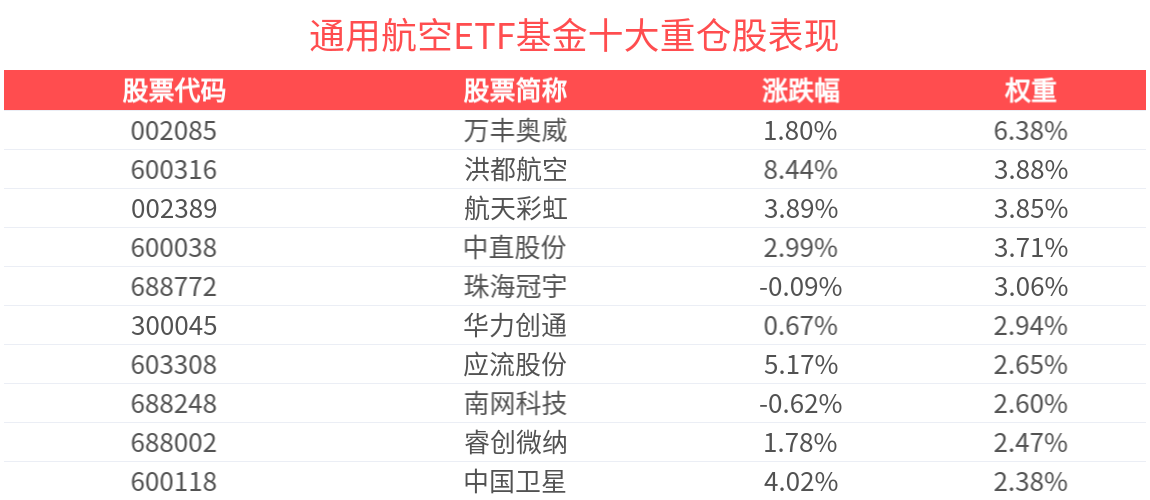
Core Insights - The Guozheng General Aviation Industry Index (980076) has shown a strong increase, with notable stock performances including Aerospace Nanhu up 18.27%, Aerospace Electronics hitting the daily limit, and Guangwei Composites rising 9.64% [1] - The General Aviation ETF (159230) has experienced a 3.84% increase, with a total net inflow of 139 million yuan over the past week, reaching a new high in both share count and total scale [1] - Southwest Securities reports that national strategies are focusing on the low-altitude economy, with various regions implementing development policies and state-owned enterprises establishing low-altitude economic companies [1] Industry Developments - The application scenarios for low-altitude economy are advancing, particularly in low-altitude logistics and low-altitude tourism, with leading eVTOL manufacturers securing orders and expanding overseas [1] - The General Aviation ETF closely tracks the Guozheng General Aviation Industry Index, with the top ten weighted stocks as of December 31, 2025, including Wan Feng Aowei, Aerospace Rainbow, and China Satellite, collectively accounting for 33.92% of the index [1] Stock Performance - The performance of key stocks within the index includes Wan Feng Aowei at 1.80% weight, Hongdu Aviation at 8.44%, and Aerospace Rainbow at 3.89%, among others [3] - The listed stocks are part of the index components and do not imply specific recommendations [3]
低空经济行业专题四:通用航空市场稳步发展,低空运营未来可期
Guoxin Securities· 2026-01-08 03:13
Investment Rating - The report rates the low-altitude economy industry as "Outperform" compared to the market [1] Core Insights - The general aviation market is steadily developing, with promising prospects for low-altitude operations driven by policy, technology, and marketization [2] - The global general aviation market is expected to grow, with an estimated delivery of 4,197 aircraft in 2024, generating a delivery value of $31.9 billion [3] - China's general aviation industry has significant growth potential compared to the U.S., particularly in infrastructure, aircraft numbers, and flight usage structure [4] Summary by Sections General Aviation Industry Overview - General aviation encompasses all flight activities except military and scheduled passenger/cargo flights, characterized by flexibility and a wide range of applications [12] - Traditional general aviation aircraft include fixed-wing planes and helicopters, while emerging types like drones and eVTOLs are gaining traction [19] Global General Aviation Market Situation - The global general aviation market has maintained growth, with annual deliveries exceeding 4,000 aircraft for two consecutive years [24] - In 2024, the delivery value of global general aviation aircraft is projected to reach $31.9 billion, marking a 13.5% increase from the previous year [27] - North America dominates the market, accounting for 70.4% of global deliveries, while the Asia-Pacific region shows the fastest growth [28] Comparison of China and the U.S. General Aviation Industries - The U.S. general aviation industry is highly developed, with a significant gap in infrastructure and aircraft numbers compared to China [40] - As of 2024, the number of registered general aviation airports in the U.S. is approximately 40 times that of China, highlighting the potential for growth in China's aviation infrastructure [43] New Opportunities in China's General Aviation Industry - The rise of low-altitude economy as a national strategy is creating new opportunities for the general aviation industry [64] - The market for low-altitude economy is projected to reach ¥859.17 billion by 2025, with significant contributions from low-altitude aircraft manufacturing and operational services [60]