
大参林

Search documents
大参林:公司会持续关注并学习国内外药店的发展新模式以及AI医学和AI检测的新趋势
Zheng Quan Ri Bao Wang· 2025-12-10 12:41
Group 1 - The company, Dazhenglin, is actively monitoring and learning from new development models of pharmacies both domestically and internationally [1] - The company is exploring innovative service methods to enhance customer experience and satisfaction [1] - The company is paying attention to trends in AI medicine and AI testing [1]

2025年中国药品流通行业经营模式、行业政策、产业链、直报企业主营业务收入、销售总额、区域分布、产品结构、重点企业经营对比及发展方向分析研判:市场规模保持增长,西药类占据主要份额[图]
Chan Ye Xin Xi Wang· 2025-12-10 01:43
Core Insights - The pharmaceutical distribution industry is a crucial component of the national healthcare system and health industry, significantly impacting public health and safety [1][7] - The industry is experiencing growth due to the implementation of the "two-invoice system" reform and increasing public awareness of healthcare [1][7] Industry Overview - The pharmaceutical distribution market in China is projected to reach a sales volume of 29,470 billion yuan in 2024, with wholesale sales accounting for 22,970 billion yuan (77.94%) and retail sales for 6,500 billion yuan (22.06%) [1][7] - The regional distribution of sales shows that East China accounts for 36.3%, Central South 27.0%, North China 15.2%, Southwest 13.4%, Northeast 4.3%, and Northwest 3.8%, with the top three regions contributing to 78.5% of total sales [9][10] Sales Structure - The sales composition indicates that Western medicine accounts for 70.8% of total sales, followed by traditional Chinese medicine at 14.6%, medical devices at 7.7%, and other categories [9][10] Current State of the Industry - As of the end of 2024, there are 705,400 licensed pharmaceutical businesses in China, including 15,100 wholesale companies and 66,070 retail chain enterprises [3][5] - The total number of retail pharmacies has increased to 683,700, with a notable rise in single retail pharmacies [3][5] Financial Performance - In 2024, the main business income of reported pharmaceutical distribution enterprises reached 22,431 billion yuan, reflecting a 0.8% increase from 2023, while the profit totaled 468 billion yuan with an average gross margin of 7.2% [5][6] Industry Chain - The pharmaceutical distribution industry serves as a critical link in the pharmaceutical supply chain, connecting manufacturers with end-users, including hospitals and pharmacies [11][12] Competitive Landscape - Major players in the pharmaceutical distribution sector include East China Pharmaceutical, Shanghai Pharmaceutical, China National Pharmaceutical Group, and others, with significant revenue contributions from these companies [14][15] Future Development Directions - The industry aims to enhance operational efficiency and inventory management to ensure a stable supply of pharmaceuticals while minimizing financial risks [18][19]




贪图200万,券商投行金领卷入受贿案,曾主持参与多个重大项目
Mei Ri Jing Ji Xin Wen· 2025-12-09 22:35
Core Viewpoint - The case of a senior sponsor representative facing severe criminal charges for "sudden shareholding" has shocked the investment banking community, highlighting the stringent regulatory environment and the serious consequences of corruption in the industry [1][2]. Group 1: Case Details - On December 9, it was reported that Du Pengfei, a senior sponsor representative from a leading brokerage, was prosecuted for "bribery" related to the IPO project of Zhenhua New Materials, with the prosecution suggesting a sentence of 10 to 11 years despite the involved amount being 4.1 million yuan [1][2]. - Du Pengfei had a notable career, having participated in significant capital operations, including IPO projects for Zhenhua New Materials and others, and was recognized as a key figure in the investment banking sector [2][3]. - The case is currently under trial, with the prosecution's recommendation indicating a strong message against corruption in the financial sector [2]. Group 2: Background and Mechanism - The case involves a dramatic narrative where the issuer, Zhenhua New Materials, actively sought assistance from Du Pengfei after failing to meet fundraising targets during a private placement, leading to his involvement through a familiar intermediary [4][5]. - Du Pengfei's investment was facilitated through a familiar company employee, who contributed 1.5 million yuan to a designated holding account, with profits to be shared verbally, highlighting the lack of formal agreements in such transactions [4][5]. Group 3: Legal Implications - The prosecution's classification of the "sudden shareholding" as "bribery" stems from the nature of the sponsor's role, where leveraging position for personal gain is deemed a violation of legal and ethical standards [6]. - The Securities Law explicitly prohibits securities professionals from holding or trading stocks directly or indirectly, reinforcing the legal framework against such corrupt practices [6]. - Historical trends indicate an increasing severity in penalties for financial misconduct, with criminal accountability becoming more common in recent years as part of a broader anti-corruption effort in the financial sector [7].

贪图200万元,券商投行金领卷入受贿案,检方建议量刑10到11年!其履历光鲜,曾主持参与多个重大项目
Mei Ri Jing Ji Xin Wen· 2025-12-09 15:19
Core Viewpoint - A senior sponsor representative from a leading brokerage firm, Du Pengfei, faces severe legal consequences for allegedly engaging in "sudden shareholding" during the IPO project of Zhenhua New Materials, with the prosecution suggesting a prison sentence of 10 to 11 years for the crime of bribery, despite the involved amount being 4.1 million yuan [1][2][6]. Group 1: Case Details - Du Pengfei was the executive general manager of the investment banking business management committee at a top brokerage firm and had a notable career, having participated in several significant capital operation projects, including the IPOs of Zhenhua New Materials and others [2][3]. - The case has been widely discussed due to its dramatic nature, where the issuer, Zhenhua New Materials, allegedly initiated the request for Du to participate in a financing round through a familiar shareholder, leading to a hidden operation involving shareholding [4][5]. - The prosecution's recommendation for a heavy sentence reflects a clear signal of strict punishment for such actions, indicating a shift towards more severe legal repercussions for financial misconduct in the industry [2][6]. Group 2: Legal Implications - The prosecution's classification of Du's actions as "bribery" stems from the nature of the sponsor's role, which combines labor and official duties, allowing for the exploitation of position for personal gain [6][7]. - The case highlights a growing trend in the industry where penalties for financial misconduct are becoming increasingly severe, moving from administrative penalties to criminal accountability [7].

涉案410万!或将面临超十年刑期 头部券商资深保代“突击入股”震惊投行圈
Mei Ri Jing Ji Xin Wen· 2025-12-09 12:59
Core Viewpoint - A senior underwriter from a leading brokerage firm, Du Pengfei, faces severe legal consequences for allegedly engaging in "sudden shareholding" during the IPO project of Zhenhua New Materials, with the prosecution suggesting a prison sentence of 10 to 11 years for bribery, despite the involved amount being 4.1 million yuan [1][2]. Group 1: Case Details - Du Pengfei, the former executive general manager of the investment banking business management committee at a top brokerage, was involved in the IPO of Zhenhua New Materials, which successfully listed on the Sci-Tech Innovation Board in September 2021 [2][3]. - The case has drawn significant attention due to the heavy sentencing recommendation and the complex circumstances surrounding the alleged bribery, including the issuer's proactive solicitation for assistance [4][5]. - The prosecution's case is based on the assertion that Du Pengfei utilized his position to gain economic benefits, which constitutes "transaction-type bribery" under Chinese law [7]. Group 2: Financial Implications - The total amount involved in the case is reported to be 4.1 million yuan, with Du Pengfei personally receiving approximately 2 million yuan from the investment [1][5]. - Following Zhenhua New Materials' IPO, the stock price surged, reaching as high as 80 yuan per share, resulting in substantial profits from the investment made through a third party [5]. Group 3: Regulatory Context - The case highlights a growing trend of stricter penalties in the financial sector, with an increasing number of criminal prosecutions for similar offenses in recent years, contrasting with earlier cases that primarily resulted in administrative penalties [8]. - The Securities Law explicitly prohibits securities practitioners from holding or trading stocks directly or indirectly, emphasizing the need for integrity and diligence in their duties [7].
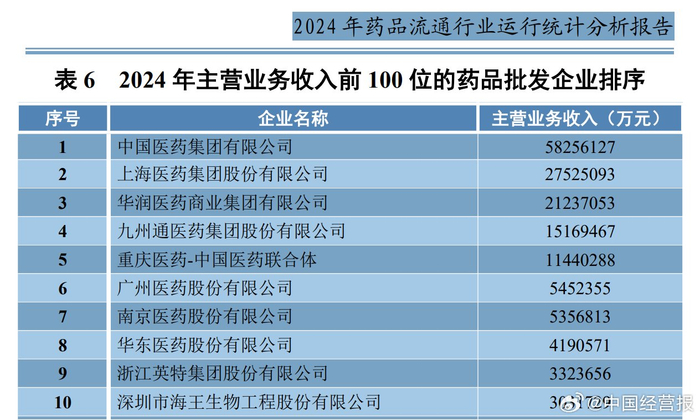
2024年医药流通百强榜发布,国药大参林领跑批发零售
Zhong Guo Jing Ying Bao· 2025-12-08 14:53
Group 1 - The core viewpoint of the article highlights the ranking of the top pharmaceutical wholesale and retail companies in China, with China National Pharmaceutical Group and Dazhonglin leading the sectors [1] - In 2024, the top 10 pharmaceutical wholesale companies include China National Pharmaceutical Group, Shanghai Pharmaceuticals, and China Resources Pharmaceutical, while the top 10 retail companies include Dazhonglin, Yifeng Pharmacy, and Guoda Pharmacy [1] - The total sales scale of the national pharmaceutical circulation market reached 29,470 billion yuan in 2024, with a year-on-year growth of 0.6% after excluding non-comparable factors [1] Group 2 - In 2024, 28 listed companies in the pharmaceutical circulation industry achieved a total main business revenue of 18,850 billion yuan, representing a year-on-year growth of 0.6% and accounting for 72.3% of the industry scale [2] - The market concentration remains stable, with the top five national pharmaceutical wholesale companies accounting for 51.2% of the total market size, unchanged from the previous year [2] - The total number of retail pharmacies reached 683,700 by the end of 2024, showing a year-on-year increase of 1.67% [1][2]

“腾笼换鸟、拓展空间、改造升级” 广州荔湾产业园区转型之路
2 1 Shi Ji Jing Ji Bao Dao· 2025-12-08 03:59
Core Insights - The article discusses the transformation of Guangzhou Liwan into a modern urban industrial cluster by addressing space constraints through "腾拓改" (teng tuō gǎi) and fostering industry development via "五链协同" (wǔ liàn xié tóng) [1][2][4] Group 1: Historical Context and Challenges - Liwan has a solid industrial foundation with companies like Guang Steel and Guang Ship, but faces challenges due to limited space in the old city area [1] - Many enterprises are forced to operate in a "two-location" model, where they have offices in Liwan but production facilities elsewhere, leading to operational inefficiencies [1] Group 2: Space Expansion Initiatives - In early 2023, Liwan set a development direction focused on modern urban industry, using "腾拓改" to create more industrial space [2] - The transformation of old properties and the construction of new industrial facilities, such as the 1906 Technology Park, have attracted high-tech companies like Yihua Tong [2] - The establishment of the Guangzhou Liwan Industrial Park in 2024 aims to integrate three major areas, significantly increasing available industrial space [2] Group 3: Industry Upgrading and Cluster Development - After addressing space issues, Liwan is focusing on developing industry clusters in sectors like laser and additive manufacturing, supported by specialized funds and partnerships with leading enterprises [3] - The region has formed clusters in biomedicine and health, with companies like Ruitong Additive leading in metal 3D printing technology [3] Group 4: Ecosystem Development - Liwan has created a collaborative development system involving party-building, talent, industry, and innovation chains to enhance the industrial ecosystem [4] - A budget of 1 billion yuan is allocated for an industrial investment fund by 2025, aiming for a total scale of 10 billion yuan [4] - The establishment of a "产学研用" (industry-university-research-application) mechanism facilitates the rapid commercialization of research outcomes [4] Group 5: Integration and Urban Development - Liwan leverages its strategic location to promote urban integration and collaboration with Foshan, enhancing local employment and resource flow [5] - The development model integrates industrial, living, and ecological spaces, ensuring that employees have access to necessary services [5] Group 6: Support Policies for Enterprises - Various support policies are in place for property upgrades, including subsidies for old property renovations and extended lease terms for state-owned properties [6][7] - Incentives for attracting enterprises include one-time rewards for registered businesses and expedited registration processes [8] - Specific industry support policies are available, with significant financial incentives for companies in e-commerce and healthcare sectors [9]
国信证券晨会纪要-20251208
Guoxin Securities· 2025-12-08 00:56
Group 1: Macro and Strategy Insights - The report highlights three key drivers for unlocking service sector growth in China: overseas "input demand," domestic "time-scarce" potential demand, and "innovation demand" arising from industrial upgrades [8][9] - The macroeconomic environment is characterized by a classic cycle dilemma in the service sector, where boosting service demand is seen as dependent on increasing resident income, creating a paradox [8][9] - The report discusses the evolution of anti-involution policies, emphasizing the need for industry self-discipline and administrative guidance to address overcapacity issues in various sectors [9] Group 2: Banking Industry Outlook - The banking industry is projected to experience a decline in net interest margins, with the bottom line estimated at around 1.2% to 1.3% [22][23] - A potential decrease in the Loan Prime Rate (LPR) by 10 basis points could lead to a year-on-year decline in net interest margins by approximately 5 to 8 basis points [23][24] - The report suggests that 2026 will likely mark the end of the current cycle of declining net interest margins, with a focus on quality stocks that are expected to see margin improvements [25] Group 3: Wealth Management and Asset Allocation - The report indicates that the scale of bank wealth management products reached a historical high of nearly 34 trillion yuan in November, with expectations to stabilize around 33 trillion yuan by year-end [26][27] - A shift towards multi-asset strategies is seen as essential for wealth management firms to adapt to declining returns from traditional fixed-income products [27][28] - The report emphasizes the importance of matching the risk-return profile of wealth management funds with investor preferences to successfully implement multi-asset strategies [28][30] Group 4: REITs Market Insights - The report notes a decline in the REITs index by 1.0% for the week ending December 5, 2025, with a year-to-date increase of 1.5% [12][13] - The first city renewal REIT was successfully issued in Beijing, signaling new opportunities in the REITs market [14] - The report highlights the need for regulatory support to enhance the potential for REITs to attract more investment [14][30] Group 5: Overseas Market Overview - The U.S. stock market is showing a concentration in technology, with the S&P 500 and Nasdaq experiencing slight increases [34] - The report indicates a mixed performance across sectors, with notable gains in automotive and semiconductor industries, while utilities and consumer staples faced declines [34][35] - The earnings expectations for the S&P 500 components have been slightly revised upward, reflecting a stable outlook for most industries [35]


中国医药零售板块:行业整合、产品多元化带来的机遇-China Pharmacy Sector _Opportunities from industry consolidation, product...__ Opportunities from industry consolidation, product diversification
2025-12-08 00:41
Summary of Conference Call Notes on China Pharmacy Sector Industry Overview - **Industry**: China Pharmacy Sector - **Key Insights**: The sector is experiencing opportunities from industry consolidation and product diversification, drawing parallels with Japan's drugstore sector [4][8]. Core Points and Arguments Industry Consolidation - **Consolidation Trend**: The consolidation in Japan's drugstore sector has been ongoing for over a decade, with the concentration ratio (CR7) increasing from 67% in FY14 to 81% in FY24 [2]. - **Expansion Methods**: Initially, drugstore chains expanded through store openings, but as larger regional chains emerged, the focus shifted to mergers and acquisitions (M&A) [2]. - **M&A Examples**: Notable mergers include Matsumotokiyoshi and Cocokara Fine, and Welcia and Tsuruha, which are aimed at improving margins [2]. - **Goodwill Impairment Risk**: There is currently limited risk of goodwill impairments for drugstores that have relied on M&A for expansion, with reasonable acquisition valuations around 8-10x EV/EBITDA [2]. Product Diversification - **Growth Strategy**: Drugstores in Japan have diversified into food sales to increase store traffic and customer visits, despite food being a lower-margin product [3]. - **Market Share Gains**: Successful drugstores have gained market share from smaller competitors and supermarkets by adopting a discount-store approach [3]. - **Focus Areas**: Some chains are also increasing their exposure to prescription drugs, cosmetics, and OTC drugs to differentiate their offerings [3]. Implications for China Pharmacies - **Early Stages of Consolidation**: The Chinese pharmacy sector is still in the early stages of consolidation and product diversification, with leading chains expected to increase their market share [4]. - **Current CR10**: The concentration ratio for pharmacies in China was 33% in 2024, up from 14% in 2014, indicating room for consolidation [8]. - **Expansion Flexibility**: Listed pharmacies have limited geographical overlap and can utilize various expansion methods, including self-operated stores, M&A, and franchising [8]. Valuation Insights - **Preferred Companies**: Yifeng and Dashenlin are identified as industry leaders that have completed internal adjustments and are now focusing on outward expansion and product diversification [5]. - **Valuation Metrics**: Current valuations for Yifeng and Dashenlin are at historical lows, with forward P/E ratios of 14x and 15x, respectively [5]. - **Growth Potential**: There is potential for growth driven by accelerating store expansion and improvements in same-store sales growth (SSSG) [5]. Risks Identified - **Industry Policies**: Changes in state medical insurance policies could impact drugstore traffic and margins, while regulatory requirements could affect expansion plans and operating costs [11]. - **Operational Management**: Non-compliance with regulations could lead to severe consequences, including disqualification from state insurance payments [11]. - **Competitive Landscape**: Accelerating consolidation may lead to increased competition among regional leaders, affecting cross-region expansion [11]. - **Shift to Online Channels**: The rise of pharmaceutical e-commerce could divert traffic from offline drugstores [11]. Additional Important Points - **Revenue Exposure**: Listed pharmacies in China currently have only about 20% revenue exposure to products outside of traditional drugs, with plans to expand into FMCG and functional foods [9]. - **Cost Management**: Leading chains expect minimal incremental costs when expanding non-traditional product sales, allowing competitive pricing against supermarkets [9]. This summary encapsulates the key insights and implications for the China pharmacy sector based on the conference call notes, highlighting both opportunities and risks in the evolving landscape.

2025年1-10月医药制造业企业有9846个,同比增长1.01%
Chan Ye Xin Xi Wang· 2025-12-07 03:10
Core Viewpoint - The report highlights the growth and trends in the Chinese pharmaceutical manufacturing outsourcing (CMO/CDMO) industry, indicating a slight increase in the number of enterprises in the sector from the previous year [1]. Industry Summary - As of January to October 2025, the number of pharmaceutical manufacturing enterprises reached 9,846, an increase of 98 enterprises compared to the same period last year, representing a year-on-year growth of 1.01% [1]. - The pharmaceutical manufacturing sector accounts for 1.88% of the total industrial enterprises in China [1]. Company Summary - The report mentions several listed companies in the pharmaceutical sector, including Guoyao Modern (600420), Kunming Pharmaceutical Group (600422), and others, indicating their relevance in the industry landscape [1]. - The data is sourced from the National Bureau of Statistics and organized by Zhiyan Consulting, a leading industry consulting firm in China [1].
