
大成基金

Search documents
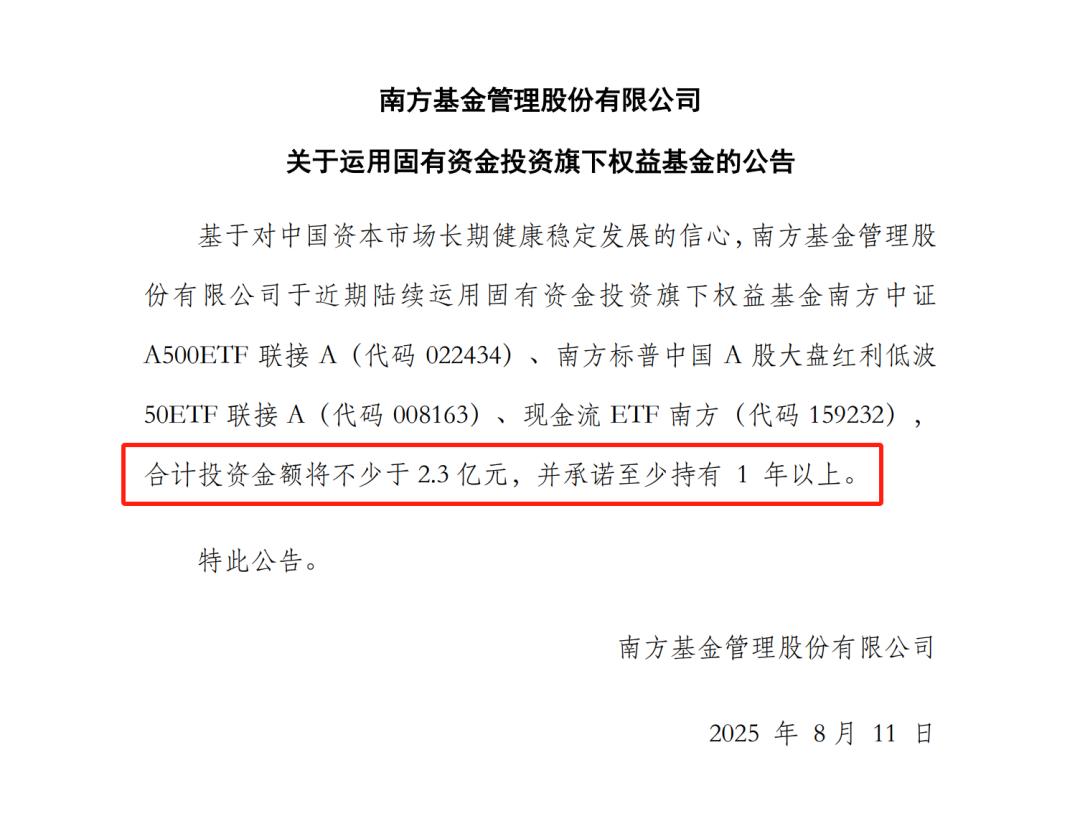
公募“自购潮”再起,南方基金拟出手2.3亿元布局权益
Bei Jing Shang Bao· 2025-08-11 12:55
Core Viewpoint - The recent trend of public fund self-purchases in China reflects confidence in the long-term stability and health of the capital market, with significant investments being made by various fund companies [1][3][4]. Group 1: Public Fund Self-Purchases - On August 10, Southern Fund announced a self-purchase of at least 230 million yuan using its own funds to invest in its equity funds, committing to hold these investments for over one year [1][3]. - Other public funds, including ICBC Credit Suisse Fund and Huashang Fund, have also engaged in similar self-purchase activities, indicating a resurgence of self-purchase trends in the industry [1][4]. - Since the beginning of the year, over 20 public funds have announced self-purchases, with amounts typically ranging from 1.55 million to 54 million yuan [4][6]. Group 2: Performance and Market Confidence - The three funds targeted by Southern Fund's self-purchase have shown positive returns this year, with yields of 3.78%, 6.78%, and 11.46% respectively [3]. - Industry experts suggest that such large-scale self-purchases, like that of Southern Fund, serve as a benchmark in the industry, enhancing investor trust through a binding interest mechanism [3][6]. - The overall net subscription amount for actively managed equity funds by public institutions has reached 1.579 billion yuan this year, reflecting a strong belief in the high-quality development of the Chinese capital market [6][9]. Group 3: Regulatory Environment and Future Trends - Recent regulatory guidance encourages fund companies to allocate a portion of their annual profits to self-purchase their equity funds, which is expected to promote a trend of continuous self-purchases [8][9]. - The "Action Plan for Promoting the High-Quality Development of Public Funds" emphasizes long-term assessments and increases the scoring for self-purchase metrics by 50% [8]. - Experts predict that the trend of public funds self-purchasing equity funds will continue, potentially leading to a more stable market structure [9].

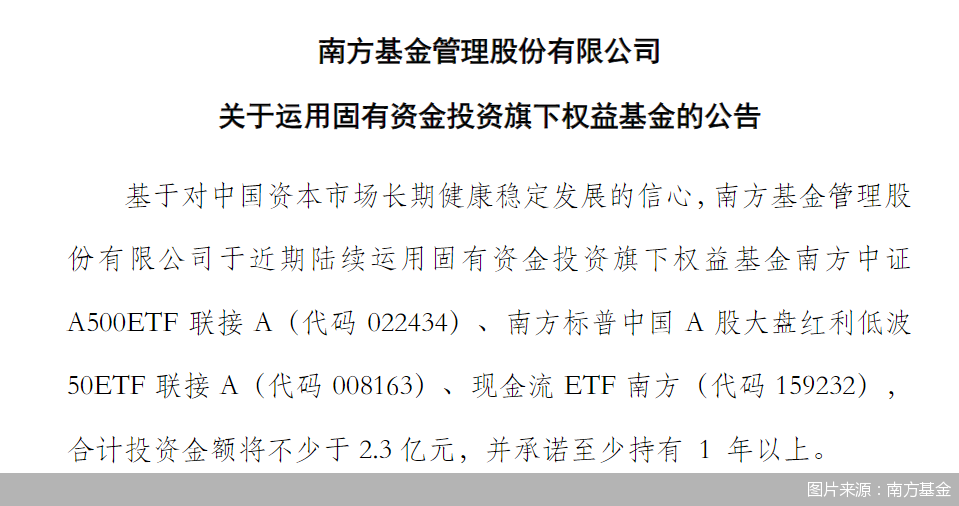
不少于2.3亿元!南方基金官宣自购
Guo Ji Jin Rong Bao· 2025-08-11 11:56
Group 1 - Southern Fund announced a self-purchase of at least 230 million yuan in its equity funds, demonstrating confidence in the long-term stability of the Chinese capital market [1] - Multiple fund companies, including Huashang Fund and Dachen Fund, have engaged in self-purchases recently, indicating a trend in the industry [3] - The self-purchase phenomenon is driven by recognition of the value of equity asset allocation and regulatory encouragement to use profits for purchasing equity products [3][4] Group 2 - The self-purchase behavior of fund companies is expected to become a norm, supported by regulatory policies that encourage such actions [4] - This practice strengthens the alignment of interests between management and investors, acting as a stabilizing force in the market [4] - Long-term, this model fosters a culture of long-term investment among investors, enhances industry stability, and improves the brand value of fund companies, contributing to high-quality industry development [4]
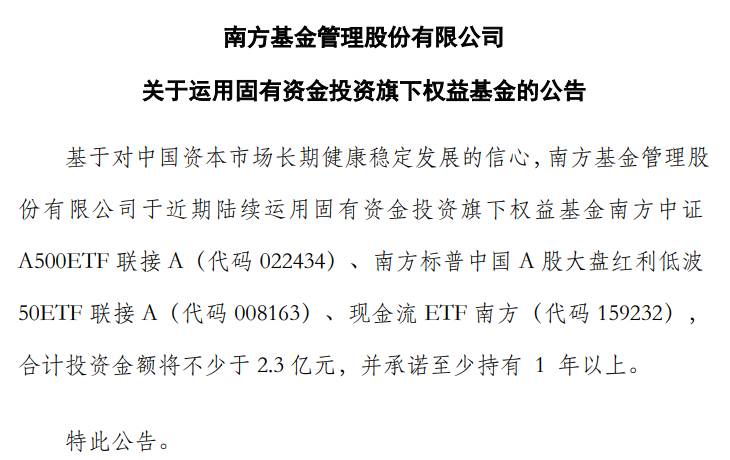
“真金白银”力挺A股,公募“接力”自购权益基金
2 1 Shi Ji Jing Ji Bao Dao· 2025-08-11 11:39
Core Viewpoint - Several large public fund companies have recently announced self-purchase plans, indicating confidence in the long-term stability and health of the Chinese capital market [1][4]. Group 1: Self-Purchase Announcements - On August 11, Southern Fund announced a self-purchase plan involving an investment of at least 230 million yuan in three equity funds, committing to hold for at least one year [1][2]. - Four public fund companies, including Southern Fund, Industrial Bank of China Credit Fund, Taikang Fund, and Founder Fubon Fund, have announced self-purchase plans since July 28, with a total investment exceeding 260 million yuan [1][2]. - Southern Fund's self-purchase plan is particularly notable, with a commitment to invest in specific equity funds [2]. Group 2: Market Sentiment and Valuation - The self-purchase actions by multiple fund companies signal a recognition of the current market's reasonable valuations and a belief in the long-term investment value [4][8]. - According to Wind data, as of August 6, the price-to-earnings ratios for the CSI 300 Index and the Hang Seng Index were 13.93 and 11.83, respectively, both lower than major mature market indices, indicating a valuation advantage for Chinese stocks [3]. Group 3: Implications for Investors - Fund companies' self-purchases are seen as a way to enhance trust and stabilize investor sentiment, as they align the interests of fund companies with those of investors [4][9]. - While self-purchase can be a positive signal, it should not be the sole criterion for investment decisions; investors are advised to consider other factors such as fund manager capability and investment strategy [8][9]. - The trend of self-purchases has been ongoing, with over 100 fund management companies having implemented self-purchases this year, reflecting a broader industry movement [6][7].
南方基金2.3亿元自购权益基金,公募密集出手提振市场信心
Nan Fang Du Shi Bao· 2025-08-11 09:57
Core Viewpoint - Southern Fund's announcement of a 230 million yuan self-purchase of three equity funds reflects confidence in the long-term stability and health of China's capital markets, marking a significant event in the recent trend of public fund self-purchases [2][5]. Group 1: Self-Purchase Details - Southern Fund's self-purchase of 230 million yuan sets a new record for a single institution's equity fund self-purchase in 2023 [5]. - The self-purchase includes three ETFs: Southern CSI A500 ETF Link A, Southern S&P China A-Share Large Cap Dividend Low Volatility 50 ETF Link A, and Cash Flow ETF Southern, focusing on small and medium-sized growth stocks, low-volatility dividend assets, and cash flow themes [5]. - The trend of public fund self-purchases has been increasing since the beginning of the year, with regulatory guidance from the China Securities Regulatory Commission (CSRC) mandating a 10% annual increase in public fund holdings of A-shares over the next three years [5][6]. Group 2: Industry Trends - Since July, several institutions, including Dacheng Fund, Founder Fubon Fund, and others, have announced self-purchase plans, contributing to a total of nearly 130 public funds initiating self-purchases, amounting to over 5 billion yuan, with equity fund self-purchases accounting for a significant portion [6]. - The self-purchase behavior is seen as a way for fund companies to convey confidence in their investment management capabilities and product value, which helps stabilize investor expectations and enhance holding confidence [6]. - The self-purchase also aligns the interests of fund companies with investors, motivating research teams to focus on long-term performance and providing liquidity support during market fluctuations [6].

纳斯达克100指数ETF今日合计成交额29.51亿元,环比增加36.35%
Zheng Quan Shi Bao Wang· 2025-08-11 08:47
Core Insights - The total trading volume of Nasdaq 100 Index ETFs reached 2.951 billion yuan today, an increase of 787 million yuan from the previous trading day, representing a growth rate of 36.35% [1] Trading Volume Summary - The trading volume of GF Nasdaq 100 ETF (159941) was 833 million yuan, up 267 million yuan from the previous day, with a growth rate of 47.23% [1] - The trading volume of Huaxia Nasdaq 100 ETF (QDII) (513300) was 588 million yuan, an increase of 174 million yuan, with a growth rate of 41.93% [1] - The trading volume of Guotai Nasdaq 100 (QDII-ETF) (513100) was 654 million yuan, up 166 million yuan, with a growth rate of 33.96% [1] - Notable increases in trading volume were observed in Huatai-PineBridge Nasdaq 100 ETF (159660) and Bosera Nasdaq 100 ETF (513390), with increases of 83.61% and 69.49% respectively [1] Market Performance Summary - As of market close, the average increase for ETFs tracking the Nasdaq 100 Index was 1.03%, with GF Nasdaq 100 ETF (159941) and Bosera Nasdaq 100 ETF (513390) leading the gains at 1.26% and 1.10% respectively [1]
ETF午评 | A股三大指数集体收涨,锂矿股强势上涨,新能车ETF、科创板新能源ETF涨3%,黄金股ETF跌2.3%,人工智能ETF涨3%
Sou Hu Cai Jing· 2025-08-11 03:58
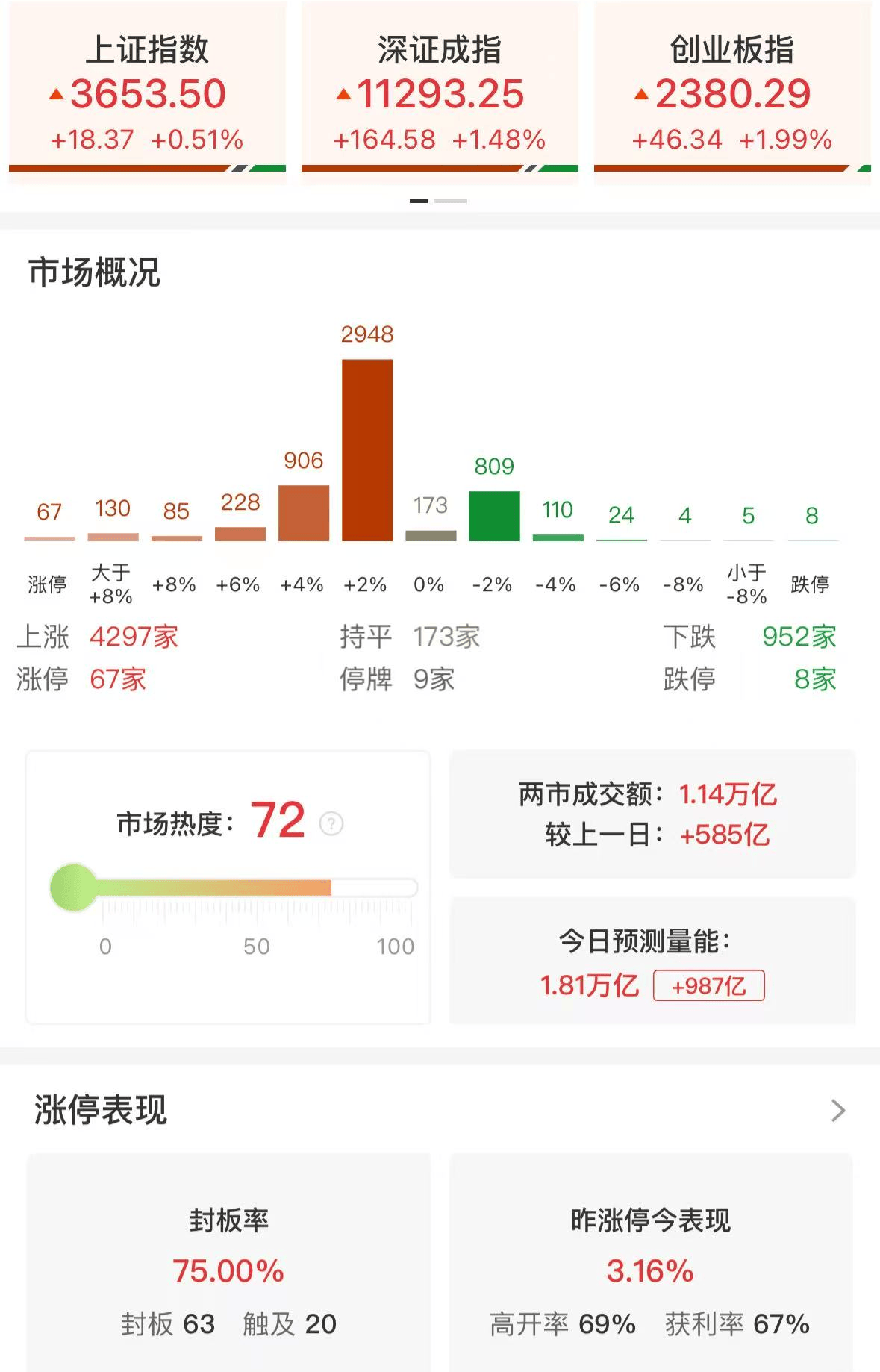
Market Performance - The three major A-share indices collectively rose, with the Shanghai Composite Index increasing by 0.51%, the Shenzhen Component Index by 1.48%, and the ChiNext Index by 1.99% [1] - The total trading volume in the Shanghai, Shenzhen, and Beijing markets reached 1,149.6 billion yuan, an increase of 56.3 billion yuan compared to the previous day [1] - Over 4,200 stocks in the market experienced gains [1] Sector Performance - PEEK materials, energy metals, and CPO sectors showed upward movement, while the precious metals sector underwent adjustments [1] - Lithium mining stocks surged, with ETFs such as Bosera New Energy Vehicle ETF, FT Fund Sci-Tech Innovation Board New Energy ETF, and Huaan New Energy Vehicle ETF all rising by 3% [6] - The fintech sector regained momentum, with ETFs like Huabao Fintech ETF, Bosera Fintech ETF, and Huaxia Fintech ETF increasing by 3.13%, 2.96%, and 2.71% respectively [6] - The CPO sector remained active, with the ChiNext Artificial Intelligence ETF Dachen and ChiNext Artificial Intelligence ETF Huabao rising by 3% and 2.94% respectively [6] - Gold stocks experienced a pullback, with Gold Stock ETF, Gold Stocks ETF, and Gold Stock ETF declining by 2.3%, 2.29%, and 2.27% respectively [6] - The innovative drug sector continued its downward trend, with Hang Seng Innovative Drug ETF and Hong Kong Innovative Drug Selection ETF falling by 0.91% and 0.83% respectively [6]
1985只“权益类基金”创新高!近一年20强全是“翻倍基”!医药、北交所主题基金成大赢家!
私募排排网· 2025-08-11 03:48
Core Viewpoint - The article highlights the performance of equity funds in the A-share market, noting that many funds have reached historical highs in net value as of July 2025, driven by a strong upward trend in major stock indices [4][5]. Group 1: Performance of Equity Funds - As of the end of July 2025, 1,985 equity funds (established for over a year) reached historical highs in net value [4]. - The Shanghai Composite Index rose by 3.74%, the Shenzhen Component Index by 5.20%, and the ChiNext Index by 8.14% in July 2025 [4]. - Among the top-performing funds from January to July 2025, 834 funds were analyzed, with 74% meeting the criteria for the top 20 performers [5]. Group 2: Top Performing Funds - The top three funds for the period of January to July 2025 are: 1. Zhongyin Hong Kong Stock Connect Medical Mixed Fund A (Code: 020397) with a return of 113.51% [5][10]. 2. Yongying Medical Innovation Selected Mixed Fund A (Code: 015915) with a return of 113.30% [5]. 3. Guangfa Growth Leading One-Year Holding Mixed Fund A (Code: 016243) with a return of 97.33% [5]. - The Zhongyin fund had a scale of approximately 139 million yuan as of the second quarter of 2025 and has achieved a cumulative return of 88.72% since its inception [10][11]. Group 3: Recent Year Performance - In the past year, all top 20 funds have achieved over 100% returns, with six being North Exchange theme funds and five being medical theme funds [12]. - The top three funds for the past year are: 1. CITIC Construction North Exchange Selected Two-Year Open Mixed Fund A (Code: 016303) with a return of 202.70% [12][17]. 2. Huitianfu North Exchange Innovation Selected Two-Year Open Mixed Fund A (Code: 014279) with a return of 152.49% [12]. 3. Wanjia North Exchange Wise Selection Two-Year Open Mixed Fund A (Code: 014277) with a return of 139.98% [12]. Group 4: Three-Year Performance - The top three funds over the past three years are: 1. Huitianfu North Exchange Innovation Selected Two-Year Open Mixed Fund A (Code: 014279) with a return of 135.25% [19][24]. 2. Jia Shi Mutual Fund Selected Stock A (Code: 006603) with a return of 120.26% [19]. 3. Wanjia North Exchange Wise Selection Two-Year Open Mixed Fund A (Code: 014277) with a return of 108.56% [19]. Group 5: Five-Year Performance - The top three funds over the past five years are: 1. Jinyuan Shun'an Yuanqi Flexible Allocation Mixed Fund (Code: 004685) with a return of 262.69% [26][31]. 2. Dongwu New Trend Value Line Mixed Fund (Code: 001322) with a return of 183.15% [26]. 3. Dongwu Mobile Internet Mixed A (Code: 001323) with a return of 178.89% [26].
南方基金出手!2.3亿,自购!
证券时报· 2025-08-11 00:27
Core Viewpoint - The article highlights the increasing trend of public funds in China engaging in self-purchase of equity funds, reflecting institutional confidence in the market's future performance despite recent market fluctuations [2][4][5]. Group 1: Self-Purchase Activities - On August 10, Southern Fund announced a self-purchase of 230 million yuan in three equity ETFs, demonstrating strong institutional confidence [1][4]. - As of August 10, nearly 130 public funds have initiated self-purchases this year, totaling over 5 billion yuan, with equity fund products accounting for a significant portion [2][4]. - The trend of self-purchases has continued even after a market peak in June, indicating expectations for a favorable market in the second half of the year [5][7]. Group 2: Market Valuation and Economic Outlook - Public funds are making self-purchases based on the belief that the Chinese capital market is currently undervalued, with a slow but steady growth outlook rather than a rapid surge [6][7]. - The strong resilience and vitality of the Chinese economy, evidenced by a 5.3% GDP growth in the first half of the year, supports the long-term positive outlook for the capital market [7][8]. - Current valuation metrics show that the price-to-earnings ratios of major Chinese indices are significantly lower than those of developed markets, indicating a favorable investment environment [2][7]. Group 3: Investor Behavior and Market Dynamics - The shift of household savings into the capital market, driven by low deposit interest rates, is expected to create more investment opportunities and enhance market participation [8]. - The issuance of new equity funds has seen a notable recovery, with many new funds exceeding 1 billion yuan in initial scale, signaling increased willingness from external investors to enter the market [8]. - Foreign capital inflows into A-shares and Hong Kong stocks have also been significant, with over 10.1 billion USD entering the market in the first half of the year, suggesting a positive sentiment towards Chinese assets [8].

巨头官宣大手笔自购:2.3亿元
3 6 Ke· 2025-08-11 00:25
Core Viewpoint - Southern Fund demonstrates confidence in the Chinese capital market by announcing a self-purchase of its equity funds amounting to no less than 230 million yuan, reflecting a strong belief in the long-term health and stability of the market [1][2]. Group 1: Fund Self-Purchase Actions - Southern Fund has committed to investing at least 230 million yuan in its equity funds, including specific funds like the Southern CSI A500 ETF and Southern S&P China A-Share Large Cap Dividend Low Volatility ETF, with a holding period of at least one year [2]. - Other fund companies, such as ICBC Credit Suisse, Founder Fubon, and Da Cheng, have also engaged in self-purchases, indicating a broader trend among asset management institutions to invest their own capital [1][5]. - The total net subscription amount for public funds' self-purchases in equity funds (stock and mixed types) has reached 2.464 billion yuan this year, highlighting a sustained trend of self-purchase actions among fund companies [15]. Group 2: Market Confidence and Economic Outlook - The recent market recovery has led many institutions to recognize the medium to long-term investment value of the A-share market, with Southern Fund citing the strong vitality and resilience of the Chinese economy as a foundation for the capital market's long-term growth [16]. - Despite external complexities, China's GDP achieved a steady growth of 5.3% in the first half of the year, indicating a positive macroeconomic trend [16]. - The current valuation of the Chinese stock market is seen as particularly attractive, with the CSI 300 Index and Hang Seng Index trading at price-to-earnings ratios of 13.93 and 11.83, respectively, which are lower than those of major mature markets [16]. Group 3: Future Market Expectations - A fund company expressed a cautiously optimistic view on the A-share market for the second half of 2025, anticipating a three-phase upward cycle driven by policy support, technological advancements, and globalization [17]. - The market may enter a phase of adjustment after a rapid rise, but the long-term outlook remains positive, particularly in sectors such as technology, domestic demand stimulation, and financial reform [17].
积极因素不断涌现 公募基金掀起自购潮
Zhong Guo Zheng Quan Bao· 2025-08-10 21:05
Group 1 - Public funds are experiencing a renewed wave of self-purchase, with institutions like ICBC Credit Suisse Fund, Taikang Fund, and Founder Fubon Fund announcing plans to use proprietary funds to buy their equity public funds, reflecting confidence in the long-term stability and health of the capital market [1][2] - The Shanghai Composite Index has recently surpassed 3600 points, boosting investor confidence in the market, and industry insiders suggest that a new round of self-purchase by public funds has begun, signaling positive market sentiment [1][3] - As of August 10, 2025, a total of 137 public fund companies have initiated self-purchases, with 56 companies focusing on stock funds and 73 on mixed funds, indicating a strong preference for equity assets [3] Group 2 - ICBC Credit Suisse Fund announced a self-purchase of at least 10 million yuan for its "ICBC Credit Suisse Selected Return Mixed Fund," with a commitment to hold for at least one year [1][2] - Taikang Fund has utilized 1.55 million yuan of its proprietary funds to invest in its "Taikang Hong Kong Stock Connect Index Fund," while Founder Fubon Fund plans to self-purchase at least 25 million yuan in equity public funds, marking its second self-purchase this year [2][3] - The self-purchase actions by fund companies are expected to enhance performance stability, instill confidence in investors, and encourage a focus on long-term performance rather than short-term gains [3]