Stripe

Search documents
传OpenAI二级股票发售规模激增至103亿美元 估值飙至5000亿创新高
Zhi Tong Cai Jing· 2025-09-04 01:44
Core Viewpoint - OpenAI plans to expand its secondary stock sale to over $4 billion, providing eligible current and former employees the opportunity to sell approximately $10.3 billion worth of stock, significantly higher than the initial target of $6 billion [1] Group 1: Stock Sale Details - The estimated valuation for this stock sale is expected to reach $500 billion, aligning with previous market expectations [1] - OpenAI's latest funding round earlier this year valued the company at $300 billion [1] - Employees holding OpenAI stock for over two years must decide by the end of September whether to participate in this transaction, which is anticipated to complete in October [1] Group 2: Investor Participation - Investors participating in this transaction include SoftBank, Dragoneer Investment Group, Thrive Capital, Abu Dhabi's MGX, and T. Rowe Price [1] - Thrive Capital and Public Investment Fund declined to comment, while representatives from other firms did not respond to requests for comments [1] Group 3: Context of Stock Sales - OpenAI regularly offers employees the chance to sell a portion of their equity to alleviate pressure for an IPO, a practice also seen in companies like SpaceX, Stripe, and Databricks [1] - In November of the previous year, OpenAI allowed employees to sell approximately $1.5 billion worth of stock as part of a tender offer with SoftBank [1]
X @Bloomberg
Bloomberg· 2025-09-02 20:28
Industry Focus - Fintech firm Stripe is publicly appealing to the US Consumer Financial Protection Bureau [1] - Stripe is urging immediate action against banks charging for access to customers' financial data [1]
想成为一名合格的 AI PM,先抛弃过去那些让你成功的经验
Founder Park· 2025-09-02 12:26
Core Insights - The role of AI product managers (PMs) has evolved from merely adding features to designing systems that can learn and optimize over time, creating a compounding value system [2][4][12] - A well-defined and actionable AI product strategy is crucial for PMs to succeed in the current landscape [3][5] - Understanding the unique economic principles and product design philosophies brought by AI is essential for PMs to lead their companies towards sustainable success [12][13] Group 1: AI Product Strategy - Mastering AI product strategy is the primary skill required for PMs today, as highlighted by OpenAI's product lead Miqdad Jaffer [5] - AI product strategy involves insights into how AI can change unit economics, building feedback loops that compound value, and resisting homogenization [13][18] - The strategy must begin with selecting the right moat, as AI models are temporary while moats are enduring [19][21] Group 2: Unique Moats in AI - There are three primary moats in AI: data moat, distribution moat, and trust moat [32][36] - A data moat is built by generating unique, structured, high-quality data with each user interaction, which can be used to train better models and provide insights that competitors cannot access [25][26] - A distribution moat is critical for scaling AI products, as having a large user base allows for immediate adoption of new features [29][30] Group 3: Differentiation in AI Products - Differentiation is essential in a landscape where many products can access the same AI models; it focuses on user experience, workflow integration, and creating systems that accumulate value over time [42][45] - Successful AI products often integrate seamlessly into existing workflows, making them feel like invisible assistants rather than standalone tools [48][49] - The most effective differentiation strategies include building trust through transparency, governance, and community engagement [46][55] Group 4: Designing AI Products - Designing AI products requires a shift in mindset, recognizing that AI products are fundamentally different from traditional SaaS products due to their cost structures and user interactions [62][63] - Key design principles include considering cost implications, choosing the right workflow integration points for AI, and embedding safeguards from the outset [64][75] - The choice of product model (Copilot, Agent, Augmentation) significantly impacts user experience and cost management [72][78] Group 5: Deployment and Scaling - Deploying AI products involves balancing user growth with cost control, as each user interaction incurs costs that can escalate quickly [82][83] - Effective scaling strategies include starting small, controlling adoption curves, and building feedback loops that enhance product value [85][91] - Organizations must ensure that their internal capabilities grow in tandem with user growth to avoid operational failures [95] Group 6: Leadership in AI Integration - Leadership in AI requires PMs to view AI as a system that evolves and compounds value over time, rather than a set of features [96][103] - Establishing a structured experimental culture is vital for navigating the rapid changes in AI technology [105][110] - Clear communication of AI strategy and its business impact is essential for gaining support from stakeholders [104][109]



一位被开除的00后爆红
投资界· 2025-09-01 07:42
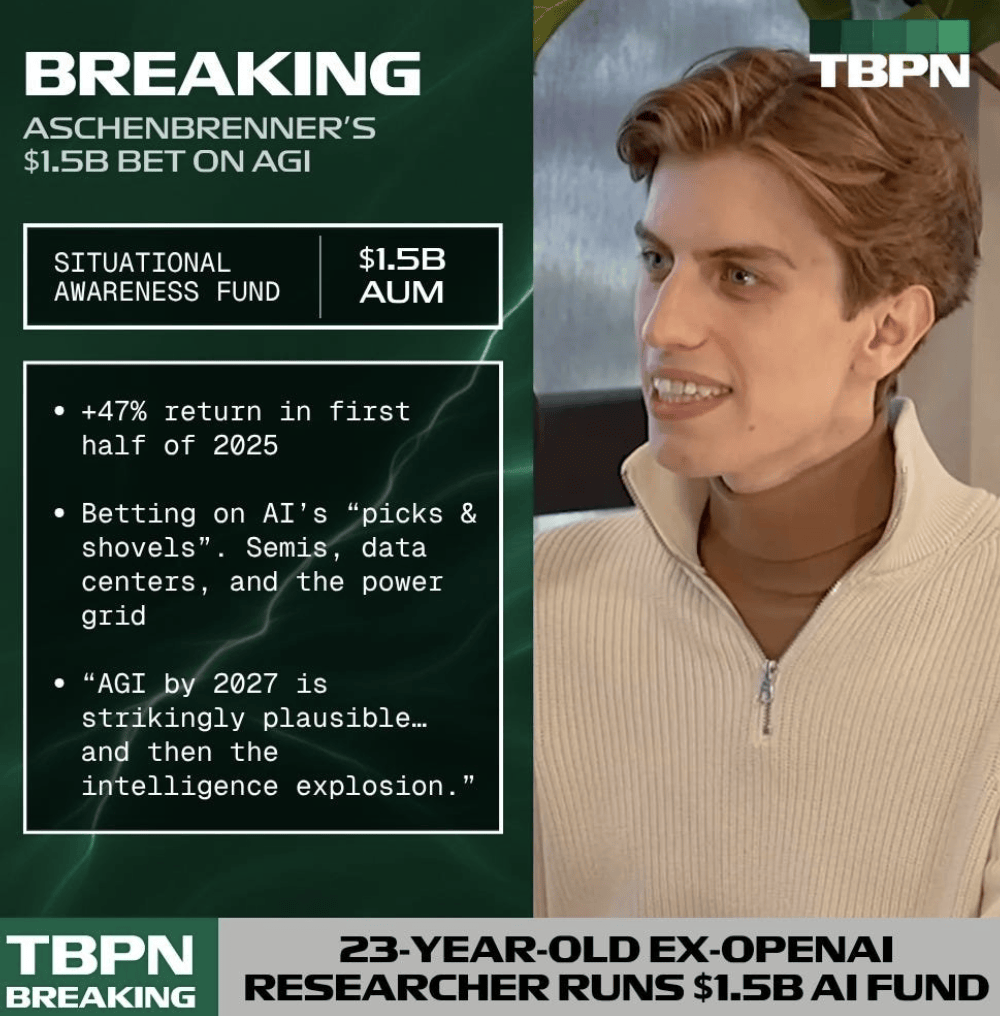
Core Viewpoint - The article discusses the remarkable rise of Leopold Aschenbrenner, a former OpenAI employee who founded a hedge fund that has significantly outperformed Wall Street, achieving a 700% higher return this year compared to traditional benchmarks [5][7][12]. Group 1: Background of Leopold Aschenbrenner - Aschenbrenner was a member of OpenAI's "super alignment" team and was dismissed for allegedly leaking internal information [10][12]. - After his dismissal, he published a 165-page analysis titled "Situational Awareness: The Decade Ahead," which gained widespread attention in Silicon Valley [10][19]. - He has a strong academic background, having graduated from Columbia University at 19 with degrees in mathematics, statistics, and economics [13][14]. Group 2: Hedge Fund Strategy and Performance - Aschenbrenner's hedge fund, named "Situational Awareness," focuses on investing in industries likely to benefit from AI advancements, such as semiconductors and emerging AI companies, while shorting industries that may be negatively impacted [11][12]. - The fund quickly attracted significant investment, reaching a size of $1.5 billion, supported by notable figures in the tech industry [11][12]. - In the first half of the year, the fund achieved a 47% return, far exceeding the S&P 500's 6% and the tech hedge fund index's 7% [12][28]. Group 3: Insights on AI Development - Aschenbrenner emphasizes the exponential growth of AI capabilities, particularly from GPT-2 to GPT-4, and the importance of "orders of magnitude" (OOM) in assessing AI progress [20][21]. - He identifies three main factors driving this growth: scaling laws, algorithmic innovations, and the use of vast datasets [22][26]. - Aschenbrenner predicts the potential arrival of Artificial General Intelligence (AGI) by 2027, which could revolutionize various industries and enhance productivity [26][28]. Group 4: Implications of AGI - The emergence of AGI could lead to significant advancements in fields such as materials science, energy, and healthcare, but it also raises concerns about unemployment and ethical governance [28][31]. - Aschenbrenner discusses the concept of "intelligence explosion," where AGI could rapidly surpass human intelligence and self-improve at an unprecedented rate [29][31]. - He argues that the development of AGI will require substantial industrial mobilization and improvements in computational infrastructure [31][33].

Manus、PlaudAI等齐聚,易点天下AIxDTC闭门交流活动都聊了啥?
Ge Long Hui· 2025-09-01 06:25
Group 1 - The event hosted by 易点天下 in Singapore focused on the development of global brands and technological evolution in the AI era, featuring participants from companies like Manus, PlaudAI, Twilio, and Paypal [1] - 易点天下 announced the upcoming launch of SEOpage.ai, the world's first self-developed SEO AI Agent, along with a comprehensive marketing solution for AI-driven overseas enterprises [1] - The new DTC and AIO solutions introduced by 易点天下 aim to shift brands from a passive response model to a proactive, data-driven growth model [1] Group 2 - Manus co-founder Zhang Tao discussed the future trends of general and vertical agents, emphasizing the significant value and development space for vertical agents, which require a focus on understanding data within specific fields and existing tool usage habits [2] - PlaudAI, an innovative tech company combining AI with hardware, launched the Plaud Note Pro and has over 1 million users across more than 170 countries [2] - Shopify has enhanced its AI capabilities and data insights, collaborating with 易点天下 to provide comprehensive support and efficiency improvements for merchants [2]
被OpenAI开除的00后搞投资,700%回报率降维暴击华尔街
Sou Hu Cai Jing· 2025-08-30 04:59
Core Insights - A 23-year-old named Leopold Aschenbrenner has rapidly grown his hedge fund, Situational Awareness, to manage $1.5 billion in assets within a year, achieving a remarkable 47% return in the first half of the year, significantly outperforming Wall Street averages [1][4][5]. Fund Overview - The fund, Situational Awareness, was founded in mid-2022 in San Francisco and focuses primarily on AI-related investments, particularly in AI semiconductors, infrastructure, and energy companies, while also investing in a few startups like Anthropic [4][5]. - The fund's return of 47% during the first half of 2023 starkly contrasts with the S&P 500's return of 6% and the technology hedge fund index's return of 7%, marking a 700% outperformance compared to the average Wall Street performance [4][5]. Investment Strategy - Leopold's investment strategy is straightforward, emphasizing an "ALL in AI" approach, with plans to hedge risks through smaller short bets against industries potentially disrupted by AI [5][6]. - The fund has attracted notable investors, including Patrick and John Collison (founders of Stripe) and Daniel Gross (from Meta's superintelligence team), indicating strong backing and credibility in the investment community [6]. Background of the Founder - Leopold Aschenbrenner, originally from Germany, graduated from Columbia University at 19 with degrees in mathematics, statistics, and economics. He briefly worked at OpenAI before being dismissed due to a security leak [6][8]. - His controversial report titled "Situational Awareness," which predicted the arrival of AGI by 2027, gained significant attention and laid the foundation for his investment philosophy [6][8].
被OpenAI开除的00后搞投资,700%回报率降维暴击华尔街
量子位· 2025-08-30 04:42
Core Insights - A 23-year-old individual, previously dismissed by OpenAI, has successfully grown his fund to over $1.5 billion within a year [1] - The fund achieved an impressive 47% return in the first half of the year, outperforming Wall Street's average by 700% [2][8] - The fund's investment strategy focuses on AI-related sectors, particularly AI semiconductors, infrastructure, and energy companies, along with some early-stage startups [10] Fund Performance - The fund's 47% return significantly surpasses the S&P 500's return of 6% and the technology hedge fund index's return of 7% during the same period [8] - The fund has attracted long-term investments from various notable investors, indicating strong confidence in its management and strategy [5] Investment Strategy - The fund's strategy, termed "ALL in AI," emphasizes investments in AI semiconductors and related sectors, while also planning small short bets to hedge against industries potentially disrupted by AI [10][12] - The fund is managed by Leopold, who has a background in mathematics, statistics, and economics, and has previously worked with OpenAI [16][18] Notable Backers - The fund has garnered support from prominent figures such as Patrick and John Collison (founders of Stripe) and Daniel Gross (from Meta's superintelligence team), enhancing its credibility [12] - The fund's name, "Situational Awareness," is derived from a report published by Leopold, predicting the arrival of AGI by 2027 [12][21] Background of the Manager - Leopold, who was born in Germany and graduated from Columbia University at 19, has a strong academic foundation [16] - After being dismissed from OpenAI for leaking internal security issues, he published a widely discussed report that contributed to his subsequent success in the investment field [19][21]

23岁小哥被OpenAI开除,成立对冲基金收益爆表,165页论文传遍硅谷
机器之心· 2025-08-30 04:12
Core Viewpoint - The article discusses the rapid rise of Leopold Aschenbrenner, a former OpenAI employee who was dismissed for allegedly leaking internal information, and his subsequent success in the investment field with a hedge fund that has significantly outperformed the market, particularly in AI-related investments. Group 1: Background of Leopold Aschenbrenner - Aschenbrenner was a member of OpenAI's "Superalignment" team and was considered close to the former chief scientist Ilya Sutskever before being fired for leaking internal information [7]. - He published a 165-page analysis titled "Situational Awareness: The Decade Ahead," which gained widespread attention in Silicon Valley [9][21]. - Aschenbrenner has a strong academic background, having graduated from Columbia University at 19 with degrees in mathematics, statistics, and economics, and previously worked at FTX Future Fund focusing on AI safety [16][17]. Group 2: Investment Strategy and Fund Performance - After leaving OpenAI, Aschenbrenner founded a hedge fund named Situational Awareness, focusing on industries likely to benefit from AI advancements, such as semiconductors and emerging AI companies [10]. - The fund quickly attracted significant investments, reaching a size of $1.5 billion, supported by notable figures in the tech industry [11]. - In the first half of the year, the fund achieved a 47% return, far exceeding the S&P 500's 6% and the tech hedge fund index's 7% [14]. Group 3: Insights on AI Development - Aschenbrenner's analysis emphasizes the exponential growth of AI capabilities, particularly from GPT-2 to GPT-4, and the importance of "Orders of Magnitude" (OOM) in evaluating AI progress [24][26]. - He identifies three main factors driving this growth: scaling laws, algorithmic innovations, and the use of massive datasets [27]. - Aschenbrenner predicts the potential arrival of Artificial General Intelligence (AGI) by 2027, which could revolutionize various industries and enhance productivity [29][30]. Group 4: Implications of AGI - The emergence of AGI could lead to significant advancements in productivity and efficiency across sectors, but it also raises critical issues such as unemployment and ethical considerations [31]. - Aschenbrenner discusses the concept of "intelligence explosion," where AGI could rapidly improve its own capabilities beyond human understanding [31][34]. - He highlights the need for robust governance structures to manage the risks associated with fully autonomous systems [31][36].

X @Andy
Andy· 2025-08-29 22:47
Layer-1 (L1) Blockchain Analysis - The discussion revolves around the legitimacy and potential of new Layer-1 blockchains [1] - The central question is whether a new L1 can achieve the prominence of Bitcoin or Ethereum [1] Specific L1 Project - Stripe's new L1 is considered as a potential candidate to become a leading blockchain [1] Experts' Perspectives - @im_manderson, @ayyyeandy, and @robbie_rollup are involved in the discussion [1]
Ethereum's Biggest Threat Is Here: What It Means For ETH!
Coin Bureau· 2025-08-29 14:01
Crypto Industry Trends - Stablecoin issuers and fintech companies are launching their own blockchains, creating uncertainty for the future of major chains like Ethereum [1][2] - Companies are building private, permissioned blockchains, potentially diminishing the appeal of public blockchains like Ethereum [2] Company Blockchain Initiatives - Circle is launching ARK, a new blockchain for stablecoin payments, aiming for 3,000 transactions per second and using USDC for gas fees [7] - Tether is backing Plasma and Stable, two new blockchains for stablecoin payments, with Plasma focusing on global remittances and Stable on user-friendly peer-to-peer payments [16][21] - Robin Hood is building Robin Hood Chain, a customizable EVM-compatible network, to bridge traditional finance and crypto by tokenizing real-world assets [26] - Stripe is building Tempo, a payments-focused Layer 1 blockchain, to control the entire payment stack and facilitate seamless stablecoin payments [37][38] Potential Impact on Major Chains - Ethereum risks losing its role as the primary payment rail if stablecoin activity shifts to corporate-backed chains [43] - Major chains may face existential risks as companies launch their own chains, potentially losing fee revenue and user base [47] - Ethereum is shifting towards high-value use cases like real-world assets, while day-to-day payments may move to purpose-built rails [50] Regulatory and User Experience Considerations - New regulations are driving mega banks and fintechs to issue their own stablecoins and build their own rails [45] - Company chains sacrifice decentralization for improved speed, privacy, and user experience, which may be appealing to many users [44]