
Cerebras

Search documents
G42 获得美国尖端人工智能芯片出口许可,为大规模部署可信赖的人工智能基础设施铺平道路
Globenewswire· 2025-11-28 07:00
Core Insights - The approval of advanced AI semiconductor exports to G42 by the White House marks a significant transition from planning to deployment in the UAE-US AI corridor, highlighting mutual trust and commitment to building secure and scalable AI infrastructure [1][2] - The G42-led UAE AI Gateway project includes a 1 GW AI computing cluster for OpenAI, part of a larger 5 GW AI infrastructure hub aimed at providing computing power and low-latency inference services across the Middle East [1][2] - G42 has established a world-class technology and compliance framework for the deployment of these advanced chips, adhering to the regulated technology environment (RTE) guidelines set by the US Department of Commerce and the Bureau of Industry and Security (BIS) [2] Group 1 - The collaboration between the UAE and the US is designed to ensure the secure global diffusion of American technology, with the deployment of advanced chips following strict regulatory standards [2] - G42's CEO emphasized that this announcement signifies a critical moment for G42 and its partners, establishing a new benchmark for secure and high-performance computing technology [2][3] - The UAE is currently the only country in the Middle East undertaking such large-scale infrastructure development that complies with US regulatory frameworks and export controls [2] Group 2 - Khaldoon Khalifa Al Mubarak, Secretary-General of the Artificial Intelligence and Advanced Technology Council, stated that this decision reflects the deep mutual trust in UAE-US relations and the strategic view that technology is a platform for stability and long-term cooperation [3] - G42 operates three of the world's top 500 supercomputers, with two ranking as the second and third in the Middle East, and its Maximus-01 supercomputer in New York ranking 20th globally [3] - G42's expanding AI infrastructure now spans Abu Dhabi, France, and several US states, including California, Minnesota, Texas, and New York [3] Group 3 - G42 is a technology holding group focused on pioneering AI technologies and driving global innovation, with a commitment to harnessing AI for the benefit of humanity across various sectors [4]

WhiteFiber (WYFI) CEO: Markets "Incorrect" on A.I. Sell-Off, Demand "Very Real"
Youtube· 2025-11-16 21:00
Core Insights - The primary concern in the industry is power scarcity, which is impacting the ability to meet the high demand for data centers driven by AI and hyperscalers [1][5][6] - There is a significant and ongoing demand for megawatt capacity from clients, particularly in the AI sector, despite market volatility [2][3] - The current trend in AI is viewed as a long-term secular growth opportunity, with many companies reporting strong AI-related earnings [4][6] Industry Demand and Trends - The demand for AI infrastructure is described as real and substantial, with companies struggling to keep up with this demand [2][3] - The slowdown in AI development is attributed to power limitations rather than financial constraints, indicating a shift in the challenges faced by the industry [5][6] - The industry is experiencing a circular funding model, which differs from traditional venture capital expectations [4][5] Company Strategy and Execution - White Fiber is focusing on retrofitting existing facilities into tier three data centers, which allows for quicker execution compared to building new facilities from scratch [9][11] - The company has successfully retrofitted a former mattress factory into a data center in six months, showcasing its operational efficiency [11] - White Fiber is leveraging its experience and established relationships, particularly with Nvidia, to enhance its market position and execution capabilities [15][17] Financial Performance and Outlook - The company has recently gone public and is using the capital to expand its data center operations, particularly a flagship facility in North Carolina with 99 megawatts of capacity [14][18] - Although the company reported a loss in its latest quarterly report, revenue is on the rise, and investments are being made in technology and software engineering to build a sustainable business model [18][19] - The focus is on performance rather than price competition, aiming to avoid a "race to the bottom" in the cloud business [19][20]

太卷了!专属Coding的新一代Arena榜单来了,有国产模型登上榜首
机器之心· 2025-11-13 10:03
Core Insights - The article highlights the rapid advancements in large model programming, emphasizing the competitive landscape among model vendors as they enhance coding capabilities and develop new tools [2][3] - The introduction of the Code Arena by LMArena marks a significant evolution in the evaluation of coding capabilities of large models, focusing on real-world application development rather than just code generation [4][6] Model Performance - The new Code Arena ranks the domestic model GLM-4.6 at the top, alongside Claude and GPT-5, showcasing its superior coding abilities [6][10] - GLM-4.6 has demonstrated a success rate of 94.9% in code modification tasks, closely trailing behind Anthropic's Claude Sonnet 4.5, which has a success rate of 96.2% [11] - The performance gap between open-source models and top proprietary models has significantly narrowed from 5-10 percentage points to mere basis points, indicating a rapid convergence in capabilities [14] Industry Trends - There is a noticeable shift among users towards utilizing GLM-4.6 for daily tasks, reflecting its growing acceptance and recognition in the AI programming community [15] - Cerebras has decided to adopt GLM-4.6 as its default recommended model, phasing out the previous model, which underscores the model's rising prominence in the industry [16] - The article emphasizes the remarkable acceleration of domestic models, transitioning from a phase of catching up to one of leading the market, particularly in the open-source ecosystem [17][18]

美国编程产品输出「中国话」
3 6 Ke· 2025-11-02 08:02
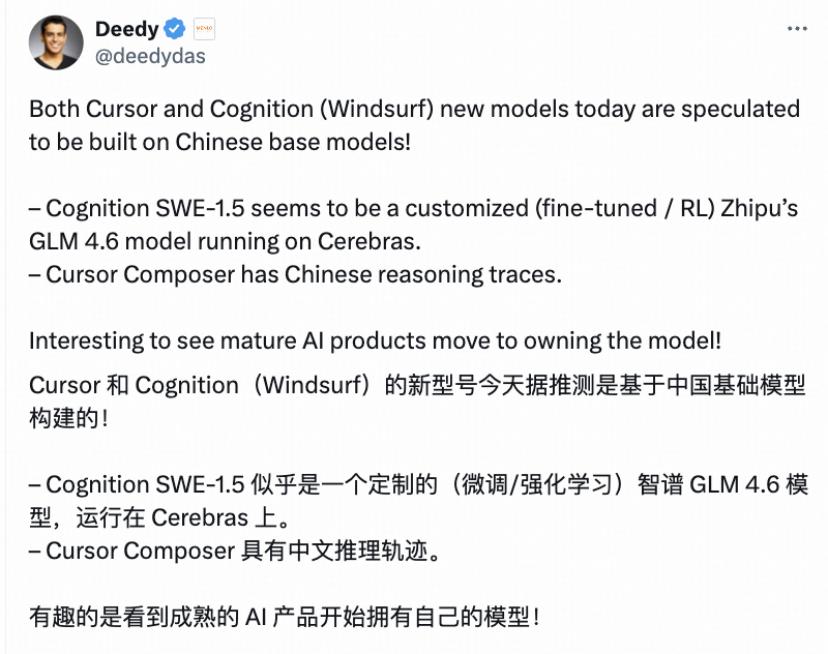
Core Insights - The article highlights a significant shift in the AI landscape, where American tech companies are increasingly adopting Chinese-developed large models for programming tools, marking a reversal from the previous trend where Chinese companies sought access to American models [5][6][7]. Group 1: Adoption of Chinese Models - Cursor and Windsurf, two prominent programming tools, have launched their own models, Composer and SWE-1.5, which are confirmed to utilize Chinese large models [1]. - The global user base of Cursor has reported frequent occurrences of Chinese characters in the code output, indicating the integration of Chinese models [1]. - Windsurf explicitly stated that its model is provided by the Chinese company "Zhiyu AI," further emphasizing the trend of American companies leveraging Chinese technology [1]. Group 2: Competitive Landscape - The article notes that the Chinese open-source models are recognized for their quality, speed, and affordability, making them attractive options for American AI companies [6][7]. - Vercel, a platform valued at $9.3 billion, has incorporated Zhiyu GLM-4.6 into its official API services, showcasing the growing acceptance of Chinese models in the U.S. market [5][6]. - The increasing presence of Chinese models in global rankings, particularly in the coding domain, demonstrates their competitive strength and recognition among key players [6][8]. Group 3: Market Dynamics - The AI coding sector is identified as a critical battleground for global competition, with significant developments from both American and Chinese companies [7]. - OpenRouter, a platform connecting various large models, has seen a surge in the usage of Chinese models, with Zhiyu GLM and Kimi being particularly popular among users [8]. - The introduction of subscription packages by Zhiyu and Kimi, priced significantly lower than their American counterparts, indicates a strategic move to capture market share and generate substantial revenue [11].
A Look Inside the FASTEST Data Center in the WORLD
Matthew Berman· 2025-10-31 17:25
What if you built a chip, but it was the size of a dinner plate that is 50 times the size of a traditional chip. This is Cerebras' wafer scale engine. And the size is not just for show.It's that big. So, they can hold the memory on the chip itself, vastly reducing the latency. This allows the chip to be up to 30 times faster than a traditional chip.To house this behemoth of a chip, Cerebrus built out an incredible data center in Oklahoma City, and the CEO took me on a tour. This data center has two gigantic ...

美国AI公司们,开始青睐Made in China的大模型
3 6 Ke· 2025-10-29 08:55
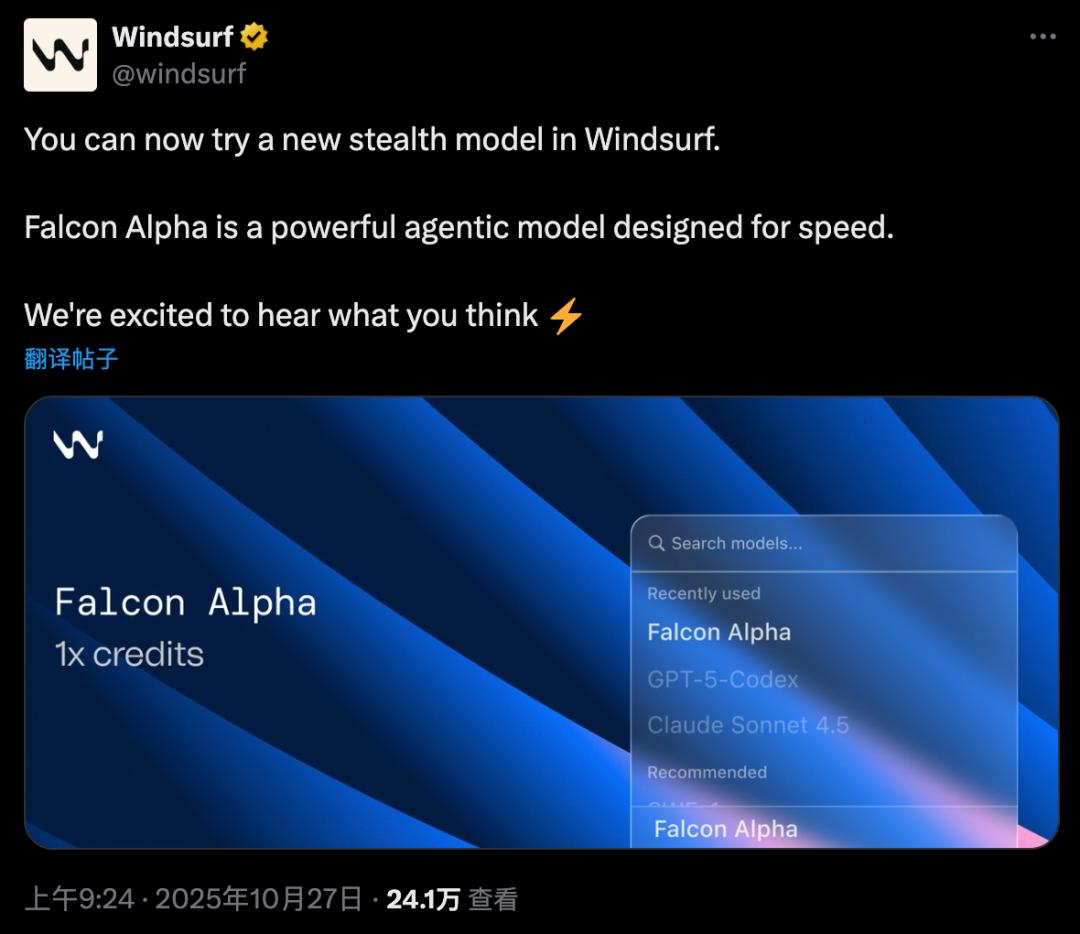
Core Insights - The article discusses the increasing adoption of Chinese AI models by American companies, highlighting a shift in the AI landscape where performance and cost-effectiveness are becoming key factors in model selection [1][22]. Group 1: Adoption of Chinese AI Models - Windsurf, a leading AI programming product, recently integrated a mysterious model that turned out to be based on China's GLM [5][9]. - Companies like Vercel and Featherless are collaborating with Chinese AI firms, indicating a trend where American companies are utilizing Chinese models for AI programming and reasoning [9][14]. - The performance of models like GLM-4.6 has been praised by industry leaders, showcasing the growing recognition of Chinese AI capabilities [11][17]. Group 2: Factors Driving Adoption - The primary reasons for the shift towards Chinese models are their strong performance and cost-effectiveness, as highlighted by industry experts [17][19]. - Social Capital's founder emphasized the high costs associated with models from OpenAI and Anthropic, making Chinese alternatives more appealing [19]. - The competitive pricing strategies of Chinese AI companies, such as promotional offers and free token distributions, further enhance their attractiveness to American firms [21][22]. Group 3: Implications for the AI Industry - The trend signifies a move from a focus on the most powerful models to a more pragmatic approach that prioritizes efficiency and economic viability [22]. - This shift challenges the notion that only the strongest models can succeed, indicating a more diverse and competitive global AI market [22][24]. - The increasing value of Chinese large models suggests a rising significance in the global AI landscape, reflecting a broader acceptance of their capabilities [24].
Inside the World's FASTEST Data Center | Cerebras
Matthew Berman· 2025-10-23 20:12
You open your AI chatbot. You type in your prompt and you hit enter. What happens next.We're pulling back the veil on the hidden backbone behind every AI response you see. Beneath the Oklahoma sky sits an unassuming concrete building. An AI factory built for one purpose.Speed. Heat. Heat.I'm standing in front of Cerebrus' brand new data center which they just did the ribbon cutting for and now they are serving 44 exaflops of new compute power to their customers. It is the fastest AI infrastructure on Earth ...

AI芯片,大泡沫?
半导体行业观察· 2025-10-21 00:51
Core Viewpoint - The article discusses the current state of the AI industry, comparing it to the internet bubble of 1999-2000, highlighting the rapid rise in valuations and the potential risks associated with companies like Coreweave [3][5]. Valuation and Market Trends - As of September, the Nasdaq composite index had a P/E ratio of 33, with major companies like Amazon, Apple, Google, Microsoft, Meta, and TSMC ranging from 27 to 39 [6]. - Nvidia's P/E ratio is notably high at 52, reflecting its leadership in the AI sector, while AMD's P/E has surged to 140 due to its acquisition of OpenAI [6][7]. - GenAI revenue is experiencing rapid growth, with predictions of AI data center investments reaching $5 trillion by 2030, primarily from large, profitable companies [6][7]. Adoption Rates and Consumer Behavior - GenAI adoption is accelerating, with ChatGPT reaching 100 million users in just two months, significantly faster than other platforms like TikTok and Facebook [6][11]. - A consumer AI market valued at $12 billion has emerged within two and a half years, with 60% of U.S. adults using AI in the past six months [11][12]. Enterprise Use Cases and Productivity - GenAI is expected to be the largest market, with significant applications in enhancing productivity, particularly in programming and financial analysis [13][14]. - Companies like Walmart and Salesforce are leveraging AI to avoid hiring additional staff while still achieving growth [14][15]. Competitive Landscape and Future Outlook - The cost of training advanced models is projected to reach billions, limiting participation to companies with substantial resources [16]. - Major players like Anthropic, AWS, Google, and Microsoft are expected to dominate, while smaller companies may need to specialize in niche markets [30][31]. - The article suggests that multiple winners may emerge in the GenAI space, as differentiation and ecosystem bundling are likely to occur [40]. Hardware and Infrastructure Challenges - The demand for data center capacity is surging, with predictions that the scale of data centers will grow significantly by 2026 [32]. - There are concerns about the adequacy of power supply to meet the growing needs of AI data centers, with projections indicating that AI could consume a substantial portion of the U.S. electricity supply by 2024 [38][39].

The Newest Artificial Intelligence Stock Has Arrived -- and It Claims to Make Chips That Are 20x Faster Than Nvidia
Yahoo Finance· 2025-10-19 11:30
Key Points Nvidia's GPUs are the backbone of generative AI infrastructure. Cerebras believes its wafer-style chip designs can deliver processing speeds 20 times faster than what Nvidia offers. Cerebras had previously planned to go public, but has tabled its path to the public exchanges following a recent funding round. 10 stocks we like better than Nvidia › Over the past three years, Nvidia (NASDAQ: NVDA) evolved from a niche semiconductor player into the most valuable company in the world. The c ...

Billionaire bosses like Jeff Bezos and Reid Hoffman denounce work-life balance—and some think working nonstop is key to success
Yahoo Finance· 2025-10-15 15:30
Core Insights - The concept of work-life balance is being redefined by prominent CEOs, with a preference for terms like "work-life harmony" or "work-life fluidity" to emphasize the interconnectedness of personal and professional life [2][3] Group 1: CEO Perspectives - Jeff Bezos criticizes the term "work-life balance," suggesting it implies a tradeoff, and instead promotes "work-life harmony," where happiness at home enhances work performance [2] - Microsoft CEO Satya Nadella shares a similar view, advocating for harmony over balance as the ultimate goal [2] - Nespresso's UK CEO Anna Lundstrom believes in "work-life fluidity," arguing that separating work and personal life is impractical for top executives [2] Group 2: Work Ethic and Commitment - Andrew Feldman, CEO of Cerebras, argues that achieving greatness requires more than a standard 40-hour work week, emphasizing that extraordinary accomplishments demand full-time dedication [6] - Feldman expresses disbelief at the notion that one can build something significant while adhering to a traditional work schedule, stating that true innovation requires every waking minute [6] - Lucy Guo, cofounder of Scale AI, exemplifies this commitment, having dedicated extensive hours to her company, which has led her to become a self-made billionaire at a young age [8]
