
SMIC

Search documents
摩根士丹利:中芯国际
摩根· 2025-05-10 10:11
Investment Rating - The investment rating for SMIC is Equal-weight [7]. Core Insights - SMIC's 1Q25 revenue was US$2.25 billion, reflecting a 2% quarter-over-quarter (Q/Q) increase and a 28% year-over-year (Y/Y) increase, driven by a 15% Q/Q growth in shipments due to geopolitical concerns, rising demand from consumption subsidies, and restocking in industrial and automotive sectors [2][5]. - The guidance for 2Q25 indicates a revenue decline of 4-6% Q/Q and a gross margin (GM) of 18-20%, down 2.5-4.5 percentage points Q/Q, attributed to a decline in blended average selling price (ASP) due to yield issues and rising equipment depreciation [3][5]. - Management expects the pressure on blended ASP to persist until Q3, with new equipment debugging taking time [3][5]. Summary by Sections Financial Performance - 1Q25 GM was 22.5%, up 0.1 percentage points Q/Q, exceeding market expectations by 2.1 percentage points and 1.8 percentage points, driven by a utilization rate (UTR) of 89.6% [2]. - Revenue projections for the fiscal years ending in 2025, 2026, and 2027 are US$10.155 billion, US$11.620 billion, and US$12.505 billion respectively [7]. Market Dynamics - The strong demand for AI inference is expected to drive revenue growth for SMIC's advanced nodes, although GM erosion from yield decline may negatively impact earnings performance [5]. - Management noted that rush orders from US customers are being observed as they build inventory for 2025 and 2026, with limited financial impact on SMIC due to capacity constraints and logistics bottlenecks [9]. Capacity and Investment - SMIC plans to expand capacity at a rate of an additional 50 kilowatts per month (kwpm) per year, with 82-85% of the US$7.5 billion capital expenditure in 2025 allocated for equipment purchases [9]. - R&D expenses are expected to account for 8-10% of revenue in the long run, despite a temporary reduction in Q1 due to rush orders occupying capacity [9].

Nvidia Stock Falls on Export Control Warning. Why This Could Be a Great Buying Opportunity.
The Motley Fool· 2025-04-23 01:15
Core Viewpoint - Nvidia's stock has declined significantly due to a $5.5 billion charge related to new export restrictions on its H2O GPUs, particularly affecting sales to China, leading to a 25% drop in share price as of early 2025 [1] Group 1: Impact of Export Restrictions - Nvidia's H20 chip, designed for the Chinese market, now requires an export license to sell to China, which will limit its sales [2] - China was Nvidia's fourth-largest market in fiscal year 2024, generating $17 billion in sales, but revenue from China has halved since the original export restrictions [3] - The H20 export ban affects 13% of Nvidia's total revenue of $130.5 billion from the last fiscal year, but other chips like L20 and L2 are still available for sale [4] Group 2: Market Dynamics and Alternatives - There is no direct replacement for Nvidia's chips in China, as Huawei's AI chips face manufacturing limitations due to restricted access to advanced lithography tools [5] - Nvidia may redirect manufacturing capacity from H20 chips to higher-cost chips like Hopper and Blackwell, potentially benefiting the company [6][7] Group 3: Demand and Future Growth - Overall demand for Nvidia's chips remains strong, with major cloud computing companies planning to spend over $250 billion on AI data center capital expenditures this year [8] - Companies like OpenAI and Meta are heavily investing in AI infrastructure, indicating a robust market for Nvidia's products [9] - Nvidia anticipates AI data center capex to exceed $1 trillion by 2028, suggesting significant growth potential even without Chinese revenue [10] Group 4: Stock Valuation and Investment Opportunity - Nvidia's stock is currently trading at a forward P/E ratio of under 23 and a PEG ratio of 0.44, indicating it is undervalued [12] - If $15 billion in Chinese revenue were removed, Nvidia's revenue growth would decrease from 54% to 43%, and earnings per share would drop by about $0.35, still leaving the stock attractively valued [13][14] - This situation presents a good opportunity for investors to accumulate Nvidia shares, especially during any further price pullbacks [14]



英伟达-英伟达 H20 这样的产品在中国市场的前景如何
2025-04-15 07:00
Summary of NVIDIA Corp. Conference Call Company Overview - **Company**: NVIDIA Corp. - **Industry**: Semiconductors - **Market Cap**: $2,695.331 million [8] - **Stock Rating**: Overweight [8] - **Price Target**: $162.00 [8] - **Current Stock Price**: $107.57 [8] Key Points on H20 Product and Market Dynamics - **H20 Product**: A performance-limited version of the H100, designed to comply with US export restrictions to China, with performance approximately 75% below H100 [2][11] - **Market Assumptions**: It is assumed that H20 will face meaningful restrictions, although recent reports suggest potential for continued shipments [1][3] - **Gross Margins**: H20 gross margins are estimated to be in the 50s, significantly lower than the corporate average of 70s, impacting overall profitability [2][17] - **Sales Forecast**: H20 sales are projected to exceed $5 billion in each of the last two quarters [6] Competitive Landscape - **Performance Comparison**: H20 is significantly less powerful than alternatives like Blackwell, which offers up to 25x better performance [4] - **Chinese Market Dynamics**: Chinese companies are restricted from purchasing high-end GPUs, leading to reliance on products like H20 or AMD's MI308 [4][12] - **Local Competition**: As the state-of-the-art performance doubles every few years, H20's viability in the Chinese market is increasingly challenged [12] Export Control Regulations - **Current Regulations**: The Biden administration's "AI diffusion" rules are still in effect, limiting cluster sizes in China but allowing H20 shipments [13][19] - **Future Outlook**: Anticipation of changes in export controls, with potential impacts on H20's market presence and NVIDIA's sales in China [13][22] - **Licensing Concerns**: Restrictions on tier two countries could delay multinational operations, complicating NVIDIA's global strategy [22] Financial Projections - **Earnings Per Share (EPS)**: Projected EPS for fiscal years 2025 to 2028 are $2.99, $4.44, $5.38, and $6.18 respectively [8] - **Revenue Growth**: Expected revenue growth of 50.8% in 2025 and 17.64% in 2026, driven by data center demand and AI applications [37] Risks and Considerations - **Market Sentiment**: Current market sentiment is negative due to export control concerns, but NVIDIA's overall demand for GPUs remains strong [21] - **Potential Bans**: An outright ban on H20 could negatively impact stock prices, but growth from other segments may offset this [28] - **Long-term Viability**: H20's long-term viability is questioned as performance thresholds remain unchanged while competition increases [12][27] Conclusion - **Strategic Positioning**: NVIDIA is navigating complex regulatory environments while maintaining a focus on AI and data center growth, with H20 serving as a critical, albeit lower-margin, product in the Chinese market [18][38] - **Investment Outlook**: Despite challenges, NVIDIA's strong positioning in AI hardware and anticipated revenue growth present a compelling investment case, with a focus on managing export control risks [32][37]
人工智能供应链-推出我们对 2026 年前先进封装(CoWoS)的预测
2025-04-14 01:32
Summary of Key Points from the Conference Call Industry Overview - The focus is on the AI supply chain, particularly the CoWoS (Chip on Wafer on Substrate) capacity and its implications for the global AI market, with TSMC's decisions being pivotal for 2026 capacity allocation [1][2][3]. Core Insights - **TSMC's Capacity Expansion**: TSMC is expected to adopt a conservative approach for its 2026 CoWoS capacity expansion, with an early decision anticipated in mid-May based on customer demand feedback. Current expectations suggest an increase from approximately 70-75k to 105-125k in 2026 [2][3]. - **Forecasted Growth**: The forecast for CoWoS capacity is set at 70kwpm for 2025 (doubling from 2024) and 90kwpm for 2026, indicating a year-over-year growth of 119% in 2025 and 29% in 2026 [3]. - **China's GPU Supply Chain**: There is a noted decoupling of China's GPU and CoWoS supply chain from global suppliers, with local production expected to ramp up if SMIC can enhance its capacity [4][5]. - **AI Capex in China**: Chinese cloud service providers (CSPs) are projected to spend up to RMB 300 billion on AI capital expenditures from 2026 to 2028, with significant allocations for GPUs [5][47]. Additional Important Points - **Tariff Impacts**: The ongoing tariff policies are expected to influence AI capital expenditures and procurement costs, creating uncertainty in the market [2][11][15]. - **Demand for Local GPUs**: There is a strong demand for local GPUs in China, although dependency on domestic production remains low outside of government use [44][45]. - **Spot Price Trends**: The demand for Nvidia's gaming graphics cards has surged, leading to increased spot prices, while rental prices for AI GPUs are trending downward ahead of new product launches [10][11]. - **Customer Allocation**: Nvidia is expected to see a 35% year-over-year growth in CoWoS consumption in 2026, driven by larger chip sizes, while AWS and Google are also anticipated to gain market share in AI ASICs [13][16]. Data Highlights - **CoWoS Demand Breakdown**: The total demand for CoWoS wafers is projected to grow significantly, with Nvidia, Broadcom, and AMD being the key customers [18][27]. - **Revenue Projections**: AI computing wafer consumption is expected to generate up to $16.1 billion in revenue by 2025, with Nvidia being the largest customer [41][43]. - **HBM Demand**: The demand for High Bandwidth Memory (HBM) is projected to reach nearly double the 2024 levels, with Nvidia again being the largest consumer [34][39]. Conclusion - The AI supply chain is poised for significant growth, driven by advancements in CoWoS technology and increasing demand for AI capabilities. However, external factors such as tariffs and geopolitical dynamics will play a crucial role in shaping the landscape.


2024 年 Q4 全球晶圆代工行业收入同比增长 26%
Counterpoint Research· 2025-03-18 09:14
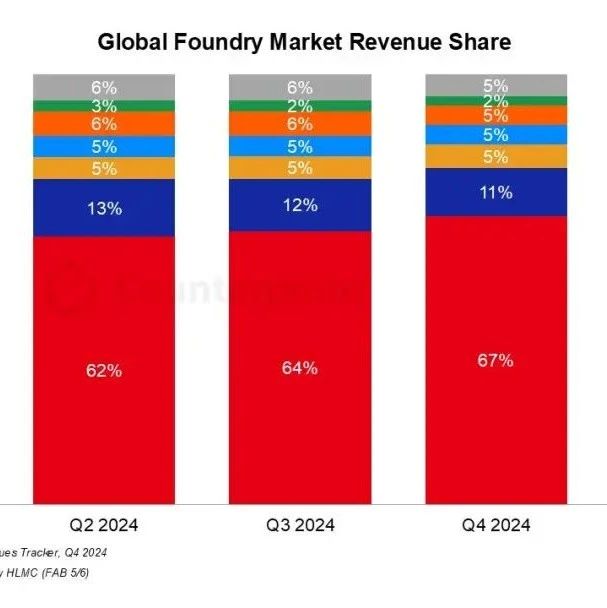
Core Viewpoint - The global wafer foundry industry is expected to see a 26% year-on-year revenue growth and a 9% quarter-on-quarter growth in Q4 2024, driven primarily by strong AI demand and the ongoing recovery of the Chinese market [1][3]. Summary by Sections Industry Performance - The advanced process capacity utilization remains high, driven by AI and flagship smartphone demand, particularly for TSMC's N3 and N5 processes [1][3]. - The overall utilization rate for global (excluding China) mature process foundries hovers between 65%-70%, with 12-inch processes recovering faster than 8-inch processes due to weaker demand in automotive and industrial sectors [1][3]. Demand Recovery - Non-AI demand is gradually recovering, particularly in consumer electronics and PC semiconductor sectors, supported by pre-production demand related to U.S. tariffs and demand driven by Chinese subsidies [1][3]. - Advanced packaging demand remains strong and stable, with TSMC actively expanding its CoWoS-L and CoWoS-R capacities, alleviating previous market concerns regarding capacity and order adjustments [1][3]. Company-Specific Insights - TSMC's revenue share reached a record 67% in Q4 2024, up from 64% in the previous quarter, primarily due to high capacity utilization in advanced processes [4]. - Samsung Foundry experienced a slight quarter-on-quarter revenue decline in Q4 2024, attributed to lower-than-expected demand for Android smartphones, leading to a decrease in its market share from 12% to 11% [5]. - SMIC's performance in Q4 2024 met expectations, with revenue growth driven by the recovery in consumer electronics and domestic localization efforts, although overall capacity utilization decreased from 90.4% to 85.5% [6]. - UMC's performance in Q4 2024 was stable, supported by occasional urgent orders in consumer electronics, but faced pricing pressure and a negative impact from a January earthquake [7]. - GlobalFoundries reported stable performance in Q4 2024, with strong wafer shipments offsetting seasonal weakness in the smartphone sector, driven by automotive demand and growth in communication infrastructure [8]. Analyst Commentary - The strong performance of the wafer foundry industry in Q4 2024 is largely attributed to the surge in AI and flagship smartphone demand, maintaining high capacity utilization in advanced processes [9].
全球晶圆厂TOP 10,中国大陆三家入围
半导体行业观察· 2025-03-11 00:53
Core Viewpoint - The global wafer foundry industry is experiencing a polarized development in Q4 2024, with advanced processes benefiting from the growth of emerging applications like AI servers and new flagship smartphones, leading to a nearly 10% quarter-on-quarter revenue increase for the top ten foundries, reaching a record high of $38.48 billion [1]. Group 1: Industry Overview - The advanced process segment is seeing growth due to demand from AI servers and new smartphone platforms, which is offsetting the decline in demand for mature processes [1]. - The new tariff policies from the U.S. government are beginning to impact the wafer foundry industry, with increased orders for TVs and PCs expected to continue into Q1 2025 [1]. - China's subsidy policy for upgrading appliances has led to increased inventory replenishment, further boosting demand for advanced chips from TSMC [1]. Group 2: Company Performance - TSMC's revenue in Q4 2024 is projected to grow to $26.85 billion, maintaining a market share of 67% [2]. - Samsung Foundry's revenue is expected to decrease slightly by 1.4% to $3.26 billion due to client transitions [2]. - SMIC's revenue is forecasted to increase by 1.7% to $2.2 billion, benefiting from new 12-inch capacity and improved product mix [2]. - UMC's revenue is expected to decrease marginally by 0.3% to $1.87 billion, while GlobalFoundries is projected to grow by 5.2% to $1.83 billion [2]. Group 3: Market Dynamics - HuaHong Group's revenue is anticipated to increase by 6.1% to $1.04 billion, driven by improved capacity utilization [3]. - Tower's revenue is expected to grow by 4.5% to $387 million, while VIS is projected to see a 2.3% decline to $357 million due to weakened consumer demand [3]. - Nexchip's revenue is expected to increase by 3.7% to $344 million, marking a rise in market ranking [3]. - PSMC's revenue is expected to decline, resulting in a drop in market ranking, although it remains slightly above Nexchip for the year [3].
ACM Research(ACMR) - 2024 Q4 - Earnings Call Transcript
2025-02-26 22:38
Financial Data and Key Metrics Changes - For Q4 2024, the company reported revenue of $223 million, an increase of 31% compared to Q4 2023. For the full year 2024, revenue reached $782 million, up 40% year-over-year [13][41]. - Gross margin for Q4 was 49.8%, compared to 46.8% in Q4 2023, while the full-year gross margin was 50.4%, up from 49.8% in 2023 [44]. - Operating profit increased by 46% in Q4 and 63% for the full year [13]. - Net income for Q4 was $37.7 million, up from $28.7 million in Q4 2023, and for the full year, net income was $152.2 million compared to $107.4 million in 2023 [48]. Business Line Data and Key Metrics Changes - Revenue from Single Wafer Cleaning, Tahoe, and Semi-Critical Cleaning products grew by 43% in 2024, representing 74% of total revenue [18][43]. - Revenue from ECP, furnace, and other technologies increased by 46% in 2024, contributing significantly to overall revenue [21][43]. - Advanced packaging revenue, excluding ECP services and spares, grew by 3% in 2024, representing 7% of total revenue [24][43]. Market Data and Key Metrics Changes - The global semiconductor WFE market is expected to grow by 4% in 2024 to $107 billion, while the Mainland China WFE market is projected to grow by 12% to $38 billion [16]. - The company estimates its product portfolio addresses an $18 billion global market opportunity [15]. Company Strategy and Development Direction - The company is focused on localizing its supply chain due to recent U.S. export restrictions, aiming to reduce reliance on U.S. sourced components [10][11]. - The company plans to continue expanding its market presence and product offerings, particularly in cleaning, plating, and advanced packaging [15][39]. - The company is also investing in R&D and sales to reach new customers globally, with a long-term gross margin target range adjusted to 42% to 48% [36][46]. Management's Comments on Operating Environment and Future Outlook - Management expressed confidence in managing the impact of U.S. export controls, noting that while some customers are affected, others continue to expand [10][69]. - The company reiterated its revenue outlook for 2025, projecting a range of $850 million to $950 million, indicating a 15% year-over-year growth at the midpoint [36][37]. Other Important Information - The company has begun operations at its new Lingang Production and R&D Center, which is expected to enhance production capabilities [27]. - ACM Shanghai has become a key supplier in the Asia semiconductor industry, contributing dividends to the parent company [31][32]. Q&A Session Summary Question: Can you provide color on the assumptions for the fiscal '25 revenue outlook? - Management indicated that the revenue prediction is based on last year's shipment records and customer expansion plans, with visibility clearer through Q3 but less so for Q4 [57][60]. Question: What impact do the export control rules have on customer spending plans? - Management noted that the impact varies by customer, with some affected by being added to the Entity List while others continue to expand [68][69]. Question: What is the market share for plating in front-end versus back-end applications? - Management stated that the market share for plating is approximately 30% to 35% in both front-end and back-end applications [70][72].

ACM Research(ACMR) - 2024 Q4 - Earnings Call Transcript
2025-02-26 14:54
Financial Data and Key Metrics Changes - For Q4 2024, the company reported revenue of $223 million, an increase of 31% compared to Q4 2023. For the full year 2024, revenue reached $782 million, up 40% year-over-year [13][41] - Gross margin was 49.8% for Q4 and 50.4% for the full year, compared to 46.8% and 49.8% in the previous year, respectively [44] - Operating profit increased by 46% in Q4 and 63% for the full year, with operating income of $52.8 million for Q4 [13][48] - Net income attributable to the company was $37.7 million for Q4, up from $28.7 million, and $152.2 million for the full year, compared to $107.4 million in 2023 [48] Business Line Data and Key Metrics Changes - Revenue from Single Wafer Cleaning, Tahoe, and Semi-Critical Cleaning products grew by 43% in 2024, representing 74% of total revenue [18][43] - Revenue from ECP, furnace, and other technologies increased by 46% in 2024, contributing over $150 million for the year [21][43] - Advanced packaging revenue, excluding ECP services and spares, grew by 3% in 2024, representing 7% of total revenue [24][43] Market Data and Key Metrics Changes - The global semiconductor WFE market is expected to grow by 4% in 2024 to $107 billion, while the Mainland China WFE market is projected to grow by 12% to $38 billion [16] - The company estimates its product portfolio addresses an $18 billion global market opportunity, with significant growth attributed to market share gains and new product cycles [15][17] Company Strategy and Development Direction - The company is focused on localizing its supply chain in response to U.S. export restrictions, reducing reliance on U.S. sourced components [10][11] - The company aims to expand its market presence and product offerings, particularly in cleaning, plating, and advanced packaging technologies [15][39] - The company is also investing in R&D and sales to enhance its product line and reach new customers globally [46] Management's Comments on Operating Environment and Future Outlook - Management expressed confidence in managing the impact of recent U.S. export controls, stating that the production impact is manageable [12][10] - The company reiterated its revenue outlook for 2025, projecting a range of $850 million to $950 million, implying a 15% year-over-year growth at the midpoint [36] - Management highlighted the importance of customer relationships and ongoing evaluations of the impact of export controls on customer spending plans [69][70] Other Important Information - The company has begun operations at its new Lingang Production and R&D Center, which is expected to enhance product development and manufacturing capabilities [27] - ACM Shanghai, a subsidiary, has become a key supplier in the Asian semiconductor industry and is expected to continue providing dividends to support global business development [31][34] Q&A Session Summary Question: Can you provide color on the assumptions for the fiscal '25 revenue outlook? - Management indicated that the revenue prediction is based on last year's shipment records and customer expansion plans, with visibility clearer through Q3 but less so for Q4 [57][60] Question: What impact do the recent export controls have on customer spending plans? - Management noted that the impact varies by customer, with some experiencing effects due to being added to the Entity List, while others continue to expand [68][70] Question: What is the market share for plating in front-end versus back-end applications? - Management estimated the market share for plating in China to be around 30% to 35%, consistent across both front-end and back-end applications [72]