OPPO

Search documents
端侧AI再迎催化!豆包发布手机助手预览版,消费电子50ETF(159779)冲击两连涨
2 1 Shi Ji Jing Ji Bao Dao· 2025-12-01 05:57
Group 1 - The consumer electronics sector is experiencing a resurgence, with the Consumer Electronics 50 ETF (159779) rising by 1.46%, marking two consecutive days of gains [1] - Notable stocks within the sector include Beijing Junzheng and Transsion Holdings, both rising over 10%, while companies like Lingyi iTech, Lens Technology, and Zhaoyi Innovation saw increases of nearly 5% [1] - The launch of the Doubao APP mobile assistant, an AI tool that integrates with smartphone operating systems, is expected to enhance user interaction through voice commands and is being developed in collaboration with multiple smartphone manufacturers [1] Group 2 - Dongwu Securities highlights that the development of AI on mobile devices is driving hardware upgrades, potentially leading to a new wave of smartphone replacements [2] - The evolution of on-device large models is shifting AI from a mere interactive tool to an "embodied intelligent agent," expanding its application from voice assistance to multimodal understanding and personalized productivity tasks [2] - The Consumer Electronics 50 ETF (159779) tracks the CSI Consumer Electronics Theme Index, which includes leading companies in AI smartphones and AIPC, with top holdings such as Luxshare Precision, SMIC, and Cambrian [2]
本周2只新股可申购 国产GPU赛道再添猛将
Chang Sha Wan Bao· 2025-12-01 04:59
Group 1: New Stock Offerings - Two new stocks available for subscription this week: Beijing Angrui Microelectronics Technology Co., Ltd. and Muxi Integrated Circuit (Shanghai) Co., Ltd. [1] - Muxi is recognized as the "second domestic GPU stock" following Moore Threads, focusing on AI training inference, general computing, and graphics rendering with fully proprietary GPU IP [1][2] Group 2: Company Profiles - Angrui Micro is a leading domestic manufacturer of RF front-end chips, supported by investments from Xiaomi and Huawei, with a market share of approximately 20% in the domestic RF front-end market [1][2] - The company has a comprehensive product line covering all series of RF front-end chips for 5G/4G/3G/2G, achieving performance levels comparable to international competitors [2] - Muxi has established a clear product matrix with three main product lines, including the "Xiyun C series" for AI training and general computing, the "Xisi N series" for AI inference, and the "Xicai G series" for graphics rendering [2] Group 3: Financial Performance - Muxi's revenue is projected to grow from 426,400 yuan in 2022 to 743 million yuan in 2024, reflecting a compound annual growth rate of 4074.52% [3] - Angrui Micro ranks among the top three domestic RF front-end manufacturers with a revenue scale of 2.101 billion yuan in 2024 [2] Group 4: Market Trends - The new stock market has maintained a record of zero first-day price drops, with electronic stocks averaging a first-day increase of 248.04% as of November 28 [3] - Notable first-day performance includes Dingjia Precision on the North Exchange with a 479.12% increase and Tongyu New Materials on the Growth Enterprise Market with a 128.05% increase [3]
双十一手机真实销量:只有苹果OV赢麻,小米华为荣耀却下跌了
3 6 Ke· 2025-12-01 04:08
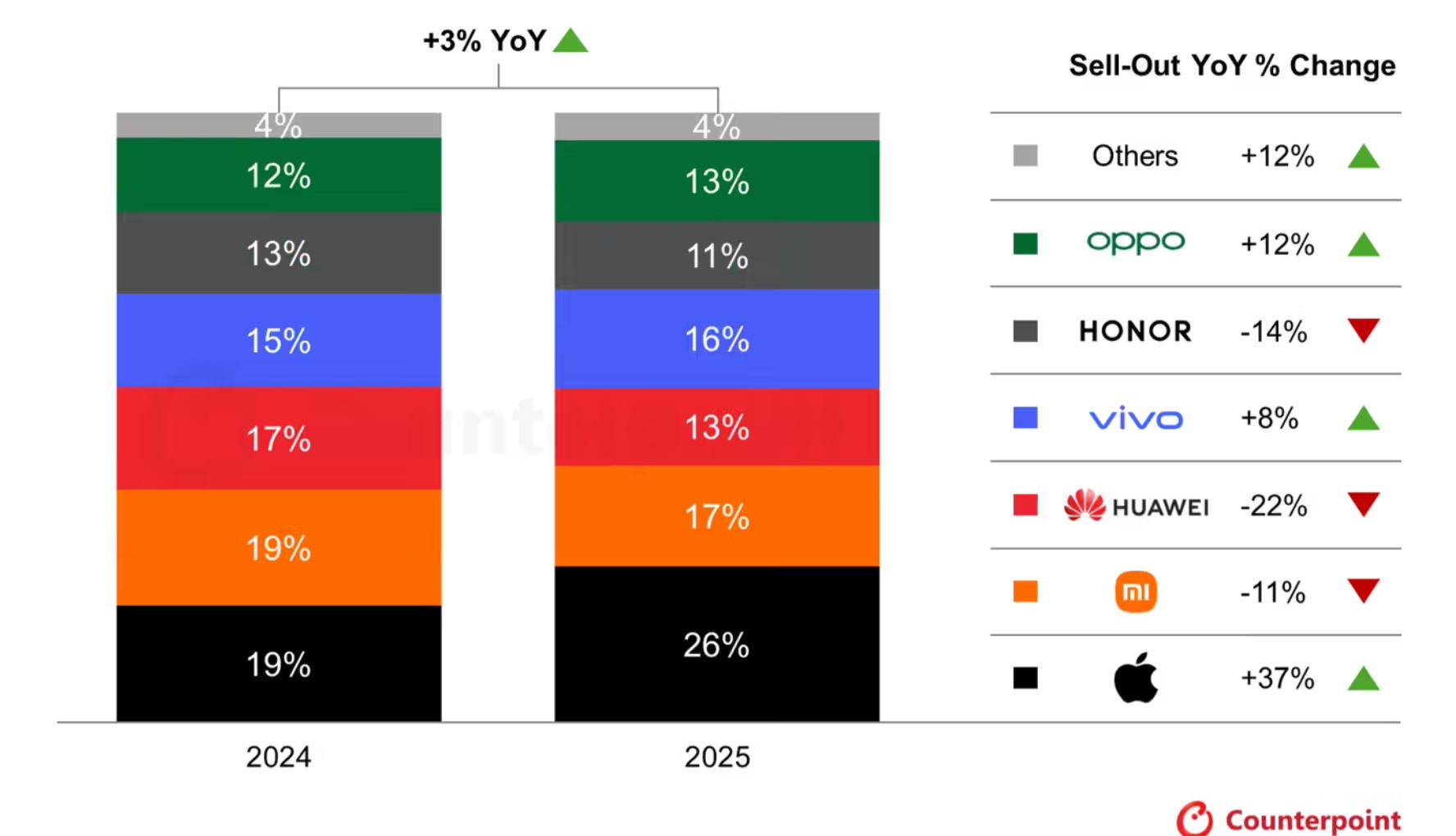
Core Insights - The 2023 Double Eleven shopping festival saw significant sales fluctuations among major smartphone brands, with Apple experiencing a 37% increase in sales, while Xiaomi, Huawei, and Honor faced declines of 11%, 22%, and 14% respectively [1][3][5]. Sales Performance - Apple's sales surge is attributed to the strong performance of the iPhone 17, despite a strict pricing strategy limiting discounts to around 500 yuan [3][5]. - Xiaomi's decline is linked to the early launch of the Xiaomi 17 series, which sold over 1 million units before the Double Eleven period, resulting in lower sales during the event [7][11]. - Huawei's significant drop in sales is due to a lack of new product launches during the Double Eleven period, with previous successful models released earlier in the year [8][10]. Market Dynamics - The competitive landscape is shifting, with OPPO and Vivo reporting sales growth due to successful new product launches, contrasting with the declines of Xiaomi and Huawei [11][12]. - Consumer behavior is changing, with a growing preference for first-sale benefits over traditional Double Eleven discounts, indicating a shift in purchasing psychology [13][15]. Future Trends - The smartphone market is evolving, with brands likely to adjust their strategies for future sales events, potentially leading to earlier flagship releases to capture consumer interest [16].



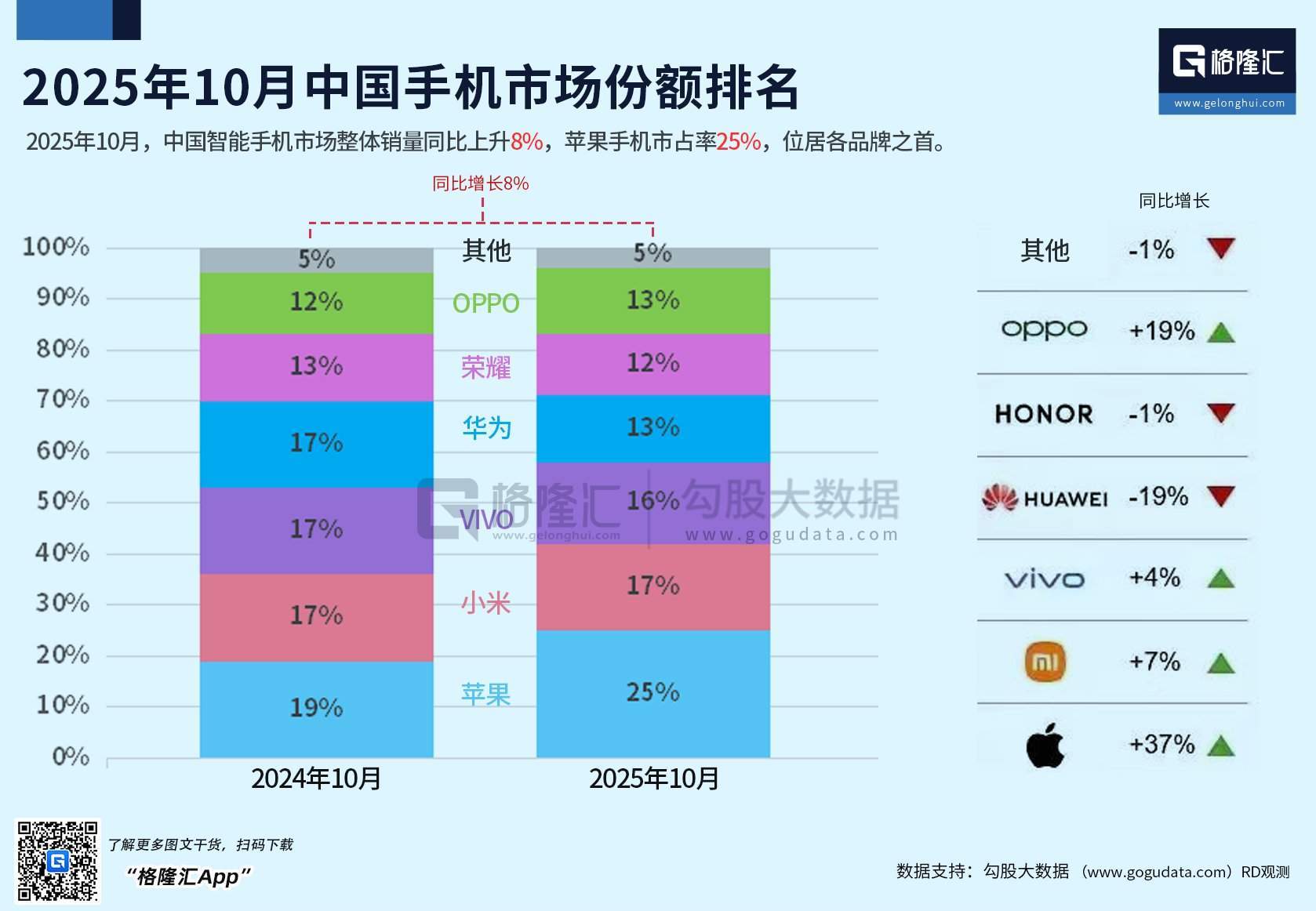
2025年10月中国手机市场份额排名:苹果市占率升至25%排第一,小米17%列第二名,vivo市占率16%第三,华为13%与OPPO并列第四
Ge Long Hui· 2025-12-01 02:38
Core Insights - In October 2025, iPhone shipments in China increased by 37% year-over-year, achieving a market share of 25%, marking the first increase since 2022 [1] - The iPhone 17 series, particularly the standard iPhone 17, significantly contributed to this growth, driving overall sales [1] - Apple's strong performance led to an 8% growth in the Chinese smartphone market [1] Company Performance - Xiaomi's 17 series also performed well, with October sales increasing by 7% year-over-year, securing the second position in the market [1] - Vivo ranked third with a market share of 16%, experiencing a 4% year-over-year growth [1] - OPPO's smartphone sales rose by 19% year-over-year in October, driven by demand for the new Find X9 model [1]
抢占全球AI营销版图,天娱数科与马来西亚Seahub达成深度战略合作
Zheng Quan Shi Bao Wang· 2025-12-01 01:27
Group 1 - Tianyu Digital Technology (002354) has officially reached a strategic cooperation with Seahub, focusing on cross-border e-commerce and localized marketing services, leveraging AI technology and local resources to create an efficient service system for global brands [1] - Seahub is recognized as an official service provider for TikTok Shop and a core partner for Shopee Live, having successfully provided comprehensive services for over a hundred international and regional brand clients in the Southeast Asian market [1] - Tianyu Digital Technology emphasizes a core strategy of "digitalization, intelligence, and globalization," continuously promoting the practical application of AI and global layout, supported by various AI models and algorithms [1] Group 2 - The cooperation marks a key advancement in Tianyu Digital Technology's globalization strategy, transitioning from "APP going overseas" to "capability going overseas," aiming to convert China's AI technology and marketing experience into sustainable business models [2] - Seahub's management expresses confidence in enhancing localized service quality in Southeast Asia by combining Tianyu Digital Technology's AI capabilities with local e-commerce insights [2] - Tianyu Digital Technology's leadership reiterates the commitment to integrating cutting-edge global technology with practical AI experience to drive global resource allocation and sustainable growth for enterprises [2]

有多少人半夜玩手机,结果被HDR照片闪瞎了
3 6 Ke· 2025-12-01 00:25
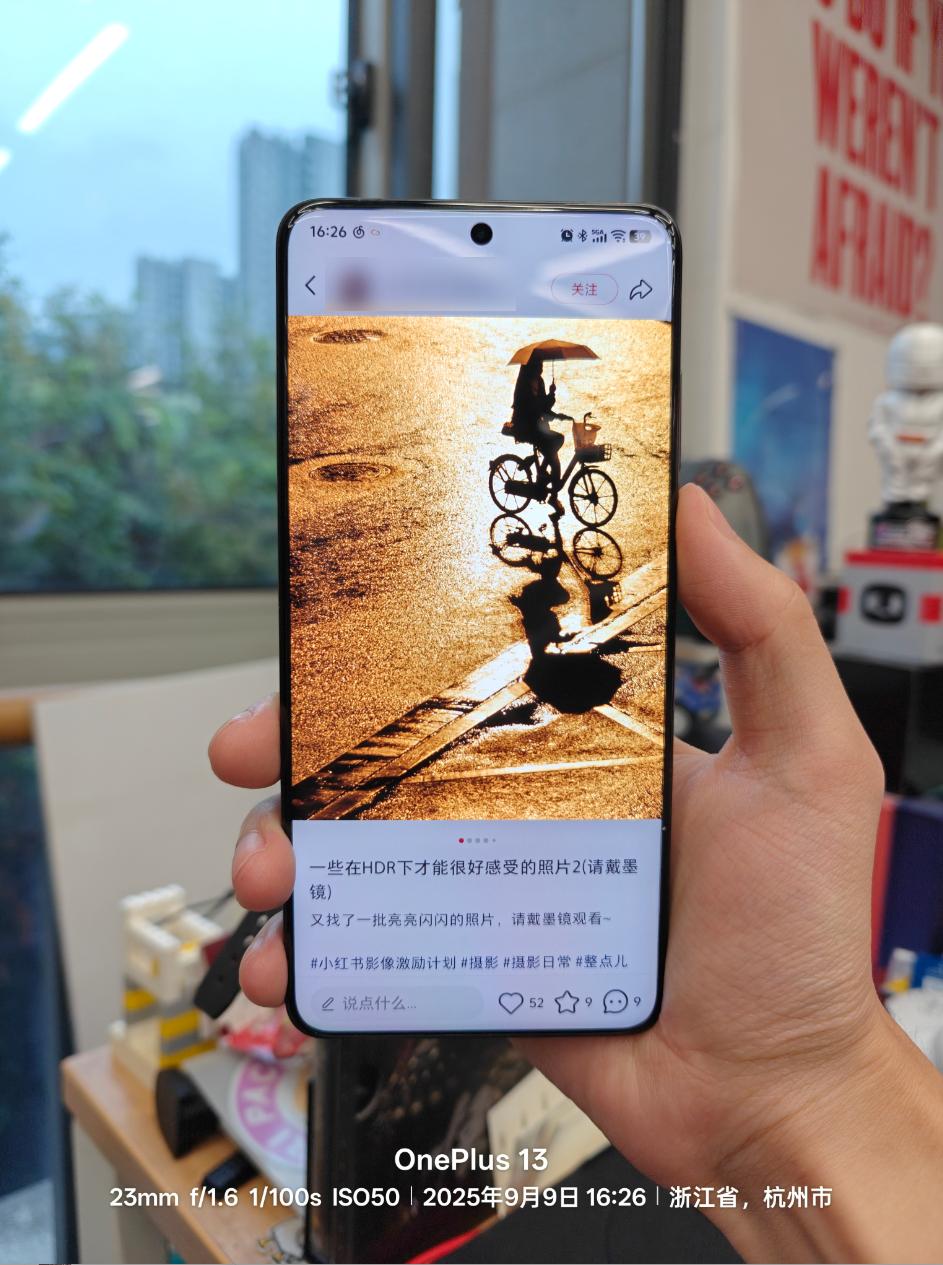
Core Viewpoint - The article discusses the evolution and current state of HDR (High Dynamic Range) imaging technology, highlighting its transition from professional use to mainstream consumer adoption, driven by advancements in smartphone technology and social media platforms [5][34]. Group 1: HDR Technology Overview - HDR technology has been around since the late 1990s, with its roots tracing back to the 1850s when photographers began experimenting with multiple exposures to capture a wider dynamic range [16][19]. - The transition from SDR (Standard Dynamic Range) to HDR involves significant improvements in image quality, with HDR images offering greater brightness and detail [10][12]. Group 2: Smartphone Influence - The iPhone 12 series was a pioneer in fully supporting HDR imaging, including both capture and display capabilities, using the HEIF format to store HDR images [21][24]. - Android devices lagged behind in HDR support, with hardware and software compatibility issues delaying widespread adoption until the introduction of Google's Ultra HDR standard in Android 14 [30][32]. Group 3: Industry Standardization - The introduction of Ultra HDR by Google marks a significant step towards standardizing HDR across Android devices, allowing for better compatibility and sharing of HDR content [32][34]. - Apple has also made strides in HDR compatibility by enabling HDR image capture in JPG format starting with the iPhone 16, enhancing cross-platform sharing capabilities [34]. Group 4: Market Dynamics - The push for HDR adoption is fueled by social media platforms seeking to enhance user engagement through improved image quality, leading to a collaborative effort between manufacturers and platforms [34][36]. - The article emphasizes the importance of standardization in HDR technology, noting that the lack of a unified approach among Android manufacturers previously contributed to confusion and inconsistency in HDR image sharing [36].

12 月手机市场迎收官之战:高端市场卷差异,中端市场卷配置
3 6 Ke· 2025-12-01 00:20
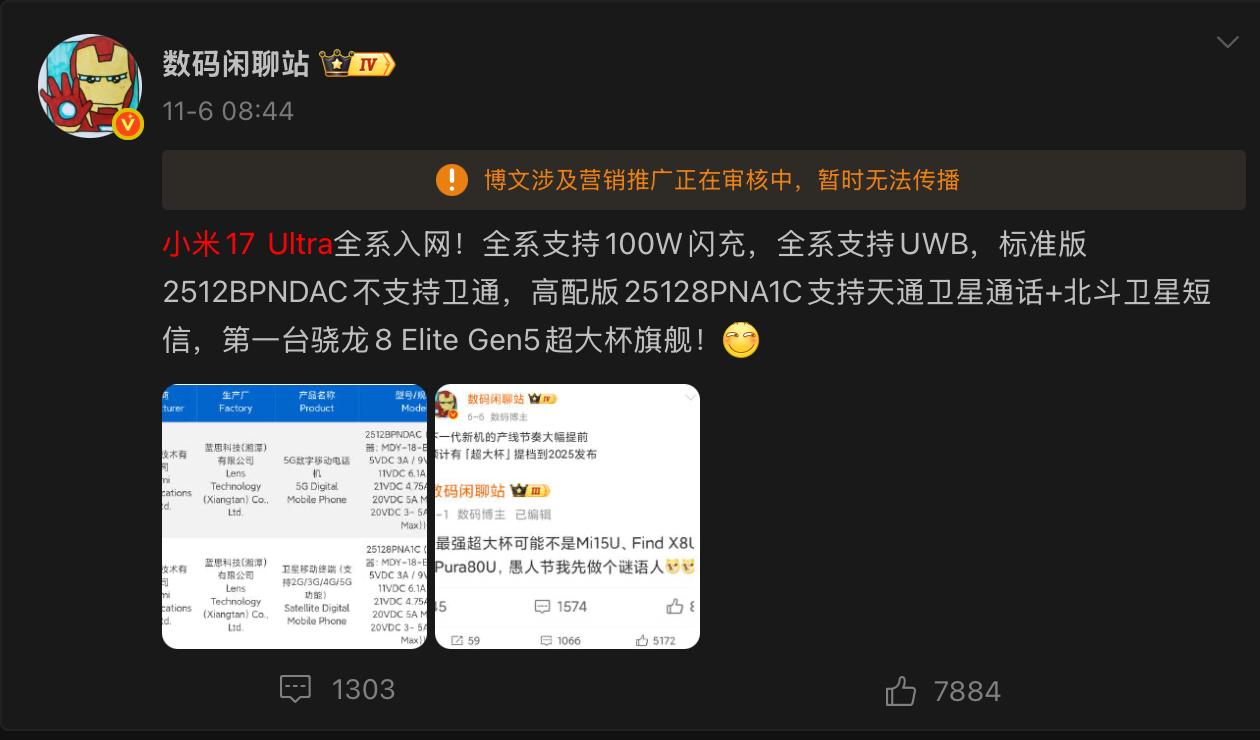
Core Insights - The smartphone market is experiencing intense competition as companies prepare for the end of 2025, with significant product launches expected in December that will shape the industry direction for 2026 [1] Group 1: High-End Market Developments - Xiaomi's upcoming flagship, the Xiaomi 17 Ultra, is set to lead in imaging technology with features like a 50MP main camera and a 200MP periscope lens, aiming to enhance the photography experience [2][3][6] - Samsung is launching its first tri-fold smartphone, the Galaxy Z TriFold, which features a unique folding mechanism and aims to differentiate itself from competitors like Huawei [7][8][14] - The Galaxy Z TriFold will include advanced features such as a Snapdragon 8 Gen 2 processor and a 10-inch display when fully unfolded, targeting the high-end market segment [9][14] Group 2: Mid-Range Market Competition - The mid-range smartphone market is becoming increasingly competitive, with brands like Vivo and Redmi introducing models that offer flagship-level specifications at lower price points [15][24] - Vivo's S50 series is expected to feature the Snapdragon 8 Gen 5 processor and innovative camera capabilities, positioning it as a strong contender in the mid-range segment [16][18] - Redmi's Turbo 5 Pro is set to compete directly with OnePlus's Turbo 6, both offering large battery capacities and high-performance specifications, indicating a fierce battle for market share in the mid-range category [20][23] Group 3: Overall Market Trends - The ongoing competition in the smartphone market is driving technological advancements and improving user experiences, benefiting consumers with better specifications and pricing [24][25] - The December product launches are seen as both a conclusion to 2025 and a prelude to the developments expected in 2026, with a focus on foldable technology and enhanced imaging capabilities [25]
强于大市(维持评级):机械设备3C设备周观点:消费电子产品深度融合AI,打造行业新增长点-20251130
Huafu Securities· 2025-11-30 12:54
Investment Rating - The industry rating is "Outperform the Market" [8] Core Insights - The Quark AI glasses were officially launched on November 27, featuring voice interaction, navigation, payment, travel reminders, and schedule management. The glasses have achieved significant sales, with over 20,000 units sold and revenue exceeding 80 million within the first 48 hours of launch [3] - The smart glasses market is experiencing rapid growth, with projections indicating that global sales of AI-enabled glasses will reach 14.5 million units by 2025, with a compound annual growth rate (CAGR) exceeding 50% from 2025 to 2029, potentially reaching 60 million units by 2029 [4] - The integration of AI into consumer electronics is creating new growth opportunities, with major smartphone manufacturers like Apple, Vivo, OPPO, and Honor launching flagship models that emphasize AI capabilities [5] Summary by Sections Smart Glasses Market - The Quark AI glasses have maintained the top sales position in the smart glasses category on Tmall since their pre-sale began in mid-October [3] - The cost of smart glasses chips is expected to decrease significantly over the next three years, enhancing performance [4] Consumer Electronics and AI Integration - ByteDance and ZTE are collaborating on an AI smartphone expected to launch in early December, highlighting the trend of AI integration in mobile devices [5] - The smartphone is becoming a key device for implementing AI technology in daily life [5] Investment Opportunities - Recommended areas for investment include foldable devices, smart glasses, silicon-based OLED screens, automation assembly and testing equipment, thermal management solutions, and 3D printing applications [6]
阿里夸克S1AI眼镜,缺一个“AppStore”
3 6 Ke· 2025-11-30 04:12
Core Insights - The Alibaba Quark S1 glasses are gaining significant attention in the AR and AI glasses market due to their integration of display, AI models, and voice control capabilities, allowing users to perform various tasks such as payments, music playback, and photography with a notable battery life of 7 hours [1][2] - The current market trend indicates that AR and AI glasses are becoming the second terminal product for users, alongside smartphones, suggesting a shift in consumer behavior towards adopting these devices as essential technology [2][11] - The development of a robust developer ecosystem for AR and AI glasses is hindered by the closed nature of the Android XR operating system, which is not fully open-source, making it challenging for developers to create applications [2][11] Product Features - The Quark S1 glasses feature a detachable design with a battery life of 7 hours and a standby time of 25 hours, catering to user convenience [1] - The glasses are currently integrated with Alibaba's ecosystem, including applications like Tongyi Qianwen, Amap, and NetEase Cloud Music, focusing on a closed-loop ecosystem [1] Market Dynamics - The competition in the AR and AI glasses market is intensifying, with various manufacturers vying for market share, indicating a potential for rapid growth in this sector [2][11] - The lack of a unified operating system among different AR and AI glasses manufacturers is leading to fragmentation, making it difficult for developers to create cross-compatible applications [15][17] Developer Ecosystem - The success of the Quark S1 and similar devices hinges on the establishment of a developer ecosystem, which requires a significant user base to attract developers [11] - The current absence of a dedicated App Store for the Quark S1 limits its potential user engagement and application development [1][11] Future Outlook - The introduction of new operating systems like MentraOS, which aims to provide an open-source platform for AR glasses, could potentially reshape the market by allowing more flexibility for developers and manufacturers [15][17] - The evolution of user interaction with AR and AI glasses is expected to lead to the emergence of new social applications, potentially replacing existing platforms like WeChat [12][13]

超百家企业捐赠总额超12亿港元,企业驰援香港大埔火灾救援


第一财经· 2025-11-29 07:06
Core Points - A significant fire occurred in Hong Kong's Tai Po district, resulting in major casualties and prompting over 100 companies and foundations to donate for emergency relief and community recovery efforts, with total donations exceeding HKD 1.2 billion [2][4]. Donation Summary - Major companies such as Yuexiu Group donated HKD 10 million, while China Overseas and China State Construction contributed HKD 20 million [3]. - Tencent donated HKD 30 million, and Alibaba made an initial donation of HKD 20 million [3]. - Other notable contributions include HKD 30 million from the Li Ka Shing Foundation and HKD 12 million from the Chaozhou Association [4]. - The total amount of donations has surpassed HKD 1.2 billion as of the latest reports [4].