Stripe

Search documents
Agentic Web与互联网的“原罪”
3 6 Ke· 2025-06-17 23:10
Core Insights - The article discusses the decline of the internet advertising model and explores the potential of combining stablecoins with AI agents to address content monetization challenges [1][2][6]. Group 1: Advertising Model Decline - The internet's reliance on advertising as a default business model has led to negative consequences, including the commodification of user attention and the proliferation of low-quality content [2][6]. - The traditional advertising-supported internet is facing a bleak future, particularly for text-based websites, as the quality of ad-supported content has deteriorated [6][11]. - The shift towards subscription models is seen as a potential solution, emphasizing the need for clear value delivery to subscribers rather than relying on ad revenue [5][9]. Group 2: Microsoft and the Agentic Web - Microsoft’s vision for an "open Agentic Web" aims to enable AI agents to act on behalf of users, requiring protocols for reliable and interoperable connections [12][13]. - The introduction of NLWeb as a natural language interface for websites is intended to enhance the accessibility of services for AI agents [13][14]. - The success of the Agentic Web concept hinges on the integration of native payment systems, which are currently lacking in the proposed framework [17][23]. Group 3: Stablecoins and Microtransactions - Recent developments in stablecoin legislation in the U.S. signify a potential breakthrough for the crypto industry, which could facilitate microtransactions essential for the new content economy [18][19]. - Stablecoins are positioned to solve existing challenges in microtransactions by reducing fees and enabling seamless transfers, making them suitable for AI-driven content monetization [19][20]. - The article suggests that a new content market could emerge, balancing the interests of content creators, AI services, and users, although the path to this future remains uncertain [21][24].




数字货币火爆!支付机构动作不断,拉卡拉筹划H股上市
Xin Lang Cai Jing· 2025-06-17 13:38
Core Viewpoint - The surge in stablecoins is driving the rise of digital currency concept stocks, with significant increases in various markets as regulations are implemented in multiple regions [1][3][6]. Market Performance - The stablecoin index rose by 4.29% on June 17, following a 9.05% increase on June 16, while the digital currency index increased by 2.28% on June 17 after a 6.24% rise the previous day [2]. - In the A-share market, notable stock performances included Chuangshi Technology (300941.SZ) up 20.02%, Lakala (300773.SZ) up 16.16%, and Hengbao Co., Ltd. (002104.SZ) up 10.02% on June 17 [3]. - In the Hong Kong stock market, performance was mixed, with Okex Chain (1499.HK) up 0.42% and Lianlian Technology (2598.HK) down 2.75% [3]. - In the US stock market, SharpLink Gaming (SBET.O) surged by 45.60%, and Top Win International (SORA.O) rose by 22.91% as of June 16 [3]. Stablecoin Market Insights - Circle, the issuer of USDC, saw its stock price rise to $151.06, a nearly fourfold increase from its IPO price of $31, with a market capitalization exceeding $33 billion [4]. - The total market capitalization of stablecoins is estimated at $240 billion, with a trading volume exceeding $20 trillion last year [6]. Regulatory Developments - The Hong Kong Stablecoin Regulation will take effect on August 1, with expectations on how the capital market will respond to stablecoins [7]. - The Hong Kong government is processing license applications to facilitate business operations related to stablecoins, aiming to create new opportunities for the local economy [6]. Industry Trends - The stablecoin industry is expected to see significant growth in the issuance and usage scenarios, particularly in cross-border payments, where it can reduce costs and improve efficiency [9][10]. - Stablecoins can lower transaction costs by over 80% and reduce transaction times from days to minutes, making them suitable for small and medium enterprises [10]. - The decentralized nature of stablecoins enhances financial inclusion, allowing users without traditional bank accounts to participate in the financial system [11]. Corporate Actions - Lakala is planning an H-share listing to accelerate the application of digital currency in cross-border scenarios [15]. - Stripe has made strategic acquisitions to integrate stablecoin functionalities into its payment services, indicating a trend towards vertical integration in the payment industry [14].


YC最新路演揭示最新AI创业生存法则:再不垂直,就是死
Hu Xiu· 2025-06-17 06:07
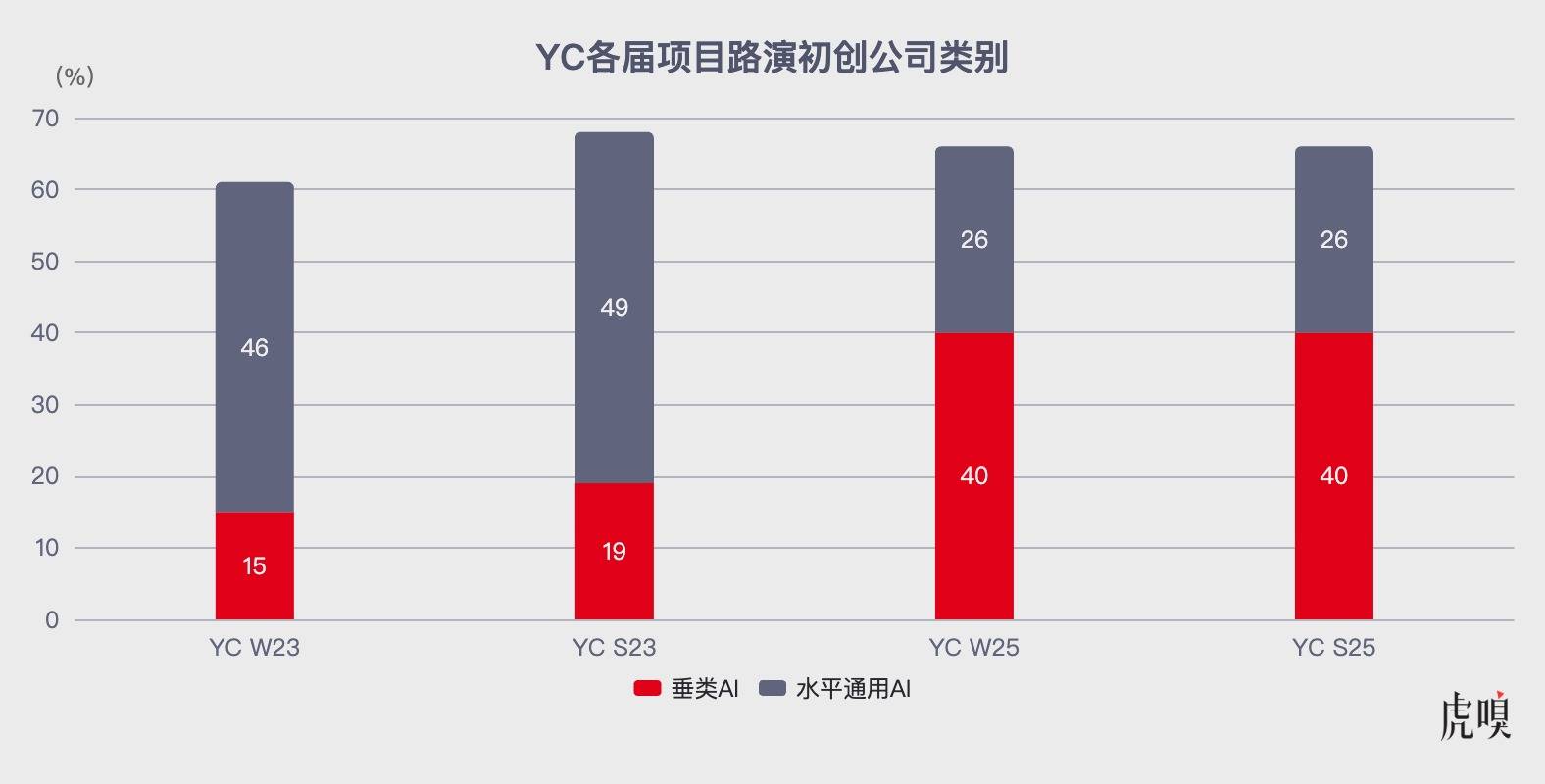
Core Insights - The traditional investment criteria for startups, such as having a strong technical background from major tech companies and stable growth, are becoming less effective in the current market [1] - Y Combinator (YC) is shifting its focus towards practical applications of AI in niche markets, emphasizing the importance of deep industry understanding over general technological prowess [1][3] Group 1: Y Combinator's Evolution - YC has been a significant player in the startup ecosystem for 20 years, having incubated over 3,000 companies with a combined valuation exceeding $800 billion [1] - The recent YC demo days have attracted global investor attention, particularly with the rise of generative AI, indicating a shift in entrepreneurial logic each year [2][3] Group 2: Trends in Startup Development - The barrier to entry for startups has lowered due to AI, allowing young teams to achieve significant revenue growth quickly, with some reaching $10 million in under 12 months [3] - The proportion of niche AI projects in YC has increased from 19% in 2023 to 40% in 2024, while general AI projects have decreased from 49% to 26% [4] Group 3: Characteristics of Successful Startups - AI-native companies are emerging, characterized by rapid iteration and product development within months [5][8] - Successful startups are now focusing on solving multiple pain points within a single industry rather than addressing a single issue across various sectors [5][10] Group 4: Importance of Industry Knowledge - The key to success in the current landscape is a deep understanding of specific industry challenges rather than just technical skills [9][13] - Companies like Kirana AI and Eloquent AI exemplify this trend by providing tailored AI solutions that address specific operational challenges in retail and financial services, respectively [11][12]

跨境支付行业现状及稳定币的应用探讨
2025-06-16 15:20
Summary of Cross-Border Payment Industry and Stablecoin Application Industry Overview - The cross-border payment industry has evolved from B2C to B2B, addressing the needs of small and medium-sized enterprises (SMEs) for compliant fund transfer channels, which traditional banks struggle to cover [1][2][3] - The pilot project initiated by the central bank and foreign exchange administration has granted licenses to institutions like Kuaiqian, Lianlian, Alipay, and Tonglian [1][2] Key Players and Market Dynamics - Major players in the cross-border payment sector include PingPong, Lianlian, and Worldpay, each with unique strengths and market shares [1][7] - PingPong was one of the first to obtain domestic payment licenses, while Lianlian holds numerous overseas licenses and Ant International ranks among the top three due to its large transaction volume [1][7] - Ant International acquired WorldFirst to enhance brand recognition and market presence, leveraging WorldFirst's established reputation in China and abroad [1][8] Business Models and Revenue Streams - Traditional cross-border payment models rely on transaction fees, currency conversion fees, and account management fees, with profits primarily derived from currency exchange [2][12] - The stablecoin model is still being explored, with potential for zero-fee structures or innovative pricing strategies, focusing on exchange rate differences and bank deposit agreements [2][12] Regulatory and Compliance Considerations - The industry faces compliance risks, particularly regarding KYC (Know Your Customer) regulations, which are critical for obtaining and maintaining licenses [2][14] - Regulatory bodies emphasize the importance of effective KYC measures during the licensing process to ensure institutions understand their clients and business activities [2][14] Stablecoin Advantages and Future Outlook - Stablecoins offer significant advantages in cross-border transactions, including reduced transaction costs, faster settlement speeds, and minimized exchange rate risks [4][10] - Major financial technology companies are beginning to explore stablecoin applications in international trade, with potential for real-time settlements via blockchain technology [4][10] - The long-term outlook for stablecoins is promising, but they face uncertainties, particularly in regulatory frameworks, especially in mainland China [10][11] Competitive Landscape - The competitive landscape is characterized by a diverse range of players, with no single entity dominating the market [7] - Institutions like XTransfer focus specifically on B2B services, while others like Lianlian maintain a strong domestic presence while expanding internationally [7][9] Challenges and Strategic Considerations - Companies with strong backgrounds and reputations are more likely to achieve scale in the cross-border payment sector, as trust and recognition play crucial roles in client acquisition [15] - The impact of stablecoins on traditional financial institutions is still uncertain, with governments likely to intervene to maintain financial stability if necessary [16] Conclusion - The cross-border payment industry is rapidly evolving, with stablecoins poised to play a significant role in future transactions. However, regulatory challenges and market dynamics will shape the trajectory of this sector in the coming years [10][11][16]
General Catalyst CEO: An AI driven power crisis lurks
Yahoo Finance· 2025-06-16 13:38
Welcome to a new episode of Yahoo Finance's opening bid podcast. I'm Yahoo Finance executive editor Brian Sazy. Like I always say, this the podcast that will make you a smarter investor, period.And I want to change it up for this episode. I've spent so much time uh over the past few months talking about AI in the enterprise. Or in other words, AI spreading throughout corporate America, mostly through agents unlocking all sorts of productivity and costing jobs.I want to focus on AI for good and a lot of thin ...

巨头入局意义重大,蚂蚁、苹果、亚马逊都有动作,香港《稳定币条例》8月1日正式生效
Xuan Gu Bao· 2025-06-16 08:38
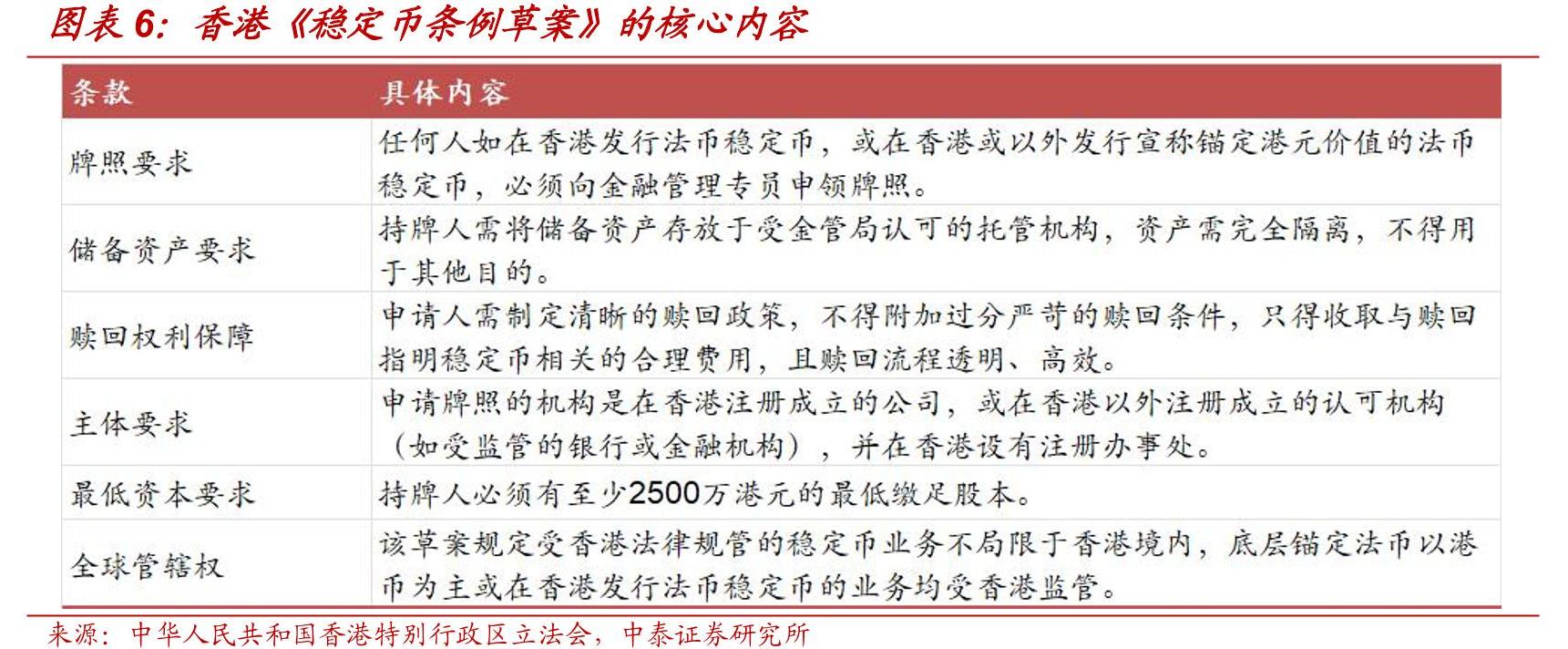
Group 1 - The Hong Kong Special Administrative Region announced that the "Stablecoin Regulation" will take effect on August 1, 2025, requiring anyone issuing fiat-backed stablecoins in Hong Kong to apply for a license from the Financial Management Commissioner [1][2] - Licensed entities must store reserve assets in custodians recognized by the Hong Kong Monetary Authority (HKMA) and must have a minimum paid-up capital of at least HKD 25 million [2] - The HKMA will expedite the processing of license applications to allow qualified applicants to commence their business operations [2][3] Group 2 - Major global companies such as Apple, X, Airbnb, and Google are exploring stablecoin integration to reduce transaction costs and enhance cross-border payment capabilities [6] - Retail giants like Walmart and Amazon are considering issuing their own stablecoins in the U.S., potentially saving billions in transaction fees and improving settlement times [6] - Ant Group is preparing to apply for stablecoin licenses in Singapore and Hong Kong, which could significantly enhance cross-border payment efficiency [7] Group 3 - The stablecoin industry has seen a surge in interest following legislative developments, with stocks related to stablecoins experiencing significant gains [8] - The stablecoin industry chain includes companies like Sifang Chuangxin, Langxin Group, and Xiexin Nengke, which are positioned to benefit from the regulatory framework [10] - Various application scenarios for stablecoins include cross-border payments, supply chain finance, and retail payments, with representative companies identified for each sector [10]
科技行业人才格局,正在发生怎样的巨变?
Hu Xiu· 2025-06-16 05:53
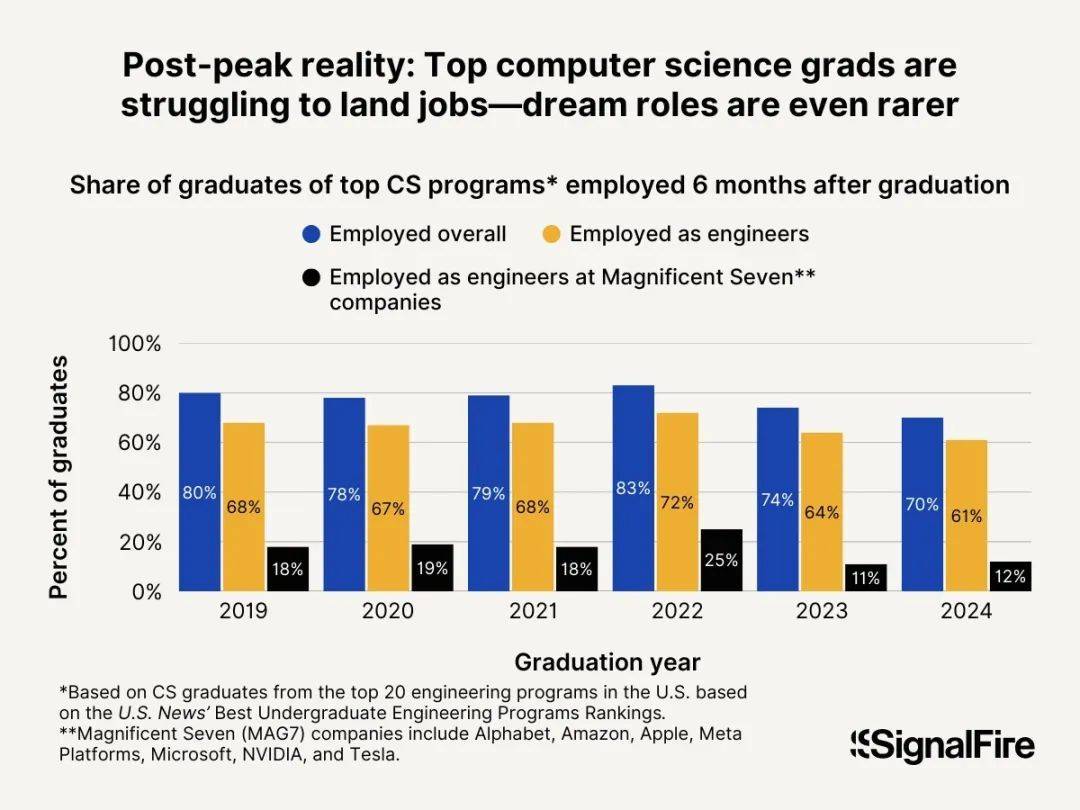
Core Insights - The technology industry is experiencing a significant shift, with a 50% decrease in hiring for new graduates compared to pre-pandemic levels, indicating a fundamental transformation rather than a temporary adjustment [1][11][14] - The "experience paradox" is emerging, where employers prioritize proven experience over potential, making it difficult for new graduates to secure jobs [8][11][39] - The geographical landscape of tech talent is changing, with traditional hubs like Texas declining while cities like Miami and San Diego are rising due to lifestyle and cost advantages [26][27][28] Group 1: Hiring Trends - Large tech companies now only hire 7% of new graduates, a 25% decrease from 2023 and over 50% from 2019 [8][11] - Startups are also seeing a decline, with new graduates making up only 6% of their hiring, down over 30% from pre-pandemic levels [8] - The shift in hiring practices reflects a broader reset in recruitment philosophy, with companies focusing on high-leverage technical roles [14][39] Group 2: Talent Retention - Anthropic stands out with an 80% employee retention rate, significantly higher than competitors like OpenAI and DeepMind [15][18] - The company attracts talent through a unique culture that emphasizes autonomy and intellectual discussion, contrasting with the bureaucratic environments of larger firms [18][22] - The trend shows that top AI talent is gravitating towards companies that offer better work environments and clearer career paths [22][44] Group 3: Geographical Shifts - Texas is losing its tech center status, with Austin and Houston seeing declines in startup employment by 6% and 10.9% respectively [26][27] - In contrast, Miami and San Diego are experiencing growth in tech jobs, with Miami seeing a 12% increase in AI positions [27][28] - Despite these changes, San Francisco and New York remain dominant, with over 65% of AI engineers still located in these cities [28][31] Group 4: Future Predictions - SignalFire predicts the rise of generalist engineers as AI tools lower the barriers to entry for building applications [32][38] - The emergence of new roles such as AI governance leads and AI ethics experts is expected, indicating a shift in job creation rather than mere job loss due to automation [37][38] - The industry is likely to see a continued emphasis on flexible work arrangements and a reevaluation of talent development strategies [39][40]
中信建投:稳定币在全球金融体系中的地位有望持续提高
智通财经网· 2025-06-15 13:35
Core Viewpoint - Stablecoins are evolving into a new financial infrastructure, playing a crucial role in payments, cross-border settlements, digital asset trading, and decentralized finance (DeFi), thereby reshaping the international financial system [1][2][24] Summary by Sections Overview of Stablecoins - Definition: Stablecoins are a special type of cryptocurrency whose value is pegged to specific assets, typically fiat currencies like the US dollar, aimed at overcoming the volatility of traditional cryptocurrencies. The total market size of stablecoins has surpassed $250 billion, with most pegged to the US dollar at a 1:1 exchange rate [3][4] - Classification: Stablecoins can be categorized into three main types: fiat-collateralized stablecoins (e.g., Tether (USDT), USD Coin (USDC)), crypto-collateralized stablecoins (e.g., MakerDAO's DAI), and algorithmic stablecoins (e.g., TerraUSD (UST)) [4][5] Characteristics and Features - Pegging Mechanism: Stablecoins maintain their value by being pegged to fiat or other assets, with fiat-collateralized stablecoins requiring a 1:1 reserve and regular audits [6] - Price Stability: By anchoring to fiat currencies or stable assets, stablecoins provide a relatively stable value, offering low volatility for digital payments and value storage [6] - Liquidity and Convertibility: Stablecoins serve as a major trading medium in the cryptocurrency market, with high liquidity allowing for easy conversion to fiat or other cryptocurrencies [6] - Openness and Cross-Border Attributes: Utilizing blockchain technology, stablecoins enable global circulation without traditional intermediaries, significantly reducing cross-border payment costs and enhancing transaction efficiency [6] Market Development - Global Market Size: The global stablecoin market has seen explosive growth, reaching approximately $245 billion by May 2025, up from about $5 billion in 2019, with a compound annual growth rate (CAGR) of nearly 2000% from 2020 to 2025 [8][9] - Market Share: As of May 2025, USDT and USDC dominate the market, accounting for approximately 85% of the total stablecoin market share [9][10] - Trends and Evolution: The demand for decentralized and synthetic stablecoins is rising, with stablecoins becoming integral to the DeFi ecosystem, representing over two-thirds of on-chain trading volume [11] Recent Regulatory Developments - US Regulatory Movements: The US Senate passed the GENIUS Act, which aims to establish a federal regulatory framework for stablecoins, ensuring that USD-pegged stablecoins become a global standard [14][15] - Hong Kong's Regulatory Framework: Hong Kong's Legislative Council passed the Stablecoin Ordinance, set to take effect on August 1, 2025, establishing a licensing regime for stablecoin issuers [17][18] Future Outlook - Institutional Adoption: Traditional financial institutions are increasingly incorporating stablecoins into their services, indicating a growing interest in stablecoin settlements and asset tokenization [12] - Central Bank Digital Currencies (CBDCs): Stablecoins are seen as complementary to CBDCs, enhancing cross-border payment efficiency and reducing reliance on traditional intermediaries [13] - Emerging Stablecoins: New stablecoins are emerging, supported by institutional backing and DeFi incentives, expanding their market share and usage across various blockchain ecosystems [14]

Bill Guerley谈美国一级市场问题:僵尸独角兽、估值失真、IPO困境、公司不想上市
IPO早知道· 2025-06-14 02:13
Core Insights - The current venture capital landscape is experiencing structural changes and challenges, particularly due to the rise of MegaFunds, which have significantly increased capital availability and blurred the lines between early and late-stage investments [2][8] - There is a proliferation of "zombie unicorns," companies that have raised substantial funds but show little growth and whose true value is questionable, leading to a disconnect between book value and actual value [2][10] - The zero interest rate environment has prolonged the survival of companies that should have been eliminated by the market, complicating the competitive landscape [2][13] - The arrival of AI has disrupted the expected market corrections, creating a new wave of investment enthusiasm and valuation bubbles, while emphasizing the importance of fundamentals and unit economics [3][21] - Liquidity issues are becoming increasingly prominent for Limited Partners (LPs), with many resorting to debt issuance or selling private equity assets to manage financial pressures [2][19] Group 1: Market Realities - The rise of Mega VC Funds has transformed the investment landscape, with notable funds increasing their commitments from $500 million to $5 billion or more, actively participating in late-stage investments [8][9] - There are approximately 1,000 private companies that have raised over $1 billion, collectively valued at around $300 billion, raising concerns about their actual worth and growth potential [10][11] - The misalignment of incentives within the investment ecosystem leads to a lack of motivation for accurate asset marking, resulting in inflated valuations [12][11] Group 2: Exit Challenges - The IPO and M&A markets have stagnated, with a notable disconnect between market performance and exit opportunities, leading to a backlog of capital trapped in the private market [16][17] - High valuations from previous funding rounds complicate acquisition opportunities, as potential buyers are deterred by inflated price expectations [17][18] Group 3: Liquidity and Structural Changes - LPs are facing liquidity challenges, with significant bond issuances indicating a need to meet capital commitments due to insufficient liquidity [19][20] - The trend of private companies remaining private longer is gaining traction, as firms find it more advantageous to delay IPOs in favor of private funding opportunities [24][25] Group 4: AI and Investment Dynamics - The AI wave is seen as a historic platform transformation, driving new investment trends and valuation expectations, with some companies achieving revenue multiples significantly higher than traditional firms [21][22] - The competitive landscape is shifting, with companies encouraged to remain private to maximize ownership stakes and avoid the burdens of public market scrutiny [24][25]

Bill Guerley谈美国一级市场问题:僵尸独角兽、估值失真、IPO困境、公司不想上市
IPO早知道· 2025-06-14 02:10
Core Insights - The current venture capital landscape is experiencing structural changes and challenges, particularly due to the rise of MegaFunds, which have significantly increased capital availability and blurred the lines between early and late-stage investments [2][8] - There is a proliferation of "zombie unicorns," companies that have raised substantial funds but show little growth and whose true value is questionable, leading to a disconnect between book value and actual value [2][11] - The zero-interest-rate environment has prolonged the survival of companies that should have been eliminated by the market, complicating the competitive landscape [2][18] - The arrival of AI has disrupted the expected market corrections, creating a new wave of investment enthusiasm and valuation bubbles, while emphasizing the importance of fundamentals and unit economics [3][54] Group 1: Mega VC Funds - The rise of Mega VC Funds has transformed the investment landscape, with notable funds increasing their commitments from $500 million to $5 billion or more, actively participating in late-stage investments [8][10] - New players have entered the late-stage market, and established firms are also participating, leading to a significant increase in available capital [8][10] Group 2: Zombie Unicorns - Approximately 1,000 private companies have raised over $1 billion each, collectively amounting to around $300 billion, raising questions about their true value as many have not been revalued since 2021 [11][12] - The lack of motivation among general partners (GPs) and limited partners (LPs) to accurately mark assets has resulted in a misalignment of incentives, with many GPs benefiting from inflated valuations [12][14] Group 3: Market Dynamics - The exit windows for IPOs and mergers and acquisitions (M&A) have effectively closed, leading to a situation where even a strong Nasdaq performance does not correlate with active exit opportunities [24][25] - The high costs associated with going public and the regulatory environment have deterred companies from pursuing IPOs, leading to a preference for remaining private [25][28] Group 4: LP Liquidity Issues - Many LPs are facing liquidity challenges, exacerbated by the closure of exit windows, leading to significant bond issuances by universities to meet capital commitments [29][30] - Notable institutions like Harvard and Yale have begun selling private equity assets to address liquidity concerns, indicating a shift in investment strategies [30][31] Group 5: AI and Investment Trends - The AI wave has created a unique investment environment, with companies achieving high valuations and revenue multiples, attracting significant capital despite traditional LP funding constraints [3][37] - The trend of private companies remaining private longer is becoming more pronounced, with companies like Stripe indicating they may not rush to go public [38][39] Group 6: Future Considerations - The current market realities suggest a potential shift in how LPs and GPs approach investments, with a need to reassess traditional models in light of prolonged liquidity issues and changing market dynamics [64][65] - The emergence of new capital sources and innovative investment strategies may provide opportunities for navigating the evolving landscape [46][64]