药师帮

Search documents
药师帮(09885.HK):2月12日南向资金减持65万股
Sou Hu Cai Jing· 2026-02-12 19:26
证券之星消息,2月12日南向资金减持65.0万股药师帮(09885.HK)。近5个交易日中,获南向资金减持 的有4天,累计净减持80.84万股。近20个交易日中,获南向资金增持的有7天,累计净增持515.72万股。 截至目前,南向资金持有药师帮(09885.HK)1.72亿股,占公司已发行普通股的25.1%。 以上内容为证券之星据公开信息整理,由AI算法生成(网信算备310104345710301240019号),不构成 投资建议。 药师帮股份有限公司是一家主要从事提供药品及保健产品批发和零售以及平台业务服务的投资控股公 司。该公司主要从事药品及保健产品的线下或线上平台批发和零售。该公司为药品经销商提供线上平台 以销售其药品及保健产品。该公司还为药店提供软件即服务(SaaS)解决方案,为基层医疗机构提供医 疗检测服务,向第三方药店销售无人智慧药柜,以及向第三方药店提供无人智慧药柜相关维护及技术支 持服务。该公司主要在国内市场开展业务。 ...


药师帮授出253.37万股奖励股份
Zhi Tong Cai Jing· 2026-02-10 12:03
药师帮(09885)发布公告,于2026年2月10日,本公司根据2023年股份激励计划向奖励承授人授出253.37 万股奖励股份,涉及253.37万股新股份,占于本公告日期已发行股份总数约0.37%(授出奖励)。 ...
药师帮(09885)授出253.37万股奖励股份
智通财经网· 2026-02-10 12:00
Group 1 - The company, Yaoshi Bang (09885), announced the grant of 2.5337 million shares to reward recipients under the 2023 share incentive plan [1] - The awarded shares represent approximately 0.37% of the total issued shares as of the announcement date [1]
药师帮(09885.HK)授出253.37万股奖励股份
Ge Long Hui· 2026-02-10 11:43
格隆汇2月10日丨药师帮(09885.HK)公告,于2026年2月10日,公司根据2023年股份激励计划向奖励承授 人授出253.37万股奖励股份,涉及2,533,700股新股份,占于本公告日期已发行股份总数约0.37%。 ...
药师帮(09885) - 根据2023年股份激励计划授出股份奖励
2026-02-10 11:40
YSB Inc. 藥師幫股份有限公司 (於 開 曼 群 島 註 冊 成 立 的 有 限 公 司) (股 份 代 號:9885) 根 據2023年股份激勵計劃授出股份獎勵 授出股份獎勵 根 據《上 市 規 則》第17.06A條,董 事 會 宣 佈,於2026年2月10日,本 公 司 根 據2023年 股份激勵計劃向獎勵承授人授出2,533,700股 獎 勵 股 份,涉 及2,533,700股 新 股 份, 佔於本公告日期已發行股份總數約0.37%(「授出獎勵」)。 香港交易及結算所有限公司及香港聯合交易所有限公司對本公告的內容概不 負 責,對 其 準 確 性 或 完 整 性 亦 不 發 表 任 何 聲 明,並 明 確 表 示,概 不 就 因 本 公 告 全部或任何部分內容所產生或因依賴該等內容而引致的任何損失承擔任何責 任。 授 出 獎 勵 詳 情 載 列 如 下: 已授出獎勵股份的 購 買 價: 零。 股股份於授出日期的 每股股份5.430港 元。 收 市 價: – 1 – 授 出 日 期: 2026年2月10日。 獎 勵 承 授 人 數 目: 415名 僱 員 參 與 者。 已 授 出 獎 勵 股 份 數 ...
药师帮(09885) - 截至二零二六年一月三十一日止月份之股份发行人的证券变动月报表
2026-02-05 10:09
FF301 呈交日期: 2026年2月5日 股份發行人及根據《上市規則》第十九B章上市的香港預託證券發行人的證券變動月報表 截至月份: 2026年1月31日 狀態: 新提交 致:香港交易及結算所有限公司 公司名稱: 藥師幫股份有限公司 (於開曼群島註冊成立之有限公司) I. 法定/註冊股本變動 | 1. 股份分類 | 普通股 | 股份類別 | 不適用 | | 於香港聯交所上市 (註1) | | 是 | | | --- | --- | --- | --- | --- | --- | --- | --- | --- | | 證券代號 (如上市) | 09885 | 說明 | | | | | | | | | | 法定/註冊股份數目 | | 面值 | | | 法定/註冊股本 | | | 上月底結存 | | | 20,000,000,000 USD | | 0.0000025 | USD | | 50,000 | | 增加 / 減少 (-) | | | 0 | | | USD | | | | 本月底結存 | | | 20,000,000,000 USD | | 0.0000025 | USD | | 50,000 | ...
“政策引导、技术支持”助力AI医疗崛起,蚂蚁阿福或成C端应用范例
Xinda Securities· 2026-01-30 05:45
Investment Rating - The investment rating for the pharmaceutical and biotechnology industry is "Positive" [2] Core Insights - The report emphasizes the clear trend of AI in the healthcare industry, driven by policy implementation and technological breakthroughs. Key policies include the State Council's directive on AI in healthcare, aiming for widespread application of AI in diagnosis, health management, and insurance services by 2030 [10][11] - The report identifies the G-end and B-end commercial models as relatively mature, while the C-end applications, particularly the Ant Financial's "Afu" app, are still developing. The app has over 30 million monthly active users, with a significant portion from lower-tier cities [11][12] - The report highlights the importance of monitoring upcoming catalysts in 2026, including AI partnerships and new model releases from major tech companies [10][11] Summary by Sections 1. AI Empowering Healthcare Industry Development - AI is set to enhance the healthcare industry chain, with policies accelerating the integration of AI in medical services, public health, and health industry development [13] - The report outlines various AI application scenarios in healthcare, including intelligent diagnosis and drug development [13][15] 2. AI Healthcare Stock Price Movements - Stock price drivers in AI healthcare include policy changes, technological advancements, and performance realization [4] - The report notes significant technological breakthroughs and product applications in the past three years, with a focus on upcoming key events in 2026 [4][11] 3. G-end and B-end Commercialization - The G-end and B-end business models are highlighted as more established, with G-end focusing on government and healthcare needs, while B-end targets hospitals and pharmaceutical companies [11] - The C-end model is primarily based on drug sales through AI health applications, with the Ant Financial's "Afu" app leading in user engagement [11][12] 4. Key Investment Targets - The report suggests focusing on companies such as MedLinker, JD Health, Alibaba Health, iFlytek Medical Technology, Ping An Good Doctor, and Ruanda Medical for potential investment opportunities [12][11]

医药支付龙头「镁信健康」二次递表,投后估值超116亿元
Xin Lang Cai Jing· 2026-01-25 09:01
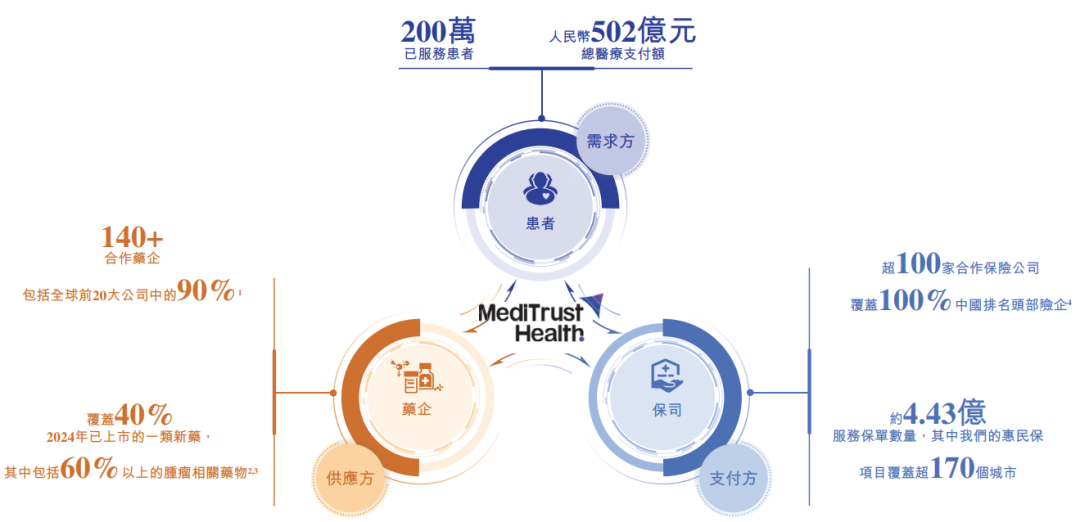
Core Viewpoint - Magnesium Health is preparing for its second IPO attempt on the Hong Kong Stock Exchange, aiming to raise funds as a leading multi-payment platform in the pharmaceutical sector, with significant revenue growth and improving financial metrics [1][8]. Company Overview - Magnesium Health is the largest multi-payment platform in China for pharmaceuticals, ranking first in both the innovative smart drug solutions market and the innovative health insurance solutions market based on partnerships with pharmaceutical companies and processed health insurance policies [1][3]. Financial Performance - For the fiscal year ending December 31, 2024, the company reported revenues of approximately RMB 20.35 billion, a 60% year-on-year increase, with a net loss of RMB 0.76 billion, narrowing by 70% [1][8]. - In the first ten months of 2025, revenues reached RMB 18.73 billion, a 30% year-on-year increase, but the net loss expanded to RMB 3.89 billion, a 366.93% increase in losses compared to the previous year [1][8]. - The gross profit margin for 2024 was 35.83%, while the gross profit for the first ten months of 2025 was RMB 6.01 billion, reflecting a 10.47% year-on-year increase [6][8]. Market Position - The company has served approximately 2 million patients, with a total medical expenditure of RMB 50.2 billion, and has partnerships with over 100 insurance companies, including all of China's top 20 insurers by premium income for 2024 [5][10]. - The innovative smart drug solutions market in China is projected to grow from RMB 521 billion in 2019 to RMB 910 billion by 2024, with a compound annual growth rate of 11.8% [10]. Product and Service Offerings - Magnesium Health has developed two major industry solutions: smart drug solutions and smart insurance solutions, aimed at providing comprehensive commercialization plans for pharmaceutical companies and end-to-end solutions for insurance companies [3][8]. - The company also offers consumer-facing services, including BluePass and a DTC pharmacy platform, designed to enhance patient experience and outcomes [3][8]. Competitive Landscape - Magnesium Health's market performance highlights its leading competitive position, with a significant number of partnerships and processed health insurance policies compared to competitors [13][15]. - The company has undergone multiple rounds of financing, raising over RMB 31.8 billion, with a post-money valuation of approximately RMB 116.8 billion following its latest financing round in December 2022 [19].
最后4分钟,突然拉升
Zhong Guo Zheng Quan Bao· 2026-01-13 12:55
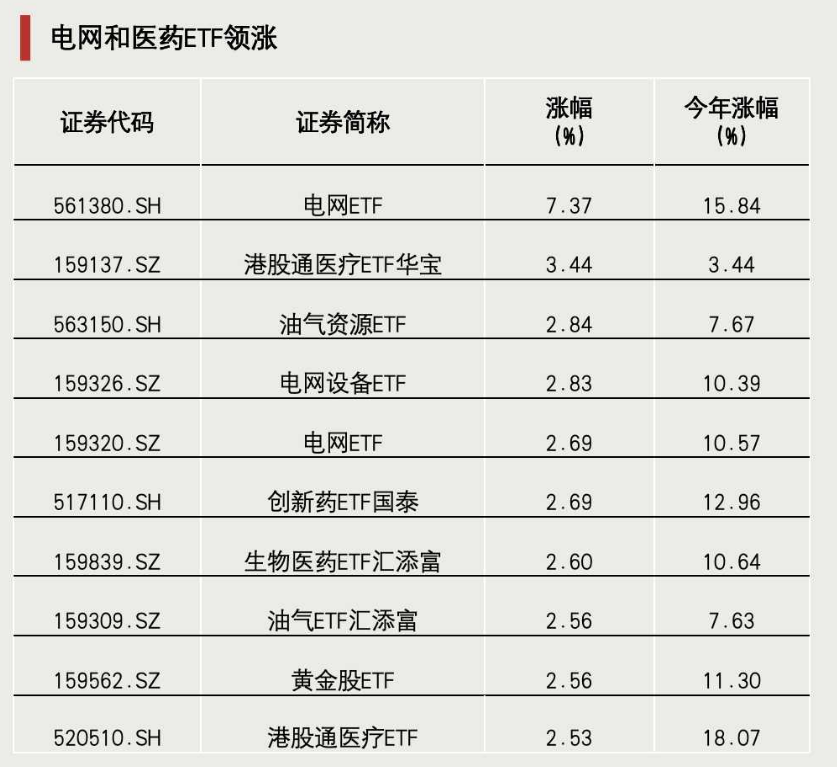
Core Viewpoint - The A-share market experienced a collective pullback on January 13, with the ChiNext index dropping nearly 2%, while over 900 out of 1300 ETFs fell. However, ETFs focused on defensive sectors like electric power, pharmaceuticals, oil and gas, and gold saw gains, with several products rising over 2% [1][3]. ETF Market Performance - The overall net inflow in the ETF market was approximately 1.16 billion yuan on January 12, a significant decrease from about 16.4 billion yuan on January 9. The media, satellite aerospace, software, non-ferrous metals, and AI sectors attracted substantial net inflows, with the media ETF (512980) leading at 2.32 billion yuan [2][6]. - On January 13, ETFs focused on electric power, oil and gas, and gold sectors showed resilience against the market downturn, with the top 20 gaining ETFs primarily concentrated in these areas. The electric power ETF (561380) surged by 7.37% due to a last-minute rally, while the oil and gas ETFs also performed well, with two tracking the China Securities Oil and Gas Resources Index rising over 2% [3][4]. Sector-Specific Insights - The gold sector ETFs all recorded gains, particularly those linked to the China Securities Hong Kong and Shanghai Gold Industry Stock Index, with all six ETFs rising over 2%. In the pharmaceutical sector, ETFs focusing on Hong Kong medical, innovative drugs, and biomedicine showed strong performance, with the Hong Kong medical ETF (159137) rising by 3.44% [4]. - Conversely, several popular sector ETFs, particularly in AI and aerospace, faced significant declines, with many dropping over 8%. The leading AI ETF, Morgan's ChiNext AI ETF, saw a sharp drop of over 11% after a trading halt due to price premiums [5]. Fund Flows and Trends - Seven ETFs attracted over 1 billion yuan in net inflows, primarily in sectors like media, satellite aerospace, software, and non-ferrous metals, as well as one small-cap broad-based index ETF. The media ETF (512980) alone garnered over 2 billion yuan in net inflows on January 12 [6][7]. - Non-equity ETFs, including money market and bond funds, experienced significant net outflows, with some non-equity ETFs seeing outflows exceeding 10 billion yuan since the beginning of the year. Despite the overall upward trend in the equity market, the ETF market faced a net outflow of over 55 billion yuan year-to-date [8]. Industry Developments - 华夏基金 became the first public fund company in China to surpass 1 trillion yuan in ETF management scale, reaching 1,016.42 billion yuan as of January 12. The rapid growth of ETFs in China is notable, with the time taken to reach successive trillion yuan milestones decreasing significantly [10].
最后4分钟,突然拉升!
Zhong Guo Zheng Quan Bao· 2026-01-13 12:47
Market Overview - On January 13, A-shares experienced a collective pullback, with the ChiNext Index dropping nearly 2% and over 900 out of 1300 ETFs declining [1] - Despite the overall market downturn, ETFs focused on defensive sectors such as electric grid, oil and gas, gold, and pharmaceuticals saw gains, with several products rising over 2% [1] ETF Performance - The Electric Grid ETF (561380) led the market with a 7.37% increase, experiencing a significant surge in the last four minutes before closing [2][4] - The AI-focused ETF Morgan (588420), which had performed well previously, saw a sharp decline of over 11% today, marking the largest drop in the market [2][7] Fund Flows - The overall net inflow into the ETF market was approximately 1.157 billion yuan, a significant decrease from the 16.4 billion yuan net inflow on January 9 [3][9] - The Media ETF (512980) attracted the highest net inflow of 2.327 billion yuan, contributing to a total of over 3 billion yuan in net inflows this year [3][10] Sector Analysis - ETFs targeting the electric grid, oil and gas, and gold sectors showed resilience, with all ETFs in these categories posting gains [4][5] - The Medical ETF focusing on Hong Kong stocks and innovative drugs also performed well, with the Hong Kong Medical ETF (159137) rising by 3.44% [5][6] Notable Declines - Several ETFs in the AI and aerospace sectors faced significant declines, with nine out of the top ten ETFs by drop percentage being aerospace-related [7] - The AI ETF Morgan experienced a drastic increase in turnover rate, indicating high trading activity amid its price drop [7] Non-Equity ETF Trends - Non-equity ETFs, including money market and bond funds, faced substantial net outflows, with some experiencing over 10 billion yuan in outflows this year [11][12] Industry Insights - The aviation sector is viewed as having significant long-term growth potential, supported by policy backing and industry acceleration [13] - The semiconductor sector is experiencing short-term volatility but is expected to maintain a positive long-term outlook due to strong demand and supportive policies [13] ETF Market Milestone - Huaxia Fund became the first public fund company in China to have an ETF management scale surpassing 1 trillion yuan, reaching 1.016424 trillion yuan as of January 12 [14]