
Flexport

Search documents
Figma(FIG) - 2025 Q4 - Earnings Call Transcript
2026-02-18 23:02
Financial Data and Key Metrics Changes - The company reported Q4 2025 revenue of $304 million, representing a year-over-year growth rate of 40% [5][25] - For the full year 2025, total revenue reached $1.056 billion, up 41% year-over-year [25][29] - The non-GAAP operating margin for Q4 was 14%, with adjusted free cash flow margin at 13% [5][32] - The company ended the year with $1.7 billion in cash, cash equivalents, and marketable securities [5][32] Business Line Data and Key Metrics Changes - The net dollar retention rate for customers with more than $10,000 in ARR increased to 136%, up five percentage points quarter-over-quarter [5][26] - Weekly active users of Figma Make grew over 70% quarter-over-quarter, with over 50% of paid customers spending more than $100,000 in ARR using it weekly [12][25] - The company added 951 net customers spending more than $10,000 in ARR in Q4, and 143 net customers spending more than $100,000 in ARR, a 46% year-over-year growth [26][27] Market Data and Key Metrics Changes - International revenue grew 45% year-over-year, with international users representing approximately 85% of monthly active users and accounting for 54% of revenue in Q4 [28][29] - The company launched in India in November 2025, indicating ongoing international expansion efforts [29] Company Strategy and Development Direction - The company plans to continue investing in AI-native workflows and enhancing product capabilities to support customer adaptation to new working methods [33][34] - Figma aims to unify its product surfaces, particularly between Figma Make and Figma Design, to enhance user experience and drive adoption [62] Management's Comments on Operating Environment and Future Outlook - Management expressed confidence in the long-term cash-generating profile of the business despite a decline in adjusted free cash flow due to investments in infrastructure and AI [32][34] - The company anticipates revenue for Q1 2026 to be in the range of $315 million to $317 million, implying 38% growth at the midpoint [34] Other Important Information - The company acquired Weavy, enhancing its AI image, video, animation, and motion generation capabilities [20][24] - Stock-based compensation was elevated in 2025 due to various factors, but the company expects improvement as revenue scales [33] Q&A Session Summary Question: Insights on UI and UX with Emerging Agentic Layers - Management believes that while agents will take on more tasks, the need for human-readable visual interfaces will remain crucial, emphasizing the importance of design [39][40] Question: 2026 Guidance and Credit Consumption Monetization - Management indicated that guidance is based on observed seat adoption behavior and usage trends, with expectations for refinement as new features are introduced [42][43] Question: User Types and Figma Make Adoption - The company is seeing new user types, including product managers, engaging with Figma Make, which could lead to seat expansion [48][49] Question: Pricing and Revenue Impact - Management explained that the pricing changes implemented last year will continue to contribute to revenue growth, with a bell curve effect expected [54][57] Question: Competition in Prototyping Space - Management noted that over 80% of full seat users of Figma Make also use Figma Design, indicating a strong integration and potential for unifying product surfaces [61][62]

Figma(FIG) - 2025 Q4 - Earnings Call Transcript
2026-02-18 23:02
Financial Data and Key Metrics Changes - Figma reported Q4 2025 revenue of $304 million, representing a 40% year-over-year growth rate, and full-year revenue of $1.056 billion, up 41% year-over-year [5][25] - The net dollar retention rate for customers with more than $10,000 in ARR increased by five percentage points quarter-over-quarter to 136%, marking the highest rate in the last 10 quarters [5][26] - The company ended the year with $1.7 billion in cash, cash equivalents, and marketable securities [5][32] Business Line Data and Key Metrics Changes - Figma expanded from four to eight products in 2025 and launched over 200 features, including new AI-native functionalities [5][6] - Weekly active users of Figma Make grew over 70% quarter-over-quarter, with over 50% of paid customers spending more than $100,000 in ARR using Figma Make weekly [12][25] Market Data and Key Metrics Changes - International revenue grew 45% year-over-year, with international users representing approximately 85% of monthly active users and accounting for 54% of revenue in Q4 [28][29] - The company is seeing strong expansion dynamics as customers broaden their use of the platform, with 67 paid customers spending more than $1 million in ARR, growing 68% year-over-year [27] Company Strategy and Development Direction - Figma is focused on defining new AI-native workflows and supporting customers as they adapt to new ways of working, while maintaining a disciplined approach to scaling the business [33][34] - The company aims to enhance integration between Figma Make and Figma Design, emphasizing the importance of round-tripping between code and design [61][62] Management's Comments on Operating Environment and Future Outlook - Management expressed confidence in the long-term cash-generating profile of the business, despite a sequential decline in adjusted free cash flow due to investments in infrastructure and AI [32][33] - For Q1 2026, Figma expects revenue in the range of $315 million to $317 million, implying 38% growth at the midpoint, and for the full year, revenue is anticipated to be between $1.366 billion and $1.374 billion, implying 30% growth at the midpoint [34] Other Important Information - Stock-based compensation was elevated in 2025 due to IPO-related expenses and is expected to improve as a percentage of revenue as the company scales [33] - The company is excited about the potential of AI to enhance creative processes and is pushing the boundaries of what can be created on the Figma platform [20][23] Q&A Session Summary Question: Insights on the impact of agentic layer offerings on UI/UX - Management believes that while agents will take on more work, humans will still need visual interfaces for understanding and auditing, which will keep design as a critical differentiator [38][39] Question: Guidance on credit consumption monetization - Management expects to refine guidance based on observed seat adoption behavior and usage trends, with 75% of paid customers consuming AI credits weekly [41][42] Question: User types and budget implications from Figma Make - Management noted an increase in non-designer roles engaging with design tasks, indicating a shift towards more generalist responsibilities within teams [65][66] Question: Concerns about AI partnerships and product development - Management emphasized the importance of maintaining control over design tasks while leveraging AI advancements, focusing on integrating AI capabilities into the product roadmap [54][71] Question: Pricing and packaging impact on revenue - Management indicated that the pricing changes implemented last year will continue to benefit revenue, with a growing impact expected as customers renew [56][57]
Figma(FIG) - 2025 Q4 - Earnings Call Transcript
2026-02-18 23:00
Financial Data and Key Metrics Changes - Figma reported Q4 2025 revenue of $304 million, representing a 40% year-over-year growth rate, and full-year revenue of $1.056 billion, up 41% year-over-year [4][22] - The net dollar retention rate for customers with more than $10,000 in ARR increased by five percentage points quarter-over-quarter to 136%, marking the highest rate in the last 10 quarters [4][23] - The company ended the year with $1.7 billion in cash, cash equivalents, and marketable securities [4][28] Business Line Data and Key Metrics Changes - Figma expanded from four to eight products in 2025 and launched over 200 features, including new AI-native functionality [4] - Weekly active users of Figma Make grew over 70% quarter-over-quarter, with over 50% of paid customers spending more than $100,000 in ARR using Figma Make weekly [11][22] Market Data and Key Metrics Changes - International revenue grew 45% year-over-year, with international users representing approximately 85% of monthly active users and accounting for 54% of revenue in Q4 [25][26] - The company added 951 net customers spending more than $10,000 in ARR and 143 net customers spending more than $100,000 in ARR, with the latter growing by 46% year-over-year [23] Company Strategy and Development Direction - Figma is focused on defining new AI-native workflows and supporting customers adapting to new ways of working, while maintaining a disciplined approach to scaling the business [30][31] - The company aims to enhance integration between Figma Make and Figma Design, emphasizing the importance of round-tripping between code and design [59] Management's Comments on Operating Environment and Future Outlook - Management expressed confidence in the long-term cash-generating profile of the business, despite a decline in adjusted free cash flow in Q4 due to investments in infrastructure and AI [28][29] - For Q1 2026, Figma expects revenue in the range of $315 million to $317 million, implying 38% growth at the midpoint, and for the full year, revenue is anticipated to be between $1.366 billion and $1.374 billion, implying 30% growth at the midpoint [31] Other Important Information - The company is seeing a shift in user types, with product managers and other non-designers increasingly engaging with Figma Make, indicating potential for seat expansion [45][62] - Figma's AI image editing capabilities were significantly enhanced, with over 10 million uses in just a few weeks after updates [18] Q&A Session Summary Question: Insights on the impact of agentic layer offerings on UI/UX - Management believes that while agents will take on more work, humans will still need to understand and trust the processes, necessitating visual interfaces [36][38] Question: Guidance on 2026 revenue and credit consumption monetization - Management expects to refine guidance based on observed seat adoption behavior and usage trends, with 75% of paid customers consuming AI credits weekly [40][41] Question: Competition in the prototyping space and budget implications - Management noted that over 80% of Figma Make users also use Figma Design, indicating a strong integration opportunity and potential for budget consolidation [58][59] Question: Future partnerships with AI companies - Management is focused on ensuring that as AI models improve, Figma also enhances its offerings, while exploring deeper partnerships with AI providers [68][69]
AI时代的一人公司 一个人就是一支队伍
3 6 Ke· 2026-02-12 23:09
Core Insights - The rise of "One-Person Businesses" is transforming the entrepreneurial landscape, allowing individuals to create impactful companies without traditional structures or large teams [3][5][24] - Independent founders leverage AI, global talent networks, and efficient tools to redefine success and operational efficiency [3][7][21] What is a One-Person Business? - A One-Person Business is operated by a single individual who maintains a minimal core structure while utilizing strategic outsourcing, automation, and collaboration networks to amplify their influence [4][6] - Independent founders act as the central visionaries and decision-makers, coordinating resources around business objectives [4] The Era of Independent Founders - The emergence of One-Person Businesses signifies a major shift in entrepreneurship, where individuals can build multimillion-dollar enterprises using just a laptop [5][21] - Data from Crunchbase indicates that startups founded by independent entrepreneurs are the most common type to secure over $10 million in funding and achieve successful exits [7] AI as a Virtual Co-Founder - AI tools serve as tireless partners for independent entrepreneurs, enabling them to perform tasks that previously required entire teams, such as generating marketing content and analyzing user data [7][9] - Successful founders view AI as a collaborator, where they provide creativity and strategy while AI handles execution and analysis [7] Connecting Global Talent Instead of Hiring Full-Time Employees - Independent founders effectively manage flexible networks of remote developers and freelancers instead of traditional full-time teams [8][10] - This model allows for significant cost savings and access to specialized expertise without the burden of managing a large workforce [10] Daily Operations of a One-Person Business - Independent founders focus on strategic tasks while automating or outsourcing other functions, allowing them to operate businesses that typically require many employees [12][15] - Successful entrepreneurs prioritize their time on essential activities, minimizing time spent on infrastructure management [12] Reasons to Maintain a One-Person Structure - Many entrepreneurs choose to remain solo to retain decision-making flexibility and avoid conflicts that can arise in co-founder partnerships [13][15] - Notable examples include Elon Musk with SpaceX, Matt Mullenweg with Automattic, and Ryan Petersen with Flexport, all of whom started as independent founders [13] Challenges of Independent Entrepreneurship - Independent entrepreneurs face unique challenges, including business continuity risks, decision-making isolation, resource limitations, and skill gaps [17][18][19][20] Core Principles for Building a One-Person Business - Key principles for success include designing business processes for automation, mastering asynchronous collaboration, and establishing clear standard operating procedures (SOPs) [21][22] - The potential of One-Person Businesses is expected to grow as AI capabilities and remote collaboration tools continue to evolve [21] Conclusion: The Infinite Possibilities of One-Person Businesses - The rise of One-Person Businesses represents a profound change in value creation logic, demonstrating that significant impact can be achieved without large organizations [24] - This trend signals that with the right strategies and tools, individuals can achieve extraordinary success, emphasizing the importance of agility and technology in the future of business [24]
Veho to flex delivery speed for price-sensitive e-commerce sellers
Yahoo Finance· 2026-02-03 16:09
Core Insights - Veho is launching FlexSave, an innovative delivery option aimed at providing e-commerce brands with cost-effective shipping solutions by allowing them to trade guaranteed delivery dates for lower rates [1][4][6] - The company has developed a proprietary technology platform, MaestroAI, which optimizes parcel movements in real-time, enhancing delivery efficiency and reducing costs for retailers [2][5][6] Group 1: FlexSave and MaestroAI - FlexSave will enable shippers to maintain free shipping for consumers while managing rising last-mile delivery costs by offering a flexible delivery window instead of a specific delivery date [4][6] - MaestroAI dynamically builds delivery routes based on seller preferences and parcel requirements, allowing for better asset utilization and cost savings [2][7][6] - The service will be available for Ground Plus (one-to-five day delivery) and Premium Economy (two-to-eight day delivery) products, with potential delivery windows extending beyond traditional timelines [6][10] Group 2: Competitive Landscape - Veho's model allows it to compete with ultra-low-cost carriers by providing a better delivery experience while maintaining cost efficiency [8][9] - The delivery industry is facing pressure from rising shipping rates and customer expectations for fast, reliable service, creating challenges for e-tailers [9][10] - Existing carriers like FedEx and UPS offer flexible shipping options, but Veho's approach with MaestroAI aims to provide a more tailored solution for modern e-commerce needs [11][12][14] Group 3: Future Outlook - Veho's CEO emphasizes that FlexSave is just the beginning, with plans to further enhance delivery options through MaestroAI, allowing brands to customize transit times and delivery windows [10][6] - The ongoing rise in shipping costs presents a significant challenge for brands, necessitating innovative solutions like FlexSave to maintain customer trust and brand reputation [10][9] - The logistics landscape is evolving, with independent carriers needing to balance cost and quality as they scale their operations [16][15]
Flexport launches tariff refund calculator as Supreme Court weighs tariff authority
Yahoo Finance· 2026-01-20 19:49
Core Viewpoint - The introduction of Flexport's Tariff Refund Calculator aims to help U.S. importers quantify potential refunds from tariffs imposed under the International Emergency Economic Powers Act (IEEPA) as they await a Supreme Court ruling that could significantly impact tariff regulations [1][2][3]. Group 1: Tool Introduction and Purpose - Flexport has launched a public-facing Tariff Refund Calculator to estimate potential refunds related to tariffs imposed under IEEPA [2]. - The tool allows importers to upload their U.S. Customs and Border Protection entry data to estimate how much they may have paid in affected tariffs and what portion could be refundable if the Supreme Court rules in favor of importers [4]. Group 2: Supreme Court Case Context - The Supreme Court is reviewing whether the executive branch overstepped its authority by using IEEPA to impose broad tariffs, which has led to significant fluctuations in tariffs throughout 2025 [5]. - The questioning during oral arguments suggests that there is a possibility the tariffs could be deemed unlawfully imposed, potentially allowing importers to claim refunds totaling billions of dollars [3][5]. Group 3: Implications for Importers - Companies are preparing for the possibility of refunds, with some large importers already filing protective lawsuits or administrative claims to secure their rights [6]. - Mid-sized companies without dedicated trade teams may face challenges in responding quickly if a refund opportunity arises with limited notice [6].
3-way combo emerges for digital load matching: DAT, AscendTMS and Convoy
Yahoo Finance· 2026-01-07 23:38
Core Insights - The integration of the Convoy tech stack into the AscendTMS transportation management system marks a significant step in the revival of AscendTMS, which is primarily known for its load board services [1] - The Convoy Platform, previously developed by the now-closed digital brokerage Convoy, is now fully integrated into AscendTMS, allowing brokers to conduct digital freight matching and transactions [5][6] Group 1: Integration and Functionality - The integration of the Convoy Platform into AscendTMS is described as one of the most comprehensive partnerships undertaken by AscendTMS [2] - AscendTMS connects to approximately 90 factoring companies, enhancing its service offerings [3] - The Convoy Platform requires integration with a TMS to function, as it relies on the data contained within the TMS for broker and carrier collaboration [6] Group 2: Historical Context and Ownership - The "old" Convoy was previously available through AscendTMS before Convoy's closure in October 2023, after which the technology was sold to Flexport and then to DAT [4] - DAT, a subsidiary of Roper Technologies, has now reintroduced the Convoy Platform into AscendTMS, which is positioned as the only multi-tenant TMS supporting this platform [6] Group 3: Operational Process - A load posted to the DAT load board will be processed through the Convoy Platform, enabling instant matching with certified carriers [7] - The process allows users to complete load bookings through full digitization, streamlining operations for brokers and carriers [7]

TPM by S&P Global to Convene Shipping and Supply Chain Leaders in California, March 1-4
Prnewswire· 2025-12-15 17:22
Core Insights - The 26th annual TPM conference will focus on the challenges faced by shippers due to rising tariff burdens and the need for cost savings while maintaining service quality [2][3] - Average U.S. tariff rates have increased to over 17%, up from 2.4% a year ago, emphasizing the urgency for importers to find cost-reduction opportunities [2] - The conference will feature a keynote address by Janet L. Yellen, former U.S. Secretary of the Treasury, highlighting the importance of relationships and collaboration in the logistics sector [3][7] Event Highlights - TPM26 will include educational workshops under TPM Academy, covering topics such as minimizing tariff burdens and the impact of AI on supply chains [4] - Discussions will address the global economic outlook, China's export diversification, and trade policy trends as the industry moves into 2026 [4] - A diverse lineup of speakers from leading logistics companies, including Hapag-Lloyd, Maersk, and DHL Global Forwarding, will contribute to the event [8] Industry Context - The conference serves as a critical platform for networking and relationship building among key players in the global container shipping industry [10] - S&P Global Market Intelligence emphasizes the need for smarter sourcing and risk-aware cost optimization in light of ongoing supply chain volatility [2][4]



最高法院裁决倒计时!特朗普关税长期存续或成定局?
Jin Shi Shu Ju· 2025-11-03 09:22
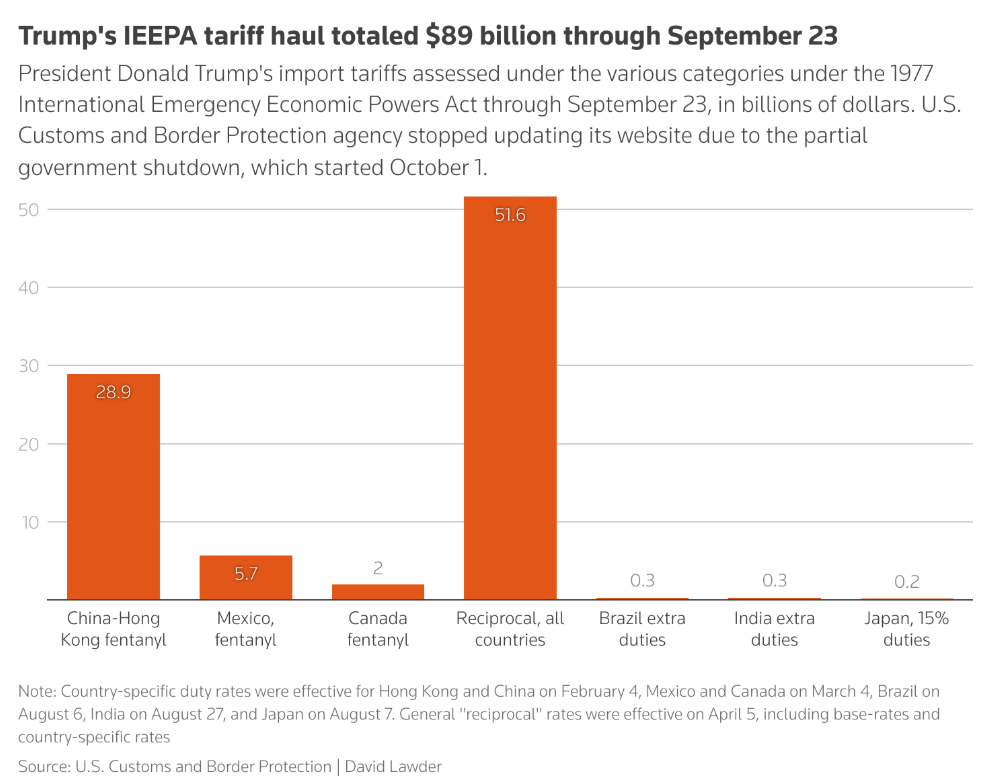
Core Points - The U.S. Supreme Court is set to hear arguments regarding the legality of Trump's global tariffs, which are expected to persist regardless of legal authorization [1][2] - Lower courts have ruled that Trump overstepped his authority by imposing tariffs under the International Emergency Economic Powers Act (IEEPA) [2] - The outcome of the Supreme Court's decision could significantly impact Trump's ability to impose tariffs as a means of punishing countries over non-trade political issues [2] Group 1: Tariff Legislation and Authority - The Supreme Court consists of six conservative and three liberal justices, and has previously supported Trump in major rulings [2] - If the Supreme Court rules against Trump, he may resort to other legal frameworks for imposing tariffs, such as the Trade Act of 1974 and the Tariff Act of 1930 [3] - Trump's administration views tariffs as a cornerstone of economic policy, and businesses should plan accordingly [3] Group 2: Trade Negotiations and Agreements - Trump's tariff policies have reportedly led to significant concessions from major trading partners like Japan and the EU, aimed at reducing the U.S. trade deficit [4] - The U.S. Trade Representative's office has announced final framework trade agreements with Vietnam, Malaysia, Thailand, and Cambodia, locking in tariff rates between 19% and 20% [4] - South Korea has agreed to a $350 billion investment plan in exchange for tariff reductions on automobiles and other goods [4] Group 3: Financial Implications and Revenue - As of September 7, the total import tariffs collected under IEEPA reached $89 billion, contributing to a net customs revenue increase of $118 billion for the fiscal year ending September 30 [8] - The reliance on tariff revenue poses significant political and economic risks, complicating future tariff reductions for any administration [8] - The potential need to refund over $100 billion in tariff revenue could create challenges for the U.S. Customs and Border Protection [8] Group 4: Inflation and Cost Management - Importers have largely absorbed the costs of tariffs, which has limited consumer price increases but has also reduced profit margins [9] - The Oxford Economics Institute estimates that tariffs have increased the Consumer Price Index (CPI) growth rate by 0.4 percentage points, pushing inflation above the Federal Reserve's target [9] - Companies are facing significant cost impacts, with over $35 billion in tariff-related costs disclosed ahead of the third-quarter earnings season [9]
DAT execs in two forums discuss how it seeks to reshape the freight sector
Yahoo Finance· 2025-10-27 11:00
Core Insights - Roper Technologies is optimistic about the performance of DAT, which has evolved beyond a traditional load board into a more comprehensive technology platform [1][4] - The acquisition of Convoy's data stack is currently not profitable, but Roper management believes it will yield attractive financial returns in the long term [2][3] Financial Performance - Roper did not disclose specific financial performance metrics for DAT during the earnings call, but expressed confidence in its growth potential [1] - The Convoy acquisition is viewed as an unusual transaction due to its current lack of profitability, yet Roper expects significant financial returns over the coming years [3] Strategic Acquisitions - DAT has made several strategic acquisitions, including the Convoy tech stack, Trucker Tools in December, and Outgo in May, to enhance its service offerings [5] - The acquired tech stack from Convoy is seen as a key asset that can scale up by leveraging DAT's customer unit economics [4] Technological Advancements - Roper's subsidiaries, including DAT, are experiencing early positive results from AI-driven initiatives aimed at improving efficiency and economic value for brokers and carriers [4] - DAT is transitioning from a traditional freight matching network to a fully automated freight marketplace powered by AI, which is expected to unlock significant growth opportunities [4]