Manus AI

Search documents
Meta Platforms:约25亿美元收购Manus AI进军企服AI
Sou Hu Cai Jing· 2025-12-30 23:16
Core Insights - Meta Platforms is set to acquire Manus AI for approximately $2.5 billion, including employee retention bonuses, marking its first significant entry into the enterprise AI sector [1] - This acquisition positions Meta more competitively in the AI agent race against rivals such as Salesforce, Google, Microsoft, and OpenAI [1] Summary by Categories Acquisition Details - The transaction value for the acquisition of Manus AI is around $2.5 billion [1] - The deal includes compensation for employee retention [1] Market Positioning - This acquisition represents Meta's initial large-scale move into the enterprise-level artificial intelligence market [1] - The deal may enhance Meta's competitive standing in the AI sector, aligning it more closely with major players like Salesforce, Google, Microsoft, and OpenAI [1]

Meta收购Manus AI的交易价值可能高达25亿美元
Di Yi Cai Jing· 2025-12-30 22:34
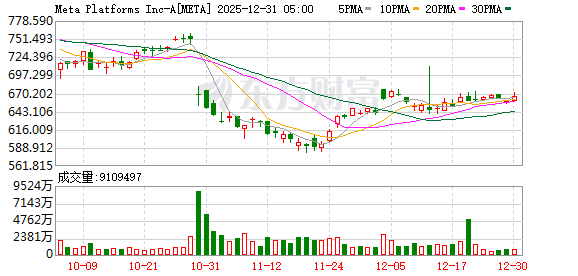
(文章来源:第一财经) 据媒体报道,从一位知情人士处获悉,Meta Platforms(META.O)收购Manus AI的交易价值可能约为25亿 美元,其中包括员工留任补偿金。Manus以订阅模式向企业销售其产品,标志着Meta首次大规模进军企 业级人工智能领域。这笔交易有可能使Meta在人工智能代理竞赛中与竞争对手Salesforce、谷歌、微软 和OpenAI处于更加平等的地位。 ...

Manus 嫁入豪门 Meta,图的是啥?
2 1 Shi Ji Jing Ji Bao Dao· 2025-12-30 10:15
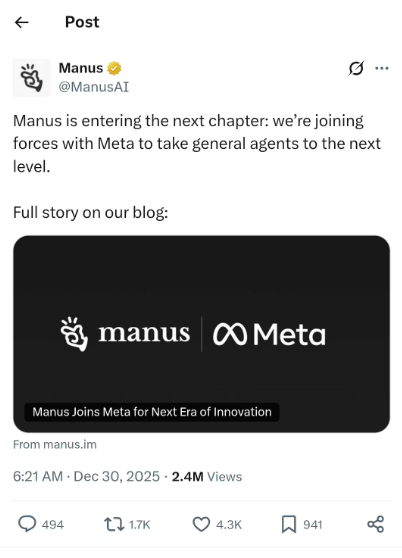
Manus帮助Meta补完了属于它的AI叙事 硅谷还在圣诞假期中,美股科技"七巨头"之一的 Meta 却玩了一笔大交易。 12月30日,由华人团队创立的通用AI智能体公司——Manus AI运营者蝴蝶效应公司宣布,被Meta 公司 收购。 Manus AI 官方社交媒体和公司创始人也确认了这一消息。 "Manus正在迈入新篇章:我们加入了Meta,致力将通用AI智能体带入下个阶段。"Manus AI官方社交平 台账号表示。 来源:Manus AI官方社交媒体账号 公司CEO肖弘表示:"加入 Meta 让我们能够在更强大,更可持续的基础上继续发展,而不会改变 Manus 的工作或决策方式。" 据透露,肖弘未来还将担任 Meta 公司的副总裁。但 Manus AI 团队依旧在新加坡展开业务,并独立运 营。 Meta 和 Manus AI 均未透露收购对价——不过考虑有消息指出此前 Manus AI 正在寻求估值为20亿美元 的新一轮融资,最终对价或高于以上水平。 Meta 巨资收购Manus的原因,硅谷和华人创业圈众说纷纭,但有一点是共识:Meta 暂时需要 Manus, 帮助自己完成属于 Meta 的AI叙事。 ...
Analysis-As global scrutiny grows, Chinese firms look to call Singapore home
Yahoo Finance· 2025-12-19 02:33
Core Viewpoint - A growing number of Chinese companies are relocating to Singapore to mitigate risks associated with Sino-U.S. geopolitical tensions [1] Group 1: Trends and Motivations - The trend, referred to as "Singapore washing," has gained momentum since the end of U.S. President Donald Trump's first term and is expanding across various sectors including critical minerals, technology, and biotechnology [2] - Interest from Chinese firms in Singapore is reportedly very strong, with inquiries increasing by approximately 15-20% year-on-year [3] Group 2: Company Examples - Notable companies that have established a presence in Singapore include Terahop, a maker of optical products, and newer entrants like DayOne, Manus AI, and ChemLex, which are involved in data centers, artificial intelligence, and chemical synthesis respectively [4][5] - Companies like Manus AI and Terahop do not publicly acknowledge their Chinese backers, indicating a strategic positioning as Singaporean firms [4] Group 3: Strategic Advantages of Singapore - Singapore serves as an attractive base for companies aiming to navigate U.S. tariffs, which are only 10% on goods from Singapore, while maintaining access to restricted American technologies [6] - The city-state's reputation for neutrality and cultural adaptability makes it appealing for Chinese firms and their expatriates [6] - With 28 free trade agreements, Singapore is positioned as a strategic hub for companies looking to expand into markets outside of China [6]
消息称DeepSeek四季度发布新一代模型:聚焦智能体,梁文锋督战
Feng Huang Wang· 2025-09-05 10:36
Group 1 - DeepSeek is developing an advanced AI model with intelligent agent capabilities to compete with US rivals like OpenAI [1] - The new AI model will execute multi-step operations with minimal user input and learn from past actions [1] - DeepSeek's founder, Liang Wenfeng, aims to release the new software in the last quarter of this year [1] Group 2 - DeepSeek's R1 model, released in January, mimics human reasoning at a development cost of only a few million dollars [1] - Since the R1 model, DeepSeek has only made minor upgrades while competitors have launched numerous new models [1] - The trend in the tech industry is towards developing intelligent agent software to simplify personal and work tasks [1][2] Group 3 - The goal of DeepSeek and the industry is to create increasingly autonomous AI systems capable of initiating and completing complex real-world tasks with minimal human intervention [2] - Currently, AI agents still require significant "adult supervision" [2]

DeepSeek四季度将推新一代AI模型,梁文锋力促智能体功能升级
Sou Hu Cai Jing· 2025-09-04 23:08
Core Insights - DeepSeek is developing an advanced AI agent model to compete globally with major players like OpenAI [1][3] - The new AI model is designed for high autonomy, capable of executing complex tasks from minimal user input [1][3] - DeepSeek's founder, Liang Wenfeng, aims to launch this innovative software by the end of the year [3] Company Developments - DeepSeek previously released the R1 model in January, which gained attention for its low-cost human-like reasoning capabilities [3] - After the initial success, DeepSeek's progress has been slower, with only minor updates released [3] - The company's entry into the AI agent field aligns with global tech trends, as competitors like OpenAI and Microsoft have also launched similar software [3] Industry Context - AI agents differ from traditional chatbots by handling more complex tasks, including travel planning and code debugging [3] - The industry is focused on creating increasingly autonomous AI systems to perform complex real-world tasks with minimal human intervention [3] - Despite advancements, AI agents still require significant human guidance at this stage [3]
腾讯研究院AI速递 20250821
腾讯研究院· 2025-08-20 16:01
Group 1: Meta's AI Department Restructuring - Meta has restructured its AI department, splitting the Super Intelligence Lab into four teams: TBD Lab (focused on the new version of Llama), FAIR (long-term research), product application team, and infrastructure [1] - The new teams are considering changing Meta's next-generation AI model to a closed-source model, potentially abandoning Llama 4 in favor of developing a new model from scratch, which challenges Meta's long-standing commitment to open-source [1] - Meta is increasing its AI investments, partnering with PIMCO and Blue Owl to lead approximately $29 billion in data center financing, and raising its annual capital expenditure to $66-72 billion [1] Group 2: DeepSeek V3.1 Base Performance - DeepSeek V3.1 has expanded its context length to 128k compared to V3, showing significant improvements in programming performance, creative writing, translation quality, and response tone [2] - Testing indicates that V3.1 has a more comprehensive code capability, considering more possibilities and proactively providing usage instructions, supporting more aggressive compression strategies [2] - In Reddit testing, V3.1 achieved a score of 71.6%, making it the state-of-the-art (SOTA) non-inference model, outperforming Claude Opus 4 by 1% while being 68 times cheaper [2] Group 3: AutoGLM 2.0 Launch - Zhizhu has launched the world's first universal mobile agent, AutoGLM 2.0, which operates independently in the cloud without occupying local devices, enabling cross-scenario applications across all devices [3] - The new system innovatively equips AI with dedicated cloud devices, allowing it to run tasks 24/7 even when users are offline, adhering to the principles of Around-the-clock, autonomous zero interference, and full-domain connectivity [3] - AutoGLM 2.0 is powered by GLM-4.5 and GLM-4.5V, outperforming mainstream products like ChatGPT Agent in Device Use benchmark tests, with three related technical papers published [3] Group 4: WeChat Work 5.0 Release - WeChat Work 5.0 has been officially released, focusing on "AI" and "office" as key themes, introducing six new AI capabilities for various enterprise office scenarios [4] - The new version includes features like intelligent search, intelligent summarization, intelligent robots, integration of intelligent meetings and emails, intelligent spreadsheets, and intelligent service summaries, achieving integrated office collaboration [4] - WeChat Work has connected over 14 million enterprises and organizations, serving more than 750 million WeChat users, allowing enterprises to create and manage intelligent robots based on their needs [4] Group 5: Looki L1 Multi-modal AI Hardware - Looki L1 is the world's first AI hardware that truly realizes multi-modal interaction, capable of using street sounds, scene visuals, and expressions as input prompts for AI [5][6] - This 30-gram AI life log camera operates automatically without user intervention, capturing and organizing materials into themed Moments, addressing the challenge of managing vast amounts of content [5][6] Group 6: New Humanoid Robot by Yushu - Yushu has announced a new generation humanoid robot, standing 180 cm tall with 31 degrees of freedom, showcased in a ballet dancer pose, indicating a high degree of anthropomorphism [7] - This is the fourth humanoid robot following H1, G1, and R1, with a 63% increase in freedom compared to the same height H1, focusing on enhanced flexibility in arm and waist movements [7] - Yushu's founder, Wang Xingxing, stated that the company initially opposed humanoid robots but started the project after the emergence of ChatGPT, with the core goal still being "to make robots work" [7] Group 7: Anthropic's Insights on Large Models - Anthropic researchers tracked the internal thought processes of large models, revealing discrepancies between the models' actual reasoning and the reasoning presented to users, often leading to misleading conclusions [8] - The study showed that large models possess planning capabilities, such as determining rhyme schemes in poetry before filling in content and simultaneously processing digits in arithmetic problems, demonstrating abstract thinking [8] - The research team is developing a model thought tracking diagram, having analyzed about 20% of the thought processes of large models, with the goal of achieving "one-click operation" for explainability in the next one to two years [8] Group 8: Manus AI's Revenue and Agent Payment - Manus AI's Chief Scientist disclosed that the company's annual recurring revenue (RRR) has reached $90 million, nearing the $100 million mark, and is collaborating with Stripe to facilitate payment processes within the Agent [9] - The expansion of Agent applications will follow two main lines: using multiple Agents for parallel processing of large-scale tasks and extending the Agent's "toolset" to allow it to call upon the open-source ecosystem like a programmer [9] - The current barriers in the digital world are primarily non-API web pages and CAPTCHA, with bottlenecks more related to ecosystem and institutional constraints rather than model intelligence, necessitating collaboration between Agents and infrastructure to reduce friction [9] Group 9: BVP Annual AI Report - Bessemer Venture Partners' report indicates that the AI industry has entered an accelerated evolution phase, categorizing outstanding AI startups into "supernova" and "meteor" types, with the latter achieving $3 million in ARR in their first year being more sustainable [10] - For AI application founders, context and memory are becoming new competitive advantages, with companies that can build memory into their products defining the next generation of more intelligent and personalized AI systems [10] - The report predicts five major trends in AI for 2025-2026: browsers becoming the core interface for AI interaction, 2026 being the year of video generation, assessment and data traceability becoming necessities, new AI-native social media giants emerging, and a significant increase in industry mergers and acquisitions [10] Group 10: Lovable CEO on Growth and Talent - Lovable's CEO revealed that the company achieved an ARR growth from $0 to $120 million within seven months, with a valuation reaching $2 billion, primarily driven by organic user growth rather than large-scale advertising [11] - Lovable's user base is divided into three categories: 80% are individual/small team developers acting as AI co-founders to build complete applications, 10% are enterprise product managers for demo creation, and 10% are lightweight individual users [11] - The CEO emphasized that talent is more critical than capital in AI entrepreneurship, focusing on recruiting individuals with strong learning abilities rather than just resumes, and prioritizing long-term success based on user value accumulation over short-term profit margins [11]

X @s4mmy
s4mmy· 2025-07-24 17:07
This is an interesting point around OpenAI's ChatGPT agent coming for the agent market share (Manus etc.)GI appears to be providing an alternative solution with price reflecting this at $30mmhttps://t.co/4glBzm7CoB https://t.co/UmkV3hWM81General Impressions (@gen_impressions):ChatGPT just launched its agents, incredibly powerful for general-purpose research and reasoning.That’s great for users. But it’s also a warning shot to $500M+ agent startups like @ManusAI_HQ, @genspark_ai, and @flowith_ai. The general ...
叫板 OpenAI Sora?Manus 推出文生视频服务,计划向所有用户开放
AI前线· 2025-06-05 09:13
Core Insights - Manus AI has launched a text-to-video generation service that transforms text prompts into fully structured, storyboarded video narratives, currently available for select subscription users and soon to be open to all [1] - This service directly competes with leading products in the industry, such as OpenAI's ChatGPT Pro Sora, which costs $200 per month, and other subscription-based or pay-per-use models from Runway, Synthesia, and Google [1] - The text-to-video sector is rapidly evolving, with Chinese tech giants Alibaba and Tencent pushing open-source solutions to challenge Western proprietary models [1] Group 1 - Manus AI gained significant recognition after launching its AI Agent tool earlier this year, which has led to investment from Benchmark Capital amid rising US-China AI competition [1] - The company has recently partnered with Microsoft Azure AI Foundry, enhancing its capabilities in the AI space [1] - Unlike traditional AI chatbots like ChatGPT, Manus can autonomously plan, execute, and complete complex multi-step tasks without continuous human intervention [2] Group 2 - Manus operates on a cloud-based asynchronous mechanism, allowing users to delegate tasks for offline processing, which can continue even during internet outages [2] - The system utilizes a multi-agent architecture, enabling specialized sub-agents to manage task planning, execution, and knowledge retrieval, thus supporting the breakdown and management of complex workflows [2]

腾讯研究院AI速递 20250514
腾讯研究院· 2025-05-13 15:57
Group 1: OpenAI Developments - OpenAI has launched a new PDF export feature for Deep Research, which supports tables, images, and clickable reference links, receiving positive feedback from users [1] - This update marks the first action under the new head of the application division, Fidji Simo, indicating OpenAI's acceleration towards enterprise market transformation [1] - The competition among AI research assistants is intensifying, shifting from feature comparison to optimizing user experience and workflow integration, with PDF export becoming a basic requirement for enterprise-level AI tools [1] Group 2: Lovart Design Agent - Lovart is the first design-specific agent that can generate design specifications, images, and execute plans based on professional design knowledge [2] - The product supports a full design workflow, integrating various tools to convert static images into dynamic videos [2] - This signifies a major transformation in design workflows, moving from mere creation to complete product asset delivery, with vertical agents likely becoming a trend in the industry [2] Group 3: Kunlun Wanwei's Matrix-Game - Kunlun Wanwei has open-sourced Matrix-Game, an interactive world model capable of generating coherent game interaction videos based on user input, surpassing existing open-source models in visual quality and physical consistency [3] - The model employs a two-phase training process and a unique architecture for high-precision action response and scene generalization [3] - This represents a significant breakthrough in spatial intelligence, applicable not only in game development but also in film, advertising, and XR content production [3] Group 4: Tencent's Unified Reward Model - Tencent has launched the UnifiedReward-Think, a unified multi-modal reward model with long-chain reasoning capabilities, enhancing evaluation ability through a three-phase training process [4][5] - This model addresses the limitations of existing reward models, demonstrating explicit and implicit reasoning capabilities, significantly improving performance in image generation and understanding tasks while maintaining high interpretability [5] - UnifiedReward-Think has been fully open-sourced, marking a shift from simple scoring systems to intelligent evaluation systems with cognitive understanding [5] Group 5: Manus AI's Free Access - Manus AI has removed the invitation system, allowing free access for all users, with each user receiving daily free task credits and a one-time bonus [6] - The platform offers three paid subscription tiers, unlocking additional features and priority services, while free credits are valid for one day only [6] - Manus AI recently completed a $75 million funding round, raising its valuation to $500 million, with plans to expand into overseas markets [6] Group 6: US AI Regulation Changes - The US Department of Commerce has repealed the Biden-era AI diffusion rules, citing concerns over innovation and diplomatic relations, while proposing new simplified regulations [7] - The new rules will strengthen controls on overseas AI chip exports, particularly targeting Huawei's Ascend chips, and may push tech giants towards Chinese AI technologies [7] - Saudi Arabia has pledged to invest $600 billion in various sectors, including AI data centers, leading to a surge in tech stocks like NVIDIA [7] Group 7: OpenAI's HealthBench - OpenAI has introduced the HealthBench, a medical evaluation benchmark developed with the participation of 262 doctors, containing 5,000 real dialogues for comprehensive AI model assessment [8] - The latest model, o3, scored 60%, significantly outperforming earlier GPT models, with notable performance improvements in smaller models and reduced costs [8] - The project has been open-sourced, providing a complete evaluation tool that aligns model scoring with physician judgments [8] Group 8: NVIDIA's AI Factory Vision - NVIDIA's CEO Jensen Huang believes AI factories will lead the next industrial revolution, with plans to invest $50-60 billion in building large-scale AI factories over the next decade [9] - AI is seen as a true digital labor force expansion, impacting nearly all industries and becoming a new generation of infrastructure following information and energy [9] - NVIDIA is transitioning from a chip company to an AI infrastructure company, investing $20-30 billion annually in R&D to establish global AI ecosystem standards [9] Group 9: Future of AI Agents - OpenAI aims to develop ChatGPT into a personalized AI service, with predictions of widespread AI agent applications by 2025 and capabilities for knowledge discovery by 2026 [10] - The team focuses on maintaining an efficient structure and rapid iteration, positioning itself as a core AI subscription service provider [10] - Different age groups perceive AI applications differently, with younger generations viewing AI as an operating system [10]