中小银行改革化险

Search documents
今年首家省级农商行登场
第一财经· 2026-03-19 13:39
Core Viewpoint - The establishment of Gansu Rural Commercial Bank marks a significant step in the ongoing reform of small and medium-sized banks in China, with a focus on enhancing quality while reducing quantity in the banking sector [3][5][10]. Group 1: Establishment of Gansu Rural Commercial Bank - Gansu Rural Commercial Bank was officially established on March 17, 2026, with a registered capital of approximately 44.9 billion yuan, making it the first provincial rural commercial bank established this year [5][6]. - The bank's establishment was approved by the National Financial Supervision Administration in early February 2026, and the process from approval to establishment took just over a month [5][6]. - Gansu Rural Commercial Bank is the 14th provincial-level rural financial institution to be established as part of the ongoing provincial association reform [3][6]. Group 2: Reform and Development of Small and Medium-sized Banks - The reform of small and medium-sized banks is accelerating, with a focus on risk management and transformation, as indicated by the government's emphasis on "reducing quantity and improving quality" [3][10]. - The reform has seen various models, including the provincial rural commercial bank model and the provincial rural commercial bank joint model, with significant differences in implementation across regions [6][7]. - The Gansu provincial government has shifted its approach to focus on establishing an independent provincial rural commercial bank rather than a joint bank model, which is expected to enhance resource allocation and risk management [7][10]. Group 3: Capital and Funding Sources - The registered capital of Gansu Rural Commercial Bank is second only to Inner Mongolia Rural Commercial Bank, which has a registered capital of approximately 58 billion yuan [9][11]. - The establishment of provincial rural commercial banks typically requires higher capital strength, and funding sources primarily include local government financial departments and state-owned enterprises [11][12]. - There is a call for the issuance of special bonds to support the capital needs of small and medium-sized banks, as previous funding sources have diminished [11][12].


中小银行股权拍卖降温
Bei Jing Shang Bao· 2026-02-26 16:47
Core Viewpoint - The market for small and medium-sized bank equity auctions has significantly cooled down, with "unsold" and "discounted" becoming the norm, reflecting a lack of investor confidence in the future prospects of these banks [1][5]. Group 1: Auction Market Trends - Since the beginning of the year, most small and medium-sized bank equity auctions have shown low levels of interest, participation, and transaction prices, with unsold auctions becoming common [2]. - Large equity auctions are particularly affected, with notable cases such as the 416 million shares of Shanxi Bank, which had an opening price of approximately 417 million yuan but went unsold despite attracting over 1,400 views [2]. - Smaller equity auctions also face challenges, as seen with the 34,172 shares of Shandong Yiyuan Rural Commercial Bank, which failed to sell even after a price reduction in the second auction [3]. Group 2: Pricing and Discount Trends - Even successful transactions are often completed at significant discounts, such as the 17.2 million shares of Jiangsu Dongtai Rural Commercial Bank, which sold for 25.79 million yuan, over 8.5 million yuan less than the market price [4]. - The trend of discounted sales is prevalent, with many transactions occurring below the assessed value, indicating a broader issue of market confidence [4]. Group 3: Investor Sentiment and Market Conditions - The persistent coldness in the auction market is attributed to multiple factors, including concerns over the operational stability, profitability, and long-term development prospects of small and medium-sized banks [5]. - Analysts suggest that weak profitability and limited dividend capabilities of many small banks contribute to a lack of investment appeal, even at discounted prices [5]. - The overall market sentiment is cautious, with investors reluctant to engage due to fears of poor asset quality and governance issues within these banks [5]. Group 4: Future Outlook and Recommendations - Experts believe that the current "winter" for small and medium-sized bank equity auctions is a result of risks accumulated from past development models, and that real solutions require substantial risk clearing and governance restructuring [6]. - It is anticipated that the auction market will continue to experience low activity, with trends of deeper discounts and reduced transaction volumes [6]. - Recommendations for banks include enhancing financial service capabilities tailored to local enterprises and embracing digital transformation to improve customer engagement and service offerings [7].
大额无人接、小额也遇冷,中小银行股权拍卖“不香了”
Bei Jing Shang Bao· 2026-02-26 14:04
Core Viewpoint - The market for small and medium-sized bank equity auctions has significantly cooled down since the beginning of 2026, with "unsold" and "discounted" becoming the norm in transactions [2][3][6] Group 1: Auction Market Trends - The auction market for small and medium-sized bank equities has shown low attention, participation, and transaction prices, with unsold auctions becoming common [3][6] - Large equity stakes are particularly affected, with notable cases such as the 416 million shares of Shanxi Bank, which had an initial auction price of approximately 417 million yuan but went unsold despite attracting over 1,400 views [3][5] - Smaller equity stakes also face challenges, as seen with the 34,172 shares of Shandong Yiyuan Rural Commercial Bank, which failed to sell at both the initial and subsequent auction prices [4][6] Group 2: Factors Influencing Market Sentiment - The persistent coldness in the auction market is attributed to multiple factors, including a lack of confidence in the operational stability and profitability of small and medium-sized banks [6][7] - Many small and medium-sized banks exhibit weak profitability and dividend capabilities, limiting their equity appreciation potential, which does not meet investor return expectations even at discounted prices [6][7] - Concerns over asset quality, governance issues, and limited trading scenarios further suppress investor enthusiasm, as buyers fear difficulties in exiting their investments [6][7] Group 3: Recommendations for Improvement - To address the challenges, small and medium-sized banks should enhance their financial service capabilities while maintaining their focus on supporting agriculture and small enterprises [7] - Embracing digital transformation and improving online service channels can help attract investors and enhance the core investment value of bank equities [7]

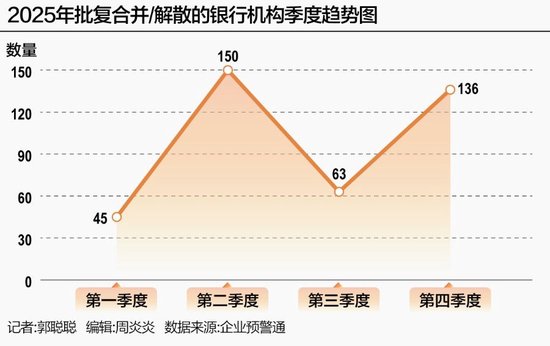
一年649家银行退出,中小银行“减量提质”加速
Zhong Guo Ji Jin Bao· 2026-02-01 06:08
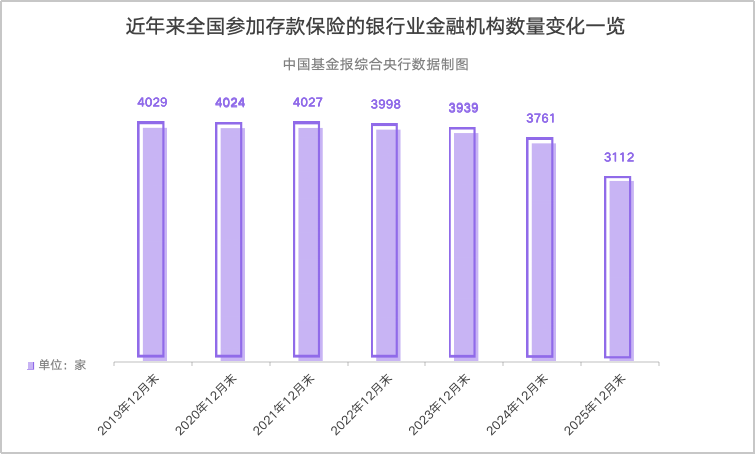
Core Viewpoint - The number of banking institutions participating in deposit insurance in China decreased by 649 in 2025, marking a significant trend towards "reducing quantity and improving quality" among small and medium-sized banks [1][2][3]. Group 1: Industry Trends - As of the end of 2025, there are 3,112 banking institutions participating in deposit insurance, a reduction from the previous year [3]. - The decline in the number of banks has been consistent since 2022, with reductions of 59, 178, and 649 banks in 2023, 2024, and 2025 respectively, primarily affecting rural commercial banks, village banks, and rural credit cooperatives [5]. - Over 400 banks exited the market in 2025 through dissolution or mergers, predominantly among small and medium-sized banks [5]. Group 2: Regulatory and Market Dynamics - Regulatory policies have driven the "reducing quantity and improving quality" initiative, focusing on reforming and mitigating risks in small and medium-sized financial institutions [5][9]. - Increased market competition has pressured small banks, as larger state-owned and joint-stock banks enhance their services, making it difficult for smaller institutions to compete [5]. - Issues such as small asset sizes, weak risk resistance, and inadequate corporate governance are prevalent among rural commercial banks and village banks [5][6]. Group 3: Reform and Risk Mitigation - The reform process for small banks has shown significant progress, characterized by a shift from isolated risk management to systematic resolution [8][9]. - Strategies include horizontal integration through the establishment of provincial-level legal entities and vertical absorption by stronger banks, which inject capital and governance capabilities [8][9]. - The focus is on a dual approach of risk resolution and capacity enhancement, with a combination of capital replenishment, mergers, and market exits [9]. Group 4: Future Directions - The core policy remains centered on "reducing quantity and improving quality," with an emphasis on creating differentiated competitive advantages for small banks [12]. - Future development for small banks should focus on enhancing quality, leveraging local advantages, and deepening digital transformation to optimize risk control and reduce operational costs [12][13]. - Recommendations include strengthening provincial-level coordination, establishing shared technology platforms, and focusing on localized and specialized services to avoid direct competition with larger banks [13].
一场“不付现金”的承接: 信托受益权置换丰富中小银行改革工具箱
Zhong Guo Zheng Quan Bao - Zhong Zheng Wang· 2026-01-22 23:45
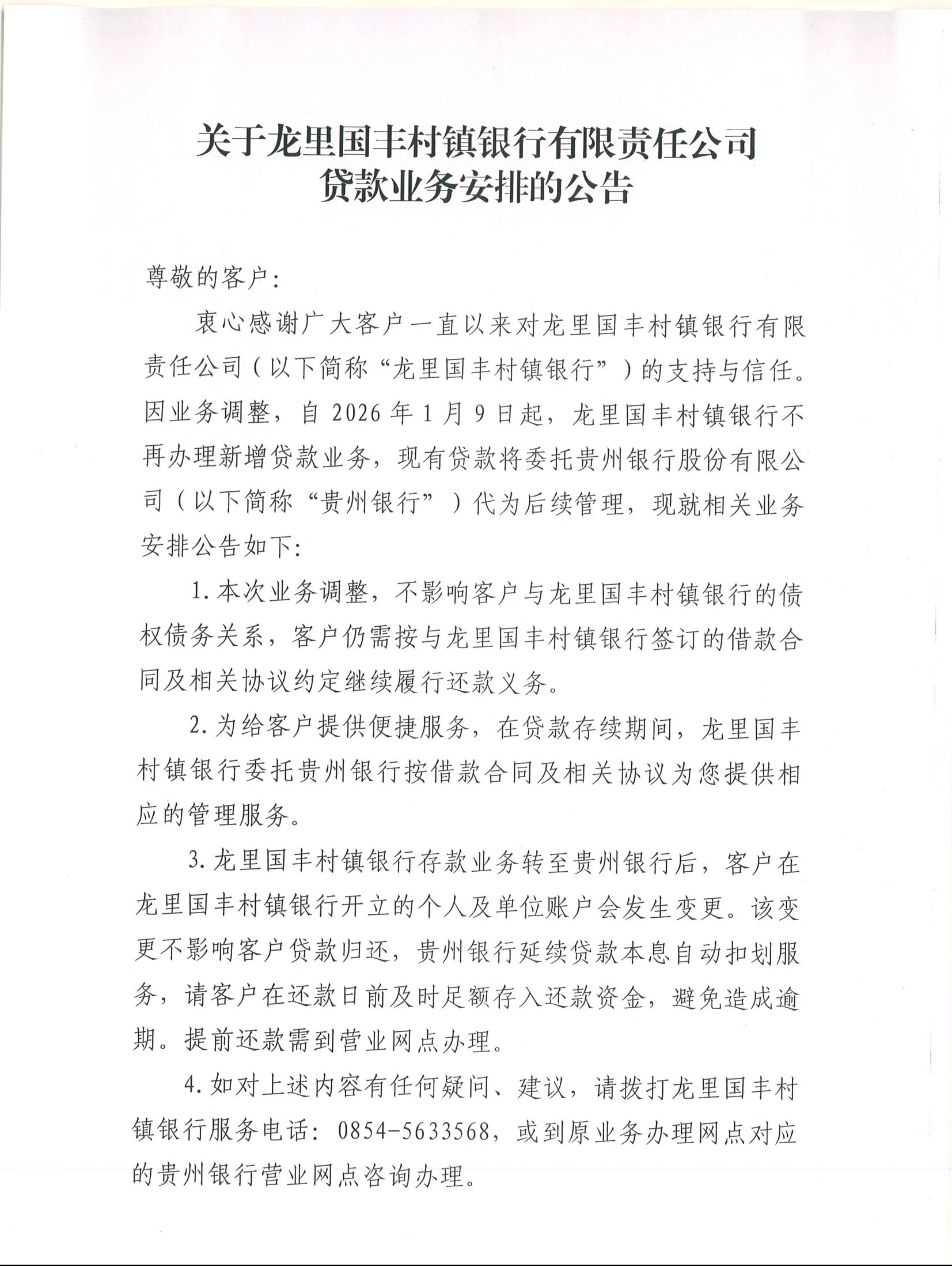
Core Viewpoint - A recent transaction involving 1.913 billion yuan in deposits has attracted market attention due to its "non-cash" payment arrangement, where Guizhou Bank acquires the deposits of Longli Guofeng Village Bank through a trust plan without immediate cash payment [1][2]. Group 1: Transaction Details - Guizhou Bank signed a deposit transfer agreement with Longli Guofeng Village Bank, effective from January 12, 2026, with a total deposit principal and interest amounting to 1.913 billion yuan, leading to a final transfer price of 1.849 billion yuan after deducting related rights [2][3]. - The payment arrangement is unique as Guizhou Bank does not pay cash directly but instead receives a beneficial interest in a trust plan, allowing for a quick transfer of deposit liabilities without complex negotiations [2][5]. Group 2: Regulatory and Operational Context - The Guizhou Financial Regulatory Bureau approved the dissolution of Longli Guofeng Village Bank on January 8, 2026, with Guizhou Bank taking over all deposits and managing existing loans [3]. - Guizhou Bank only assumes deposit liabilities and does not take on loan assets, ensuring that customer obligations remain unchanged and repayments continue as per original agreements [3]. Group 3: Reform and Innovation - The transaction is viewed as an innovative attempt to navigate the ongoing reforms in village banks, which have included various restructuring methods since 2026, such as mergers and acquisitions [4][8]. - The use of trust tools in this context is relatively rare, and it serves to align with policy advancements and regional risk management efforts [4][6]. Group 4: Risk Management and Future Considerations - While the model aims to isolate risks, experts caution that risks have merely transformed rather than disappeared, with underlying credit risks still present [6][7]. - The uncertainty surrounding the recovery of underlying assets, primarily loans from the village bank, poses potential challenges for the trust's beneficial interests and the bank's liquidity [7][8].
一场“不付现金”的承接:信托受益权置换丰富中小银行改革工具箱
Zhong Guo Zheng Quan Bao· 2026-01-22 20:56
Core Viewpoint - A recent transaction involving 1.913 billion yuan in deposits has attracted market attention due to its "non-cash" payment arrangement, where Guizhou Bank acquires the deposits of Longli Guofeng Village Bank through a trust plan without immediate cash payment [1][2] Group 1: Transaction Details - Guizhou Bank signed a deposit transfer agreement with Longli Guofeng Village Bank, effective from January 12, 2026, where Guizhou Bank will assume the liabilities and rights related to the deposits totaling 1.913 billion yuan, with a final transfer price of 1.849 billion yuan after deducting related rights [1][2] - The payment is structured through a trust plan, allowing Guizhou Bank to receive trust benefits instead of direct cash payment, facilitating a quicker transfer of deposit liabilities without complex negotiations [2] Group 2: Regulatory and Structural Context - The transaction is part of ongoing reforms in village banks, with Guizhou Bank being the main initiator of Longli Guofeng Village Bank, which was established in December 2008 [2] - Regulatory approval was granted for the dissolution of Longli Guofeng Village Bank, with all deposits to be managed by Guizhou Bank from January 9, 2026, while new loans will not be issued [2] Group 3: Risk Management and Implications - Guizhou Bank is only assuming deposit liabilities and not the loan assets, maintaining the existing debtor-creditor relationship between customers and the village bank [3] - The use of trust tools in this transaction is seen as a novel approach to manage potential asset risks while alleviating immediate capital and liquidity pressures on the main initiator [3][4] - The model aims to isolate risks but does not eliminate them, as the underlying credit risks of the assets remain, necessitating careful management of uncertainties related to asset recovery and liquidity [5][6]
改革化险另辟蹊径 中小银行减量提质加速
Xin Hua Wang· 2026-01-21 02:37
Core Viewpoint - The reform of village banks in China is accelerating, with over 300 village banks exiting the market since 2025, and new models such as "village reform into branches" and "village reform into divisions" becoming mainstream exit paths [1][4][7]. Group 1: Reform Mechanisms - Guizhou Bank announced it will assume all deposits from Longli Guofeng Village Bank through a trust plan, marking a new model in village bank reform [2][3]. - The trust plan allows Guizhou Bank to take on 1.913 billion yuan in deposit liabilities without direct cash payment, instead receiving trust beneficiary rights as compensation [3]. - The restructuring of village banks is characterized by various models, including mergers into new branches and divisions, as well as acquisitions [4][5]. Group 2: Industry Trends - Since 2025, over 310 village banks have exited the market, with significant participation from major state-owned banks in the restructuring process [5][6]. - The ongoing "reduction and quality improvement" strategy aims to enhance the capital strength and operational efficiency of small and medium-sized banks [7][8]. - Experts suggest that the restructuring of village banks will continue, with a focus on improving governance and risk management [6][7].
不花钱、不购股!贵州银行借信托承接19亿存款 改革化险出新招
Bei Ke Cai Jing· 2026-01-15 09:29
Core Viewpoint - The reform process of small and medium-sized banks is accelerating, with innovative integration solutions emerging, particularly highlighted by Guizhou Bank's acquisition of all deposits from Longli Guofeng Village Bank through a trust-based debt exchange rather than traditional cash payment methods [1][2][10]. Group 1: Guizhou Bank's Acquisition Strategy - Guizhou Bank plans to assume all deposits from Longli Guofeng Village Bank, holding only 25.36% of its shares, and will not use cash for this transaction, opting instead for a "debt for trust benefit share" approach [2][10]. - The total amount of deposits and interest from Longli Guofeng Village Bank is approximately RMB 19.13 billion, with the acquisition price set at RMB 18.49 billion after accounting for related rights [9][10]. - This method is seen as a financial innovation that allows Guizhou Bank to manage risks without altering its equity structure or incurring cash expenses [24][25]. Group 2: Advantages and Risks of the Trust Model - The trust model significantly reduces liquidity pressure and enhances risk isolation, as it allows for the independent management of debts through a trust plan [5][25]. - The approach is faster and incurs lower transaction costs compared to traditional mergers and acquisitions, while also improving the safety of depositors' funds [25][30]. - However, there are concerns regarding the valuation of trust assets and potential shareholder disputes due to the lack of equity acquisition [25][26]. Group 3: Broader Industry Context - The reform of small and medium-sized banks is part of a larger trend, with over 300 village banks exiting the market by the end of 2025, reducing the total number to 1,282 [27]. - The regulatory framework is focused on accelerating the reform and risk management of small financial institutions, emphasizing the need for governance restructuring and business reorganization [28]. - Guizhou Bank's innovative approach may serve as a model for other banks facing similar challenges, particularly in regions with mature financial ecosystems [29][31].
村镇银行撤牌背后:一场“毛细血管”的重构与新生
Zhong Guo Zheng Quan Bao· 2025-12-29 21:13
Core Insights - The article highlights the ongoing reform wave in China's rural banks, transitioning many from "village banks" to branches of larger banking institutions, enhancing their risk resilience and service capabilities [1][2][3] Group 1: Reform Trends - Over 250 village banks have been deregistered since 2025 due to regulatory approvals for mergers or dissolutions [1] - Many village banks are being restructured into branches of larger banks, such as the recent merger of Zhengzhou Bank with a village bank, which will dissolve the latter's legal entity [1][2] - In December alone, nearly 50 village banks were approved for mergers or dissolutions by regulatory authorities [2] Group 2: Structural Changes - The restructuring of village banks includes four main methods: absorption by the main initiating bank, mergers of multiple village banks, direct dissolution, and increasing shareholding in village banks by the main bank [2][3] - The focus of these reforms is not merely on reducing the number of banks but on enhancing the quality and governance of remaining institutions [3][4] Group 3: Service Enhancement - The fundamental goal of the reforms is to optimize the quality of rural financial services and improve support for agriculture and local economies [3][4] - Post-reform, village banks are expected to maintain their local customer relationships while benefiting from improved capital strength and risk management systems [4][5] - The reforms aim to stimulate the internal motivation of banks by enhancing governance and resource integration, ensuring they meet diverse financial needs effectively [4][5]

银行业“瘦身”
Xin Lang Cai Jing· 2025-12-26 13:11
Core Insights - The wave of mergers and restructuring among China's small and medium-sized banks has progressed with unexpected intensity and speed, focusing on financial risk prevention and high-quality industry development in 2025 [1][19] - A total of 394 banking institutions were approved to exit the market through mergers and dissolutions by December 26, 2025, doubling the total from 2024 [1][19] - The restructuring involved 550 banking institutions over 2024 and 2025, surpassing the total from the previous seven years [1][19] Regional and Institutional Analysis - The restructuring covered 28 provinces, with Inner Mongolia leading by integrating 139 institutions, followed by Shandong (33), Henan (26), and Sichuan (25) [1][7][26] - Village banks were the primary focus of the restructuring, with 231 banks involved, followed by rural commercial banks (81) and rural credit cooperatives (71) [1][12][27] Characteristics of the Restructuring - The 2025 restructuring is characterized by two significant trends: the entry of state-owned banks into the "village to branch" transformation and the acceleration of provincial-level reforms in the rural credit system [1][11] - State-owned banks have begun acquiring city commercial banks, marking a new phase in the restructuring process [1][11] Policy and Regulatory Framework - The central government emphasized the need for a systematic approach to risk management in small and medium-sized banks, aligning with the broader economic strategy [3][21] - The "14th Five-Year Plan" has prioritized the resolution of financial risks, particularly in small financial institutions, as a core responsibility of regulatory bodies [3][22] Achievements and Future Outlook - Significant progress has been made in risk resolution, with over 40% more non-performing assets disposed of compared to the previous five-year period, and total capital and provisions exceeding 50 trillion yuan [4][23] - The restructuring is expected to continue into 2026, focusing on quality improvement and effective integration, with a clear directive from regulatory authorities [17][36]