主观策略

Search documents
百亿元级私募机构增至118家
Zheng Quan Ri Bao· 2026-01-26 16:41
据私募排排网最新统计数据,截至2026年1月26日,管理规模为100亿元以上的私募证券投资基金管理人 总数已攀升至118家,较2025年末净增5家。这一增长并非简单的数量叠加,而是伴随着"百亿元级私募 阵营"内部的动态调整——1月份共有9家私募机构新晋或重返"百亿元梯队",另有4家机构暂时退出这一 行列。与此同时,百亿元级"险资系"私募机构数量增至3家,百亿元级外资私募机构增至2家。 深圳市融智私募证券投资基金管理有限公司FOF基金经理李春瑜对《证券日报》记者表示:"百亿元级 私募机构数量持续增长主要得益于四方面因素共同推动。一是A股市场整体回暖,为私募基金行业创造 了有利的业绩环境,不少机构旗下产品净值回升;二是技术赋能,人工智能等技术的深入应用,正从量 化策略优化、风险控制、交易执行等多维度提升私募机构的投资效率与管理规模承载能力;三是资金持 续向策略成熟、品牌效应突出的头部私募机构集中,'强者恒强'的行业格局进一步深化;四是政策面与 资金面的双重支持,当前适度宽松的货币政策与'十五五'规划建议带来的产业机遇,激发了市场对权益 资产的配置热情。" 在2026年1月份新增的9家百亿元级私募机构中,上海汐泰投 ...
百亿私募阵营加速洗牌
Guo Ji Jin Rong Bao· 2026-01-20 14:37
Core Insights - The number of private equity firms managing over 10 billion yuan has reached 114 as of January 19, 2026, with a slight increase from the end of 2025, indicating a reshuffling within the sector [1][3] - The entry of three new or returning firms into the 10 billion yuan club highlights a dynamic market, with two firms adopting subjective strategies and one yet to disclose its investment approach [1][2] - The growth of private equity firms is driven by market recovery, technological advancements, a concentration of capital in leading firms, and supportive policies [3] Group 1: Market Dynamics - The total number of 10 billion yuan private equity firms has increased by one from the end of 2025, with two firms exiting and three firms entering or returning [1] - Among the new entrants, Suijiu Private Equity has returned after previously being part of the 10 billion yuan group, while Guoyuan Xinda and Hengyi Chiying (Shenzhen) are making their debut [1] - The rapid growth of Hengyi Chiying (Shenzhen) from a management scale of 0 to 500 million yuan at the end of 2025 to over 10 billion yuan in January 2026 is noteworthy [1] Group 2: Investment Strategies - Quantitative strategies dominate the 10 billion yuan private equity sector, with 55 firms (48.25%) employing this approach, while subjective strategies account for 46 firms (40.35%) [2] - There are 10 firms using a mixed strategy, and three firms have not disclosed their investment models [2] - The average number of employees in these firms is 52, significantly higher than the industry average of 9, indicating a robust team structure [2] Group 3: Internationalization and Team Strength - 38 out of 114 firms hold a Hong Kong license, representing 33.33% of the total, which is a significant factor in the internationalization of the industry [2] - The concentration of talent and resources in leading firms is evident, with 14 firms employing over 100 people, primarily in quantitative strategies [2] - The strong team capabilities of these firms reflect their competitive edge in the market [2] Group 4: Drivers of Growth - The expansion of 10 billion yuan private equity firms is attributed to four main drivers: market recovery, technological advancements in AI, a concentration of capital in established firms, and supportive monetary policies [3] - The trend of insurance capital entering the private equity sector is seen as a strategy to seek enhanced returns and risk diversification in a low-interest-rate environment [3]


成立7个月规模超百亿!私募“百亿俱乐部”扩容
中国基金报· 2026-01-19 13:21
Core Viewpoint - In January 2026, three private equity firms entered or returned to the 100 billion yuan club, indicating a significant shift in the private equity landscape in China, driven by insurance capital actively entering the market [2][3][4]. Group 1: New Entrants to the 100 Billion Yuan Club - The number of private equity firms with over 100 billion yuan in assets reached 114 as of January 19, 2026, an increase of one from the end of 2025 [4]. - The three firms that entered or returned to the 100 billion yuan club are Hengyi Chiying (Shenzhen) Private Equity, Guoyuan Xinda, and Suijiu Private Equity [4][5]. - Hengyi Chiying (Shenzhen) Private Equity was established in late May 2025 and had a management scale of only 0 to 500 million yuan by the end of 2025, but it quickly surpassed 100 billion yuan in January 2026 [4][5]. Group 2: Performance and Background of New Entrants - Guoyuan Xinda has shown strong long-term performance, with its scale increasing from over 2 billion yuan to surpassing 100 billion yuan within a year [5]. - Suijiu Private Equity is making a comeback to the 100 billion yuan tier after previously being part of it [5]. - The insurance capital's accelerated entry into the private equity sector is primarily driven by the need for yield-enhancing tools and risk diversification in a low-interest-rate environment [5]. Group 3: Strategy Types and Internationalization - Among the 114 private equity firms, quantitative strategies dominate, with 55 firms (48.25%) employing this approach, while 46 firms (40.35%) use subjective strategies [7][8]. - The trend of private equity firms "going abroad" is accelerating, with 38 firms holding Hong Kong's Type 9 license, representing 33.33% of the total number of 100 billion yuan private equity firms [8].

百亿级私募阵营动态调整 险资背景私募规模快速破百亿元
Xin Lang Cai Jing· 2026-01-19 09:56
Group 1 - The total number of private equity firms managing over 10 billion yuan has reached 114 as of January 19, 2026, showing a slight increase of 1 firm compared to the end of 2025 [1] - Within this period, there has been a notable dynamic adjustment among the firms, with 2 institutions exiting the 10 billion yuan tier and 3 institutions either newly entering or returning to this group [1] - The three firms that have newly entered or returned include Suijiu Private Equity, which rejoined after previously being in the tier since 2021, and Guoyuan Xinda and Hengyi Chiying (Shenzhen) Private Equity, which are making their debut in the 10 billion yuan category [1] Group 2 - Hengyi Chiying (Shenzhen) Private Equity, established in May 2025, achieved a remarkable growth from a management scale of 0-500 million yuan at the end of 2025 to surpassing 10 billion yuan within just one month [1] - The firm has a distinct insurance capital background, being controlled by Ping An Asset Management Co., Ltd., and is one of three private equity firms in China with such a background [1] - The trend of insurance capital accelerating its layout in the private equity securities industry is driven by the low interest rate environment, as insurance capital seeks effective ways to enhance returns and diversify risks [2] Group 3 - Quantitative strategies remain the mainstream choice among the 10 billion yuan private equity firms, with 55 firms adopting this strategy, accounting for 48.25% of the total [2] - Subjective strategy private equity firms number 46, making up 40.35%, while mixed strategies combining subjective and quantitative approaches account for 10 firms, or 8.77% [2] - The internationalization of 10 billion yuan private equity firms is accelerating, with 38 firms obtaining the Hong Kong No. 9 license, representing 33.33% of the total and 28.57% of all firms holding this license [2]
量化领跑 主观分化 百亿级私募2025年平均收益32.77%
Shang Hai Zheng Quan Bao· 2026-01-18 18:23
Core Insights - The average return of billion-level private equity funds in 2025 reached 32.77%, with quantitative funds performing particularly well at over 37% [1][2] - The private equity issuance market remains active, with a significant increase in new registrations, indicating a strong market sentiment [3] Performance Summary - In 2025, 75 billion-level private equity funds reported an average return of 32.77%, with 74 funds achieving positive returns, representing 98.67% [2] - Quantitative private equity funds had an impressive average return of 37.61%, with all funds reporting positive returns. Specifically, 7 funds exceeded 50% returns, while 34 funds had returns between 20% and 49.99% [2] - In contrast, subjective strategy private equity funds had an average return of 25.8%, with 22 funds achieving positive returns, which is 95.65% of the total [2] Issuance Trends - The private equity issuance market is thriving, with 12,645 new private equity securities investment funds registered in 2025, a 99.54% increase from 6,337 in 2024 [3] - Stock strategy funds dominated the issuance market, accounting for 8,328 new registrations, or 65.86% of total products [3] - Multi-asset strategies and futures/derivatives strategies followed, with 1,806 and 1,274 new registrations, representing 14.28% and 10.08% respectively [3] Market Outlook - The market sentiment is expected to remain positive into 2026, with expectations of continued profit-making effects due to economic recovery and technological advancements [5] - The focus on quantitative long strategies remains high, particularly in market-neutral strategies that aim to reduce volatility and pursue absolute returns [4][5] - Factors supporting the performance of quantitative strategies include improved market risk appetite and ongoing technological and strategic iterations within the industry [5]
又见“爆款”,私募市场“开门红”来了?
Zhong Guo Ji Jin Bao· 2026-01-15 01:48
Group 1 - The private equity market in China is experiencing a "good start" in 2026, with significant interest in quality subjective strategies and continued popularity of quantitative strategies [1][3] - Shanghai Fusheng Asset's actively managed stock private equity product raised 1 billion yuan in a single day, becoming the first "daylight" private equity hit of the year, reportedly selling out in seconds [1][3] - There is a structural characteristic in the current market recovery, with long-term performance-validated quality subjective managers regaining attention while quantitative strategies remain mainstream [3][4] Group 2 - The private equity issuance market has shown a "structured good start" trend, primarily driven by quantitative blue-chip institutions and some outstanding subjective private equity products [3][4] - As of January 9, 2026, 238 private equity securities products have been registered this year, with quantitative products accounting for 47.48% [4] - The sales pace of private equity products has accelerated compared to last year, driven by market policies and increased capital activity, leading to a higher demand for allocations [6][7] Group 3 - Existing clients remain the main source of funding, with new client entry being relatively slow but showing a growth trend [9] - High-net-worth individual clients, especially ultra-high-net-worth clients, are significantly increasing their allocation intentions [9] - Investment strategies are focusing on high-growth sectors, with companies like Shen Nong Investment and Tong Ben Investment targeting AI applications and new consumption as key areas for 2026 [11][12]
又见“爆款”,私募市场“开门红”来了?
中国基金报· 2026-01-15 01:28
Core Viewpoint - The private equity market in China is experiencing a "good start" in 2026, with a notable increase in demand for quality subjective strategies and sustained interest in quantitative strategies [1][3]. Group 1: Market Trends - The Shanghai Composite Index has surpassed 4100 points, leading to a surge in private equity fundraising, exemplified by Shanghai Fusheng Asset's 10 billion yuan product that sold out in seconds [1]. - The current private equity issuance and sales show a "structured good start," with quantitative strategies maintaining high popularity and some outstanding subjective strategy products also experiencing "instant sell-out" phenomena [1][3]. - Compared to last year, the pace of private equity sales has accelerated, with investors showing increased demand for equity assets and quicker decision-making [1][7]. Group 2: Investor Behavior - Existing clients remain the primary source of funding, with new client entry being relatively slow but showing a growth trend [8][9]. - High-net-worth individuals continue to dominate subscription activities, with a notable increase in the willingness of ultra-high-net-worth clients to increase their allocations [8][9]. Group 3: Strategy Focus - Institutions are focusing on high-growth sectors, with a dual investment strategy that includes waiting for results in the innovative drug sector and embracing explosive growth opportunities in AI applications [11]. - The innovative drug sector is expected to capture 20% to 30% of the global market share in the next decade, indicating a significant growth potential [11]. - New consumption and the AI industry chain are identified as key focus areas for investment, driven by long-term growth logic and short-term performance support [12].

百亿私募2025年平均收益近33%,量化策略领跑
Xin Hua Cai Jing· 2026-01-13 07:48
Core Insights - In 2025, the overall performance of billion-yuan private equity funds was impressive, with an average return of 32.77% among 75 funds that reported performance, and 98.67% of these funds achieved positive returns [1][2]. Group 1: Performance Overview - Among the 75 billion-yuan private equity funds, 18 funds had returns within 20%, 45 funds had returns between 20% and 50%, and 11 funds exceeded 50% [1]. - Notable performers included Yuanshin Investment, Fusheng Asset, and Wangzheng Asset [1]. Group 2: Investment Strategies - Quantitative private equity funds stood out, with 45 funds achieving an average return of 37.61%, all reporting positive returns, significantly higher than the overall average [2]. - In the quantitative category, 4 funds had returns within 20%, 34 funds had returns between 20% and 49.99%, and 7 funds exceeded 50% [2]. - The quantitative strategy was identified as the main driver of performance growth for billion-yuan private equity funds in 2025, with firms like Ningbo Huansheng Quantitative and Xinhong Tianhe showing strong results [2]. Group 3: Comparison with Subjective Strategies - In contrast, subjective strategy private equity funds had an average return of 25.80%, with 95.65% achieving positive returns [3]. - Among the subjective funds, 12 had returns within 20%, 6 had returns between 20% and 49.99%, and 4 exceeded 50% [3]. - The mixed strategy funds, combining subjective and quantitative approaches, had an average return of 24.59%, with all funds reporting positive returns [3]. Group 4: Market Conditions and Strategy Adaptation - The significant outperformance of quantitative private equity funds is attributed to their adaptability to market conditions, characterized by rapid rotations and active small-cap stocks [3]. - Quantitative strategies leverage AI and computational upgrades to quickly adjust portfolios and capture short-term opportunities, while subjective strategies face limitations due to slower decision-making processes and liquidity pressures [3].
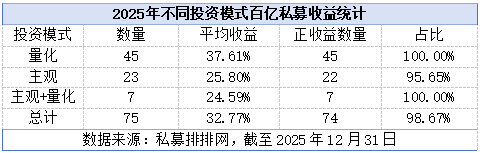
百亿私募2025年业绩出炉:平均收益率近33%,量化策略领跑
Zheng Quan Shi Bao Wang· 2026-01-13 07:04
Group 1 - The overall performance of the A-share market in 2025 was strong, with 75 billion private equity firms achieving an average return of 32.77%, and 98.67% of them reporting positive returns [1] - Among the billion quantitative private equity firms, the average return reached 37.61%, significantly higher than the overall level of billion private equity firms, with all firms reporting positive returns [1] - The performance of subjective strategy private equity firms was relatively weaker, with an average return of 25.80%, and 95.65% of them achieving positive returns [1] Group 2 - Seven mixed strategy private equity firms achieved an average return of 24.59%, with all firms reporting positive returns [2] - The A-share market showed a rapid rotation trend, with major indices such as the Shanghai Composite Index and Shenzhen Component Index rising by 18.41% and 29.87% respectively [2] - The strong performance of the A-share market created a favorable environment for private equity performance, with expectations of approximately 3 trillion yuan in incremental funds in 2026, primarily from public offerings, insurance funds, and bank wealth management [2] Group 3 - The spring market rally is expected to continue, with a focus on the support of fundamental data and the impact of policy expectations on market confidence [3] - The market may experience increased volatility in the short term as it reaches new highs, emphasizing the need for structural investment opportunities [3]

2025收官盛宴!超百家私募管理人的“财富共鸣”,不容错过!
私募排排网· 2026-01-04 03:33
Core Insights - The private equity industry is experiencing significant growth, with over 100 private equity firms surpassing 10 billion yuan in assets by October 2025, marking a return to the "double hundred era" [2] - By the end of November, over 600 firms among the 7,000 existing securities private equity firms achieved annual growth, with nearly 100 firms elevating their scale by two levels or more, indicating strong momentum in the industry [2] - The total management scale of domestic private equity funds exceeded 22 trillion yuan by the end of October, further rising to 22.09 trillion yuan by the end of November, reflecting a robust increase in both industry scale and product issuance [2] - The average return for 5,116 private equity products with performance data was notable, with quantitative long and subjective long strategies showing strong performance, achieving average returns of ***% and ***% respectively [2] Industry Trends - The private equity sector is characterized by a diverse range of products, with over 12,000 new products registered in 2025, indicating a growing variety and sustained high issuance enthusiasm [2] - The industry is at a critical juncture, facing opportunities and uncertainties, particularly regarding the continuation of the easing cycle in 2026 and the potential for quantitative strategies to maintain their success from 2025 [2] - A VIP roadshow event titled "Hearing Wealth" is set to commence on January 5, 2026, featuring leading private equity managers focusing on annual reviews and future outlooks, particularly in quantitative and subjective strategies [2]