
人工智能赋能新型工业化

Search documents
株洲多项工作获省政府通报表扬
Xin Lang Cai Jing· 2026-02-08 05:06
Core Viewpoint - The provincial government has recognized Zhuzhou for its significant achievements in promoting high-quality development by implementing various initiatives aimed at enhancing economic growth and improving living standards [1][2] Group 1: Economic Development Initiatives - Zhuzhou has been commended for its efforts in expanding domestic demand and boosting consumption through targeted actions and equipment upgrades [1] - The city is focusing on cultivating new productive forces and accelerating the construction of a modern industrial system, including the implementation of key industry doubling plans and major industrial projects [1] - Efforts to establish Zhuzhou as a national advanced manufacturing hub have been highlighted, including actions to stabilize industrial growth and enhance manufacturing quality [1] Group 2: Investment and Financial Management - High-quality investment attraction has been emphasized, with successful initiatives to stabilize foreign investment and attract major projects [1] - The city is enhancing its financial resources and reforming budget management to improve fiscal management and tax source cultivation [1] Group 3: Business Environment and Support for Enterprises - Zhuzhou is actively working to optimize its business environment through administrative efficiency reforms and improved service levels for businesses [1] - The city is focusing on increasing credit support for small and micro enterprises, green finance, and agricultural sectors, alongside initiatives to enhance the market value of listed companies [1] Group 4: Social Welfare and Education - The city is committed to improving living standards by addressing key social issues and ensuring employment for vulnerable groups [1] - Efforts to enhance educational resources and promote balanced development in education have been recognized, including initiatives to attract university graduates to start businesses in the region [1]
三年行动攻关“人工智能+”
Xin Lang Cai Jing· 2026-01-03 22:19
Core Viewpoint - Sichuan Province has launched a three-year action plan to empower new industrialization with artificial intelligence, aiming for comprehensive digital transformation of large-scale industrial enterprises by 2027, along with the establishment of over 50 digital industrial parks and the cultivation of more than 90 national manufacturing champions in the AI sector [1][2]. Group 1: Goals and Objectives - By 2027, all large-scale industrial enterprises in Sichuan will achieve full digital transformation, with the creation of over 50 digital industrial parks and the nurturing of more than 90 AI-related national manufacturing champions and specialized "little giant" enterprises [1][2]. - The action plan outlines five key tasks, including strengthening technological innovation, product iteration, application scenarios, governance mechanisms, and industrial ecosystem development, which are further divided into 18 sub-tasks [2]. Group 2: Funding and Support - Sichuan will provide annual support for high-level intelligent software and hardware technology research, offering up to 50% funding of project total investment, capped at 10 million yuan [2]. - Key areas of focus for technological breakthroughs include pre-trained large models and high-performance computing chips [2]. Group 3: Infrastructure Development - The province will enhance the "computing power-network-data" infrastructure, accelerating the construction of a national integrated computing power network hub in Chengdu, ensuring that provincial industrial parks achieve full coverage of 10-gigabit optical networks [3].
四川出台三年行动方案 加快推进人工智能赋能新型工业化
Xin Lang Cai Jing· 2025-12-30 12:59
Core Viewpoint - The Sichuan Provincial Government has issued the "Three-Year Action Plan for Artificial Intelligence Empowering New Industrialization (2025-2027)", marking the first provincial-level initiative in Western China to promote the application of artificial intelligence in new industrialization [1] Group 1: Key Tasks and Goals - The action plan outlines five key tasks aimed at enhancing technological innovation, product upgrades, application scenarios, governance mechanisms, and industrial ecosystem development [2] - By 2027, Sichuan aims for full digital transformation coverage among large-scale industrial enterprises, the establishment of over 50 digital industrial parks, and the cultivation of more than 90 national manufacturing champions and "little giant" enterprises in the AI sector [1] Group 2: Technological Innovation and Support - Sichuan will accelerate the construction of a comprehensive independent innovation system for artificial intelligence, providing up to 50% funding support, not exceeding 10 million yuan, for high-level software and hardware technology projects [2] - Key areas of focus for technological breakthroughs include pre-trained large models and high-performance computing chips [2] Group 3: Application and Infrastructure Development - The province will address challenges in the deep integration of AI with industry and fragmented application promotion by opening over 20 application scenarios annually for social and enterprise engagement [2] - Sichuan plans to strengthen the "computing power-network-data" infrastructure, aiming for comprehensive coverage of 10-gigabit optical networks in provincial-level industrial parks [2]
报告显示,我国已迈入制造强国行列!
半导体芯闻· 2025-12-30 10:24
Group 1 - The core viewpoint of the article highlights that China has made significant progress in its manufacturing sector, achieving a position among the world's manufacturing powerhouses, alongside the US, Germany, and Japan, as indicated by the Manufacturing Power Development Index for 2024 [1] - The report emphasizes that all sub-indices have shown positive growth, marking a successful first step in the strategic goal of becoming a manufacturing powerhouse [1] - The next decade is identified as a critical period for advancing manufacturing, with a focus on establishing manufacturing as a long-term national strategy and maintaining a reasonable proportion of the manufacturing sector in the economy [1] Group 2 - The article outlines the importance of innovation as a fundamental driving force for the manufacturing sector, highlighting the need for quality improvement and transformation [1] - It stresses the strategic significance of strengthening the industrial foundation and accelerating the integration of artificial intelligence into new industrialization [1] - The goal is set for 2035, aiming for China to achieve a new type of industrialization and rank among the leading manufacturing countries in the world [1]

报告显示,我国已迈入制造强国行列!
券商中国· 2025-12-30 06:57
Group 1 - The core viewpoint of the article is that China has made significant progress in its manufacturing sector, achieving a position among the world's leading manufacturing countries by 2024, alongside Germany and Japan [1] - The report indicates that the manufacturing power development index for China has shown positive growth across all sub-indices, marking a successful first step towards becoming a global manufacturing powerhouse [1] - The next decade is identified as a critical period for advancing manufacturing capabilities, emphasizing the need for innovation, quality improvement, and transformation within the sector [1] Group 2 - The report outlines that by 2035, China aims to achieve a new type of industrialization and rank among the top manufacturing countries globally [1] - It stresses the importance of maintaining a reasonable proportion of manufacturing in the national economy and enhancing the role of the real economy [1] - The strategy includes accelerating the integration of artificial intelligence into industrialization and developing a green energy and manufacturing system [1]
最新报告:中国进入全球制造强国第二阵列
Zhong Guo Xin Wen Wang· 2025-12-30 04:11
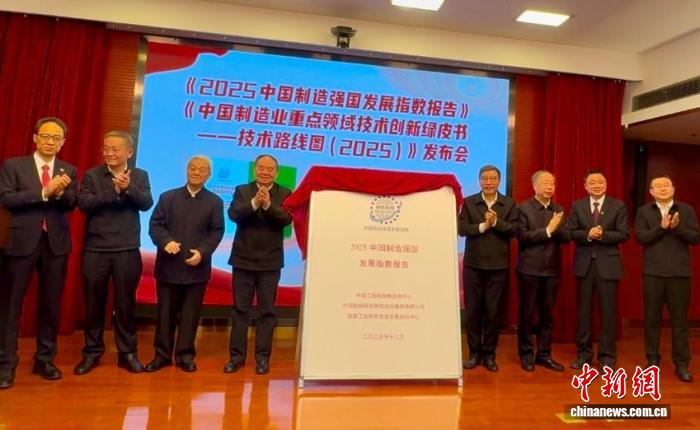
Core Insights - The "2025 China Manufacturing Power Development Index Report" indicates that in 2024, China's manufacturing power development index will be on par with Germany and Japan, with all sub-index values showing positive growth, solidifying its position as the world's leading manufacturing country [1][3]. Group 1: Manufacturing Power Development - China has successfully achieved the "first step" strategic goal in building a manufacturing power, becoming the fourth country to enter the global manufacturing power ranks after the United States, Germany, and Japan [3]. - The report identifies three main characteristics of China's manufacturing industry in 2024: 1. The innovation development sub-index value growth is the highest among all sub-indexes [3]. 2. The quality and efficiency sub-index continues its positive trend from the previous year, ranking second among nine countries [3]. 3. The share of manufacturing exports in global exports has rebounded, halting the decline seen in 2023 [3]. Group 2: Future Outlook - The next decade is critical for China's manufacturing power construction, emphasizing the need to treat manufacturing development as a long-term strategy and maintain the importance of the real economy [5]. - The report highlights the importance of innovation as a fundamental driving force and the need to enhance the quality and efficiency of manufacturing while transitioning and upgrading the sector [5]. - By 2035, China aims to achieve new industrialization and rank among the world's leading manufacturing powers, focusing on building a green energy system and a green manufacturing system [5].
助力企业精准“找伙伴”,朝阳区上线“AI+工业”对接平台
Xin Jing Bao· 2025-12-03 06:09
Core Insights - The Chaoyang District has launched an AI-enabled supply-demand matching service platform aimed at enhancing industrialization through digital solutions [1][2] - The platform serves as a digital bridge for enterprises, facilitating efficient matching between supply and demand in the manufacturing sector [1] Group 1: Platform Features - The platform is designed as a website focused on service delivery and precise matching [1] - It offers four main services: efficient aggregation of supply-demand resources, promotion of typical cases, effective certification of supply-demand information, and acceleration of precise matching between supply and demand enterprises [1] - Eight functional modules have been established, including resource aggregation, precise matching, enterprise profiling, and event publishing [1] Group 2: Technological Integration - The platform incorporates large models and retrieval enhancement technology to develop an industrial intelligent Q&A assistant [2] - This assistant accurately interprets user intent and improves the efficiency and accuracy of resource searches [2] - The platform has also introduced an intelligent supply-demand matching workstation, transitioning from traditional "tag comparison" to "content understanding" for better matching [2] Group 3: Operational Mechanism - The platform actively collaborates with AI-enabled industrialization initiatives to facilitate supply-demand matching activities [2] - It aims to create a synergistic loop of supply-demand collaboration through both online and offline channels [2] - The service network covers 31 provinces, with over 100 typical scenarios for supply resources, demonstrating significant empowerment effects in supply-demand matching [2]
省市领导密集“点题”,最强地级市苏州如何发力人工智能?
Mei Ri Jing Ji Xin Wen· 2025-11-20 12:38
Core Insights - Suzhou is making significant investments in artificial intelligence (AI), aiming to establish itself as a leading hub for AI innovation and application in China [1][4][11] - The city has already achieved a strong position in the national AI landscape, ranking fifth overall and first in Jiangsu province according to the "China Urban AI Development Index (2024-2025)" [3][5] - Suzhou's AI industry has seen substantial growth, with revenues reaching 247.2 billion yuan and an 18.7% increase year-on-year from January to August [4] Government Initiatives - The Jiangsu provincial government has emphasized AI as a key focus area during the 14th Five-Year Plan, with plans to leverage local advantages to compete in the AI sector [1][2] - Suzhou has been recognized at the national level, being approved as a national new generation AI innovation development pilot zone and a unique AI-enabled new industrialization pilot area [3][4] - The city has introduced various policies to support AI development, including financial incentives for core technology research and talent acquisition, with individual project support reaching up to 100 million yuan [3][4] Industry Development - Suzhou has established over 60 AI-related industrial platforms and attracted nearly 2,500 companies, including 58 listed firms and 1,140 high-tech enterprises [5] - The city aims to increase the number of AI companies to over 3,000 by the end of 2026, with an annual growth rate of over 20% in the core scale of the intelligent economy [5] - The AI industry in Suzhou is supported by a comprehensive manufacturing ecosystem, which is expected to facilitate the integration of AI technologies into traditional industries [8][9] Challenges and Opportunities - Despite its advancements, Suzhou faces challenges such as a lack of original innovation capabilities and insufficient higher education resources, which may hinder talent development [9][10] - The city is looking to enhance collaboration with top-tier research institutions in Shanghai to address these gaps and attract talent [10][12] - Experts suggest that the integration of AI with traditional manufacturing remains a critical challenge that needs to be addressed for Suzhou to fully realize its AI potential [12][13]
2025年人工智能产业及赋能新型工业化创新任务揭榜挂帅工作启动
机器之心· 2025-11-08 06:10
Core Viewpoint - The Ministry of Industry and Information Technology (MIIT) of China has initiated a project to promote the integration of artificial intelligence (AI) into new industrialization, focusing on key areas such as AI industry development, "AI + manufacturing," and intelligent product equipment [2][4]. Group 1: Task Content - The initiative aims to discover and cultivate a batch of key technologies and products that are strong in technological innovation, quick in application, and exemplary in demonstration, accelerating the deep integration of AI with industry [5]. Group 2: Recommendation Conditions - Applicants must be legally registered entities within China and cannot reapply for projects that have already been recognized in previous rounds. Recommendations should prioritize projects with outstanding innovation capabilities and good industrialization prospects [7]. Group 3: Work Requirements - Applicants are required to register and submit materials by November 20, 2025. Recommendation units must confirm their recommended lists by November 30, 2025, with specific limits on the number of projects that can be recommended by different regions and entities [9][10]. Group 4: Support for Winning Units - Local governments are encouraged to leverage their development advantages to provide support in terms of policy funding, scenario opening, and application promotion for the winning units [11].

工业和信息化部:加快关键核心技术突破 深入实施“人工智能+制造”
Zheng Quan Ri Bao· 2025-11-03 23:26
Core Insights - The article emphasizes the rapid development of China's artificial intelligence (AI) industry, positioning it among the top global players, with projections indicating that the core AI industry will exceed 900 billion yuan by 2024 and the number of AI companies will surpass 5,000 [1] Group 1: Key Areas for Development - Accelerating breakthroughs in key core technologies is essential for gaining an advantage in the AI field, focusing on foundational technologies such as computing power, algorithms, and data [2] - The manufacturing sector is identified as the primary battlefield for AI applications, with plans to enhance the policy framework and implement specific actions for AI integration in manufacturing [3] - Emphasis on nurturing leading AI enterprises, supporting both large and small companies to innovate and develop, thereby creating globally influential firms [4] Group 2: Industry Environment Optimization - The article highlights the need for increased financial support and the role of national AI industry investment funds to attract long-term investments in hard technology [4] - It calls for the establishment of national manufacturing innovation centers in the AI sector to enhance the supply of critical common technologies and foster collaborative development [4]