
元认知

Search documents
神经科学家:让元认知升级你的大脑
3 6 Ke· 2026-02-12 23:15
Core Insights - The article emphasizes the importance of metacognition, or strategic thinking, as a crucial ability for achieving success, alongside creativity and perseverance [2][3]. Group 1: Definition and Importance of Metacognition - Metacognition is defined as thinking about one's own thinking processes, which involves not only pursuing goals but also reflecting on the methods used to achieve them [3]. - Research from Stanford University and the National University of Singapore indicates that individuals who utilize metacognitive abilities are more likely to achieve their goals, regardless of their intelligence or resilience [3]. Group 2: Cultivation of Metacognitive Skills - Metacognitive abilities can be cultivated through systematic training, which has been shown to significantly increase goal achievement rates among participants [4][5]. - The research highlights that adults possess varying degrees of strategic thinking ability, which can be developed over time [5]. Group 3: Techniques for Enhancing Metacognition - Neuroscientist Annie-Laure Le Cunf suggests five specific methods to enhance metacognitive skills, including explaining concepts to oneself, analyzing mistakes, verbalizing thought processes, assessing confidence levels, and observing thought patterns [6][10]. - These techniques encourage individuals to closely monitor and reflect on their thinking processes, leading to more effective problem-solving strategies [8].


长脑子最快的方式,读懂《认知觉醒》
洞见· 2026-01-26 12:37
Core Viewpoint - The article emphasizes the importance of cognitive awakening and the need for individuals to enhance their thinking abilities to navigate the complexities of modern life effectively [4][12][20]. Group 1: Understanding the Brain - The evolution of the brain is outlined, highlighting the development from the "instinctive brain" 360 million years ago to the "rational brain" 2.5 million years ago, indicating a long history of cognitive development [6][8]. - Many individuals remain at a primitive cognitive level, relying on instinct and emotion rather than rational thought, which hinders their ability to solve problems effectively [8][9]. Group 2: The Importance of Deep Thinking - The article discusses the concept of "pseudo-diligence," where individuals engage in activities without strategic thinking, leading to minimal progress [9][12]. - A case study from Stanford University illustrates how deep thinking can lead to innovative solutions, contrasting with traditional approaches that yield limited results [11][12]. Group 3: Enhancing Cognitive Abilities - Five key strategies for enhancing cognitive abilities are proposed: 1. **Activate the Subconscious**: Recognizing and reflecting on feelings can lead to greater self-awareness and cognitive awakening [15]. 2. **Initiate a Reflection System**: Regular reflection helps update one's understanding and improve decision-making [16]. 3. **Push Beyond Comfort Zones**: Continuous effort beyond initial comfort zones is necessary for significant learning and growth [17]. 4. **Cultivate Associative Skills**: Connecting new knowledge with existing frameworks enhances understanding and retention [19]. 5. **Engage in Physical Activity**: Regular exercise, such as running, is linked to improved brain function and cognitive connectivity [20]. Group 4: The Role of Mindset in Success - The article concludes that mental acuity and awareness are crucial for personal growth and competitive advantage in life [22][23].

AI时代,法律随笔如何写?
Xin Lang Cai Jing· 2026-01-24 20:40
Core Viewpoint - The article emphasizes the interconnectedness of law and other social sciences, arguing that understanding legal principles requires a broader perspective beyond isolated legal studies [1] Group 1: Legal Principles - The preference for rigid rules in law is explained as a necessity to avoid arbitrary exceptions, highlighting the tension between substantive justice and procedural justice [1] - A deeper understanding of law involves recognizing the need for a legal system to maintain robustness against uncertainties while managing implementation costs [1] Group 2: Knowledge and Learning - The article advocates for a broad approach to learning, suggesting that depth in a narrow field may not lead to true understanding, and that interdisciplinary connections can enhance comprehension [1] - In the age of AI, the focus shifts from the scarcity of knowledge to the importance of metacognition, emphasizing awareness of one's knowledge gaps as a strategic advantage [1]
真正的AI高手,都在训练自己的“元认知”
3 6 Ke· 2026-01-08 01:08
Core Insights - Generative AI can enhance creativity but primarily for employees with strong metacognitive abilities, allowing organizations to gain deeper insights and accelerate innovation when AI deployment is combined with intentional support for metacognitive thinking [1][3][4] Group 1: Generative AI and Creativity - Generative AI is increasingly integrated into daily workflows, with tools like ChatGPT being used for brainstorming, exploring options, summarizing information, and accelerating project progress [3] - A Gallup survey found that only 26% of employees using generative AI reported an increase in creativity, highlighting a gap between widespread use and limited creativity enhancement [3] - Research published in the Journal of Applied Psychology indicates that generative AI can indeed boost creativity, but this effect is not universal; employees with higher metacognitive skills are more likely to benefit [3][5] Group 2: Importance of Metacognitive Skills - The study emphasizes that organizations must not only introduce new tools but also invest in developing employees' metacognitive abilities to maximize AI's potential in enhancing creativity [4][10] - Employees with strong metacognitive skills can effectively monitor and adjust their thinking processes, leading to better utilization of AI tools for creative outcomes [6][8] - A field experiment involving 250 employees from a tech consulting firm demonstrated that those with higher metacognitive abilities generated more novel and useful ideas when using AI [7] Group 3: Recommendations for Leaders - Leaders should help employees leverage AI to expand cognitive resources by encouraging diverse information gathering and offloading routine tasks to AI [11] - Establishing the understanding that metacognition is the engine for AI-enabled creativity is crucial; employees must critically evaluate AI outputs rather than accepting them at face value [12] - Targeted training programs should be implemented to enhance metacognitive skills, enabling employees to actively engage with AI and improve their creative processes [13] - Workflow designs should promote iterative interactions with AI, positioning it as a thinking partner rather than a shortcut, to foster metacognitive thinking and prevent over-reliance on AI outputs [14]

情绪韧性,优秀CEO必备能力
3 6 Ke· 2025-12-29 03:13
Core Insights - The article emphasizes that the success of CEOs is not determined by the speed of action but by the depth of thought and emotional awareness before making decisions [1][2][3] - It introduces the concept of "emotional resilience" as a key trait of effective CEOs, highlighting its importance in navigating uncertainty and making critical decisions [2][4][41] Group 1: Emotional Resilience in Decision-Making - Emotional resilience is defined as the ability to examine one's thoughts and emotions during the decision-making process and incorporate them as input variables [7][10] - High emotional resilience allows CEOs to maintain clarity and make informed decisions even in high-pressure situations filled with uncertainty [6][12] - The article discusses the dual pressures of rationality and emotion that CEOs face when making dangerous decisions, leading to either analysis paralysis or impulsive choices [4][5][6] Group 2: Learning from Self-Doubt - Self-doubt and negative emotions can be valuable resources for CEOs, driving creativity and further exploration when managed properly [15][16] - CEOs often leverage metacognitive abilities to extract insights from their self-doubt and other uncomfortable emotions during challenging decisions [15][19] - The article suggests that sharing these feelings with trusted advisors can enhance decision-making and foster a deeper understanding of the emotional landscape [20][25] Group 3: Strategies for Developing Emotional Resilience - The article outlines practical steps for CEOs to cultivate emotional resilience, including identifying and objectively assessing their emotions and thoughts related to decisions [27][28] - Engaging in open discussions about feelings and thoughts can activate neural networks and improve problem-solving effectiveness [29][30] - Keeping a metacognitive journal can help CEOs track their internal processes and clarify their thoughts and emotions over time [34][35] Group 4: The Role of External Support - CEOs are encouraged to seek external support from trusted advisors to discuss their thoughts and emotions, which can provide new perspectives and insights [33][25] - The article highlights the importance of explaining decision-making processes and emotional factors to enhance trust within the organization [36][37] - Reflecting on the decision-making process post-decision can help identify effective strategies and improve future decision-making [38][40]
“学习如何学习”,这是所有技能背后的核心技能
3 6 Ke· 2025-11-07 07:11
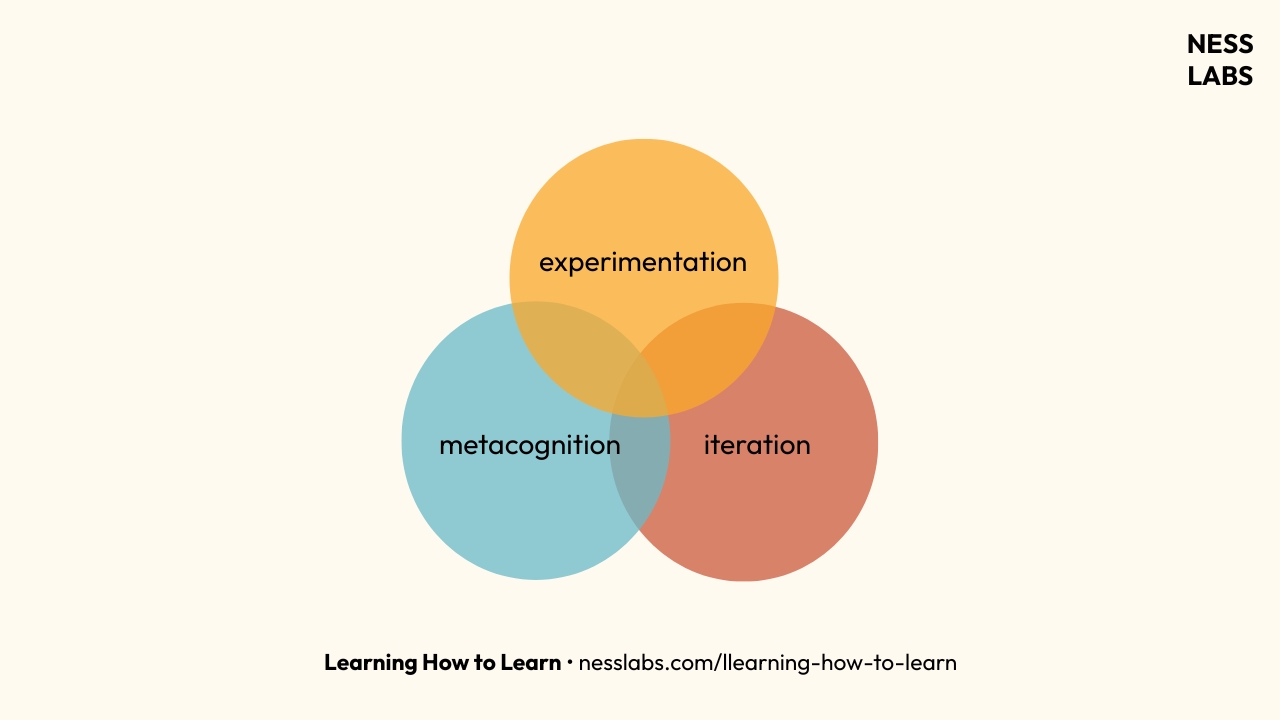
Core Insights - The article emphasizes the importance of learning how to learn in a rapidly changing world where skills become obsolete quickly [1][8] - Traditional education focuses on memorization rather than teaching individuals how to think and design their own learning paths [1][8] Group 1: Modern Learning Paradox - Understanding how the brain learns is increasingly important, as it operates in two distinct modes that work together to help acquire new knowledge [2] - The abundance of information can hinder learning, making it difficult to filter valuable content [2] - Artificial intelligence is reshaping learning dynamics, reducing the importance of memorizing facts and increasing the need for asking the right questions and evaluating AI-generated answers [2] Group 2: Learning Strategies - "Learning how to learn" can be distilled into three core practices that yield cumulative effects over time [3][6] - The three practices are experimentation, metacognition, and iteration, which help individuals actively engage in their learning process [6] - Experimentation involves designing small experiments to gather data on what methods work best for the individual [6] - Metacognition is the practice of observing one's own thought processes to understand how to handle uncertainty [6] - Iteration allows for adjustments after each experiment, leading to a continuous growth cycle [6] Group 3: Focus and Divergence - Focus mode refers to the active concentration state, while divergent mode allows for free-flowing thoughts [7] - Both modes are essential for effective learning and creativity [7] Group 4: Conclusion - In a world where knowledge evolves faster than individuals can keep up, the most valuable skill is not what one knows, but how one learns [8] - Maintaining curiosity and purpose through experimentation, reflection, and adjustment is crucial for personal growth [8]
在失败中进化?UIUC联合斯坦福、AMD实现智能体「从错误中成长」
机器之心· 2025-11-07 03:06
Core Insights - The article discusses the transition of artificial intelligence (AI) from merely performing tasks to doing so reliably, emphasizing the need for self-reflection and self-correction capabilities in AI agents [2][43] - A new framework called AgentDebug is introduced, which aims to enable AI agents to diagnose and rectify their own errors, thus enhancing their reliability and performance [2][43] Summary by Sections AI Agent Failures - AI agents often exhibit failures such as goal forgetting, context confusion, misjudgment of task completion, and planning or execution errors [5][6][12] - A significant issue is that these agents can confidently output reasoning even when deviating from their goals, leading to a cascading effect of errors throughout the decision-making process [6][7][31] Research Innovations - The research proposes three key innovations to understand and improve AI failure mechanisms: 1. **AgentErrorTaxonomy**: A structured error classification system for AI agents, breaking down decision-making into five core modules: memory, reflection, planning, action, and system [9][10][11] 2. **AgentErrorBench**: A dataset focused on AI agent failures, providing detailed annotations of errors and their propagation paths across various complex environments [16][20] 3. **AgentDebug**: A debugging framework that allows AI agents to self-repair by identifying and correcting errors in their execution process [21][23][24] Error Propagation - The study reveals that over 62% of errors occur during the memory and reflection stages, indicating that the primary shortcomings of current AI agents lie in their cognitive and self-monitoring abilities [13][15] - The concept of "Error Cascade" is introduced, highlighting how early minor mistakes can amplify through the decision-making process, leading to significant failures [34][35] Learning from Errors - The research indicates that AI agents can learn from their failures by incorporating corrective feedback into their future tasks, demonstrating early signs of metacognition [38][41] - This ability to self-calibrate and transfer experiences signifies a shift in AI learning paradigms, moving beyond reliance on external data [41][42] Implications for AI Development - The focus of AI research is shifting from "what can be done" to "how reliably tasks can be completed," with AgentDebug providing a structured solution for enhancing AI reliability [43]

下一个10年,普通人改命的4大机会
3 6 Ke· 2025-09-22 23:41
Group 1 - The essence of AI is the scalability of human experience, leading to the emergence of complex intelligent services as a new business model [2][9] - AI development has two phases: cost-saving efficiency and market expansion, with true GDP growth occurring only when market-expanding applications are widely adopted [3][4] - Historical patterns show that great technologies eventually create new markets, as seen with the steam engine and the Ford Model T, which transformed transportation and created significant demand [4][5][6][7] Group 2 - The AI revolution's core is service scalability, transitioning from energy-saving to new market creation, which is where the true potential of technology lies [8][9] - Future AI services will have four key characteristics: continuous service, expert-level service, and inclusive service, enabling personalized and widespread access [10][11] - Continuous service allows for deep understanding of individual needs over generations, enhancing service precision beyond traditional methods [12][13] Group 3 - Expert-level services will become widely available and affordable due to AI, transforming previously scarce and expensive expert services into accessible options for the masses [14][15] - Inclusive services will ensure that essential services are affordable and widely available, allowing for a large user base to benefit from new offerings [16][18] - The shift from product ownership to service enjoyment will redefine consumer behavior, emphasizing the need for service over mere product acquisition [20][21] Group 4 - The current technological foundation supports the emergence of complex AI services, with advancements in complex reasoning, long-term memory, and third-party functionality [22][23][26] - AI is evolving towards specialized capabilities rather than general intelligence, focusing on domain expertise to meet specific user needs [27][28] - The development of AI will progress through four stages, culminating in complex, personalized services that address intricate user requirements [28][29] Group 5 - Companies must redefine their identity, recognizing their potential and the importance of understanding market needs over merely mastering technology [35][41] - Successful examples like Walmart and UPS illustrate the significance of identifying and addressing emerging market demands through innovative business models [42][44] - Execution involves focusing on a specific industry, mastering relevant tools, and continuously accumulating knowledge to enhance expertise [45][46][49] Group 6 - Predictive capabilities are crucial for anticipating market trends and positioning effectively, allowing companies to capitalize on emerging opportunities [50][52] - Companies must maintain confidence in their predictions and be prepared to act on them, balancing timing and market understanding to seize opportunities [54][56] - A systematic approach to understanding industry dynamics and refining predictions will enhance decision-making and strategic positioning [58][59]

破解「长程智能体」RL训练难题,腾讯提出RLVMR框架,让7B模型「思考」比肩GPT-4o
机器之心· 2025-08-14 01:26
Core Viewpoint - The article discusses the development of the RLVMR framework by Tencent's Hunyuan AI Digital Human team, which aims to enhance the reasoning capabilities of AI agents by rewarding the quality of their thought processes rather than just the outcomes, addressing inefficiencies in long-horizon tasks and improving generalization abilities [4][26]. Group 1: Challenges in Current AI Agents - Many AI agents succeed in tasks but rely on luck and inefficient trial-and-error methods, leading to a lack of effective reasoning capabilities [2]. - The low-efficiency exploration problem arises as agents often engage in meaningless actions, resulting in high training costs and low reasoning efficiency [2]. - The generalization fragility issue occurs because strategies learned through guessing lack a logical foundation, making them vulnerable in new tasks [3]. Group 2: RLVMR Framework Introduction - RLVMR introduces a meta-reasoning approach that rewards good thinking processes, enabling end-to-end reinforcement learning for reasoning in long-horizon tasks [4][6]. - The framework allows agents to label their cognitive states, enhancing self-awareness and tracking their thought processes [7]. - A lightweight verification rule evaluates the quality of the agent's thinking in real-time, providing immediate rewards for good reasoning and penalizing ineffective habits [8]. Group 3: Experimental Results - The RLVMR-trained 7B model achieved a success rate of 83.6% on the most challenging L2 generalization tasks in ALFWorld and ScienceWorld, outperforming all previous state-of-the-art models [11]. - The number of actions required to solve tasks in complex environments decreased by up to 28.1%, indicating more efficient problem-solving paths [13]. - The training process showed faster convergence and more stable strategies, significantly alleviating the issue of ineffective exploration [13]. Group 4: Insights from RLVMR - The introduction of a reflection mechanism allows agents to identify problems and adjust strategies rather than blindly retrying, leading to a significant reduction in repeated actions and an increase in task success rates [19]. - Rewarding good reasoning habits establishes a flexible problem-solving framework that enhances generalization capabilities in unseen tasks [20][21]. - The two-phase training process of cold-start SFT followed by reinforcement learning aligns with cognitive principles, suggesting that teaching agents how to think before allowing them to learn from mistakes is more efficient [22][24]. Group 5: Conclusion and Future Outlook - RLVMR represents a paradigm shift from outcome-oriented to process-oriented training, effectively addressing the challenges of low-efficiency exploration and generalization fragility in long-horizon tasks [26]. - The ultimate goal is to develop AI agents capable of independent thinking and rational decision-making, moving beyond mere shortcut-seeking behaviors [26][27].


吵架,如何更高级和有效?
Hu Xiu· 2025-08-06 09:08
Group 1 - The article discusses the importance of constructive arguments and emotional expression in relationships, highlighting that effective communication can lead to deeper connections [6][12][27] - It emphasizes that arguments should not merely be about venting emotions but should aim to resolve issues and enhance understanding [13][31][33] - The concept of "meta-communication" is introduced, which refers to discussing the way communication occurs, suggesting that successful arguments require both parties to understand how to communicate effectively [14][31][32] Group 2 - The article illustrates examples from the show "Billions," where characters Chuck and Wendy navigate their conflicts by expressing vulnerability and understanding each other's feelings [24][26][30] - It contrasts different cultural approaches to conflict, noting that Western perspectives often emphasize individual responsibility, while Eastern perspectives may focus on familial or collective blame [41][42] - The piece concludes that the ability to establish connections in relationships relies on empathy and meta-cognition, rather than just shared interests or emotional intelligence [48][49][50]