
公积金补亏

Search documents
荣科科技:公司公积金补亏系基于优化财务结构、提升投资者回报基础的合规操作
Zheng Quan Ri Bao Wang· 2026-02-11 08:48
Core Viewpoint - Rongke Technology (300290) is optimizing its financial structure and enhancing investor returns by addressing accumulated losses in compliance with the new Company Law and relevant financial regulations [1] Group 1 - The company is focusing on its core business development while implementing loss compensation as a compliant financial optimization strategy [1] - The actions taken are aimed at improving the company's financial health and ensuring long-term returns for investors [1] - The company emphasizes that the loss compensation is a necessary step under the premise of compliance [1]

荣科科技:公司公积金补亏,系严格遵循新《公司法》及财政部《关于公司法、外商投资法施行后有关财务处理问题的通知》规定
Sou Hu Cai Jing· 2026-02-11 03:54
Core Viewpoint - The company is utilizing 556 million yuan from its reserve fund to cover losses, which aligns with the new Company Law and aims to optimize its financial statements and clear obstacles for future development [1] Group 1 - The use of reserve funds to cover losses is a compliant operation under the new Company Law and relevant financial regulations [1] - This financial optimization strategy is intended to enhance the company's financial health and improve returns for investors [1] - The company remains focused on its core business development while using loss coverage as a means of financial optimization [1] Group 2 - The company expresses gratitude for investor interest and emphasizes its commitment to long-term value creation [1] - There is an implication that the company will provide further details on how it plans to leverage its improved financial structure for profit distribution, refinancing, or core business investments in the future [1]
荣科科技:公司始终聚焦主业发展,补亏是合规前提下的财务优化手段
Zheng Quan Ri Bao Wang· 2026-01-29 06:51
Core Viewpoint - Rongke Technology (300290) is focusing on financial optimization through the replenishment of reserves, which is a compliant operation aimed at enhancing investor returns and improving the financial structure [1] Group 1: Financial Strategy - The company is adhering to the new Company Law and relevant financial regulations from the Ministry of Finance regarding financial processing [1] - Replenishing reserves is a financial optimization method that does not directly generate profits but facilitates the conversion of operational results into shareholder returns in the future [1] Group 2: Business Focus - The core task of the company remains to focus on its main business and achieve fundamental operational improvements [1] - Management is fully committed to this goal, emphasizing the importance of long-term investor returns [1]
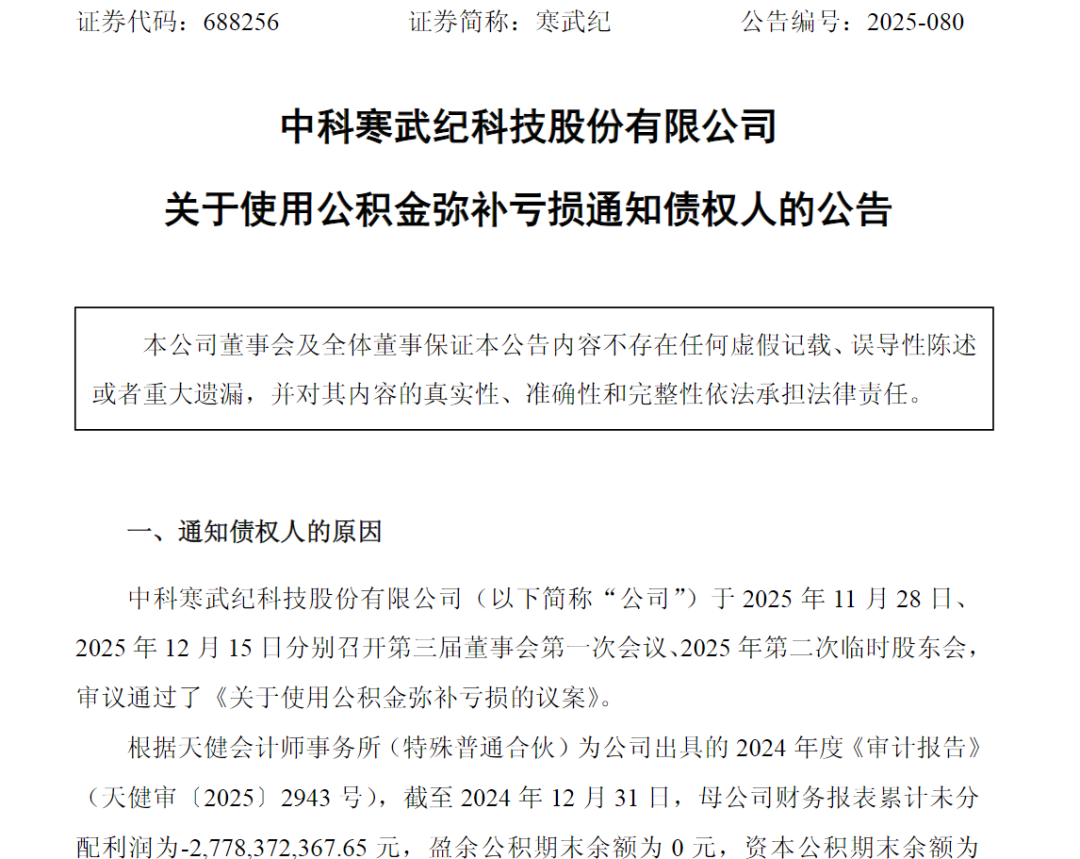
寒武纪股价连续5日下跌 拟使用资本公积27.78亿元弥补亏损
Shang Hai Zheng Quan Bao· 2025-12-16 05:35
Core Viewpoint - The company, Cambrian, is utilizing its capital reserve of 2.778 billion yuan to offset accumulated losses, which is a strategic move to clear historical financial burdens and potentially enhance future profitability and shareholder returns [1][4][6]. Group 1: Financial Performance - Cambrian's stock price has seen a decline of 5.01% on December 16, with a total market value of 534.1 billion yuan and a cumulative drop of nearly 12% over the past five days [1]. - As of December 31, 2024, Cambrian's accumulated undistributed profits stand at -2.778 billion yuan, with a capital reserve balance of 9.625 billion yuan [4]. - The company reported a revenue of 4.607 billion yuan for the first three quarters of the year, marking a significant year-on-year increase of 2386.38%, and a net profit of 1.605 billion yuan, indicating a turnaround from previous losses [6][7]. Group 2: Strategic Implications - The decision to use capital reserves for loss compensation is based on the requirement that companies with negative undistributed profits cannot distribute profits to shareholders [6][7]. - This move is expected to facilitate future profit distribution and financing opportunities, as it alleviates the historical loss burden [6][7]. - Cambrian's main business involves the research, design, and sales of AI core chips for various applications, including cloud servers and edge computing devices, which positions the company for potential growth in the tech sector [7].


600590,用超13亿公积金为母公司填“坑”
Di Yi Cai Jing Zi Xun· 2025-12-12 07:20
Core Viewpoint - Taihao Technology is utilizing its capital reserve and surplus reserve to cover significant accumulated losses, which may have gone unnoticed by the market without this action [2][12]. Group 1: Financial Measures and Regulations - The company plans to use 1.04 billion yuan from surplus reserves and 12.63 billion yuan from capital reserves, totaling 13.67 billion yuan, to offset accumulated losses by December 31, 2024 [2]. - The new Company Law effective from July 1, 2024, allows the use of capital reserves to cover losses, which was previously prohibited, thus facilitating a wave of loss compensation among A-share companies [3][12]. - Over 30 listed companies have disclosed loss compensation plans, with a total amount exceeding 30 billion yuan, indicating a trend in the market [3]. Group 2: Company Performance and Losses - Taihao Technology has reported losses for five consecutive years since 2020, with a significant loss of 9.1 billion yuan at the parent company level in 2024 [4][5]. - The company's consolidated net profit turned negative, dropping to -5.4 billion yuan due to the losses incurred [4]. - The losses in 2024 were attributed to multiple factors, including cyclical adjustments in the military industry and substantial asset impairment [5]. Group 3: Historical Context and Asset Quality - The company's previous profitability was largely supported by non-recurring gains from asset sales, which raises concerns about the sustainability of its earnings [6][10]. - Taihao Technology's goodwill from acquisitions has fluctuated significantly, with a peak of 12.7 billion yuan in 2018, and has since decreased to 3.2 billion yuan by the end of 2024 [7][9]. - The company faces ongoing risks related to accounts receivable, with over 48% of its accounts aging over one year, posing potential impairment risks [9]. Group 4: Strategic Investments and Business Segments - The investment in Guokai Military Industry has provided substantial returns, contributing over 700 million yuan to the company's cash flow [10]. - The emergency equipment business has emerged as a core growth area for the company's strategic transformation [11].


600590,用超13亿公积金为母公司填“坑”
第一财经· 2025-12-12 07:08
Core Viewpoint - The article discusses the recent financial maneuver by Taihao Technology to use its capital reserves to offset significant accumulated losses, highlighting a broader trend in the A-share market driven by new regulatory changes that allow such practices to restore financing qualifications and dividend eligibility [3][4][16]. Group 1: Financial Maneuver and Regulatory Changes - Taihao Technology plans to use 1.04 billion yuan from its surplus reserves and 12.63 billion yuan from its capital reserves, totaling 13.67 billion yuan, to cover accumulated losses as of December 31, 2024 [3][4]. - The new Company Law effective from July 1, 2024, permits the use of capital reserves to offset losses, breaking the previous prohibition [3][17]. - Over 30 listed companies have announced similar capital reserve offset plans, with a total amount exceeding 30 billion yuan, indicating a surge in such activities in the A-share market [4][17]. Group 2: Financial Performance and Historical Context - Taihao Technology has reported losses for five consecutive years since 2020, with a significant loss of 910 million yuan in 2024, leading to a negative retained earnings balance of 540 million yuan [6][7][9]. - The company's profitability has been heavily reliant on non-recurring gains from asset sales, with core operating profits showing a cumulative net loss of 2.624 billion yuan from 2019 to 2024 [9][8]. - The company’s financial struggles are linked to its aggressive acquisition strategy, which resulted in substantial goodwill that has since been impaired, reflecting a decline in asset quality [11][12][13]. Group 3: Implications for Future Operations - The capital reserve offset is seen as a "paper improvement" that does not provide real benefits to shareholder equity but is aimed at meeting regulatory requirements for future dividends and financing [16][17]. - The company has faced tightening financing conditions, with cash outflows from financing activities since 2023, indicating a need for improved financial metrics to regain investor confidence [17][16]. - Despite the challenges, Taihao Technology's emergency equipment business has shown strong performance, becoming a key growth area amid the company's strategic transformation [14].

泰豪科技逾13亿公积金填平母公司“累亏坑”,账面扭亏难掩主业困局
Di Yi Cai Jing· 2025-12-12 05:45
Core Viewpoint - Taihao Technology (600590.SH) is utilizing its capital reserve and surplus reserve to cover significant accumulated losses, which may have gone unnoticed by the market without this action [2][13]. Group 1: Financial Measures and Regulations - The company plans to use 1.04 billion yuan from surplus reserves and 12.63 billion yuan from capital reserves, totaling 13.67 billion yuan, to offset accumulated losses by December 31, 2024 [2]. - The new Company Law effective from July 1, 2024, allows the use of capital reserves to cover losses, breaking the previous prohibition [2][12]. - Over 30 listed companies have disclosed plans to use reserve funds to cover losses, with a total exceeding 30 billion yuan, indicating a trend in the A-share market [2][12]. Group 2: Financial Performance and Historical Context - Taihao Technology has reported losses for five consecutive years since 2020, with a significant loss of 910 million yuan at the parent company level in 2024 [4]. - The company's net profit before 2024 was maintained due to profits from subsidiaries, but the 2024 losses were exacerbated by industry adjustments and asset impairments [4][7]. - The company’s cumulative net profit from 2019 to 2024, excluding non-recurring gains, was -2.624 billion yuan, indicating ongoing operational challenges [7]. Group 3: Impact of Mergers and Acquisitions - The company's past mergers and acquisitions have led to significant goodwill impairments, with a peak goodwill of 1.27 billion yuan in 2018, which has since decreased to 320 million yuan by the end of 2024 [8][10]. - Notable impairments include a 161 million yuan write-down in 2020 and a 327 million yuan write-down in 2021 related to the acquisition of Shanghai Boyuan [9]. - The company’s asset quality remains under pressure, with a significant portion of accounts receivable at risk of impairment [10]. Group 4: Strategic Business Developments - The emergency equipment business has become a core growth area for the company, contributing positively to its strategic transformation [11]. - The investment in Guokai Military Industry has provided substantial returns, contributing over 700 million yuan to the company’s cash flow [10].
康希诺“补亏”背后:分红可期,经营隐忧未除
Xin Lang Zheng Quan· 2025-11-21 09:17
Group 1 - The company plans to use approximately 1.45 billion yuan from surplus reserves and capital reserves to eliminate accumulated losses, which has been interpreted as paving the way for future dividends [1] - This action has raised concerns among some investors about potential "window dressing" and benefits to major shareholders, especially given the company's limited history of cash dividends [1][4] Group 2 - Despite achieving a net profit of approximately 27.92 million yuan in Q3 2025, the company's non-recurring net profit remains negative at -82.86 million yuan for the first three quarters, indicating ongoing operational challenges [2] - The profit increase is largely attributed to government subsidies and non-recurring income, with other income rising by 233.63% to 91.6 million yuan, significantly outpacing net profit growth [2] Group 3 - The company heavily relies on the "Manhansin" quadrivalent meningococcal vaccine for revenue, which saw a 28% increase in sales, contributing to a 22.13% growth in revenue for the first three quarters [3] - The company has faced two consecutive years of losses following the decline of COVID-19 vaccine demand, highlighting its over-reliance on a single product amidst increasing market competition [3] Group 4 - While the use of surplus reserves to cover losses may temporarily boost market sentiment, fundamental issues regarding the company's operational quality, negative non-recurring net profit, limited product diversity, and high sales expenses remain significant long-term concerns [4]

招商南油:拟用公积金补亏并与关联方签金融服务协议
Xin Lang Cai Jing· 2025-11-03 08:57
Core Viewpoint - The company, China Merchants Jinling, plans to hold its third extraordinary general meeting on November 12, 2025, to discuss two key proposals related to financial adjustments and agreements with affiliated parties [1] Group 1: Financial Adjustments - The first proposal involves using reserve funds to cover losses, with the company's undistributed profits projected to be -1.574 billion yuan by the end of 2024. The plan includes reducing surplus reserves by 3.1939 million yuan, and the remaining shortfall of 1.571 billion yuan will be covered by capital reserves, resulting in undistributed profits being adjusted to zero [1] Group 2: Financial Service Agreement - The second proposal is to sign a financial service agreement with the affiliated company, China Merchants International Finance, which is a subsidiary of China Merchants Group. This agreement will provide deposit and settlement services to China Merchants Jinling and its subsidiaries for a duration of three years, with a daily deposit balance not exceeding 500 million HKD and a loan balance not exceeding 1 billion HKD [1]

浩物股份连续4个季度盈利 拟使用公积金“补亏”以恢复分红能力
Zheng Quan Shi Bao Wang· 2025-10-27 14:20
Core Viewpoint - The financial performance of Haowu Co., Ltd. continues to improve, with a significant increase in net profit despite a decline in revenue [1] Financial Performance - For the first three quarters of 2025, Haowu Co., Ltd. reported a revenue of 2.183 billion yuan, a year-on-year decrease of 16.98% - The net profit for the same period was 42.7752 million yuan, showing a year-on-year increase of 279.04% - In the third quarter alone, the company achieved a revenue of 726 million yuan, down 18.69% year-on-year, while net profit reached 12.3436 million yuan, up 324.27% year-on-year - The net profit has been positive for four consecutive quarters [1] Business Segments - Haowu Co., Ltd. operates in two main segments: automotive sales and services, and internal combustion engine crankshaft manufacturing - The automotive sales segment includes vehicle sales, maintenance services, and comprehensive services, with key brands such as SAIC Volkswagen, FAW Volkswagen, and various new energy vehicle brands - The crankshaft business focuses on the research, manufacturing, and sales of crankshafts for automotive, engineering machinery, and agricultural machinery, leading in production and sales within the domestic passenger car crankshaft industry [2] Capital Management - On October 27, the company announced plans to use its surplus reserves to cover losses, with a total of 944 million yuan allocated from surplus reserves and capital reserves - This move aims to eliminate the accumulated losses reported in the parent company's financial statements, which stood at -944 million yuan at the end of last year - The implementation of this plan requires approval from the shareholders' meeting [3] Regulatory Context - The use of surplus reserves to cover losses aligns with the new Company Law, which allows companies to utilize capital reserves for loss compensation after exhausting other reserves - This regulatory change is seen as a way to enhance the operational flexibility of listed companies and create conditions for future dividend distributions [3][4] Expert Opinion - Financial experts suggest that using surplus reserves to cover losses can effectively relieve operational constraints and optimize equity structure, potentially restoring cash dividend capabilities and improving key financial metrics - This strategy is expected to enhance market confidence and valuation for the company [4]
