
区域全面经济伙伴关系协定

Search documents
驻奥克兰总领馆经商处出席新西兰越南商业理事会成立仪式
Shang Wu Bu Wang Zhan· 2026-01-30 15:02
Group 1 - The New Zealand-Vietnam Business Council (NZVBC) was officially established, with over 50 representatives from various business sectors in attendance [1] - Wang Chengguang, the Consul of the Economic and Commercial Office in Auckland, congratulated the establishment of the NZVBC and emphasized the importance of economic cooperation between China, Vietnam, and New Zealand [3] - The Chinese side will host the APEC Business Leaders Summit in 2026, inviting business representatives from the region to actively participate [3]


2025年12月亚洲制造业PMI升至51.1% 继续保持扩张态势
Zhong Guo Xin Wen Wang· 2026-01-07 03:27
Group 1 - The Asian manufacturing PMI rose to 51.1% in December 2025, indicating continued expansion for eight consecutive months [1] - China's manufacturing PMI increased and remained above 50%, while India's PMI decreased to 55% [1] - ASEAN countries showed positive PMI readings, with Thailand above 55% and Malaysia, Singapore, Indonesia, the Philippines, and Myanmar all above 50% [1] Group 2 - The global manufacturing PMI slightly decreased to 49.5% in December 2025, down by 0.1 percentage points from the previous month [2] - The Asian economy is expected to continue driving high-quality development and growth, remaining a core engine for global economic recovery [2] - China's economic policies are projected to support a positive economic outlook, with international organizations raising China's growth forecasts for 2025 [2]
完善西部陆海新通道金融服务体系
Jing Ji Ri Bao· 2025-12-29 01:00
Core Viewpoint - The recent issuance of the "Opinions on Financial Support for Accelerating the Construction of the Western Land-Sea New Corridor" by the People's Bank of China and eight other departments aims to enhance the financial service system for the corridor, promoting high-quality development through 21 key measures focused on financing and settlement functions [2][3]. Financial Support Measures - The "Opinions" emphasize the importance of financial cooperation with relevant countries to expand capital connectivity and establish a clear and scalable financial cooperation network, particularly in light of China's participation in the Regional Comprehensive Economic Partnership (RCEP) [2][3]. - The document outlines a development line that integrates logistics, trade, and industry, advocating for financial reform and innovation to enhance the financial service system for the corridor [3]. Regional Collaboration - The initiative involves 13+2 provinces and municipalities, aiming to break regional barriers and promote a collaborative financial development model [4]. - Measures include integrated credit granting among financial institutions along the corridor and establishing a joint credit and syndicate loan mechanism to enhance financial cooperation across regions and with ASEAN countries [4]. Financial Product Innovation - A highlight of the initiative is the deepening of financial product innovation in the logistics sector, particularly through railway transport document financial services, which align with the corridor's development goals [5]. - Financial institutions are encouraged to develop tailored financial products to meet diverse financing and settlement needs across different stages of development [4]. Capital Market Contributions - The capital market is expected to provide diverse financing channels, with nearly 700 billion yuan in corporate bonds issued to support enterprises along the corridor in the first 11 months of the year [6]. - The China Securities Regulatory Commission aims to deepen comprehensive reforms in the capital market to enhance financing for various entities [6]. Cross-Border Financial Services - The "Opinions" propose measures to optimize cross-border trade settlement and investment financing, creating a more convenient and secure foreign exchange service environment [7]. - The initiative includes promoting the use of the digital yuan for cross-border transactions, enhancing efficiency and reducing costs for enterprises [7]. Implementation and Monitoring - The People's Bank of China plans to establish a collaborative mechanism to ensure the effective implementation of the "Opinions," including a dynamic monitoring and evaluation system for financial services [8]. - A financial service center for the corridor is set to be established in Chongqing, aiming to facilitate cooperation among financial institutions and enhance service capabilities [8].
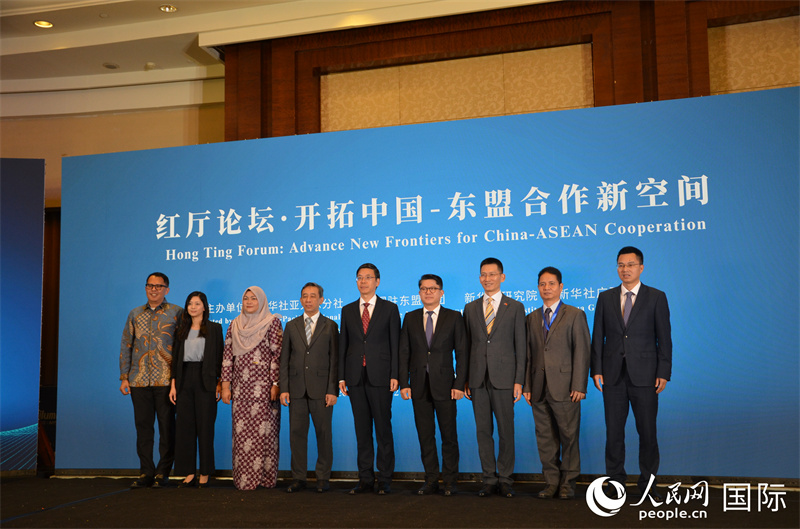
“红厅论坛·开拓中国—东盟合作新空间”在印尼举行
人民网-国际频道 原创稿· 2025-12-12 03:20
Group 1 - The forum "Red Hall Forum: Exploring New Spaces for China-ASEAN Cooperation" was held in Jakarta, Indonesia, with nearly a hundred guests from government, academia, business, and media discussing the strengthening of China-ASEAN cooperation and building a community with a shared future [1][2] - Participants emphasized the importance of close cooperation between China and ASEAN amid global economic recovery challenges and geopolitical tensions, highlighting that policy coordination, practical cooperation, and promoting mutual understanding will help consolidate regional stability and drive common prosperity [2][3] - ASEAN Secretary-General Kao Kim Hourn noted that ASEAN and China have established one of the most substantive and dynamic partnerships in the region, with China being ASEAN's largest trading partner, and the signing of the Regional Comprehensive Economic Partnership (RCEP) and the upgraded China-ASEAN Free Trade Area 3.0 agreement opening new chapters for cooperation [2] Group 2 - The forum featured a report titled "RCEP and the Vision of the Maritime Silk Road: New Spaces for China-ASEAN Cooperation," which was released in Indonesian and reviewed the achievements of China and ASEAN under the RCEP and the 21st Century Maritime Silk Road frameworks, analyzing cooperation opportunities in regional economic integration [5] - The forum also included a China-ASEAN media think tank salon, attracting representatives from over ten media and think tanks from ASEAN countries, emphasizing the importance of media and think tank exchanges in deepening understanding and solidifying the social foundation for regional cooperation [5]
海南“十五五”规划建议:稳步扩大制度型开放 推动率先落地《区域全面经济伙伴关系协定》条款
Zheng Quan Shi Bao Wang· 2025-12-10 02:24
Core Viewpoint - The Hainan Provincial Committee of the Communist Party of China has released suggestions for the 15th Five-Year Plan, emphasizing the need to steadily expand institutional openness and align with international high-standard economic and trade rules [1] Group 1: Economic Development Strategies - The plan aims to promote the implementation of the Regional Comprehensive Economic Partnership (RCEP) provisions and actively connect with the Comprehensive and Progressive Agreement for Trans-Pacific Partnership (CPTPP) and the Digital Economy Partnership Agreement (DEPA) [1] - It emphasizes the full implementation of the upgraded protocol of the China-ASEAN Free Trade Area 3.0, expanding autonomous openness towards key trading partners [1] Group 2: Regulatory and Standards Alignment - The strategy focuses on leveraging the advantages of the socialist system with Chinese characteristics to meet the industrial development needs and strengths of Hainan [1] - It aims to advance the alignment of international rules, regulatory coordination, mutual recognition of standards, and consistency in supervision, while steadily conducting pilot projects for standard institutional openness [1]
广州白云机场迎来客流与航线双丰收
Jing Ji Ri Bao· 2025-12-07 22:48
Core Insights - Guangzhou Baiyun Airport's T3 terminal has been operational for a month, achieving significant passenger traffic growth, with 7.32 million passengers in November, a year-on-year increase of 12.56% [1] - The airport has served a total of 76.52 million passengers this year as of December 2, surpassing the total passenger throughput for the entire year of 2024, with international passengers reaching 15.84 million, up 19.01% year-on-year [1] - Baiyun Airport is a key international aviation hub in China, contributing to the development of a world-class airport cluster as outlined in the Guangdong-Hong Kong-Macao Greater Bay Area Development Plan [1] Passenger and Flight Operations - In the winter-spring flight season, Baiyun Airport plans to operate 10,728 passenger flights weekly, with multiple airlines increasing flights from Guangzhou [2] - Indigo Airlines has resumed the first mainland passenger route between China and India, opening direct flights from Guangzhou to Delhi, enhancing the airport's coverage in South Asia [2] - China Southern Airlines has launched new international routes to Madrid and Darwin, with a 30% increase in flights to Australia [2] Infrastructure and Future Development - Baiyun Airport's infrastructure includes five runways and three terminals, significantly enhancing its international route density and intercontinental direct flight capabilities [2] - The airport is solidifying its position as the primary gateway from southern China to Africa and the Middle East, with plans to further develop routes in Southeast Asia, South Asia, the Middle East, Australia, New Zealand, and Africa [2] - Future expansions will include new and enhanced routes to countries involved in the Belt and Road Initiative and members of the Regional Comprehensive Economic Partnership, as well as coverage to Europe, North America, and South America [2]

T3航站楼“满月答卷”亮眼 广州白云机场迎来客流与航线双丰收
Jing Ji Ri Bao· 2025-12-07 21:58
Core Insights - Guangzhou Baiyun Airport's T3 terminal has been operational for a month, achieving significant passenger traffic growth, with 7.32 million passengers in November, a year-on-year increase of 12.56% [1] - The airport has served a total of 76.52 million passengers this year as of December 2, surpassing the total passenger throughput for the entire year of 2024, with international passengers reaching 15.84 million, up 19.01% year-on-year [1] - Baiyun Airport is a key international aviation hub in China, contributing to the development of a world-class airport cluster as outlined in the Guangdong-Hong Kong-Macao Greater Bay Area Development Plan [1] Passenger and Flight Operations - In the winter-spring flight season, Baiyun Airport plans to operate 10,728 passenger flights weekly, with multiple airlines increasing flights from Guangzhou [2] - Indigo Airlines has resumed the first mainland passenger route between Guangzhou and Kolkata, and has launched a direct flight to Delhi, enhancing the airport's coverage in South Asia [2] - China Southern Airlines has opened new international routes to Madrid and Darwin, with a 30% increase in flights to Australia [2] Infrastructure and Future Development - Baiyun Airport's infrastructure includes five runways and three terminals, significantly enhancing its international route density and intercontinental direct flight capabilities [2] - The airport is solidifying its position as the primary gateway from southern China to Africa and the Middle East, with plans to further develop routes in Southeast Asia, South Asia, the Middle East, Australia, New Zealand, and Africa [2]
何佳倍、翟崑:RCEP展现跨区域发展新趋势
Sou Hu Cai Jing· 2025-12-01 23:10
Core Insights - The RCEP (Regional Comprehensive Economic Partnership) is evolving towards a cross-regional arrangement, with new member applications from countries like Sri Lanka and Chile, indicating its potential to enhance regional integration and economic connectivity in the Asia-Pacific region [1][2] Group 1: RCEP Development and Member Expansion - The RCEP Joint Committee's recent meeting in Chiang Mai, Thailand, focused on implementing agreements from the October leaders' meeting, particularly advancing the process for new members to join [1] - The restructuring of global supply chains since the US-China trade tensions has highlighted the need for regional integration, with RCEP positioned to facilitate this shift [1] - The potential for RCEP to expand beyond its current members is underscored by interest from various economies, suggesting a move towards a more inclusive economic framework [1] Group 2: China's Role and Regional Cooperation - China is set to play a pivotal role in promoting RCEP's new member accession process during its tenure as the non-ASEAN chair in 2024, emphasizing the importance of cross-regional dialogue [2] - The collaboration between China and ASEAN is central to RCEP, with initiatives like the ASEAN-China-GCC summit signaling a commitment to regional connectivity [2] - The integration of "ASEAN+" and "China+" practices aims to create a more resilient and inclusive global governance structure [2] Group 3: Strategic Initiatives for RCEP - Strengthening cooperation with neighboring countries through initiatives like the Belt and Road Initiative is essential for achieving mutual benefits and enhancing trade and investment ties [3] - Promoting connectivity by aligning economic needs of Belt and Road countries with RCEP's objectives is crucial for fostering a competitive edge [3] - Establishing regional think tanks and research networks will support RCEP's development by providing comprehensive assessments and collaborative studies on governance and standards [4] Group 4: Communication and Perception Management - Improving the public perception of RCEP is vital, especially in light of geopolitical concerns raised by external parties like the US, Japan, and India [4] - Enhancing strategic recognition among current members and attracting potential members through clear communication of RCEP's openness and constructive role in addressing global challenges is necessary [4] - Efforts should focus on dispelling misconceptions and building consensus around RCEP's objectives and benefits for regional and global development [4]
柬埔寨芒果进入中国市场 吸引中企赴柬投资设厂 小果干带来大合作(进博会故事)
Ren Min Ri Bao· 2025-11-08 22:12
Core Insights - The Cambodian mango, particularly the "Koh Lanh" variety, has gained significant traction in the Chinese market, with increasing orders and investments from Chinese companies in Cambodia's processing industry [1][2][3] Group 1: Market Demand and Growth - The "Koh Lanh" mango is a key product for Cambodia, known for its size, thick flesh, and sweetness, making it ideal for high-quality dried mango production [2] - The demand for Cambodian mangoes in China has been rising, with the number of orders increasing year by year since the mangoes were approved for export to China [2][6] - The export volume of Cambodian dried mangoes is projected to grow by 19.3% year-on-year in the first half of 2025, driven by the strong demand from the Chinese market [6] Group 2: Investment and Economic Impact - Chinese investments in mango processing facilities in Cambodia have improved local processing capabilities and provided economic benefits to local farmers [4][5] - The establishment of modern processing lines has created job opportunities for local families, allowing them to earn dual incomes from farming and factory work [4] - The Cambodian government has reported that the total export value of major agricultural products exceeded $2.4 billion from January to July 2025, with China being a crucial market [6] Group 3: Trade Facilitation and Future Prospects - The signing of the upgraded China-ASEAN Free Trade Area 3.0 agreement is expected to enhance trade facilitation and increase the accessibility of Cambodian agricultural products to Chinese consumers [7] - The participation in trade exhibitions like the China International Import Expo (CIIE) has provided a unique platform for Cambodian products, enhancing their visibility and market reach [6][7] - The introduction of fresh durians from Cambodia to China marks a significant expansion of Cambodian fruit exports, indicating potential for further diversification of agricultural exports [7]
李家超:香港会持续强化内联外通优势 推动内地企业出海
智通财经网· 2025-11-06 03:35
Core Insights - The Hong Kong government emphasizes the need for substantial funding and professional services to support mainland enterprises in their international expansion, positioning Hong Kong as the best platform and partner for these companies [1][4] - The trend of mainland enterprises going global is accelerating, with China's foreign direct investment projected to exceed $190 billion in 2024, reflecting an annual growth of over 8% [1] - Hong Kong's unique advantages under the "one country, two systems" framework, including its status as a global financial and trade center, are highlighted as key factors in facilitating international business [2] Group 1 - Hong Kong will continue to strengthen its role as a "super connector" and "super value creator" for mainland enterprises seeking to enter international markets [1] - The government plans to expand its network of economic and trade offices overseas, with a new office in Kuala Lumpur set to commence operations by the end of the year [2] - Hong Kong has signed free trade agreements covering 21 economies and investment protection agreements with 33 economies, enhancing its international trade relationships [2] Group 2 - The Hong Kong government is actively promoting its advantages and opportunities in various countries, having signed 59 cooperation memorandums and agreements in sectors such as trade, finance, and technology during recent visits to the Middle East [3] - A one-stop platform for mainland enterprises has been established to facilitate their overseas expansion, which has already begun operations [3] - Hong Kong aims to align with national strategies to foster cooperative and mutually beneficial relationships with mainland enterprises [4]