
单边关税措施

Search documents
中方就美近期关税调整举措答问
Shang Wu Bu Wang Zhan· 2026-02-25 00:35
Group 1 - The U.S. Customs has stopped imposing tariffs under the International Emergency Economic Powers Act and has instead imposed a 10% import surcharge on all trading partners based on Section 122 of the Trade Act of 1974 [1] - In early February and April 2025, the U.S. imposed a 10% so-called fentanyl tariff and a 34% reciprocal tariff on Chinese goods, with the actual tariff level being 20% after suspending 24% of the reciprocal tariff [1] - China is closely monitoring the U.S. actions and will assess the measures taken by the U.S., reserving the right to take necessary countermeasures to protect its legitimate rights and interests [1] Group 2 - China opposes all forms of unilateral tariff measures and urges the U.S. to cancel these tariffs and refrain from imposing new ones [2] - The practice has shown that cooperation between China and the U.S. benefits both sides, while conflict harms both [2] - China is willing to engage in candid discussions during the upcoming sixth round of China-U.S. economic and trade consultations, aiming to resolve concerns and manage differences based on mutual respect and equal negotiation [2]
商务部回应美近期关税调整
Zhong Guo Qing Nian Bao· 2026-02-24 11:05
Core Viewpoint - The Chinese government is closely monitoring recent changes in U.S. tariffs and is prepared to adjust its countermeasures accordingly, emphasizing the importance of mutual cooperation in U.S.-China trade relations [1] Group 1: U.S. Tariff Adjustments - On February 24, 2026, the U.S. Customs ceased the tariffs imposed under the International Emergency Economic Powers Act and introduced a 10% import surcharge based on the Trade Act of 1974 [1] - In early February and April 2025, the U.S. had imposed a 10% "fentanyl tariff" and a 34% equivalent tariff on Chinese goods, with the effective tariff level being 20% after the suspension of the 24% equivalent tariff [1] Group 2: China's Response - China is evaluating the U.S. measures and will decide on adjustments to its countermeasures against the fentanyl tariff and equivalent tariffs based on the situation [1] - The Chinese government opposes unilateral tariff measures and urges the U.S. to eliminate such tariffs, highlighting that cooperation benefits both countries while conflict is detrimental [1] Group 3: Future Negotiations - China expresses willingness to engage in sincere discussions during the upcoming sixth round of U.S.-China economic consultations, aiming to resolve mutual concerns and manage differences effectively [1] - The Chinese government emphasizes the need for respect and equal negotiation to maintain a healthy, stable, and sustainable development of U.S.-China economic relations [1]
商务部回应美近期关税调整:将视情适时决定调整反制措施,保留采取一切必要措施的权利,坚决捍卫自身合法权益
Xin Lang Cai Jing· 2026-02-24 10:05
Group 1 - The U.S. has stopped imposing tariffs under the International Emergency Economic Powers Act and has instead imposed a 10% import surcharge based on Section 122 of the Trade Act of 1974 [1] - In early 2025, the U.S. had previously imposed a 10% fentanyl tariff and a 34% reciprocal tariff on Chinese goods, with the actual tariff level on China being 20% after some tariffs were suspended [1] - China is closely monitoring the U.S. actions and will assess the situation to determine potential countermeasures against the U.S. tariffs [1] Group 2 - China opposes unilateral tariff measures and urges the U.S. to cancel such tariffs, emphasizing that cooperation benefits both sides while conflict harms both [2] - China expresses willingness to engage in honest discussions during the upcoming sixth round of U.S.-China economic consultations, aiming to resolve concerns and manage differences [2]
商务部回应美方近期关税调整: 将视情适时决定调整反制措施
Yang Shi Xin Wen Ke Hu Duan· 2026-02-24 09:26
Group 1 - The U.S. has stopped imposing tariffs under the International Emergency Economic Powers Act and has instead imposed a 10% import surcharge based on Section 122 of the Trade Act of 1974 [1] - In early February and April 2025, the U.S. had previously imposed a 10% fentanyl tariff and a 34% reciprocal tariff on Chinese goods, with the effective tariff level on China being 20% after the suspension of a 24% reciprocal tariff [1] - China is closely monitoring the U.S. actions and will assess the situation to determine potential countermeasures against the U.S. tariffs [1] Group 2 - China opposes unilateral tariff measures and urges the U.S. to cancel such tariffs, emphasizing that cooperation benefits both sides while conflict harms both [2] - China expresses willingness to engage in candid discussions during the upcoming sixth round of U.S.-China economic consultations, aiming to resolve concerns and manage differences based on mutual respect and equal negotiation [2] - The goal is to maintain a healthy, stable, and sustainable development of U.S.-China economic relations [2]
事关美国近期关税调整举措!商务部新闻发言人回应
智通财经网· 2026-02-24 08:32
Group 1 - The Chinese government consistently opposes unilateral tariff measures and urges the U.S. to cancel and refrain from imposing such tariffs [1][3] - The Chinese side emphasizes that cooperation benefits both countries, while conflict harms both [1][3] - China is willing to engage in candid discussions during the upcoming sixth round of China-U.S. economic and trade consultations [1][3] Group 2 - The U.S. has recently stopped imposing tariffs under the International Emergency Economic Powers Act, but has introduced a 10% import surcharge based on the Trade Act of 1974 [2] - In early February and April 2025, the U.S. imposed a 10% fentanyl tariff and a 34% reciprocal tariff on Chinese goods, with the actual tariff level currently at 20% [2] - China is closely monitoring the U.S. actions and will assess the situation to determine potential countermeasures against the U.S. tariffs [2]
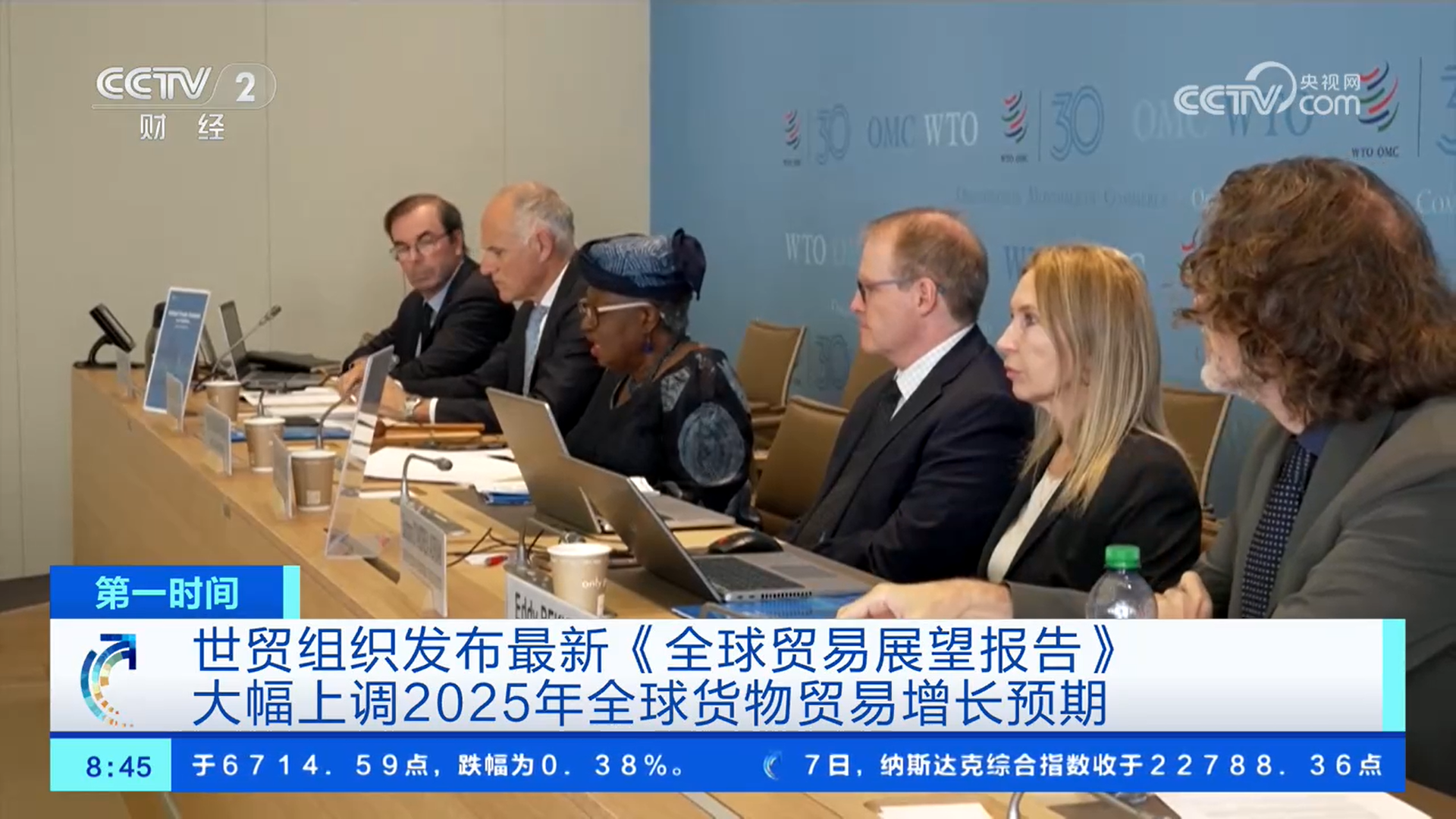
世贸组织发布最新《全球贸易展望报告》大幅上调2025年全球货物贸易增长预期
Yang Shi Wang· 2025-10-08 05:09
Group 1 - The core viewpoint is that despite strong headwinds from unilateral tariff measures and trade policy uncertainties, global trade shows resilience due to the stability provided by the multilateral trading system and appropriate responses from members to tariff changes [1] Group 2 - The latest Global Trade Outlook Report indicates a significant year-on-year increase of 4.9% in global trade volume in the first half of 2025, driven by factors such as preemptive imports in the U.S. due to anticipated tariff hikes, improved macroeconomic conditions, and a surge in demand for artificial intelligence products [3] - The World Trade Organization has revised its global goods trade growth forecast for 2025 from 0.9% in August to 2.4% [3] Group 3 - However, the report also indicates a substantial downward adjustment of the global goods trade growth forecast for 2026, from an earlier prediction of 1.8% to only 0.5%, due to global economic cooling and the full impact of higher tariffs becoming evident over the year [4] - In terms of service trade, while not directly affected by tariffs, it may still face indirect impacts through its association with goods trade and output, with global service export growth expected to decline from 6.8% in 2024 to 4.6% in 2025, and further to 4.4% in 2026 [4]

中美双方将在西班牙举行会谈 讨论美单边关税措施、滥用出口管制等问题
Yang Shi Xin Wen Ke Hu Duan· 2025-09-12 12:50
Core Points - The U.S. Treasury Secretary, Janet Yellen, is set to meet with Chinese Vice Premier He Lifeng in Madrid from September 14 to 17 to discuss various economic and trade issues [1] - Key topics for discussion include U.S. unilateral tariff measures, the abuse of export controls, and issues related to TikTok [1] Group 1 - The meeting is part of ongoing efforts to address bilateral economic relations between the U.S. and China [1] - The discussions are expected to focus on trade policies that have significant implications for both countries' economies [1] - The engagement highlights the importance of dialogue in managing trade tensions and fostering cooperation [1]
中方呼吁反对单边关税措施 共同维护多边贸易体制
news flash· 2025-07-23 14:18
Core Viewpoint - China calls for opposition to unilateral tariff measures and emphasizes the importance of maintaining a multilateral trade system amid increasing global trade volatility and uncertainty [1] Summary by Relevant Sections - **Current Trade Situation** - Global trade is experiencing heightened turbulence, with rising uncertainty and fragmentation risks [1] - The value of trade affected by restrictive measures has reached $2.7 trillion, the highest since 2009 [1] - **China's Proposal** - China submitted a written proposal titled "Suggestions for Supporting the Multilateral Trade System under Current Circumstances" during the WTO General Council meeting [1] - The proposal aims to strengthen unity and cooperation among WTO members to effectively support the multilateral trade system [1]
中国驻智利大使:美单边关税战影响中智双边贸易,应携手反对霸凌胁迫行径
news flash· 2025-06-17 23:45
Group 1 - The term "China-US trade war" is deemed inaccurate, as it implies mutual responsibility, while it is actually a unilateral tariff war initiated by the US against global trade, with China opposing these measures [1] - The unilateral tariff measures by the US have negatively impacted international trade rules and the rule-based international trading system, particularly affecting smaller countries like Chile [1] - The US is attempting to coerce Chile into accepting unreasonable demands regarding key minerals and infrastructure, which could undermine Chile's sovereignty and economic development [2] Group 2 - China views international trade as a win-win scenario, asserting that there are no winners in a trade war, and emphasizes the need to counter unilateralism to maintain international fairness and justice [2] - Chile's economy is highly export-oriented, and maintaining a multilateral, open international trade system aligns with its national interests, as Chile has expressed opposition to US unilateral tariff measures [2] - There is a call for collaboration among China, Chile, and other countries to oppose unilateral tariff measures and coercive actions, promoting inclusive economic globalization and building a community with a shared future for humanity [2]