发现式智能

Search documents
盛大科技战略调整聚焦AI新方向,股价历史波动引关注
Jing Ji Guan Cha Wang· 2026-02-13 22:39
Recent Events - The founder of Shengda Group, Chen Tianqiao, released an internal letter on February 6, 2026, outlining the technological direction of MiroMind, focusing on "discovery-based intelligence" and "general solvers," while avoiding the general chatbot arena [1] - The emphasis is on promoting AI development through causal reasoning and systematic innovation, which may indirectly impact Shengda Technology's business ecosystem [1] Stock Recent Trends - Historical data indicates that Shengda Technology's stock price experienced multiple fluctuations in December 2025, including a surge of 5.34% on December 29 and a drop of 5.00% on December 17 [2]
陈天桥携MiroThinker 1.5开年登场:跑赢万亿模型,实现小模型大智能
Tai Mei Ti A P P· 2026-01-08 04:45
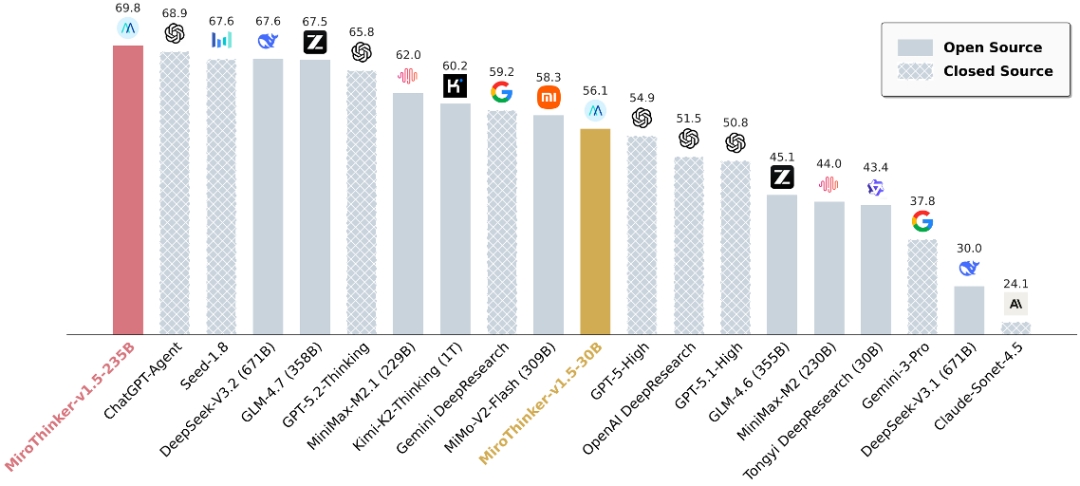
Core Insights - MiroMind team has launched MiroThinker 1.5, a flagship search intelligence model, which emphasizes "discovery-based intelligence" as a path to true general artificial intelligence [2][3] - The model aims to reconstruct understanding of the world under unknown conditions, focusing on research, verification, and correction rather than sheer data accumulation [2] Model Performance - MiroThinker 1.5 operates with 30 billion parameters, achieving performance comparable to larger models with 1 trillion parameters, demonstrating a high efficiency-to-intelligence ratio [3] - The model's cost per call is as low as $0.07, which is 1/20th of the cost of its competitor Kimi-K2-Thinking, while also providing faster inference [5] Interactive Scaling Concept - MiroThinker introduces "Interactive Scaling," shifting the focus from internal parameter expansion to external information interaction, enhancing reasoning capabilities [6][9] - The model is designed to function like a "scientist," emphasizing verification and correction over memorization, thus avoiding the pitfalls of traditional large models [8][10] Training Mechanism - The training process incorporates a "reason-verify-correct" loop, allowing the model to engage with external data for validation, which helps mitigate logical errors [9][12] - MiroThinker employs a time-sensitive training mechanism that restricts the model to only interact with information available before a given timestamp, ensuring realistic decision-making [12] Verification and Correction - The model encourages breaking down key judgments into verifiable sub-hypotheses and actively seeking external evidence, making the evidence-gathering process the primary training goal [11] - It emphasizes iterative verification, where reasoning is treated as a revisable process, allowing for adjustments based on conflicting evidence [11]

MiroMind发布全球最强搜索智能体模型MiroThinker 1.5,以“发现式智能”挑战传统大模型路径
3 6 Ke· 2026-01-06 09:06
Core Insights - MiroMind team has launched its flagship search intelligence model, MiroThinker 1.5, which emphasizes "discovery intelligence" rather than merely increasing parameter size [1][2] - The model aims to reconstruct understanding of the world under unknown conditions, focusing on research, verification, and correction [1] - MiroThinker 1.5 demonstrates high performance with significantly fewer parameters compared to larger models, achieving results comparable to those with 1 trillion parameters [2][7] Performance Evaluation - MiroThinker-v1.5-30B operates with only 1/30 of the parameters yet matches the performance of many 1 trillion parameter models [2] - In key benchmark tests, MiroThinker-v1.5-235B ranks among the top globally, showcasing its efficiency [2][6] Competitive Analysis - MiroThinker-v1.5-30B shows competitive performance against Kimi-K2-Thinking, which has 30 times more parameters, with a significantly lower inference cost of $0.07 per call, just 1/20 of Kimi-K2-Thinking's cost [7] - The model's performance in the BrowseComp-ZH benchmark indicates that larger models do not necessarily equate to stronger performance [7] Technological Innovations - MiroThinker 1.5 introduces "Interactive Scaling," shifting focus from internal parameter expansion to external information interaction, enhancing model performance [8][9] - The model employs a "scientist mode" for reasoning, emphasizing evidence-seeking and iterative verification to avoid hallucinations and ensure accuracy [9][12] Training Methodology - The training process incorporates a time-sensitive sandbox, ensuring the model learns to make predictions based on past information without future leakage [14] - MiroThinker 1.5 is trained to actively seek evidence, verify hypotheses, and correct itself, fostering a robust reasoning process [12][13] Market Applications - MiroMind's predictive capabilities have been demonstrated in stock market scenarios, accurately forecasting stock performance amidst market fluctuations [15][19] - The model is positioned to impact major tech companies, with upcoming events likely to influence stock prices and market dynamics [25]
陈天桥代季峰打响2026大模型第一枪:30B参数跑出1T性能
量子位· 2026-01-06 05:48
Core Viewpoint - MiroThinker 1.5, developed by MiroMind, is positioned as a leading AI model in the intelligent agent field, showcasing superior performance in various benchmark tests compared to other top models like GPT-5-High and Gemini-3-Pro [1][3][5]. Performance Evaluation - MiroThinker 1.5 achieved notable scores in benchmark tests: - HLE-Text: 39.2% - BrowseComp: 69.8% - BrowseComp-ZH: 71.5% - GAIA-Val-165: 80.8% [3][4]. - It surpassed ChatGPT-Agent's previous record in BrowseComp, establishing itself in the global top tier [5]. Model Efficiency - MiroThinker 1.5 operates with significantly fewer parameters (30B and 235B) compared to competitors, achieving comparable or superior results through high efficiency [7][8]. - The model's inference cost is notably low at $0.07 per call, which is only 1/20 of Kimi-K2-Thinking's cost, while also demonstrating faster inference speeds [8]. Development Team and Background - The MiroMind team, responsible for MiroThinker 1.5, previously excelled in predicting outcomes in decentralized markets, showcasing their expertise in model development [9][10]. Interactive Scaling and Model Training - MiroThinker 1.5 incorporates a novel approach called Interactive Scaling, which emphasizes interaction with the external environment during both training and inference phases, enhancing its reasoning capabilities [46][58]. - The model employs a feedback loop in its reasoning process, allowing for iterative verification and correction, which contrasts with traditional models that rely heavily on memorization [48][57]. Predictive Capabilities - MiroThinker 1.5 demonstrates a robust ability to make predictions based on real-time data, as evidenced by its analysis of sports events and video game release timelines, showcasing a logical and evidence-based approach [15][35][41]. - The model's predictions are structured to avoid reliance on past knowledge, instead focusing on current information and real-world interactions [52][63]. Conclusion - MiroThinker 1.5 represents a significant advancement in AI model development, prioritizing interaction and evidence-based reasoning over sheer parameter size, thus redefining the landscape of intelligent agents [64].

刚刚,蝉联Future X全球榜首的MiroMind发布全球最强搜索智能体模型
机器之心· 2026-01-05 06:09
Core Viewpoint - MiroMind team has launched its flagship search intelligence model MiroThinker 1.5, emphasizing the concept of "discovery intelligence" as a path to true general artificial intelligence, focusing on external information interaction rather than merely increasing internal parameters [1][10]. Group 1: Model Performance and Comparison - MiroThinker 1.5-30B achieved performance comparable to many 1 trillion parameter models while using only 1/30 of the parameter scale [4]. - In key benchmark tests, MiroThinker 1.5-235B ranked among the top globally, demonstrating its effectiveness despite a smaller parameter size [4]. - MiroThinker 1.5-30B exhibited a significantly lower inference cost of $0.07 per call, which is only 1/20 of the cost of Kimi-K2-Thinking, while also providing faster inference [9]. Group 2: Interactive Scaling and Training Mechanism - MiroMind team has shifted from traditional scaling laws focused on internal parameter expansion to "Interactive Scaling," which emphasizes external information interaction to enhance model performance [10][12]. - The training process encourages models to engage in evidence-seeking behaviors, breaking down key judgments into verifiable sub-hypotheses and actively querying external data [19]. - The model is trained under strict temporal visibility constraints, ensuring it learns to make judgments based only on past information, thus avoiding future leakage [17][20]. Group 3: Unique Training Approaches - MiroThinker 1.5 employs a "scientist mode" rather than a "test-taker mode," focusing on verification and correction rather than memorization [11]. - The model's training paradigm includes a time-sensitive training sandbox, which forces it to operate under real-world conditions of incomplete information and noise [18]. - The training emphasizes iterative verification and self-correction, allowing the model to adjust its hypotheses based on conflicting evidence [19]. Group 4: Market Predictions and Applications - MiroMind has demonstrated its predictive capabilities in stock market scenarios, accurately identifying stocks with high potential for upward movement amidst market noise [22][25][30]. - The model is also applied to predict significant events that may impact major companies, providing insights into potential market reactions and volatility [31].

陈天桥旗下盛大AI东京研究院于SIGGRAPH Asia正式亮相,揭晓数字人和世界模型成果
机器之心· 2025-12-22 04:23
Core Insights - Shanda Group's Shanda AI Research Tokyo made its debut at SIGGRAPH Asia 2025, focusing on "Interactive Intelligence" and "Spatiotemporal Intelligence" in digital human research, reflecting the long-term vision of founder Chen Tianqiao [1][10] - The article discusses the systemic challenges leading to the "soul" deficiency in current digital human interactions, which is a significant barrier to user engagement despite substantial investments in visual effects [2][3] Systemic Challenges - **Long-term Memory and Personality Consistency**: Current large language models (LLMs) struggle with maintaining a stable personality over extended conversations, leading to "persona drift" and inconsistent narrative logic [3] - **Lack of Multimodal Emotional Expression**: Digital humans often exhibit "zombie-face" phenomena, lacking natural micro-expressions and emotional responses, which diminishes immersive experiences [3] - **Absence of Self-evolution Capability**: Most digital humans operate as passive systems, unable to learn from interactions or adapt to user preferences, hindering their evolution into truly intelligent entities [3] Industry Consensus - Experts at the SIGGRAPH Asia conference reached a consensus that the bottleneck in digital human development has shifted from visual fidelity to cognitive and interaction logic, emphasizing the need for long-term memory, multimodal emotional expression, and self-evolution as core competencies [13][10] Introduction of Mio - Shanda AI Tokyo Research introduced Mio (Multimodal Interactive Omni-Avatar), a framework designed to transform digital humans from passive entities into intelligent partners capable of autonomous thought and interaction [16][22] - Mio's architecture includes five core modules: Thinker (cognitive core), Talker (voice engine), Facial Animator, Body Animator, and Renderer, which work together to create a seamless interaction loop [20][21] Performance Metrics - Mio achieved an overall Interactive Intelligence Score (IIS) of 76.0, representing an 8.4 point improvement over previous technologies, setting a new performance benchmark in the industry [25][22] Future Outlook - The development of Mio signifies a paradigm shift in digital human technology, moving focus from static visual realism to dynamic, meaningful interactive intelligence, with potential applications in virtual companionship, interactive storytelling, and immersive gaming [22][25] - Shanda AI Tokyo Research has made the complete technical report, pre-trained models, and evaluation benchmarks of the Mio project publicly available to foster collaboration in advancing this field [28]

天桥脑科学研究院宣布成立尖峰智能实验室
Xin Hua Cai Jing· 2025-12-13 12:29
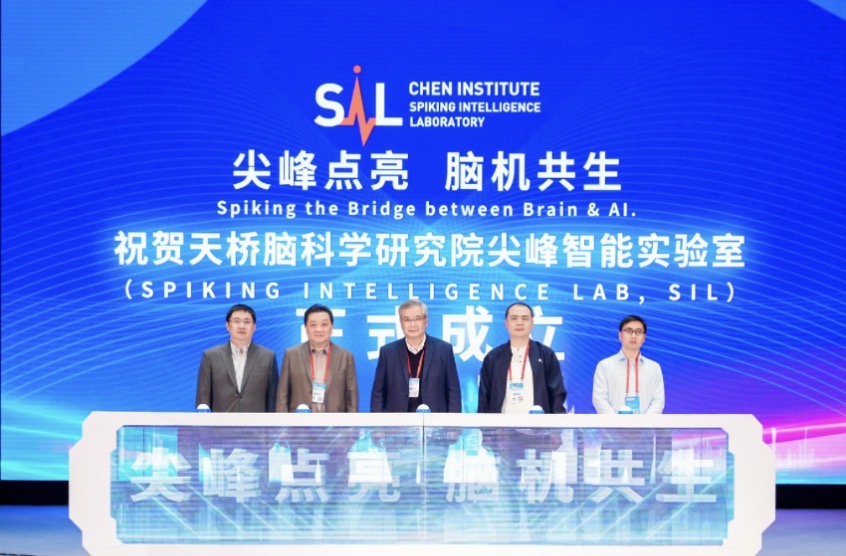
Core Insights - The Tianqiao Brain Science Research Institute has established the Spiking Intelligence Lab (SIL) to focus on brain-like models and spiking neural networks, aiming to explore the deep integration of artificial intelligence and human intelligence [1][5] - The concept of "Discoverative Intelligence" was introduced by Chen Tianqiao, and the Spiking Intelligence Lab serves as a key implementation platform for this idea [2] Group 1: Research and Development Focus - The lab emphasizes the development of brain-like models with neural dynamics, inspired by the human brain's efficiency, which operates at approximately 20 watts while supporting complex functions of billions of neurons [5] - The lab aims to create a "whole-brain architecture" that combines spiking communication and dynamic coding with the intricate structure of dendritic neurons, enhancing perception, memory, and cognitive abilities [5] Group 2: Institutional Transformation - The establishment of the Spiking Intelligence Lab marks a shift from an "external" donation-based model to an "in-house" research model, allowing the institute to recruit top talent and independently determine research directions [6] - This transition enables the institute to accelerate the transformation of the "Discoverative Intelligence" concept from theory to practical technological outcomes [6] Group 3: Strategic Positioning in Brain Science - As one of the largest private brain science research institutions globally, the Tianqiao Brain Science Research Institute has made significant contributions to brain science research over its nine years of operation [10] - The institute has previously collaborated with Fudan University and other institutions to establish cutting-edge laboratories focusing on brain-machine interfaces and mental health, contributing to advancements in the field [10] - The institute has hosted over 300 international and interdisciplinary academic conferences, promoting knowledge dissemination and engagement in cutting-edge technology [10]

天桥脑科学研究院成立尖峰智能实验室 支持“发现式智能”
Di Yi Cai Jing· 2025-12-13 08:28
Group 1 - The newly established Spiking Intelligence Lab (SIL) aims to develop brain-like models and spiking neural networks, focusing on the deep integration of artificial intelligence and human intelligence [1] - The lab is led by Professor Li Guoqi and is a non-profit research institution under the Tianqiao Brain Science Research Institute, which seeks to provide key capabilities for the "discovery-based intelligence" proposed by founder Chen Tianqiao [1] - The research emphasizes the importance of neural dynamics, contrasting with mainstream AI models that rely on scaling parameters, and aims to create a comprehensive brain architecture with strong perception, memory, and thinking capabilities [1][2] Group 2 - Chen Tianqiao highlighted the limitations of the "scale path" based solely on data and computing power, advocating for a "structural path" that resembles the "cognitive anatomy" of intelligence [2] - The Tianqiao Brain Science Research Institute plans to invest over $1 billion to build dedicated computing clusters to support young scientists in exploring structural mechanisms and validating new hypotheses in neuroscience [2] - The first brain-like spiking model, "Shunxi 1.0," developed by Li Guoqi's team, demonstrates breakthroughs in brain-like computing and large model integration, providing a new technical route for the next generation of AI [2][3] Group 3 - The current mainstream model architecture, based on the Transformer framework, faces resource consumption bottlenecks and limitations in processing long sequences due to its reliance on simple point neuron models [3] - The "Shunxi 1.0" model is characterized by "small data, high performance," requiring only about 2% of the data used by mainstream models while achieving comparable performance in various language understanding and reasoning tasks [3] - The model has successfully completed full training and inference on domestic GPU platforms, showcasing the feasibility of building a new ecosystem for domestically controlled large model architectures [3]
天桥脑科学研究院成立尖峰智能实验室,支持“发现式智能”
Di Yi Cai Jing· 2025-12-13 08:23
Core Insights - The establishment of the Spiking Intelligence Lab (SIL) aims to develop brain-like models with neuro-dynamic characteristics, focusing on the integration of artificial intelligence and human intelligence [1][3] - The lab is led by Professor Li Guoqi and is part of the Tianqiao Brain Science Research Institute, which seeks to provide key capabilities for the "discovery-based intelligence" proposed by founder Chen Tianqiao [1][3] Research Focus - The lab emphasizes the importance of neuro-dynamics, contrasting with mainstream AI models that rely on scaling parameters, and aims to create a full-brain architecture with strong perception, memory, and thinking capabilities [3] - The research will support the construction of a full-brain architecture that operates with approximately 20 watts of power, similar to the human brain, which has complex operations supported by billions of neurons [3] Funding and Resources - The Tianqiao Brain Science Research Institute plans to invest over $1 billion to build dedicated computing clusters to provide resources for young scientists, focusing on structural exploration rather than scaling [4] - This investment aims to foster interdisciplinary innovation and support the verification of memory mechanisms and new neuro-dynamic hypotheses [4] Technological Advancements - The lab has developed the first brain-like pulse model, "Shunxi 1.0," which achieves breakthroughs in brain-like computing and large model integration, offering a new technical route for the next generation of AI [4][5] - The "Shunxi 1.0" model requires only about 2% of the data volume compared to mainstream models while achieving comparable performance in various language understanding and reasoning tasks [5]
陈天桥最新撰文:管理学的黄昏与智能的黎明——重写企业的生物学基因
创业邦· 2025-12-03 04:26
Core Viewpoint - The article presents a forward-looking judgment that we are witnessing "the twilight of management and the dawn of intelligence," emphasizing a shift from traditional management practices to a new paradigm driven by artificial intelligence [2][3]. Group 1: The Twilight of Management - Management is not an eternal truth but a construct that will be rendered obsolete as human cognitive limitations are replaced by intelligent agents [3]. - The future of enterprise transformation will not be about "better management" but rather the "exit of management" as the reliance on human characteristics diminishes [3]. Group 2: Limitations of Traditional Management - Traditional management tools have been developed to compensate for human cognitive limitations, such as KPI systems, hierarchical structures, and incentive mechanisms, which are essentially "patches" for human brain deficiencies [5]. - Management has never truly enhanced organizational intelligence; it has functioned as a "correction system" to maintain correctness before human cognitive failures occur [5]. Group 3: The Role of Intelligent Agents - Intelligent agents represent a fundamentally different existence in cognitive anatomy compared to human employees, characterized by continuous memory, holistic cognition, and intrinsic evolution [7]. - These agents do not require external motivation and operate based on a reward model, making them distinct from human workers [7][8]. Group 4: The Collapse of Traditional Structures - The introduction of intelligent agents into traditional management frameworks leads to systemic rejection of outdated practices, as the foundational elements of modern enterprises become constraints rather than supports [10]. - Key components such as KPIs, hierarchical structures, incentive mechanisms, long-term planning, and supervision are becoming obsolete in the face of intelligent agents [11][12][13][14]. Group 5: Defining AI-Native Enterprises - AI-Native enterprises must undergo a fundamental rewrite at the genetic level, focusing on architecture as intelligence, growth as compounding, memory as evolution, execution as training, and redefining the role of humans [15][16][17][18][19]. - The ultimate form of an AI-Native enterprise is not about software acquisition but about existing in a biological form that supports intelligent evolution [15][19]. Group 6: The Future of Management - Management will not disappear but will be built on the foundation of intelligence rather than the ruins of biology, leading to a future where enterprises are driven by intelligence that expands human capabilities [21].