
无人驾驶航空器

Search documents
刷新吉尼斯世界纪录!22580架亿航智能新一代无人机亮相马年春晚
Zhong Guo Min Hang Wang· 2026-02-17 02:11
Core Viewpoint - EHang's subsidiary, EHang White Heron, successfully set a Guinness World Record by launching 22,580 drones simultaneously, showcasing the integration of technology and traditional culture during the 2026 Spring Festival Gala [1][2][5]. Group 1: Record Achievement - EHang White Heron completed a performance with 22,580 GHOSTDRONE 4.0 drones, breaking the record for the most drones controlled by a single computer [2][4]. - The event was witnessed by Guinness World Record officials and media, highlighting the significance of the achievement [2][4]. Group 2: Technical Capabilities - The GD4.0 drones have a flight time of up to 45 minutes and can be rapidly deployed, reducing labor costs and enhancing operational efficiency [7]. - The drones are designed for high adaptability in extreme conditions, ensuring stable performance in various environments [7]. Group 3: Industry Implications - This record not only demonstrates EHang's leadership in drone technology but also paves the way for broader applications in air traffic, logistics, and emergency rescue [9]. - The successful demonstration indicates the potential for even larger drone clusters in the future, with capabilities to manage over 50,000 drones [7][9].



今年北京拟制定人工智能产业发展条例
Xin Lang Cai Jing· 2026-01-27 17:52
Core Viewpoint - The Beijing Municipal People's Congress is focusing on high-quality development and legislative initiatives for 2026, with a preliminary arrangement of 36 legislative topics aimed at enhancing various sectors including private economy and artificial intelligence [1][6]. Legislative Initiatives - In 2025, the Municipal People's Congress enacted 7 local regulations, modified 2, and abolished 3, while also conducting extensive reviews and audits on various governmental reports [2]. - Proposed regulations for 2026 include those for unmanned aerial vehicles, museum management, and international communication center construction [8]. Social and Economic Development - The Congress aims to promote the private economy and artificial intelligence through new regulations, while also focusing on fair market competition and data management [8][9]. - There is an emphasis on improving living standards and protecting citizens' rights through proposed laws on food safety and labor rights for new employment forms [9]. Environmental and Urban Governance - Legislative efforts will also address environmental protection, including the development of renewable energy and noise pollution prevention regulations [3][8]. - The Congress plans to enhance urban governance through regulations on geographic information and water supply management [8]. Health and Education - The Congress is set to review and legislate on issues related to public health, including food safety and educational services for young children [9]. - There will be a focus on mental health and the protection of minors in the digital space, with proposed regulations on social credit and volunteer service [9].
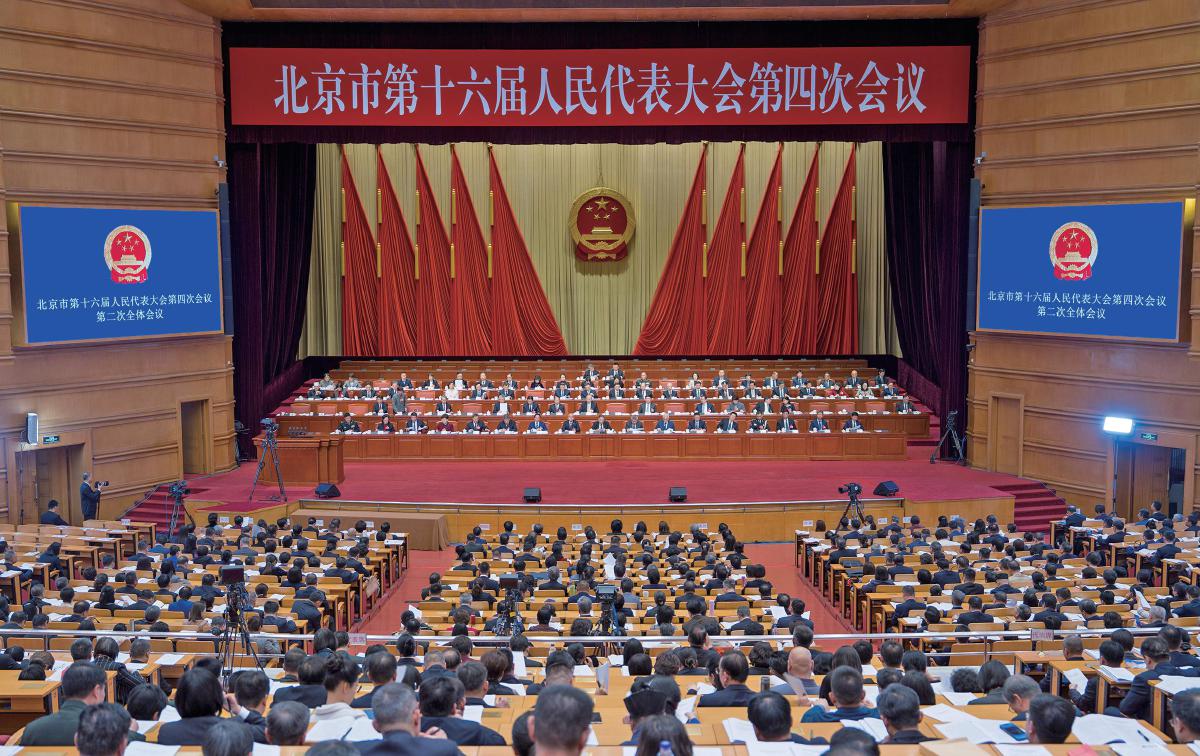
2026北京两会 | 2026年北京拟制定民营经济促进条例、人工智能产业发展条例等
Bei Jing Shang Bao· 2026-01-27 15:42
Legislative Agenda - In 2026, Beijing plans to arrange 36 legislative topics, including 16 review projects and 20 research and project verification topics [1][2] - Key legislative focuses include promoting the private economy and developing the artificial intelligence industry [1][2] Past Legislative Achievements - In 2025, significant regulations were established, such as the Yongding River Protection Regulation and the Beijing International Commercial Arbitration Center Construction Regulation [1] - Other notable regulations include the Great Wall Protection Regulation and the modification of non-motor vehicle management and fire safety regulations [1] Future Legislative Plans - Proposed regulations for 2026 include management of unmanned aerial vehicles, museum regulations, and a private economy promotion regulation [2] - Additional plans involve drafting laws related to urban governance, public welfare, and consumer rights protection [2]
2026年北京拟制定民营经济促进条例、人工智能产业发展条例等
Bei Jing Shang Bao· 2026-01-27 14:19
Legislative Agenda for Beijing in 2026 - In 2026, Beijing plans to address 36 legislative topics, including 16 review projects and 20 research and project verification initiatives [3][4] - Key areas of focus include promoting the private economy and developing the artificial intelligence industry [3][4] Recent Legislative Achievements - In the past year, significant legislation included the establishment of the Yongding River Protection Regulations, the Beijing International Commercial Arbitration Center Construction Regulations, and the Great Wall Protection Regulations [3] - Amendments to existing regulations such as the Non-Motor Vehicle Management Regulations and the Fire Safety Regulations were also highlighted [3] Future Legislative Initiatives - Proposed regulations for 2026 include management of unmanned aerial vehicles, a museum regulation, and a private economy promotion regulation [4] - Additional initiatives aim to enhance urban governance, improve public welfare, and protect citizens' rights, including food safety laws and labor rights for new employment forms [4]

2026北京两会|2026年北京拟制定民营经济促进条例、人工智能产业发展条例等
Bei Jing Shang Bao· 2026-01-27 14:06
Legislative Agenda - In 2026, Beijing plans to arrange 36 legislative topics, including 16 review projects and 20 legislative research and project verification topics [3][4] - Key legislative focuses include promoting the private economy and developing the artificial intelligence industry [4] Past Legislative Achievements - In 2025, significant regulations were established, such as the Yongding River Protection Regulation, Beijing International Commercial Arbitration Center Construction Regulation, and various cultural heritage protection laws [3] - Amendments were made to existing regulations addressing urban governance issues, including the Non-Motor Vehicle Management Regulation and Fire Safety Regulation [3] Future Legislative Plans - Proposed regulations for 2026 include management of unmanned aerial vehicles, museum regulations, and measures to enhance urban governance such as noise pollution prevention and dog management [4] - Additional plans involve legislation for food safety, labor rights for new employment forms, and various modifications to existing laws related to tourism and consumer rights [4]

全球首个混动eVTOL获发TC 国内近20款eVTOL“蓄势待飞”
Zhong Guo Jing Ying Bao· 2026-01-04 11:19
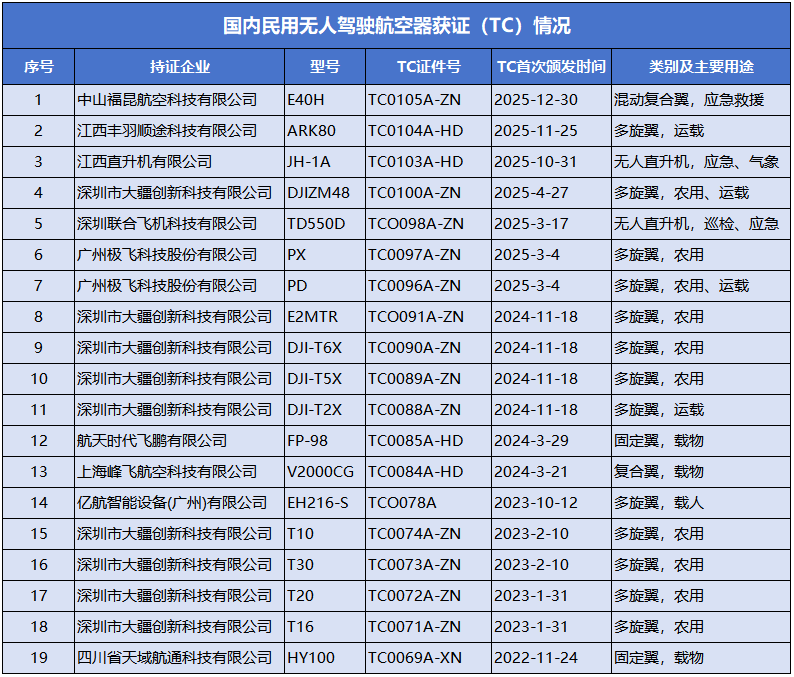
Core Viewpoint - The domestic civil unmanned aerial vehicles (UAVs) have received type certification (TC), with the E40H model from Fukun Aviation being the first to obtain TC under the new Civil Aviation Law, marking a significant milestone in the industry [2][4]. Group 1: Certification and Regulatory Framework - The E40H model is the first medium eVTOL to meet airworthiness requirements globally and is the first unmanned aerial product to receive TC after the new Civil Aviation Law was enacted [2]. - As of now, a total of 19 models of civil unmanned aerial vehicles have been issued TC in China, with DJI holding 9 of these certifications, covering various applications such as emergency response, agriculture, and transportation [4]. Group 2: Technical Achievements and Testing - The E40H underwent rigorous testing, completing 41 compliance verification tests, 42 engineering reports, and over 2000 hours of ground and laboratory tests, along with 167 flights totaling over 480 flight hours and 43,000 kilometers [2]. - The E40H has been actively involved in real-world emergency rescue operations, including flood rescue missions and typhoon response, demonstrating its operational capabilities [3]. Group 3: Future Developments - The company is progressing with the airworthiness certification for its 2-ton eVTOL model M1B, with the TC application accepted in January 2024 and expected to be completed by 2026 for commercial use in emergency firefighting and logistics [4]. - Plans are in place to submit a TC application for a manned version of the M1 model to gradually advance the commercialization of manned operations [4].
吨级无人驾驶航空器跨海峡飞行
Hai Nan Ri Bao· 2026-01-01 00:13
Group 1 - The first demonstration of a ton-level unmanned aerial vehicle (UAV) crossing the Qiongzhou Strait and its application in unmanned airport scenarios took place in Haikou, Hainan Free Trade Port on December 31, 2025 [2] - The demonstration involved the "Kairuiou" ton-level logistics aircraft and the EHang EH216-S unmanned passenger aircraft, which successfully flew from Haikou Mingzhu Island to Xu Wen Port in Zhanjiang, Guangdong [2] - The flight was completed in over 10 minutes under complex marine weather conditions, showcasing precise navigation and stable control systems [2]
纯电动载人无人机亮相吴江
Su Zhou Ri Bao· 2025-12-04 00:31
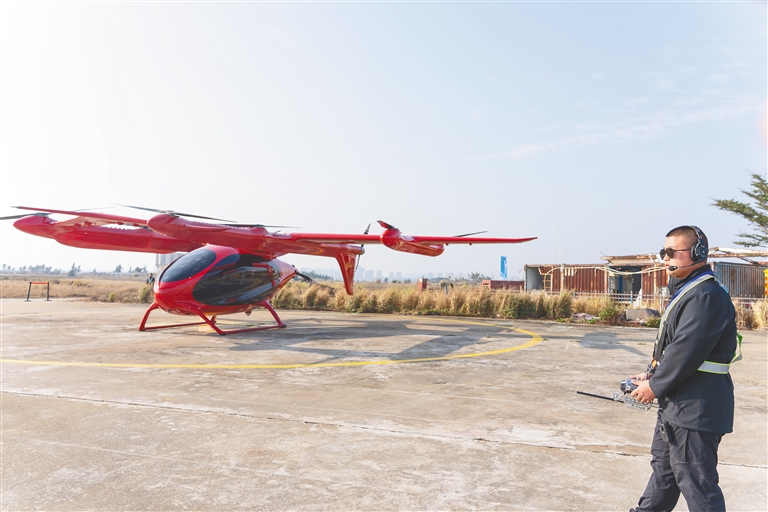
Core Insights - The introduction of the EHang EH216 drone marks an expansion of the multi-dimensional transportation business in Wujiang [1][2] - The EH216 drone offers significant advantages over traditional helicopters, including reduced installation time, smaller landing space requirements, lower noise levels, and lower operational costs [1] - The drone is designed for short-distance connections in densely populated urban areas, despite having lower endurance and speed compared to conventional helicopters [1] Group 1 - The EH216 drone can be installed in 15 minutes by four staff, compared to nearly five hours for a traditional helicopter [1] - The drone requires a landing area of only 10 meters square, significantly smaller than the 40 meters square needed for traditional helicopters [1] - Charging the EH216 takes only 2 hours, contributing to its lower operational costs [1] Group 2 - The East Rong Low-altitude Economy Company plans to utilize the EH216 for public education and awareness activities regarding low-altitude economy and unmanned aerial vehicles [2] - Future commercial operations will be based on the EH216's low operational costs, aiming to provide low-altitude flight services along existing helicopter routes [2] - Alongside the EH216, an Airbus EC135 helicopter has also arrived to enhance low-altitude service capabilities in the Suzhou area [2]
北京发布重要通告
券商中国· 2025-10-18 12:38
Group 1 - The article discusses the announcement by the Beijing Public Security Bureau regarding air safety management during the Fourth Plenary Session of the 20th Central Committee of the Communist Party of China, which prohibits the release of balloons and sky lanterns in the city from October 19 to October 23 [1] - It emphasizes that the entire administrative area of Beijing is a controlled airspace for unmanned aerial vehicles (UAVs), and any UAV activities require prior approval from air traffic management authorities [1] - The article outlines penalties for violations of UAV regulations, including fines ranging from 200 yuan to 20,000 yuan for unregistered UAV flights, and fines for guardians of individuals with limited civil capacity who operate UAVs [1]

立足创新让低空经济乘势而起
Jing Ji Ri Bao· 2025-06-18 20:15
Core Viewpoint - The document outlines the Chinese government's support for Shenzhen to deepen reforms and innovations in the low-altitude economy, marking a significant upgrade in its exploration of low-altitude economic development, which is expected to accumulate new experiences and explore new paths for the national low-altitude economy [1] Policy and Regulatory Framework - The document emphasizes the establishment of a comprehensive regulatory framework for low-altitude flight management, including the implementation of the "Interim Regulations on the Management of Unmanned Aerial Vehicle Flights" and the exploration of cross-border helicopter flights and public service aviation [1][2] Economic Growth Projections - China's low-altitude economy is projected to exceed 580 billion yuan by March 2025 and is expected to surpass 3.5 trillion yuan by 2035, indicating strong growth momentum in this sector [1] Challenges in Low-Altitude Economy - The low-altitude economy faces challenges in technology, infrastructure, regulatory mechanisms, and talent reserves, including issues with eVTOL battery energy density, autonomous navigation systems, and the need for better integration of low-altitude infrastructure with urban planning [2][3] Infrastructure Development - There is a need to build a supporting system that integrates physical facilities, digital infrastructure, and energy networks, including the construction of general airports and a low-altitude smart network for precise positioning and real-time obstacle avoidance [3] Technological Advancements - The industry is encouraged to implement a "bottleneck breakthrough plan" focusing on key areas such as batteries, flight control, and chips, promoting domestic alternatives and fostering collaboration between academia and industry [3] Market Expansion and New Business Models - The document suggests exploring new business models in the low-altitude economy, such as "shared flights" and low-altitude tourism, while also enhancing data services and establishing a low-altitude data trading platform [4] Talent Development - A multi-level talent development system is proposed, including the establishment of relevant academic programs, vocational training, and international talent recruitment to support the growth of the low-altitude economy [4]