期货市场调控

Search documents
深夜锡价跳水 当前价格已在一定程度上透支长线预期
Xin Lang Cai Jing· 2026-01-16 00:32
Core Viewpoint - The recent significant drop in both domestic and international tin futures prices is attributed to regulatory changes and market dynamics, with the Shanghai Futures Exchange implementing measures to stabilize the market [2][4]. Group 1: Market Dynamics - The main contract for Shanghai tin futures experienced a decline of over 5%, while London tin prices fell by more than 4%, closing down 3.27% [2]. - The recent surge in tin prices, which reached a historical high of 440,000 yuan per ton, was driven by supply constraints from Myanmar and Indonesia, as well as optimistic demand forecasts in advanced manufacturing sectors [3]. Group 2: Regulatory Changes - On January 15, the Shanghai Futures Exchange announced adjustments to the trading margin ratios, price fluctuation limits, and trading quotas for tin futures to guide rational market participation and maintain stability [2]. - The new measures include increasing the margin ratio for hedging positions to 12% and for general positions to 13%, along with a daily opening limit of 800 contracts for non-futures company members and certain foreign participants [2]. Group 3: Analyst Insights - Analysts suggest that the current price increase may have overshot long-term expectations, indicating a need for cautious participation in the market [3]. - The market's trading activity has significantly increased since the end of 2025, with expectations that 2026 may mark a turning point in tin concentrate supply from tight to loose [3].
华泰期货:调控政策加码,碳酸锂价格回落
Xin Lang Cai Jing· 2026-01-15 01:47
Core Viewpoint - The lithium carbonate market is experiencing significant price fluctuations and inventory changes, indicating potential volatility and the need for careful monitoring of consumption trends [3][4][9]. Market Analysis - On January 14, 2026, the main lithium carbonate futures contract opened at 169,000 CNY/ton and closed at 161,940 CNY/ton, reflecting a decrease of 3.53% from the previous settlement price [2][7]. - The trading volume for the day was 589,019 contracts, with an open interest of 452,583 contracts, down from 460,281 contracts the previous day [2][7]. - The current basis is reported at -6,940 CNY/ton, indicating a difference between the average spot price and futures [2][7]. Spot Prices - According to SMM data, battery-grade lithium carbonate is priced between 158,000 and 168,000 CNY/ton, with an increase of 3,500 CNY/ton from the previous trading day [3][8]. - Industrial-grade lithium carbonate is priced between 155,000 and 164,000 CNY/ton, also reflecting a rise of 3,500 CNY/ton [3][8]. - The price of 6% lithium concentrate is reported at 2,200 USD/ton, with a slight increase of 10 USD/ton [3][8]. Inventory Statistics - The total spot inventory stands at 109,942 tons, with a month-on-month increase of 337 tons [3][8]. - Smelter inventory is at 18,382 tons, up by 715 tons, while downstream inventory has decreased by 2,458 tons to 36,540 tons [3][8]. - Other inventory types have increased by 2,080 tons to 52,940 tons, indicating a mixed inventory trend [3][8]. Market Dynamics - Recent adjustments in trading policies by the exchange aim to prevent excessive speculation and maintain market stability, which may impact the volatility of lithium carbonate prices [3][8]. - The market is currently experiencing a divergence between spot and futures prices, with a noted slowdown in inventory depletion [4][9]. - There is a cautionary note regarding potential price corrections due to excessive short-term gains [4][9]. Influencing Factors - The consumption side continues to exceed expectations, while disruptions at the mining level are also greater than anticipated [5][10]. - Macro sentiment and changes in open interest are influencing market dynamics [5][10].


为过热交易降温,广期所出手调控碳酸锂期货
Huan Qiu Wang· 2025-11-21 05:30
Core Viewpoint - The Guangzhou Futures Exchange has announced an increase in trading fees and tightened trading limits for lithium carbonate futures to stabilize the market and prevent excessive short-term volatility [1][3][4] Group 1: Trading Fee Adjustments - Starting from November 24, 2025, the trading fee for the lithium carbonate futures contract LC2601 will be adjusted to 0.032% of the transaction amount, while the fees for contracts LC2602, LC2603, LC2604, and LC2605 will be set at 0.016% [1] - The daily opening position limit for non-futures company members or clients will be capped at 500 lots for LC2601 and 2000 lots for LC2602 to LC2605 [1] Group 2: Market Performance and Demand - The recent surge in trading activity for lithium carbonate futures is attributed to the strong performance of the lithium carbonate market, driven by supply constraints and surging demand from the energy storage and electric vehicle sectors [3] - As of November 20, the main contract for lithium carbonate futures rose by 0.84% to 98,980 yuan per ton, reaching a new high for the year [3] Group 3: Market Regulation and Future Outlook - Analysts believe that the dual measures of increased fees and trading limits are essential for rebalancing market dynamics, curbing speculative trading, and ensuring the sustainable functionality of the futures [4] - The Guangzhou Futures Exchange may continue to adjust parameters dynamically in response to market conditions to maintain long-term stability in the lithium carbonate futures market [4]
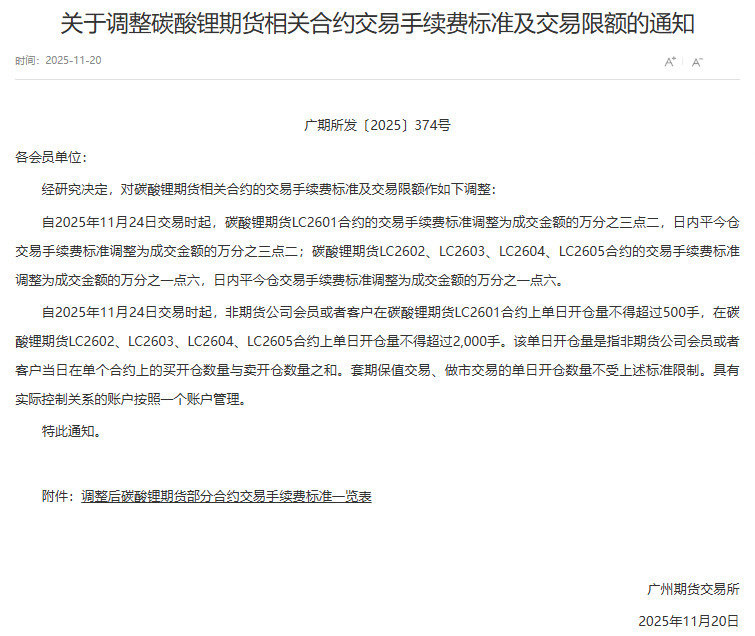
上调手续费,收紧交易限额!事关碳酸锂期货,广期所出手
券商中国· 2025-11-20 14:18
Core Viewpoint - The recent adjustments to trading fees and limits for lithium carbonate futures by the Guangzhou Futures Exchange aim to guide rational market trading, prevent excessive short-term volatility, and enhance market stability [2][3]. Summary by Sections Trading Fee and Limit Adjustments - Starting from November 24, 2025, the trading fee for the lithium carbonate futures contract LC2601 will be adjusted to 0.032% of the transaction amount, while the fees for contracts LC2602, LC2603, LC2604, and LC2605 will be set at 0.016% [3]. - Non-futures company members or clients will have a daily opening limit of 500 lots for LC2601 and 2,000 lots for LC2602, LC2603, LC2604, and LC2605. This limit applies to the total of buy and sell positions in a single contract on the same day [3]. Market Volatility and Demand - The lithium carbonate market has seen increased volatility, with trading activity rising since the futures were launched. The recent fee and limit adjustments are viewed as a necessary rebalancing to curb disorderly speculation and ensure sustainable functionality of the product [4]. - On November 20, lithium carbonate prices rose by 0.84%, reaching 98,980 yuan per ton, with the market experiencing strong performance in Q4 due to supply constraints and unexpected demand, particularly in energy storage and electric vehicles [4]. Future Market Adjustments - Analysts suggest that the Guangzhou Futures Exchange may continue to dynamically optimize related parameters in response to changing market conditions to maintain stable operations in the lithium carbonate futures market [5].
大商所连发通知,限额翻倍加码手续费,焦煤期市投机升温
Sou Hu Cai Jing· 2025-08-15 07:45
Core Viewpoint - The Dalian Commodity Exchange has implemented precise regulatory measures in response to abnormal fluctuations in the coking coal futures market, indicating a strengthened focus on risk prevention in the futures market [1] Regulatory Measures - The exchange has adopted a dual approach of trading limits and fee adjustments. For the JM2601 contract, non-futures company members or clients are limited to a daily opening position of 1,000 lots, while the JM2509 contract is capped at 500 lots, and other coking coal futures contracts are set at a maximum of 2,000 lots. This limit applies to the total of both buying and selling positions for the day, but hedging and market-making trades are exempt from these restrictions [3] - Starting from August 18, the transaction fee for day trading of the JM2601 contract has been increased from 0.01% to 0.02%, effectively doubling the cost. This fee adjustment only applies to day trading, while fees for non-day trading and hedging transactions remain unchanged, reflecting a differentiated treatment of various trading types [3] Market Risk Accumulation - Coking coal futures prices have shown a continuous upward trend since early June, rising from 700 yuan/ton to around 1,300 yuan/ton, with a maximum increase of over 80%. This price increase has been accompanied by a significant influx of capital and heightened speculative activity, with the trading volume ratio of the main contract exceeding 6 on certain trading days, far above normal market levels [4] - The rapid rise in market speculation has drawn regulatory attention. Before late July, the trading volume ratio of JM2509 fluctuated around 2, but it surged above 3 starting July 21, reaching over 6 on July 23 and 24, indicating a strong speculative atmosphere [4] - Following initial regulatory measures on July 25, which limited daily opening positions for JM2509 and other coking coal futures, there was a short-term cooling effect. However, due to supply and demand dynamics, capital began to flow back into coking coal futures in early August, leading to a rapid increase in positions for JM2601 as the delivery month approached [4] Position and Price Trends - The total open interest in coking coal futures has continued to expand, reaching 978,000 lots on August 12, surpassing the previous high of 922,000 lots in late July. On the price front, coking coal futures broke through the late July high on August 12, suggesting potential for further price increases. The ongoing accumulation of market risk and the corresponding increase in regulatory difficulty have prompted the exchange to initiate a second round of stricter regulatory measures [5]

监管精准阻击焦煤期货日内投机交易
21世纪经济报道· 2025-08-14 10:52
Core Viewpoint - The article discusses the recent regulatory measures taken by the Dalian Commodity Exchange to cool down the speculative trading in coking coal futures, particularly focusing on the JM2601 contract, which has seen significant price fluctuations and increased trading activity [1][3]. Regulatory Measures - On August 13, the Dalian Commodity Exchange announced adjustments to trading limits and increased transaction fees for the JM2601 contract, raising the day trading fee from 0.01% to 0.02% [3][10]. - This is the second round of regulatory measures following the first round on July 25, aimed at managing the heightened speculative trading activity observed since early June [3][5]. Market Dynamics - Coking coal futures prices surged from 700 yuan/ton to around 1300 yuan/ton since June, marking an increase of over 80% [3]. - The total open interest in coking coal futures exceeded the previous high in late July, indicating increased market participation and speculation [3][7]. Speculative Trading Concerns - The trading volume and open interest for JM2601 increased significantly, with open interest rising from 428,000 contracts on August 1 to 719,000 contracts by August 12 [6]. - The trading ratio, a measure of speculative activity, was noted to be around 3 on August 12, which is lower than the levels observed before the first round of regulation [6][7]. Impact of Regulatory Changes - The increase in transaction fees is expected to reduce the attractiveness of day trading in JM2601, as the cost of trading has effectively doubled, impacting potential profits and losses for traders [10]. - For instance, with a closing price of 1214 yuan/ton, the transaction cost for a single contract (60 tons) increased from approximately 7.28 yuan to 14.57 yuan, significantly affecting the profitability of trades [10]. Future Implications - The new fee structure is set to take effect from August 18, which may lead to a noticeable impact on trading volumes in coking coal futures [11]. - The stability of JM2601 is crucial for the overall pricing of coking coal futures, as it is the most actively traded contract in the market [11].
监管精准阻击焦煤期货日内投机交易
2 1 Shi Ji Jing Ji Bao Dao· 2025-08-14 09:34
Core Viewpoint - The recent regulatory measures by the exchange have effectively cooled down the heated trading in coking coal futures, following significant price increases and heightened speculative activity [2][4][6]. Group 1: Regulatory Actions - As of August 14, coking coal futures experienced a collective decline, with several contracts, including JM2601, dropping over 6% [2]. - The Dalian Commodity Exchange announced adjustments to trading limits and increased transaction fees for day trading of JM2601, raising the fee from 0.01% to 0.02% [2][10]. - This marks the second round of regulatory measures since the first round on July 25, aimed at managing the rapid price increases and speculative trading [3][5]. Group 2: Market Dynamics - Coking coal futures surged from a low of 700 yuan/ton in June to around 1300 yuan/ton, with a maximum increase of over 80% [3]. - The total open interest in coking coal futures exceeded the previous high in late July, indicating increased market activity and risk [4][8]. - The speculative trading ratio for JM2509 rose sharply from around 2 to over 6 in late July, prompting the first round of regulatory actions [5]. Group 3: Impact of Regulatory Measures - The initial regulatory measures had a temporary cooling effect on the market, but trading activity began to rebound in early August due to favorable supply-demand conditions [6]. - By August 12, the open interest for JM2601 increased significantly from 428,000 contracts to 719,000 contracts, indicating a shift in market focus [7]. - The second round of regulations was deemed necessary due to the rising price levels and increased speculative trading, despite the speculative ratio being lower than during the first round [8][12]. Group 4: Changes in Trading Costs - The adjustment in transaction fees for day trading of JM2601 effectively doubles the trading costs, which may deter speculative trading [12][14]. - For example, the transaction fee for a single contract (60 tons) at a closing price of 1214 yuan/ton increased from approximately 7.28 yuan to 14.57 yuan [12]. - The potential profit per price movement decreases significantly post-fee adjustment, which could lead to reduced trading enthusiasm among day traders [13][14].
碳酸锂全线引爆,期货市场或迎调控
21世纪经济报道· 2025-08-11 12:19
Core Viewpoint - The confirmation of the suspension of mining operations at the Jiangxiawo mine by CATL has reignited market sentiment to buy lithium prices, leading to significant increases in lithium futures and related stocks [1][3]. Group 1: Market Reactions - Following the suspension announcement, all lithium carbonate futures contracts, except for the soon-to-be-delivered LC2508, hit the daily limit, with domestic lithium carbonate spot prices and lithium mining stocks also rising sharply, including a more than 20% increase in Ganfeng Lithium's H-shares [1][5]. - The trading volume and speculative activity in lithium carbonate futures have increased, with the trading position ratio of the "old main" LC2509 contract rising from below 1 in late June to 4 times by July 24, before falling back due to exchange regulation [1][3]. Group 2: Supply Dynamics - The suspension of operations at the Jiangxiawo mine is expected to reduce supply by approximately 0.9 million tons per month, as the mine's associated three refining companies have a combined capacity of 100,000 tons [8]. - The mining rights for the Jiangxiawo mine, which began in August 2022, are set to expire in August 2025, indicating that the suspension may not be permanent if the renewal application is approved [3][8]. Group 3: Price Movements - As of August 11, lithium carbonate futures closed with significant gains, with the near-month contract LC2508 rising by 6.53%, while other contracts reached new six-month highs, surpassing 80,000 yuan/ton [5][6]. - The average market price for domestic battery-grade lithium carbonate increased by 2,560 yuan to 74,520 yuan/ton, with other benchmarks also reflecting upward adjustments [5][6]. Group 4: Future Outlook - Despite the recent price increases, there is a divergence in market sentiment regarding future lithium price trends, with some analysts suggesting limited further upside due to potential increases in imports and domestic production from other projects [7][8]. - The trading activity in lithium futures indicates a speculative environment, with the trading position ratio for the new main contract LC2511 rising to approximately 2.8 times, suggesting heightened volatility [9].


商品期货来了场降温“及时雨” 多个品种深度回调
Zheng Quan Shi Bao· 2025-08-08 07:27
Group 1 - The domestic futures market is experiencing a significant cooling trend, with major commodities like glass and silicon iron hitting their daily limit down, and the photovoltaic industry chain undergoing deep adjustments [1][2][3] - On July 30, the Federal Reserve decided to maintain the benchmark interest rate at 4.25% to 4.50%, which has led to a decrease in investor expectations for a rate cut in September, impacting global commodity markets [2][3] - The Wenhua Commodity Index dropped nearly 1.5% on July 31, with many popular commodities experiencing declines of over 6%, including焦煤 (coking coal), glass, and pure soda [2][3] Group 2 - The photovoltaic industry chain, particularly polysilicon, has seen a significant withdrawal of long positions, with polysilicon contracts nearing limit down, closing down 7.81% at 49,130 yuan/ton on July 31 [4][6] - The supply side for焦煤 (coking coal) is stabilizing, with upstream coal mine inventories returning to reasonable levels, while demand remains strong despite production losses at coking enterprises [3][4] - The overall global photovoltaic industry chain is facing deep adjustments since 2025, with polysilicon production rates at historical lows of 30% to 40%, leading to improved supply dynamics [6]
郑商所调整部分期货手续费 夜盘相关品种反弹
Huan Qiu Wang· 2025-07-30 03:27
Group 1 - Zhengzhou Commodity Exchange announced adjustments to futures contract transaction fees effective from July 30, 2025, including specific fees for glass, soda ash, and caustic soda futures [1] - Following the announcement, there was a notable rebound in previously declining futures, with coking coal rising over 6%, glass over 4%, and coking coal over 4% [3] - The overall trading volume in the futures market decreased significantly, with a 31.89% drop to 38.76 million contracts and a 23.45% decrease in trading value to 32,125.7 billion yuan, marking the lowest levels since July 21 [3] Group 2 - Glass and soda ash remained among the top traded products, but both experienced significant declines in trading volume, with decreases of 26.3% and 32.5% respectively [3] - Coking coal trading volume fell by nearly 40%, dropping to 2.96 million contracts, while other products like red dates, stainless steel, apples, and eggs saw trading volume declines exceeding 60% [3] - There was a net outflow of funds from glass and soda ash, amounting to 221 million yuan and 102 million yuan respectively, with a reduction in open positions for glass by 26,700 contracts and for soda ash by 41,500 contracts [3]