
数据要素市场化配置改革

Search documents
早新闻|重磅发布,事关城市高质量发展!
Zheng Quan Shi Bao· 2025-08-28 23:23
Macro Trends - The Central Committee and State Council of China released a document on August 28, emphasizing the importance of cities in modernization and quality of life, transitioning urbanization from rapid growth to stable development [1] - By 2030, significant progress is expected in building modern cities, with improvements in policies, living quality, green transformation, safety, cultural appeal, and governance [1] - By 2035, the basic framework of modern cities is anticipated to be established [1] Real Estate Development - The document promotes the construction of "good houses" and complete communities, aiming to meet diverse housing needs through a new real estate development model [2] - It emphasizes enhancing the entire housing lifecycle, including design, construction, maintenance, and service, while promoting safe, comfortable, green, and smart housing [2] - The plan includes the renovation of old urban areas and the integration of population, industry, and transportation in urban planning [2] Data Industry Policies - The National Data Bureau announced plans to introduce several industry policies, including data property rights and digital industry clusters, to enhance the data market [3] - Key initiatives include improving data infrastructure, strengthening application scenarios, and building a unified national data market [3] - The focus is on leveraging data as a foundational resource and innovation engine to drive economic growth [3] Market Competition Regulation - The State Administration for Market Regulation held a meeting to address market competition order and prevent irrational competition [4] - The meeting highlighted the importance of systematic planning and targeted actions to restore healthy competition in key sectors [4] - Emphasis was placed on law enforcement and creating a long-term governance mechanism to maintain fair competition [4] Company News - The 2025 China Private Enterprises 500 Strong report was released, with JD Group leading at 115.88 billion yuan in revenue, followed by Alibaba at 98.18 billion yuan [5][6] - Notable financial performances include CITIC Securities with a net profit of 13.719 billion yuan, a 29.8% increase year-on-year, and SMIC with a profit of 321 million USD, up 35.6% [7] - Other companies reported varied financial results, with some experiencing significant growth, such as Wanchen Group with a 50,358.8% increase in net profit [7][8]
我国加快建设数据要素统一大市场
Zhong Guo Chan Ye Jing Ji Xin Xi Wang· 2025-08-27 06:23
Group 1: Data Industry Growth - The data industry in China has rapidly grown during the "14th Five-Year Plan" period, with data production expected to reach 41.06 zettabytes by 2024, more than doubling from the end of the "13th Five-Year Plan" [1] - The number of data enterprises in China has exceeded 400,000, and the data industry scale has reached 5.86 trillion yuan, representing a 117% increase from the end of the "13th Five-Year Plan" [1] Group 2: Unified Data Market Development - Significant progress has been made in building a unified data market during the "14th Five-Year Plan," focusing on institutional framework, infrastructure improvement, and industry application [2] - The central government has issued guidelines to establish a basic framework for data market construction, aiming to eliminate fragmented data management [2] Group 3: Data Infrastructure Enhancement - The National Development and Reform Commission has initiated a new round of data-centric digital infrastructure development, enhancing data circulation and computing power supply [3] - The "East Data West Computing" project has made breakthroughs, utilizing green energy resources in western regions to reduce computing costs [3] Group 4: Data Transaction Growth - By July 2025, over 50 data trading institutions are expected to be operational, with transaction volumes projected to exceed 300 billion yuan, marking a significant quality leap in data trading [4] Group 5: Data Productivity Activation - Companies like Shenzhen Buke Electric Co. have achieved substantial improvements in production efficiency and reduced manufacturing cycles through digital transformation initiatives [5] Group 6: Challenges in Data Market - The data market in China is still in its early stages, facing challenges in data rights confirmation, pricing, and circulation, which hinder the transformation of data from "resource" to "asset" [7] - Issues such as the lack of a national standard for data rights registration and significant differences in local regulations are prevalent [7] Group 7: Future Directions - Continuous efforts are needed in institutional innovation, technological breakthroughs, and ecosystem building during the "15th Five-Year Plan" [8] - Key areas for development include establishing data rights management, advancing privacy computing and blockchain technologies, and fostering specialized data service providers [8]

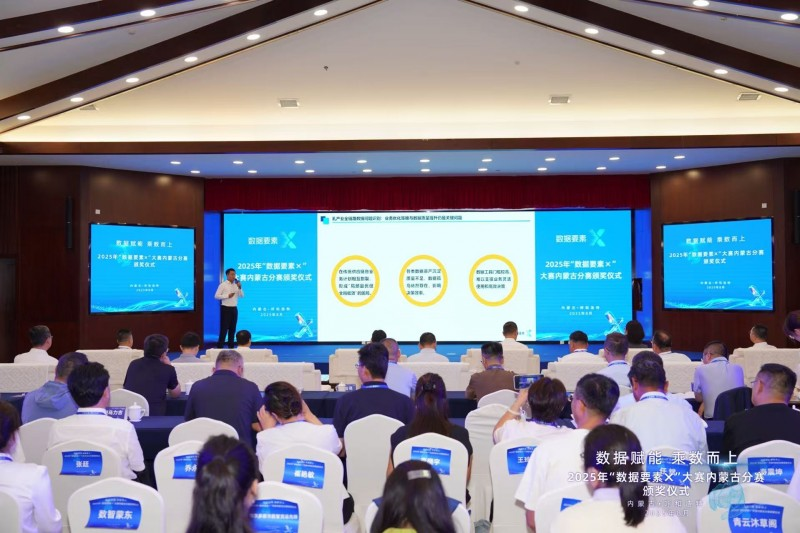
2025年“数据要素×”大赛内蒙古分赛颁奖仪式举行
Xin Hua Cai Jing· 2025-08-22 04:18
Group 1 - The 2025 "Data Element ×" competition's Inner Mongolia division award ceremony was held in Hohhot, attended by over 200 representatives from various sectors [1] - The competition, organized by the National Data Bureau and 20 other departments, focuses on the development and application of data elements, featuring both national finals and local divisions [2] - The Inner Mongolia division attracted 329 teams since its launch in June, with 61 teams advancing to the finals after evaluation by 65 experts [2] Group 2 - Three first-prize projects were showcased during the award ceremony, including initiatives aimed at enhancing the dairy industry and smart logistics [2] - The competition's theme, "Data Empowerment Multiplier," aligns with the national "Data Element ×" three-year action plan (2024-2026) and includes 14 specialized tracks [2] - The event marks a significant step for Inner Mongolia in the market-oriented reform of data element allocation, aiming to foster a data element market ecosystem and promote high-quality regional economic development [3]

大同:“算”出一片新天地
Sou Hu Cai Jing· 2025-08-22 03:39
Core Viewpoint - Datong City is leveraging its geographical, climatic, and energy advantages to develop its computing power industry, aiming to transform from a resource-based economy to a data-driven economy, with significant investments and strategic planning in place to support this transition [6][8][11]. Group 1: Industry Development - Datong has been recognized as one of the seven national-level data labeling bases, ranking third in the country for urban computing power index, highlighting its growing significance in the AI industry [6]. - The city has established a comprehensive computing power ecosystem, covering hardware manufacturing, data center construction, cloud services, and data applications, creating a closed-loop system [11]. - Since the establishment of the Qinhuai Energy Information Technology Industrial Base in 2018, Datong has attracted major projects, with total investments in computing power centers exceeding 28.2 billion yuan, and over 736,000 servers operational [11][13]. Group 2: Infrastructure and Technological Innovation - Datong's computing power industry is supported by advanced infrastructure, including two high-end server production lines with an annual capacity exceeding 100,000 units, and a national-level data labeling base leading the way in data services [13]. - The city has been recognized for its green computing initiatives, with innovations such as "waterless cooling" technology that reduces energy consumption significantly [11][14]. - Datong's computing power centers are designed to utilize renewable energy, with over 56% of its total power capacity coming from renewable sources, aiming for over 60% by 2027 [18]. Group 3: Strategic Planning and Future Outlook - The local government has implemented a three-year action plan for data industry development, focusing on integrating computing power with data and industry applications to enhance economic growth [21][22]. - Datong aims to create a multi-layered computing power supply system and explore cross-regional computing power scheduling, contributing to the national integrated computing power network [22]. - The city is committed to fostering a collaborative ecosystem involving government, academia, and industry to cultivate data talent, with plans to train at least 3,000 data professionals annually [15].



湖南省气象数据分析与共享平台上线试运行
Ren Min Wang· 2025-08-21 09:22
Core Insights - The Hunan Meteorological Information Center has launched a meteorological data analysis and sharing platform, marking a significant transition from "decentralized management" to "centralized operation" in meteorological data governance [1][2] - The platform aims to enhance the province's disaster prevention capabilities and support high-quality regional development, contributing to the national meteorological industry's data element marketization reform [1][2] - The platform has already demonstrated strong service capabilities by optimizing radar data interfaces and integrating with the Hunan Weather APP, reducing the load on the APP's DMZ area by 30% on its first day of operation [1][2] Data Ecosystem and Security - The platform integrates data warehouse theory with meteorological business characteristics, establishing a new data ecosystem centered on "safety as the foundation, service as the core" [2] - It features a multi-level data resource pool that categorizes meteorological data by type, business scenario, and security level, ensuring data is manageable, controllable, and traceable [2] - The platform's architecture enhances the accuracy of data support for extreme weather events and significantly improves disaster prevention capabilities [2] Future Developments - The Hunan Meteorological Information Center plans to continuously improve the platform's functionality and develop new interfaces, transitioning existing services to the new platform [3] - There are plans to integrate with the second phase of the regulatory platform project to enhance data traceability and management [3]
算力总规模全球第二,数字中国建设取得显著成就
Ren Min Ri Bao· 2025-08-19 11:16
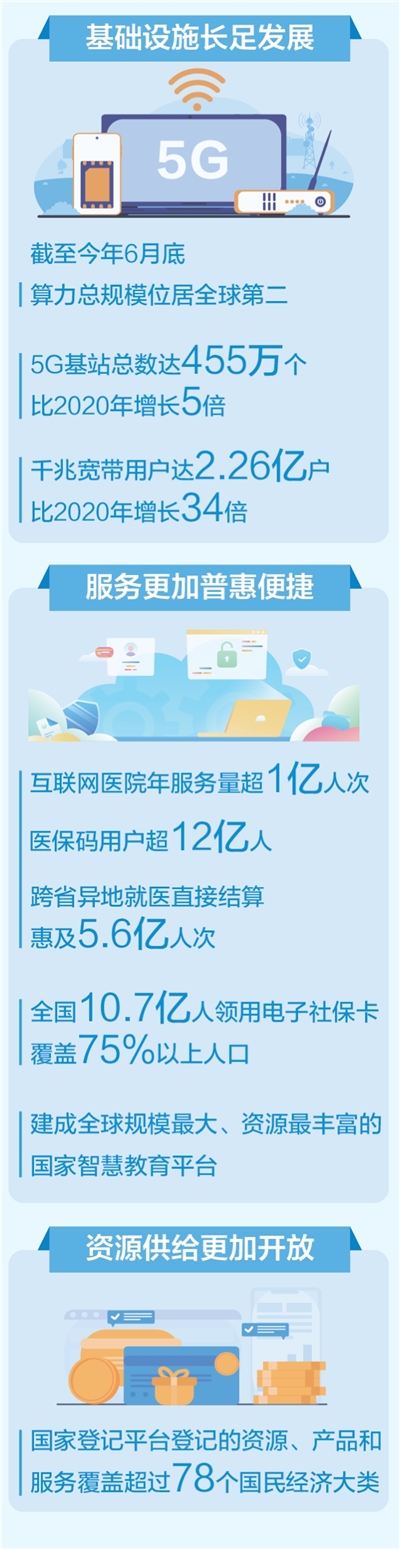
Group 1 - The core viewpoint emphasizes China's commitment to digital transformation, leveraging opportunities in digitalization, networking, and intelligence during the 14th Five-Year Plan period [1] - As of June 2023, China has established a leading position in digital infrastructure, with 4.55 million 5G base stations and 226 million gigabit broadband users, ranking second globally in total computing power [1] - The number of internet users in China has reached 1.123 billion, with an internet penetration rate of 79.7%, indicating a significant expansion of digital services [2] Group 2 - Digital services have become more accessible, with over 1 billion people using electronic social security cards, covering more than 75% of the population [2] - The national internet hospitals have served over 100 million people annually, and the cross-province medical insurance settlement has benefited 560 million instances [2] - The digital education platform in China is the largest globally, and digital elderly care services have seen positive outcomes with the launch of a national elderly care information platform [2] Group 3 - Social governance has become more precise and efficient, with the "one network for all services" initiative enhancing public service accessibility and inter-departmental data sharing [3] - The national data bureau aims to leverage data elements to promote digital transformation in public services, digital life, and social governance [3] Group 4 - Data application scenarios are expanding, with 70 demonstration scenarios covering key sectors such as agriculture and healthcare [4] - The construction of high-quality data sets has exceeded 35,000, with ongoing efforts to enhance data resource management and utilization [5][6] Group 5 - The data market is evolving, with a 70% year-on-year increase in new data products launched in the first half of the year, totaling 3,328 products [7] - The supply of high-quality data sets in the artificial intelligence sector has surged by 280% year-on-year [7] - The national data infrastructure construction is in its early stages, focusing on high-quality standards and large-scale deployment to support digital economy development [8]
市场化改革打出“组合拳” 数据要素价值加速释放
Jing Ji Wang· 2025-08-15 03:06
Core Viewpoint - The data industry is emerging as a new growth point in the digital economy, with a projected scale of 5.86 trillion yuan in 2024, representing a 117% increase compared to the end of the 13th Five-Year Plan, and is expected to maintain high growth in the coming years [1][2]. Group 1: Data Industry Growth - The number of data enterprises in China is expected to exceed 400,000 by 2024, with significant growth in the data industry scale [2]. - The data industry chain is rapidly forming, with innovations in data services such as "data as a service" and "knowledge as a service" [2]. - Average R&D investment by listed data companies is projected to increase by 79% compared to the end of the 13th Five-Year Plan, with an annual growth rate of 15.7% [2]. Group 2: Policy and Infrastructure Development - The government is systematically promoting the market-oriented allocation of data elements through a series of policy measures, including the introduction of over 10 new systems related to data property rights [2][4]. - The construction of national data infrastructure is emphasized to facilitate data sharing and enhance the value of data [4][5]. - By the end of this year, the number of node cities for data infrastructure is expected to expand to around 50, covering 80% of provinces, laying the foundation for large-scale cross-regional data flow [4]. Group 3: Market Dynamics and Applications - The data market is witnessing a surge in data products, with a 70% year-on-year increase in new data products launched by major data trading institutions in the first half of this year [6]. - Data elements are increasingly empowering various industries, with notable improvements in agricultural yield and industrial decision-making efficiency [6]. - The establishment of nearly 500 new digital technology companies by central enterprises reflects the growing ecosystem of the data market [6].
权威发布·高质量完成“十四五”规划丨数字中国建设取得显著成就
Ren Min Ri Bao· 2025-08-15 00:35
Group 1: Digital Infrastructure and Development - China's digital infrastructure is leading globally in scale and technology, with 4.55 million 5G base stations and 226 million gigabit broadband users as of June 2023 [1] - The total computing power ranks second in the world, significantly driving economic and social development [1] Group 2: Digital Services and Public Welfare - The number of internet users in China has reached 1.123 billion, with an internet penetration rate of 79.7%, enhancing public services [2] - Over 1 billion people have used internet hospitals, and 1.2 billion users have accessed medical insurance codes, facilitating cross-province medical settlements for 560 million instances [2] - The digital social security system has expanded, with 1.07 billion people using electronic social security cards, covering over 75% of the population [2] Group 3: Social Governance and Efficiency - The "One Network for All Services" initiative is improving government service efficiency, enhancing public service accessibility and cross-departmental data sharing [3] - Smart governance applications, such as natural disaster early warning systems, are being implemented to improve urban management [3] Group 4: Data Application and Market Growth - The number of new data products launched by major data trading institutions increased by 70% in the first half of the year, with 3,328 new products [6] - High-quality data set products in the artificial intelligence sector saw a 2.8 times increase year-on-year [6] - The establishment of 70 demonstration scenarios across various sectors, including agriculture and healthcare, showcases the growing application of data [4] Group 5: Data Infrastructure and Future Plans - The construction of national data infrastructure is in its early stages, focusing on high-quality standards and large-scale deployment [7] - The government aims to create a convenient, efficient, and world-leading national data infrastructure to support digital economic development and innovation [7]
数字中国建设取得显著成就(权威发布·高质量完成“十四五”规划)
Ren Min Ri Bao· 2025-08-14 22:10
Core Insights - China's digital infrastructure has achieved significant advancements, positioning itself as a global leader in scale and technology, particularly in the context of the "14th Five-Year Plan" [6][11] Group 1: Digital Infrastructure Development - As of June 2023, China has established 4.55 million 5G base stations, a fivefold increase since 2020 [2][6] - The total scale of computing power ranks second globally, with 226 million gigabit broadband users, representing a 34-fold increase since 2020 [2][6] Group 2: Digital Services Accessibility - Over 1 billion annual services are provided by internet hospitals, with more than 1.2 billion users of medical insurance codes [4][7] - Cross-province direct settlement for medical services benefits 560 million people, while 1.07 billion people have adopted electronic social security cards [4][7] Group 3: Social Governance and Efficiency - The "One Network for All Services" initiative is enhancing the efficiency of public services, with improved data sharing across departments [8] - Smart governance applications, such as intelligent disaster warnings, are being implemented to enhance urban management [8] Group 4: Data Application and Market Growth - The number of new data products launched in the first half of the year increased by 70%, with a notable rise in high-quality datasets for artificial intelligence [11][12] - A total of 70 demonstration scenarios have been established across key sectors like agriculture and healthcare, showcasing the practical applications of data [9][10] Group 5: Future Directions - The National Data Bureau aims to continue building high-quality data sets and enhance the infrastructure to support digital economic development and innovation [10][13]
算力总规模全球第二 数字服务普惠便捷 数据市场快速成长 数字中国建设取得显著成就
Ren Min Ri Bao· 2025-08-14 21:51
Group 1: Digital Infrastructure and Development - China's digital infrastructure is leading globally in scale and technology, with 4.55 million 5G base stations and 226 million gigabit broadband users as of June 2023 [1] - The total computing power ranks second in the world, significantly driving economic and social development [1] Group 2: Digital Services and Public Welfare - The number of internet users in China has reached 1.123 billion, with an internet penetration rate of 79.7%, enhancing public services [2] - Over 1 billion people have used internet hospitals, and more than 1.2 billion users have accessed health insurance codes, facilitating cross-province medical settlements for 560 million instances [2] - 1.07 billion people have adopted electronic social security cards, covering over 75% of the population [2] Group 3: Social Governance and Efficiency - The "One Network for All Services" initiative is improving the convenience of public services, with enhanced data sharing across departments [3] - Smart governance applications, such as natural disaster early warning systems, are being effectively implemented [3] Group 4: Data Application and Market Growth - The number of new data products launched by major data trading institutions reached 3,328 in the first half of the year, a 70% increase year-on-year [7] - High-quality data set products in the artificial intelligence sector saw a 2.8 times increase in the same period [7] - The construction of national data infrastructure is underway, focusing on high-quality standards and large-scale deployment [8]