爱国主义

Search documents
学习新语·抗战丨烽火乱世 弦歌不辍
Xin Hua She· 2025-08-18 04:22
Core Points - The article highlights the historical significance of the National Southwest Associated University (NSAU) during the Anti-Japanese War, emphasizing its role in preserving Chinese education and culture amidst national crisis [3][8][18] - It reflects on the legacy of NSAU, which produced numerous influential scholars and contributed significantly to China's higher education history [10][11][18] Group 1: Historical Context - NSAU was established during the Anti-Japanese War to safeguard academic pursuits, with its origins tracing back to the temporary assembly of Peking University, Tsinghua University, and Nankai University [8][10] - The university operated in Kunming from 1938 to 1946, during which it faced severe hardships, including inadequate living conditions and constant threats from enemy bombings [16][18] Group 2: Contributions and Achievements - Over its operational years, NSAU educated more than 8,000 students, including two Nobel laureates and numerous academicians, showcasing its academic excellence [11][12] - The university's alumni played vital roles in various historical periods, contributing to revolutionary, construction, and reform efforts in China [6][11] Group 3: Educational Philosophy - The article underscores the importance of linking education with national destiny and the spirit of patriotism, as emphasized by President Xi Jinping during his visit to the NSAU site [20] - It suggests that challenging environments can foster talent and that the current educational goals should focus on nurturing responsible and ambitious individuals for the future [20]


【铭记历史 缅怀先烈·抗战中的文艺】《黄河大合唱》民族危亡的怒吼
Yang Shi Wang· 2025-08-17 11:42
Core Viewpoint - The article highlights the significance of the song "Yellow River Cantata" as a powerful symbol of national spirit and unity during the Chinese People's War of Resistance against Japan and the global anti-fascist struggle, marking its 80th anniversary since its premiere in Yan'an [1][2]. Group 1 - The song "Yellow River Cantata" was created in response to the dire circumstances faced by the Chinese people during the war, with poet Guang Weiran and composer Xian Xinghai playing pivotal roles in its development [1]. - The composition consists of eight movements, using the Yellow River as a metaphor for the fate of the nation, and serves as a strong voice for the Chinese Communist Party's leadership in defending the country [1]. - Since its premiere in 1939, "Yellow River Cantata" has been continuously adapted and rearranged, transcending its original artistic context to become a core vehicle for patriotic education and the transmission of national spirit [2]. Group 2 - The song's grandeur and profound meaning continue to resonate with listeners, establishing it as a remarkable treasure in the global anti-fascist music repertoire [2].
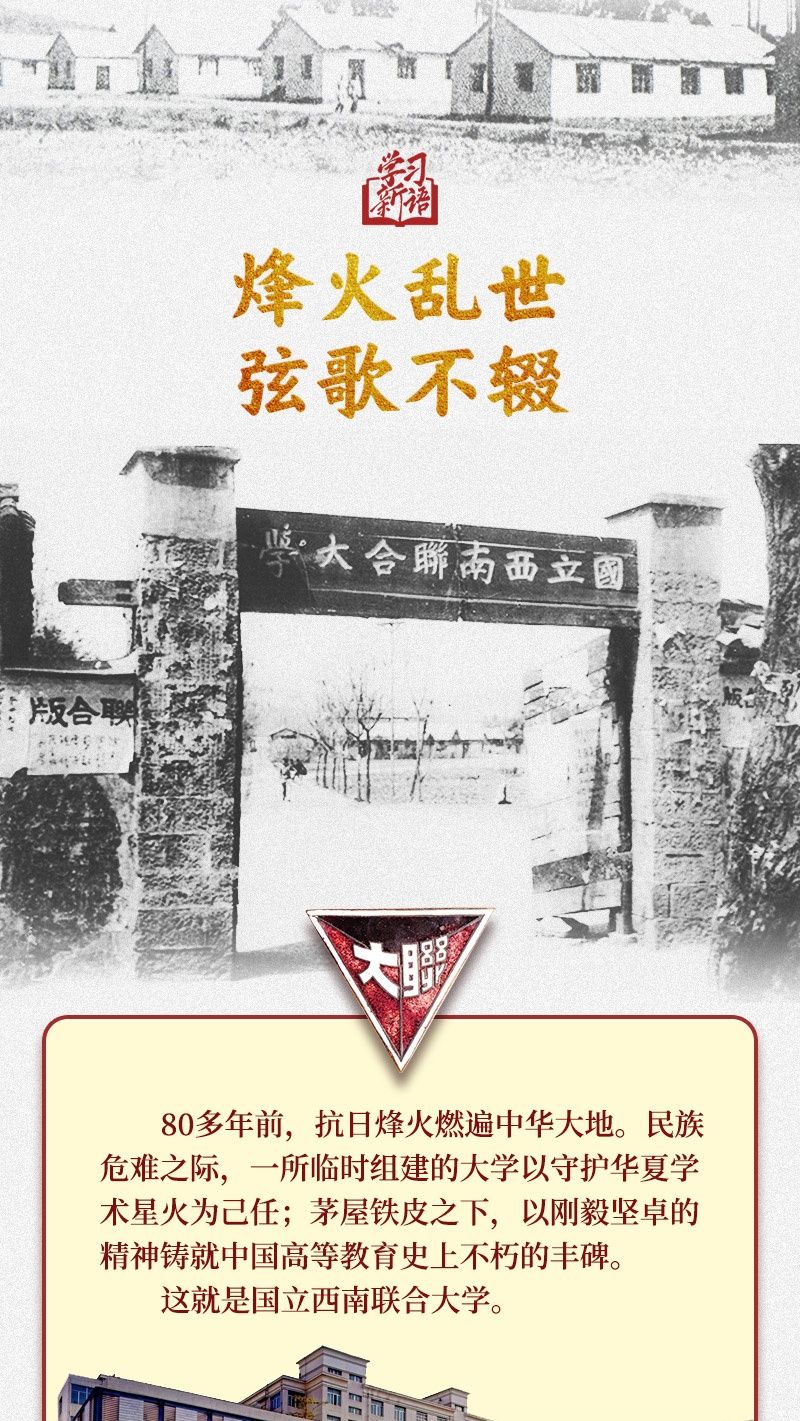
学习新语·抗战|烽火乱世 弦歌不辍
Xin Hua She· 2025-08-17 04:39
Core Viewpoint - The article highlights the historical significance and enduring legacy of the National Southwest Associated University (NSAU) during the Anti-Japanese War, emphasizing its role in preserving Chinese education and culture amidst adversity [3][10][19]. Group 1: Historical Context - Over 80 years ago, during a time of national crisis, NSAU was established to safeguard Chinese academic heritage [3]. - Following the outbreak of the Anti-Japanese War in 1937, several prestigious universities relocated to form NSAU in Kunming, Yunnan [8][19]. - NSAU operated under challenging conditions, with makeshift facilities and limited resources, yet it became a beacon of hope and education [10][17]. Group 2: Contributions and Achievements - During its eight years in Kunming, NSAU educated over 8,000 students, producing two Nobel laureates and over 170 academicians [11][13]. - The university's alumni played significant roles in various historical periods, contributing to revolutionary and reformative efforts in China [6][21]. - Many students from NSAU participated in the war effort, with 834 students commemorated for their sacrifices during the Anti-Japanese War [15][19]. Group 3: Educational Philosophy and Legacy - The spirit of NSAU is characterized by patriotism and resilience, which has become a cornerstone of its educational philosophy [19][21]. - The environment of hardship fostered a strong sense of responsibility and ambition among students, aligning education with national destiny [21]. - The legacy of NSAU serves as a permanent monument in the history of Chinese higher education, symbolizing the triumph of spirit over adversity [19][21].
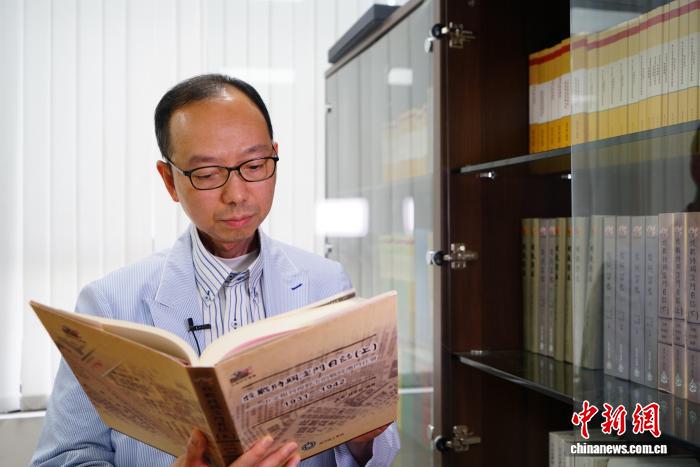
三代学者10年通力合作 150余万字记录艰苦卓绝 《上海抗日战争史》书展首发
Jie Fang Ri Bao· 2025-08-16 02:05
Core Viewpoint - The newly released three-volume work "History of the Shanghai Anti-Japanese War" serves as a significant historical account of the 14-year struggle for national independence and liberation, commemorating the sacrifices of countless patriots during the Shanghai anti-Japanese efforts [1] Group 1 - The book was launched at the Shanghai Exhibition Center, with a video message from 94-year-old historian Yu Zidao, emphasizing the importance of remembering the spirit of the Shanghai people during the war [1] - The book consists of over 1.5 million words and represents a decade of effort by three generations of historians, highlighting Shanghai's crucial role in both the Chinese and global anti-fascist movements [2] - The work provides a comprehensive view of the Shanghai anti-Japanese struggle, revealing the significant losses inflicted by Japanese military aggression, economic exploitation, and cultural invasion [2] Group 2 - The book's launch attracted significant interest, with many readers specifically attending to purchase it, reflecting the historical importance of this period for the city [3] - Other anti-war themed publications were also launched at the Shanghai Book Fair, indicating a broader interest in historical narratives related to the anti-Japanese war [3]
百岁抗战老兵郭水清:“明知道会牺牲,我们也不怕”
Xin Hua She· 2025-08-15 13:34
Core Viewpoint - The article highlights the life and contributions of Guo Shuiqing, a centenarian veteran who participated in the anti-Japanese war and emphasizes the importance of patriotism and the Communist Party in achieving a better life for the people [2][5][6]. Group 1: Personal Background and Historical Context - Guo Shuiqing was born into a poor farming family in Tianliao Village and became involved in anti-Japanese activities at a young age, joining the anti-Japanese guerrilla forces in 1943 [2][5]. - He recalls the sacrifices of his comrades during the war and his own close encounters with death, showcasing his bravery and commitment to the cause [3][5]. Group 2: Legacy and Current Activities - Guo Shuiqing is seen as a role model in his family, instilling values of love for the country and the importance of peace [5]. - After retirement, he actively engages in revolutionary tradition and patriotism education, often returning to his birthplace to share his experiences with visitors [5][6]. - He remains healthy and engaged with current affairs, valuing the honors he has received from the state as his most treasured possessions [6].
铭记历史 缅怀先烈·抗战歌曲丨再访鲁艺,那些嘹亮的抗战歌曲从这里唱响
Xin Hua Wang· 2025-08-14 00:34
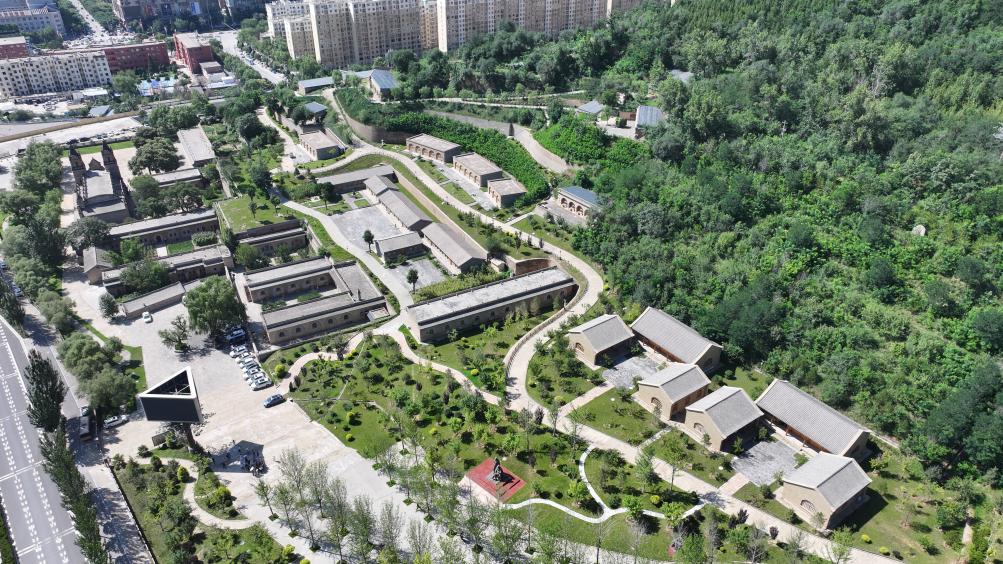
Core Viewpoint - The article highlights the historical significance of the Lu Yi (Luyin) Academy in Yan'an during the Anti-Japanese War, emphasizing its role as a cultural center that produced iconic patriotic songs that inspired the Chinese people [1][3][4]. Group 1: Historical Context - The Lu Yi Academy was established in 1938 in Yan'an, serving as a hub for artistic talent during the Anti-Japanese War, where notable musicians and artists like Xian Xinghai and Lu Ji gathered [3][4]. - The academy was pivotal in creating classic anti-war songs such as "Ode to Yan'an," "March of the Eighth Route Army," and "Yellow River Cantata," which resonated throughout the nation [3][4][8]. Group 2: Cultural Impact - The songs produced during this period were described as "torches that illuminate the heart" and played a crucial role in uniting the people against foreign aggression [3][4]. - The Lu Yi Academy became known as the center of music talent in the Anti-Japanese base areas, significantly contributing to the morale and unity of the Chinese people during the war [4][8]. Group 3: Legacy and Modern Relevance - The Yan'an Literary Memorial Hall now showcases artifacts and photographs from that era, preserving the legacy of the artists and their contributions to Chinese culture [6][11]. - The site attracts approximately 540,000 visitors annually, reflecting its ongoing significance as a cultural and historical landmark [9][11]. - Recent initiatives include the establishment of the Yan'an Printmaking Art Center and various exhibitions that promote patriotic education and the spirit of Yan'an [11].
香港各界纪念抗战胜利80周年大型图片及书画展开幕
Xin Hua She· 2025-08-13 15:18
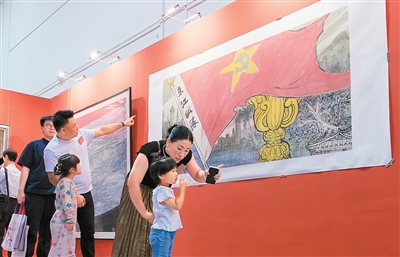
Core Viewpoint - The exhibition titled "Memory of Flames: Ink and Brush on Mountains and Rivers" commemorates the 80th anniversary of the victory in the Anti-Japanese War, showcasing nearly 80 artworks and 70 historical photographs to honor the sacrifices made during the war [1] Group 1: Exhibition Details - The exhibition is divided into two parts: calligraphy and painting, and historical photographs [1] - Over 70 renowned artists contributed to the exhibition, depicting scenes of soldiers in battle, civilians supporting the front lines, and the devastation of cities under air raids [1] - The historical photographs span from the September 18 Incident in 1931 to the victory in 1945, vividly illustrating the hardships and glory of the Anti-Japanese War [1] Group 2: Government and Organizational Support - The Secretary for Culture, Sports and Tourism of the Hong Kong SAR Government, Luo Shupei, emphasized the importance of remembering history and promoting patriotism through a series of commemorative activities [1] - The Chairman of the Hong Kong Cultural Promotion Association, Tu Huilong, stated that the exhibition aims to promote the great national spirit and enhance national identity and cultural confidence among the youth [1] - The exhibition is organized by the Hong Kong Cultural Promotion Association, with guidance from various government departments [1]
香港举办“铭记历史 珍爱和平”名家名作展
Ren Min Ri Bao Hai Wai Ban· 2025-08-06 21:23
Group 1 - The exhibition titled "Remembering History, Cherishing Peace - Commemorating the 80th Anniversary of the Victory of the Chinese People's Anti-Japanese War and the World Anti-Fascist War" opened on August 6 in Hong Kong, showcasing over 200 art pieces that reflect the journey of the Chinese nation from peril to peace [1][2] - The exhibition is divided into six thematic units: "Remembering History," "Commemorating the Martyrs," "Spring Returns to the Earth," "The Country is Ever Strong," "Creating a New World," and "Cherishing Peace," featuring works from renowned artists such as sculptor Wu Weishan and painter Zhang Ding [1] - The event aims to honor the collective memory of the anti-Japanese war and highlight Hong Kong's unique contributions, fostering a sense of patriotism and national identity among the younger generation [1][2] Group 2 - The Hong Kong government's Cultural, Sports and Tourism Bureau has organized a series of exhibitions, lectures, workshops, and field trips to commemorate the 80th anniversary of the victory, emphasizing the city's historical contributions during the war [2] - The exhibition is hosted by the Zijing Cultural Group and co-organized by Zijing Magazine and the China Foreign Cultural Group, running until August 10 [2]
众志成城奋勇抗战的视觉史诗(抗战文艺作品巡礼)
Ren Min Ri Bao· 2025-08-02 22:01
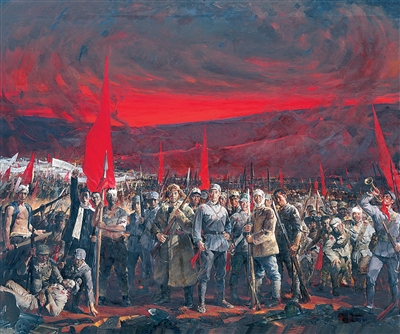
Core Viewpoint - The artwork "Blood and Flesh Great Wall - March of the Volunteers" created by Quan Shanshi and his student Weng Danxian serves as a visual epic that encapsulates the spirit of the "March of the Volunteers," reflecting the indomitable spirit of the Chinese people [2][6]. Group 1: Artistic Creation - Historical painting requires a unique approach that combines artistic language with the creator's understanding and emotions, aiming to achieve artistic truth [2]. - The theme of the artwork was derived from the enduring resonance of the "March of the Volunteers," focusing on the inner strength represented by the song rather than specific historical figures [2][4]. - The artists utilized the imagery of "Blood and Flesh Great Wall" to symbolize the resilient spirit and patriotism of the Chinese people, combining various elements such as characters, the Great Wall, and smoke to create a powerful visual narrative [3][4]. Group 2: Composition Techniques - The creators analyzed classical artworks and adopted a "block" approach to effectively manage the complexity of the composition, grouping different social classes of patriots into cohesive units [4]. - The arrangement of figures, including soldiers and civilians, creates a dynamic visual tension that enhances the theme of unity and strength [4][5]. - The use of light and shadow techniques helped to clarify layers and emphasize the main subjects, while the color scheme, particularly the use of red, symbolizes hope, struggle, and faith [5]. Group 3: Cultural Significance - The integration of music and painting in this artwork allows the powerful melody of the "March of the Volunteers" to resonate, achieving a unity of historical and artistic truth [6]. - The painting continues to convey a strong sense of national spirit and patriotism, inspiring future generations of Chinese people [6].
(抗战胜利80周年)烽烟外的“小城大义”:澳门在抗战中从未缺位
Zhong Guo Xin Wen Wang· 2025-08-02 13:03
Core Viewpoint - Macau played a significant role in supporting the national anti-Japanese war effort despite not being a main battlefield, demonstrating a strong sense of patriotism and community involvement during the period [4][5][6] Group 1: Historical Context - During the anti-Japanese war, Macau's population surged from 150,000 in 1937 to over 400,000 at the peak of the conflict, indicating that the city received nearly double its original population [3] - The influx of refugees led to severe food shortages, resulting in many residents dying from starvation between 1942 and 1944, with "body collection teams" frequently seen transporting corpses [3] Group 2: Community Involvement - Various sectors of Macau society actively participated in the war effort, with initiatives such as the establishment of the "Macau Chinese Relief Association" after the September 18 Incident, which saw widespread donations and support for the anti-Japanese cause [5] - The term "义" (righteousness) became a key theme in Macau, with local residents engaging in charitable acts like "义拉" (righteous transport) and "义卖" (righteous sales) to raise funds for the front lines [5] Group 3: Notable Figures and Contributions - Several notable individuals from Macau made significant sacrifices during the war, including Communist Party member Liao Jintao and educator Liang Yanming, both of whom were killed for their anti-Japanese activities [5] - Medical professionals like Dr. Ke Lin played crucial roles in rescuing cultural figures, while local bank manager He Xian negotiated with Japanese forces to alleviate food shortages [5] Group 4: Preservation of History - Macau has preserved various historical sites related to the anti-Japanese war, including the Ye Ting Residence and the Jinghu Hospital Historical Museum, which serve as reminders of the city's contributions [5] - Initiatives such as the "Macau Anti-Japanese War Figures Exhibition" and the upcoming publication of historical materials aim to educate future generations about this important period [5][6]