长三角一体化发展

Search documents
扬州谋划“三张清单”深度对接上海
Xin Hua Ri Bao· 2025-12-04 22:17
Group 1 - The 2025 World Cities Day series of events and the Yangtze River Delta city technology and industry collaborative innovation day were launched in Shanghai, showcasing innovative achievements from several companies, including Jiangsu Yawey Machine Tool Co., Ltd. [1] - The Yangtze River Delta industrial innovation belt, connecting nine cities, achieved a total GDP exceeding 16 trillion yuan last year, accounting for nearly 50% of the Yangtze River Delta region's economic total, making it one of the highest concentrations of innovation in China [1] - Yangzhou officially joined the Yangtze River Delta industrial innovation belt, marking a significant milestone for local enterprises [1] Group 2 - Zhang Jiangli, Chairman of Jiangsu Kunyuan Biotechnology Co., Ltd., expressed that the rapid establishment of the company in Yangzhou, taking only one year from foundation to production, influenced the decision to set up headquarters there [2] - The company has developed a rich product research and development pipeline and recently overcame challenges in early screening for multiple cancers in the digestive tract [2] - Yangzhou has attracted 1,306 projects with investments exceeding 100 million yuan from January to October this year, with 177 projects sourced from Shanghai, Suzhou, Wuxi, and Nanjing, accounting for 13.6% of the total [3]
国务院重要批复!
中国能源报· 2025-12-04 01:31
Core Viewpoint - The article discusses the approval of the "Yangtze River Delta Land Spatial Planning (2023-2035)" by the State Council, emphasizing the need for systematic optimization of land space development and protection, infrastructure support, and coordinated planning implementation to promote sustainable development in the region [2][5]. Group 1: Planning Framework - The "Planning" serves as a national-level land spatial special plan, guiding spatial development and sustainable growth in the Yangtze River Delta, and is based on Xi Jinping's thoughts and the principles of the 20th National Congress of the Communist Party of China [2][3]. - The planning aims to integrate development and security, promote harmony between humans and nature, and support the construction of a world-class urban agglomeration [2][3]. Group 2: Safety and Environmental Protection - By 2035, the region's arable land must not be less than 16.148 million acres, with permanent basic farmland protection of at least 14.29 million acres, and ecological protection red line covering no less than 77,000 square kilometers [3]. - The plan includes identifying key areas for natural disaster risk prevention and establishing control lines for geological disasters and floods [3]. Group 3: Spatial Development Strategy - The plan emphasizes optimizing the spatial layout led by metropolitan areas, enhancing the integration of urban spaces, and supporting the construction of a world-class city cluster [4]. - It aims to strengthen cross-regional collaboration in technological and industrial innovation, ensuring the spatial needs of key innovation corridors and ecological economic belts are met [4]. Group 4: Implementation and Governance - The planning document is a comprehensive arrangement for land space protection, development, utilization, and restoration, requiring strict adherence and monitoring [5][6]. - Local governments are tasked with organizing leadership, clarifying responsibilities, and integrating the planning goals into local spatial planning systems [6].


靖江:人大深度调研助力描绘港城发展新蓝图
Xin Hua Ri Bao· 2025-12-03 21:57
潮涌长江口,奋进正当时。靖江市人大常委会通过这次深度调研,不仅履行了法定职责,更展现了服务 发展的担当作为。随着调研成果的持续转化和应用,一幅以"大船大港大枢纽"为硬核支撑的靖江发展新 图景正在加速绘就。 鞠涛 系统谋划,确保调研实效。靖江市人大常委会成立专题调研组,邀请五级人大代表参与,深入市政府相 关部门、开发区、港口船舶企业及行业专家,广泛听取意见建议。调研组通过深入审视靖江在长三角一 体化发展等国家战略中的定位,系统借鉴上海洋山港、宁波舟山港、太仓港、江阴港等先进港口的发展 经验,精准锁定靖江在港口能级、产业支撑、城市配套与跨江联动等方面的优势与短板,为对症下药、 精准施策奠定坚实基础。今年5月—11月,先后召开专题调研座谈会和审稿会,累计吸纳数十条建议, 确保调研报告数据翔实、分析透彻、建议可行。 硕果盈枝,赋能规划编制。深入扎实的调研,最终凝结为一份系统全面的《关于实施"大船大港大枢 纽"战略的调研报告》,报告建议将"大船大港大枢纽"建设作为靖江未来发展的核心战略,将打造"世界 船都、枢纽港口、魅力港城"作为总体目标,并提出分阶段发展步骤设想,为"十五五"规划确定相关领 域的发展方向、目标任务提供 ...
利好来了!刚刚,国家重磅发布
Zhong Guo Ji Jin Bao· 2025-12-03 13:10
Core Viewpoint - The State Council has approved the "Yangtze River Delta Land Space Planning (2023-2035)", which serves as a national-level land space special plan and a sustainable development blueprint for the Yangtze River Delta region, guiding various development, protection, and construction activities [3][4]. Group 1: Key Objectives and Guidelines - By 2035, the Yangtze River Delta will maintain a cultivated land area of no less than 16.148 million acres, with permanent basic farmland protection of at least 14.290 million acres, and ecological protection red line covering no less than 77,000 square kilometers [4][7]. - The plan emphasizes the need to implement the Yangtze River Delta integration development strategy, aiming to build a world-class urban agglomeration and support the region's leadership in China's modernization efforts [3][6]. Group 2: Spatial Development and Coordination - The plan outlines the optimization of a spatial pattern led by metropolitan areas, supporting Shanghai's leading role and enhancing spatial integration with surrounding urban areas such as Suzhou, Wuxi, Changzhou, Nanjing, Hangzhou, Hefei, and Ningbo [4][8]. - It highlights the importance of cross-regional collaboration in technological and industrial innovation, ensuring the spatial needs of key innovation corridors and traditional industry upgrades are met [4][8]. Group 3: Safety and Environmental Considerations - The plan identifies key areas for natural disaster risk prevention, establishing control lines for geological disasters and floods, and ensuring the protection of strategic mineral resources and cultural heritage [4][7]. - It aims to enhance the resilience of land space safety, improve emergency food supply layouts, and promote coordinated disaster prevention and reduction infrastructure [8][10]. Group 4: Implementation and Governance - The plan mandates strict adherence to its guidelines, with local governments required to integrate its objectives into their land space planning and ensure compliance with the established framework [9][10]. - A monitoring and evaluation mechanism will be established to assess the implementation of the plan, ensuring that significant matters are reported promptly to higher authorities [10][11].

事关长三角空间发展 重磅文件来了!
Zhong Guo Ji Jin Bao· 2025-12-03 13:03
Core Viewpoint - The State Council has approved the "Yangtze River Delta Land Spatial Planning (2023-2035)", which serves as a national-level guideline for spatial development and sustainable growth in the Yangtze River Delta region, aiming to support the integrated development strategy and establish a world-class urban agglomeration [3][5]. Summary by Sections Spatial Development Goals - By 2035, the Yangtze River Delta will maintain a cultivated land area of no less than 16.148 million acres, with permanent basic farmland protection of at least 14.290 million acres and ecological protection redline of no less than 77,000 square kilometers [3][6]. - Total water usage must not exceed the national targets set [3][6]. Risk Management and Safety - The plan identifies key areas for natural disaster risk prevention, including geological hazards and flooding, and establishes safety zones for strategic mineral resources and cultural heritage [3][6]. Urban and Regional Coordination - The spatial layout will be optimized with urban agglomerations leading the way, enhancing the integration of the Shanghai metropolitan area with surrounding urban clusters such as Suzhou, Wuxi, Changzhou, Nanjing, Hangzhou, Hefei, and Ningbo [3][7]. - The plan emphasizes cross-regional collaboration in technological and industrial innovation, particularly in the G60 Science and Technology Corridor and along the Hu-Ning industrial innovation belt [3][7]. Marine and Coastal Development - The spatial structure will be improved to promote coordinated development of coastal areas, enhancing port and shipping functions, and rationally utilizing deep-sea spaces to unlock marine development potential [4][8]. Implementation and Governance - The planning document is a comprehensive framework for land use, protection, and restoration in the Yangtze River Delta, requiring strict adherence and regular assessments to ensure compliance [5][9]. - Local governments are tasked with leadership and coordination to integrate the planning goals into their respective land use strategies, ensuring a unified spatial planning system [9].
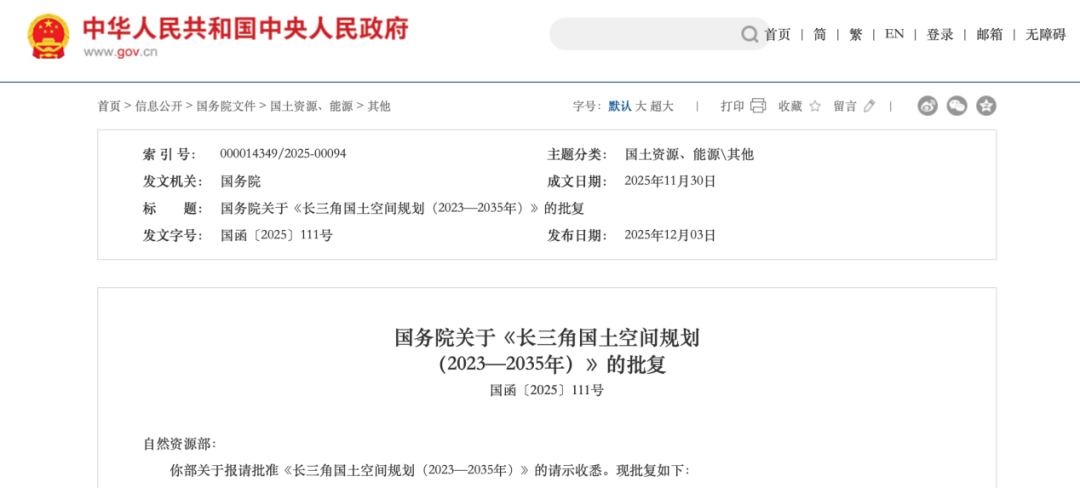
国务院批复:原则同意
证券时报· 2025-12-03 11:58
Core Viewpoint - The State Council has approved the "Yangtze River Delta Land Space Planning (2023-2035)", emphasizing sustainable development and high-quality growth in the region, with specific targets for agricultural land, ecological protection, and disaster risk management [1][2][3]. Group 1: Key Objectives - By 2035, the Yangtze River Delta will maintain a minimum of 16,148 million acres of arable land, with at least 14,290 million acres designated as permanent basic farmland [3]. - The ecological protection red line will cover no less than 77,000 square kilometers, and total water usage must not exceed national limits [3]. Group 2: Development Framework - The planning aims to create a land space system that supports a new development pattern, enhancing regional coordination and optimizing productivity layout [3][4]. - It emphasizes the integration of urban areas, particularly supporting Shanghai's role as a leading city and fostering collaboration with surrounding metropolitan areas [4]. Group 3: Safety and Compliance - The planning establishes a framework for safety in development, including risk control lines for geological disasters and floods, and ensures the protection of strategic mineral resources and cultural heritage [3][5]. - Strict adherence to the planning guidelines is mandated, with mechanisms for monitoring and evaluating implementation to prevent unauthorized modifications [5][6]. Group 4: Implementation Support - Local governments in Shanghai, Jiangsu, Zhejiang, and Anhui are tasked with organizing leadership and clarifying responsibilities to ensure the planning's objectives are integrated into local land space planning [6][7]. - A unified land space planning system will be developed, enhancing digital governance and coordination across different levels of government [7].

市委城市工作会议召开
Nan Jing Ri Bao· 2025-12-03 01:49
Core Insights - The meeting emphasized the importance of high-quality and connotative urban development, aiming to transform the development model of large cities [1][2] - The city of Nanjing has made significant progress in high-quality urban development, but still faces challenges in enhancing core urban functions and addressing weaknesses [1][2] Group 1 - The meeting highlighted the need to align with the spirit of the 20th National Congress and implement the central and provincial urban work meeting requirements [1] - It was noted that Nanjing's urban development system has improved, but there is a need for further enhancement of urban core functions and addressing shortcomings [1][2] - The city aims to integrate into national strategies to elevate urban capabilities and showcase unique characteristics through comparative advantages [1][2] Group 2 - The meeting called for the construction of a new urban spatial pattern, integrating into the Yangtze River Economic Belt and the Yangtze River Delta integration development [2] - There is a focus on fostering new drivers of innovation, strengthening core functions in technology innovation, high-end industries, and open hub portals [2] - The city aims to create a livable and workable environment, emphasizing investment in people and urban renewal as key strategies [2] Group 3 - Key areas of focus include land spatial planning, vibrant central areas, youth development, transportation hub enhancement, and digital transformation [3] - The meeting stressed the importance of comprehensive leadership in urban work, adhering to new development concepts, and maintaining a correct view of achievements [3] - Various city departments and districts participated in the meeting to share insights and strategies for urban development [3]
优化布局统筹区域协调发展
Jing Ji Ri Bao· 2025-12-03 01:04
Group 1 - The implementation of regional coordinated development strategies is crucial for China's overall economic development, with significant strategies proposed since the 18th National Congress, including the Beijing-Tianjin-Hebei coordinated development and the Yangtze River Economic Belt development [1][2] - The 14th Five-Year Plan emphasizes optimizing the regional economic layout to promote coordinated development, addressing challenges in the current complex development environment [1][2] - The need for policy guidance and institutional construction is highlighted to facilitate the efficient allocation of resources and to mitigate regional development imbalances [2][3] Group 2 - Regional coordinated development is an inherent requirement of Chinese-style modernization, focusing on optimizing economic layouts and enhancing innovation-driven development [3][4] - The establishment of innovation communities is essential for fostering new regional development momentum, leveraging advancements in technology and industry [3][4] - Strengthening internal and external linkages is necessary to expand new spaces for regional coordinated development, emphasizing collaboration and resource sharing among regions [4][5] Group 3 - Key regions such as Beijing-Tianjin-Hebei, the Yangtze River Delta, and the Guangdong-Hong Kong-Macao Greater Bay Area are identified as important drivers for high-quality national development [5] - The focus is on enhancing the innovation capabilities and resource advantages of these regions to create a balanced and complementary development pattern [5]
4000万标准箱!宁波舟山港年集装箱吞吐量新突破
Xin Hua Wang· 2025-12-02 09:06
Core Insights - Ningbo-Zhoushan Port has achieved a significant milestone by surpassing an annual container throughput of 40 million TEUs for the first time, marking a rapid growth trajectory in recent years [1][2] - The port has maintained its position as the world's largest in terms of cargo throughput for 16 consecutive years, with container business growing from 20 million TEUs in 2015 to 40 million TEUs in 2023 [1] - The port plays a crucial role in national strategies such as the Belt and Road Initiative and the development of the Yangtze River Economic Belt, enhancing its strategic importance [1] Group 1 - The annual container throughput at Ningbo-Zhoushan Port has increased from 10 million to 20 million TEUs in 7 years, from 20 million to 30 million TEUs in 6 years, and from 30 million to 40 million TEUs in just 4 years [1] - The port has over 210 berths capable of handling vessels of 10,000 tons and above, with more than 135 berths for vessels of 50,000 tons and above, making it one of the ports with the most large and super-large deep-water berths globally [1] Group 2 - Ningbo-Zhoushan Port has established a maritime trade network connecting over 600 ports in more than 200 countries and regions, with around 300 vessels operating daily, ranking second globally in port connectivity index [2] - Zhejiang Province is actively promoting the construction of a world-class strong port, implementing a comprehensive plan from 2023 to 2027 to enhance the port's core competitiveness and support capabilities [2] - The overall planning for Ningbo-Zhoushan Port has been revised and approved, optimizing the port's functional layout and resource allocation to support strong port construction [2]
聚焦高质量发展丨安徽蚌埠:逐梦新材料 智造新未来
Xin Hua Wang· 2025-12-02 08:04
Core Viewpoint - The new materials industry in Bengbu, Anhui, is rapidly developing, leveraging agricultural waste like straw to create innovative products and enhancing the local economy through strategic initiatives and project investments [1][6]. Group 1: Industry Development - Bengbu has positioned the new materials industry as a key emerging sector, focusing on integration with the Yangtze River Delta development strategy and promoting the "Intelligent Manufacturing Strong City, Industry-Based City" strategy [1][5]. - The city has established eight national-level innovation platforms and 42 provincial-level platforms in the new materials sector, fostering a robust industrial foundation [5]. - The new materials industry in Bengbu has seen significant growth, with 411 companies generating an annual output value exceeding 660 billion yuan [11]. Group 2: Product Innovation - Innovative products made from straw, such as biodegradable lunch boxes and polylactic acid shirts, were showcased at the International New Materials Industry Conference, highlighting the potential of agricultural waste [1]. - The China National Building Material Group has developed ultra-thin flexible glass, which is only 30 micrometers thick and has a lifespan of up to 27 years, contributing to advancements in the glass industry [3][5]. Group 3: Investment and Projects - At the recent conference, a total of 162 projects were signed, with a total investment of 701.97 billion yuan, including 79 projects in Bengbu worth 251.01 billion yuan [6]. - The city is actively optimizing its business environment to attract high-quality projects, implementing a comprehensive system for project management and resource allocation [8]. Group 4: Collaborative Development - The new materials industry in Bengbu has formed a collaborative development pattern across various sectors, including silicon-based, bio-based, chemical, and advanced non-ferrous metals [9][11]. - The city is leveraging its strengths in bio-based materials, particularly through the complete industrial chain for polylactic acid production, which utilizes non-grain biomass [11].