
国土空间开发保护

Search documents
如何理解细化明确特殊功能区
Xin Lang Cai Jing· 2026-01-03 07:56
Core Viewpoint - The article discusses the implementation of the主体功能区 (Main Functional Area) strategy in China, emphasizing the need to refine the classification of functional areas to enhance land space development and protection, ensuring high-quality development and stability in urbanization, agricultural production, and ecological functions [1][2][3] Group 1: Main Functional Area Strategy - The主体功能区 strategy aims to classify land space based on resource and environmental carrying capacity, existing development density, and potential for development, promoting regional comparative advantages [2] - China has established a "two horizontal and three vertical" urbanization strategy, a "seven zones and twenty-three belts" agricultural development pattern, and a "three regions and four belts" ecological security pattern [2] - Differentiated policies are implemented for urbanization areas, agricultural production areas, and key ecological function areas to enhance economic and population carrying capacity in major cities and urban clusters [2] Group 2: Special Functional Areas - The article highlights the need to identify and define special functional areas based on the existing three main functional categories, allowing for precise spatial control and support policies [2][3] - Special functional areas include border regions, energy resource-rich areas, historical and cultural resource-rich areas, and marine space optimization areas, each with specific spatial boundaries and usage control rules [3] - Differentiated development and protection policies are proposed for these special functional areas, such as supporting urbanization and infrastructure in border areas and promoting renewable energy development in energy-rich regions [3]
学习规划建议每日问答丨如何理解细化明确特殊功能区
Xin Hua She· 2026-01-03 06:03
Core Viewpoint - The article emphasizes the importance of implementing the主体功能区 (Main Functional Area) strategy to enhance the spatial development and protection of land resources in China, focusing on maintaining stability in urbanization areas, major agricultural production areas, and key ecological function areas while identifying special functional areas for targeted policies and evaluation mechanisms [1][2][3]. Group 1: Main Functional Area Strategy - The主体功能区 strategy aims to classify land into different functional areas based on resource and environmental capacity, existing development density, and potential for growth, promoting regional comparative advantages [2]. - China has established a "two horizontal and three vertical" urbanization strategy, a "seven zones and twenty-three belts" agricultural development pattern, and a "three regions and four belts" ecological security pattern [2]. - The strategy involves differentiated policies for urbanization areas, agricultural production areas, and ecological function areas to enhance economic and population carrying capacities [2][3]. Group 2: Special Functional Areas - The article discusses the need to identify and define special functional areas within the three main categories, which require precise spatial control rules and support policies due to their unique resource endowments and location conditions [2][3]. - Examples of special functional areas include border regions, energy resource-rich areas, and historical and cultural resource-rich areas, each with specific development and protection policies [3][4]. - The article highlights the importance of maintaining the overall stability of the主体功能区 structure while optimizing specific areas based on local conditions and national development strategies [3].
学习规划建议每日问答 | 如何理解细化明确特殊功能区
Xin Hua She· 2026-01-03 05:33
Core Viewpoint - The article emphasizes the importance of refining the implementation of the主体功能区 (main functional area) strategy to enhance the spatial development and protection of land resources in China, focusing on maintaining stability in urbanization areas, major agricultural production areas, and key ecological function areas while identifying special functional areas for targeted policies and evaluation mechanisms [1][2][3] Group 1: Main Functional Area Strategy - The主体功能区 strategy aims to classify land into different functional areas based on resource and environmental capacity, existing development density, and potential for development, promoting regional comparative advantages [2] - China has established a "two horizontal and three vertical" urbanization strategy, a "seven zones and twenty-three belts" agricultural development pattern, and a "three zones and four belts" ecological security pattern [2] - The strategy involves differentiated policies for urbanization areas, agricultural production areas, and ecological function areas to enhance economic and population carrying capacities in key regions while ensuring food and ecological security in others [2] Group 2: Implementation and Policy Development - The Central Committee has made several deployments since the 20th National Congress to implement and improve the主体功能区 system, emphasizing the need to optimize land spatial development patterns [3] - The proposal to clarify special functional areas is based on existing classifications, allowing for tailored support policies that leverage regional advantages without major adjustments to the overall functional area structure [3] - Special functional areas will include border regions, energy resource-rich areas, historical and cultural resource-rich areas, and marine space optimization areas, each with specific spatial boundaries and regulatory frameworks [3]
国务院重要批复!
中国能源报· 2025-12-04 01:31
Core Viewpoint - The article discusses the approval of the "Yangtze River Delta Land Spatial Planning (2023-2035)" by the State Council, emphasizing the need for systematic optimization of land space development and protection, infrastructure support, and coordinated planning implementation to promote sustainable development in the region [2][5]. Group 1: Planning Framework - The "Planning" serves as a national-level land spatial special plan, guiding spatial development and sustainable growth in the Yangtze River Delta, and is based on Xi Jinping's thoughts and the principles of the 20th National Congress of the Communist Party of China [2][3]. - The planning aims to integrate development and security, promote harmony between humans and nature, and support the construction of a world-class urban agglomeration [2][3]. Group 2: Safety and Environmental Protection - By 2035, the region's arable land must not be less than 16.148 million acres, with permanent basic farmland protection of at least 14.29 million acres, and ecological protection red line covering no less than 77,000 square kilometers [3]. - The plan includes identifying key areas for natural disaster risk prevention and establishing control lines for geological disasters and floods [3]. Group 3: Spatial Development Strategy - The plan emphasizes optimizing the spatial layout led by metropolitan areas, enhancing the integration of urban spaces, and supporting the construction of a world-class city cluster [4]. - It aims to strengthen cross-regional collaboration in technological and industrial innovation, ensuring the spatial needs of key innovation corridors and ecological economic belts are met [4]. Group 4: Implementation and Governance - The planning document is a comprehensive arrangement for land space protection, development, utilization, and restoration, requiring strict adherence and monitoring [5][6]. - Local governments are tasked with organizing leadership, clarifying responsibilities, and integrating the planning goals into local spatial planning systems [6].


支持经济回升向好,自然资源要素保障有哪些“广西经验”?
Di Yi Cai Jing Zi Xun· 2025-10-28 01:48
Core Insights - The article highlights the significant achievements of Guangxi Zhuang Autonomous Region in ensuring natural resource elements to support high-quality development and economic recovery [1][2] Group 1: Land and Resource Management - In 2024, Guangxi has allocated a new construction land plan of 373,400 acres, approved construction land of 364,300 acres, and supplied state-owned construction land of 511,900 acres [1] - The region has successfully auctioned 123 mining rights with a total transaction value of 7.659 billion yuan [1] - Guangxi has completed all 10 mineral exploration tasks assigned by the state ahead of schedule [1] Group 2: Infrastructure Development - During the 14th Five-Year Plan, Guangxi has ensured land for 198 major infrastructure projects, maintaining a leading position in land approvals nationwide [4] - The largest single new marine area project approved this year is the 901.58-hectare Phase I of the Fangchenggang Port 300,000-ton access channel project [4] Group 3: Forestry and Economic Development - Guangxi's forestry industry has the highest total output value in the country, accounting for over 10% of the national total, with man-made board production leading globally [4] - The development of the under-forest economy has covered 70.77 million acres, generating a value of 138.8 billion yuan, benefiting over 12 million forest farmers [5] Group 4: Marine Economy - The marine economy has become a "blue engine" for high-quality economic development in Guangxi, with 785 projects approved from 2017 to 2024, covering a marine area of 792,700 acres and an investment of approximately 262.93 billion yuan [6] - The marine production value in Guangxi has grown from 137.7 billion yuan in 2017 to 258.09 billion yuan in 2024, with an average annual growth rate of 9.4% [7]
济南市黄河流域国土空间专项规划公布,沿黄区域分三段建设发展
Qi Lu Wan Bao Wang· 2025-10-24 13:33
Core Viewpoint - The Jinan Municipal Bureau of Natural Resources and Planning has released the "Special Planning for Land Space in the Yellow River Basin of Jinan City (2025-2035)", focusing on optimizing land space and promoting high-quality development in the basin [1][3]. Group 1: Planning Scope and Objectives - The planning scope includes both the basin coordination area and the core control area, with a planning period from 2025 to 2035 [1]. - The plan aims to create a land space development and protection pattern that is functionally distinct, effectively constrained, and regionally complementary [3]. - Five goals are set to be achieved by 2035, including improved ecological system services, enhanced green development levels, and expanded cultural influence of the Yellow River [4]. Group 2: Key Focus Areas - The plan emphasizes the need for ecological protection and restoration, as well as high-quality development of land space in the basin [3]. - It highlights the importance of water safety, ecology, resources, environment, and culture, proposing the construction of a Yellow River cultural tourism belt [3]. - Specific tourism routes are to be developed, such as the Pingyin Yellow River tourism highway and themed series tourism routes to activate cultural tourism resources [3]. Group 3: Core Control Area - The core control area focuses on the Jinan region along the Yellow River, establishing clear management requirements and addressing usage questions [3]. - The area is divided into three segments: Changqing-Pingyin, urban area, and Jiyang-Zhangqiao, each with defined development directions [4]. - The plan aims to enhance the efficiency of urban spaces along the Yellow River and promote the construction of important central cities in the basin [4].
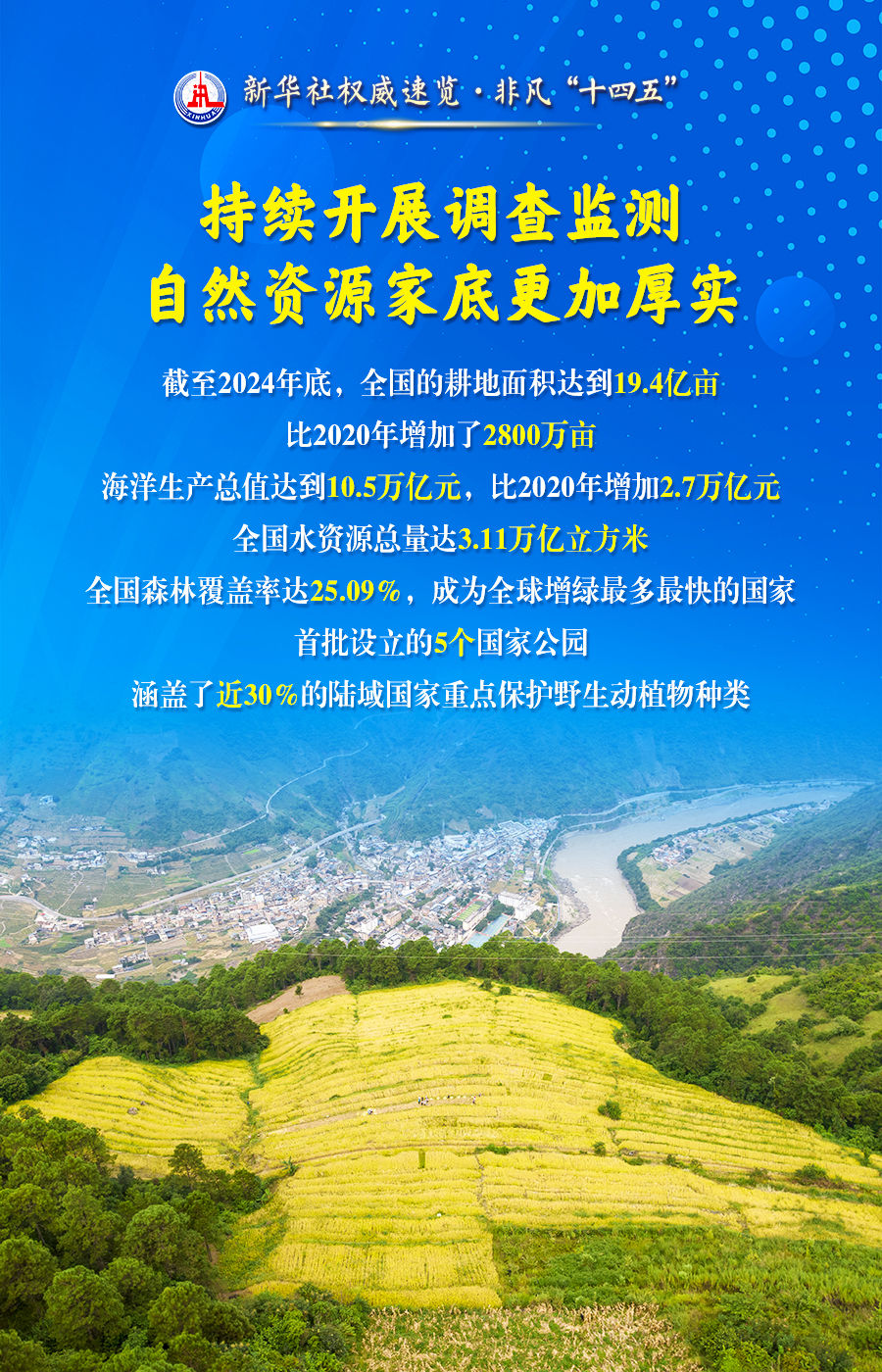
新华社权威速览·非凡“十四五”| 当好自然资源“大管家”美丽中国“守护者”,他们这样干!
Xin Hua She· 2025-09-10 07:01
Group 1 - The core viewpoint of the article emphasizes the successful completion of the "14th Five-Year Plan" goals, highlighting the role of the Ministry of Natural Resources in supporting high-quality economic and social development [1] - The national spatial planning has been fully approved and implemented at provincial, municipal, and county levels, creating a unified blueprint for land development and protection [3] - The area of comprehensive land remediation has exceeded 240 million mu, with significant efforts in restoring abandoned mines and coastal areas [5] Group 2 - The efficiency of resource utilization has improved, with a 16% decrease in construction land use per unit of GDP, and over 1,000 national-level green mines established [8] - A management system has been developed that includes a unified map, data set, and reporting framework, alongside strict actions against illegal activities in the natural resources sector [11] - International collaborations have been initiated, including the implementation of major scientific plans and the establishment of cooperation platforms for ecological restoration [13]
今年广西已办理核发乡村建设规划许可证4万本
Guang Xi Ri Bao· 2025-08-17 01:27
Group 1 - The core viewpoint of the news is the successful implementation of an online application system for rural construction planning permits in Guangxi, which has significantly improved the efficiency of the approval process [1][2] - A villager in Wuxuan County became the first to obtain a construction planning permit through the online system, marking a milestone in the use of digital tools for rural governance [1] - As of August 14, Guangxi has issued a total of 278,000 rural construction planning permits, with the online system processing its 40,000th permit this year [1] Group 2 - The Guangxi Natural Resources Planning Comprehensive Approval System was developed to address the challenges of lengthy approval times, which previously took one to two months [1] - The system integrates various data sources, including land use planning and ecological protection, to ensure compliance with regulations and prevent illegal approvals [2] - The approval process is streamlined, with a commitment to complete all reviews within 10 working days, achieving a 50% reduction in processing time compared to the legal deadline [1]
见证,土地与变迁——写在第三十五个全国“土地日”之际
Zhong Guo Zi Ran Zi Yuan Bao· 2025-06-25 01:16
Core Viewpoint - The establishment of a national "Land Day" in China marks a significant step in recognizing and protecting land resources, reflecting the harmonious relationship between humans and nature over the past 35 years [2][3]. Group 1: Historical Context - The first specialized law regulating land relations in China, the Land Management Law, was enacted in 1986 to address issues of land misuse and wastage amid rapid economic development [3]. - The annual observance of "Land Day" was officially established in 1991 to commemorate the enactment of the Land Management Law, which has undergone four revisions to adapt to changing socio-economic needs [3][4]. Group 2: Policy and Legislation - The Land Management Law emphasizes the importance of conserving and rationally utilizing land, which is a fundamental national policy, especially given the scarcity of arable land in relation to the population [5]. - The law has led to the implementation of strict land use and agricultural protection measures, including the establishment of a comprehensive system for land use rights and responsibilities [6]. Group 3: Current Initiatives - Recent reforms focus on integrating land use planning with ecological protection, aiming to address issues of disordered and excessive development that threaten quality farmland and ecological spaces [7][8]. - The "multi-planning integration" reform has created a unified national land space planning system, facilitating coordinated management across various levels of government [8]. Group 4: Future Outlook - The ongoing efforts to protect arable land and promote sustainable land use are expected to support high-quality economic development and ensure food security for the population [6][9]. - The vision for a "Beautiful China" emphasizes the interconnectedness of land, water, and ecological systems, aiming for a balanced and sustainable development model [7][9].