AI for Science

Search documents
枫清科技出席AI4S创新论坛——生态共建,智驱AI+科研新体系
Zhong Guo Jing Ji Wang· 2025-12-29 01:27
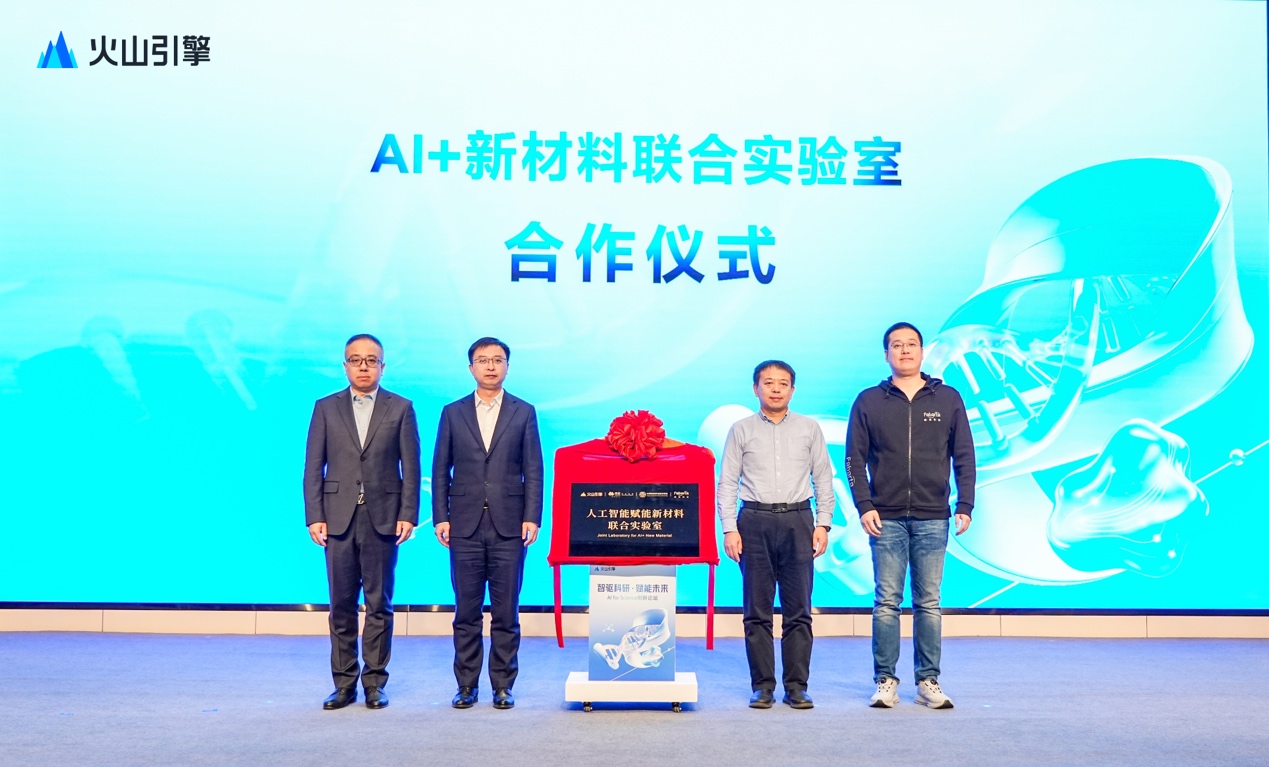
12月26日,智驱科研.赋能未来——AI4S创新论坛在北京隆重召开。活动从垂域大模型到多Agent科研提效的全栈AI for Science平台,聚焦化工材料、生物医 药核心科研需求,构建"领域模型+科研支撑"的智能化服务体系。北京市科学技术委员会、中关村科技园区管理委员会、石景山区政府及抖音集团、枫清科 技等多家企业代表出席此次大会。 石景山区AI for Science平台上线发布仪式在会议期间圆满举行,该平台由枫清科技携手火山引擎联合打造,以AI驱动科研机构与企业的科研效率革新,降低 科研门槛。 同时,AI+新材料联合实验室在大会上正式揭牌,该实验室由中化数智、吉林大学、火山引擎及枫清科技联合成立,旨在用智能化方式实现新材料的研发以 及产业落地闭环,培养更多具备交叉学科背景的创新型人才。 AI+新材料联合实验室揭牌仪式 会上,枫清科技创始人兼CEO高雪峰发表"AI4S:从技术赋能到生态共生,驱动科研新范式"主题演讲,分享了枫清科技如何通过科研垂域模型训练与蒸馏, 通用科研智能体以及科研场景智能体的开发,实现AI+科研实践落地。高雪峰表示:"我们通过将AI+新材料联合实验室的成果汇入石景山区AI for ...

未来产业周报第3期:国家创投引导基金启动,全球多国加速布局竞逐未来产业-20251228
Shenwan Hongyuan Securities· 2025-12-28 13:44
Quantum Technology - The National Venture Capital Guidance Fund has been launched, focusing on quantum technology, biomedicine, brain-computer interfaces, and other future industries, with an initial capital of 100 billion yuan to attract social capital [5][6] - A significant breakthrough in quantum error correction has been achieved by the University of Science and Technology of China, demonstrating a key milestone in achieving fault-tolerant quantum computing [7][9][10] Biomanufacturing - The European Union has released the Biotechnology Act and associated measures to enhance global competitiveness in biotechnology, aiming to mobilize 10 billion euros in capital from 2026 to 2027 [11][12] - The EU's initiatives include accelerating clinical trials, establishing regulatory sandboxes, and enhancing the application of AI in biomanufacturing, addressing funding shortages and innovation barriers [13][16] Hydrogen Energy and Nuclear Fusion - The Ministry of Industry and Information Technology of China has included three key areas in its 2025 application plan for hydrogen energy, focusing on fuel cell systems, hydrogen compressors, and ammonia co-firing technology [17][18] - South Korea has advanced its nuclear fusion power demonstration target to the 2030s, planning to overcome eight core technologies by 2035 [19][20] - The UK Tokamak Energy ST40 device has set new records in plasma current and energy storage, marking significant progress in commercial fusion energy [21] Brain-Computer Interfaces - A new generation of closed-loop brain-computer interface has been developed by the Chinese Academy of Sciences, enabling functional recovery in spinal cord injury models through real-time decoding of brain movement intentions [22] Embodied Intelligence - The establishment of a national standardization committee for humanoid robots and embodied intelligence aims to enhance the quality and application of these technologies [25] - UBTECH plans to acquire a 43% stake in Fenglong Co., enhancing collaboration in humanoid robot manufacturing and supply chain integration [26][29] Sixth Generation Mobile Communication (6G) - The Ministry of Industry and Information Technology emphasizes systematic advancement in 6G technology research and standard development during the 14th Five-Year Plan period [30] - The U.S. has initiated a spectrum strategy for 6G, focusing on reallocating frequency resources to secure a leading position in global 6G development [31][32] - China has established a collaborative system involving government, industry, and research institutions to promote 6G development, positioning itself as a leader in the field [34][36]

深势科技斩获超8亿元融资:AI for Science为何成为资本与产业的共同选择
合成生物学与绿色生物制造· 2025-12-26 01:33
关键词 | 资本事件 |深势科技 【SynBioCon】 获 悉,近日,AI for Science(人工智能驱动的科学研究)领域的标杆企业 深势 科技 宣布完成总额 超 8 亿元人民币的 C 轮融资 。这份出资方名单颇具份量:达晨财智、京国瑞基 金、北京市人工智能产业投资基金、北京市医药健康产业投资基金、联想创投、元禾璞华等机构共同 押注。 这并非简单的资金输送,而是一次凝结了国有资本意志、产业资本眼光与财务资本信心的战略合围。 它释放的信号十分明确:AI for Science 已不再只是前沿交叉学科的概念叙事,而是被主流资本市 场以更系统、更确定的方式纳入战略配置的投资主线;而深势科技,正处在这一浪潮的关键枢纽位 置。 意义远超金额本身 这次 融资被定义为深势科技发展历程中的「重要里程碑」,其意义远超过金额本身。它发生在全球 AI for Science 进入规模化应用「快车道」的宏观背景下,是资本市场用真金白银对一家中国科技 公司技术路径、商业化潜能及长期统治力的集中投票。在资本趋于谨慎的周期中,这种体量的多方联 合注资等同于一次「强信号」释放:不仅为赛道带来明显的信心增量,也迫使市场用更现实的视角重 ...

两位90后,又融8亿
华尔街见闻· 2025-12-25 10:14
以下文章来源于投资界 ,作者周佳丽 投资界 . 清科控股旗下创业与投资资讯平台 投资界获悉,全球AI for Science基础设施公司——深势科技已完成总额超8亿元人民币的C轮融资,由达晨、京国瑞基金、北京市人工智能产业投资基金、北京市 医药健康产业投资基金、联想创投、元禾璞华等机构共同出资。 至此,深势科技已累计融资数十亿元,正式跻身独角兽俱乐部。 齿轮扭转到2018年,鄂维南院士在北京大学组织了一场主题为AI for Science的会议,这很可能是国际上第一次使用"AI for Science"这样的说法。 张林峰备受鼓舞,他看到AI与学科模型相结合的巨大潜力,与孙伟杰畅聊AI for Science的未来,深势科技由此诞生。 那年,他们才刚刚25岁,两人分工明确 :张林峰任首席科学家主导技术和研发,孙伟杰则担任CEO负责战略和商业相关。 成立于2018年,深势科技始于两位北大校友——张林峰、孙伟杰。 两人同为90后,一文一理,联手构建了一系列"读文献、做计算、做实验"的智能科学工具和各领域的科学智能体,也由此集结了一份长长的投资人名单。 两位90后带队,一个新晋AI独角兽诞生 故事始于2011年,两 ...

8亿资本加码!90后掌舵,AI for Science企业深势科技完成C轮融资
机器人圈· 2025-12-25 09:40
Core Insights - DeepMind Technology successfully completed a C-round financing of over 800 million RMB, marking a significant step in building a new generation of intelligent engines for scientific discovery [2] - The company aims to attract top talent and enhance its full-stack capabilities in intelligent research tools and industry solutions, focusing on market expansion in basic research, life sciences, and material sciences [2][10] Company Background - Founded in 2018 by Zhang Linfeng and Sun Weijie, DeepMind Technology emerged from a shared vision of "AI empowering science" after attending an AI for Science conference [3] - The company focuses on solving key industrial problems in pharmaceuticals, materials, and energy through AI, with its "Deep Potential" molecular simulation technology winning the prestigious Gordon Bell Award in 2020 [3] Product Development - DeepMind Technology has developed a comprehensive capability system centered around the "Bohr Research Space Station," offering a range of intelligent research products [4] - The product matrix includes tools like Bohr Scientific Navigation and Hermite®, which support a closed-loop system integrating reading, computation, and experimentation [4] Application and Impact - The company has significantly reduced research timelines, such as compressing target research from three weeks to three days in life sciences and achieving a 50% improvement in lithium metal battery design [6] - Over 1,000 global institutions and 300 million scientists have utilized its services, saving over 2 billion minutes of research time and enhancing research efficiency [6] Funding and Market Position - DeepMind Technology faced initial challenges in securing funding but turned a corner with a 12 million RMB grant and subsequent angel round financing led by Baidu Ventures [9] - The recent financing coincides with the global rise of AI for Science, with strong policy support from the Chinese government and recognition from investors of the company's unique position in the market [9][10] Future Outlook - The founders emphasize that AI for Science is a long-term infrastructure project for scientific discovery, with plans to solidify capabilities and expand market reach [10] - Investors recognize the company's potential as a leading platform in the sector, with a clear path from laboratory to commercialization [10]

深势科技8亿融资背后:从科研作坊到中国版DeepMind
36氪· 2025-12-24 13:35
以下文章来源于暗涌Waves ,作者暗涌 暗涌Waves . 钱的流向,人的沉浮。36氪旗下投资报道账号。 6个关键的小故事。 牧羊 少年的 奇幻漂流 回到深势科技的故事起点。2017年,在一趟航班上,张林峰打开电脑,用深度学习算法模拟出了64个水分子在10皮秒内的运动结果,在40年前,这个实 验需要耗费2亿核时,而如今他只需要一个笔记本电脑。 张林峰把这件事告诉了北大同窗孙伟杰,他们都意识到,AI不仅算准了,而且比传统分子动力学模拟快了数个数量级。而这不仅仅是一个数学游戏,他手 中握住的,可能是一把通往微观世界新物理规律的钥匙。 他们的第一笔启动资金不是融资,是全国颠覆性技术创新大赛的金奖奖金,一共1200万人民币,分3年给到。直到2020年,这种技术直觉被权威奖项验证 了。张林峰、鄂维南等人凭借在"深度势能"分子模拟方面的突破,获得了国际高性能计算领域的最高奖项——"戈登·贝尔奖"。这被誉为超算领域的诺贝 尔奖。该成果随后入选了中国两院院士评选的"2020年中国十大科技进展",与新一代人造太阳、量子计算原型机"九章"并列。从那之后深势的融资变得顺 畅起来。 张林峰也是在此时从普林斯顿博士毕业,据业内传闻, ...

两位90后带队、新晋AI独角兽诞生,深势科技完成超8亿元C轮融资
Sou Hu Cai Jing· 2025-12-24 07:46
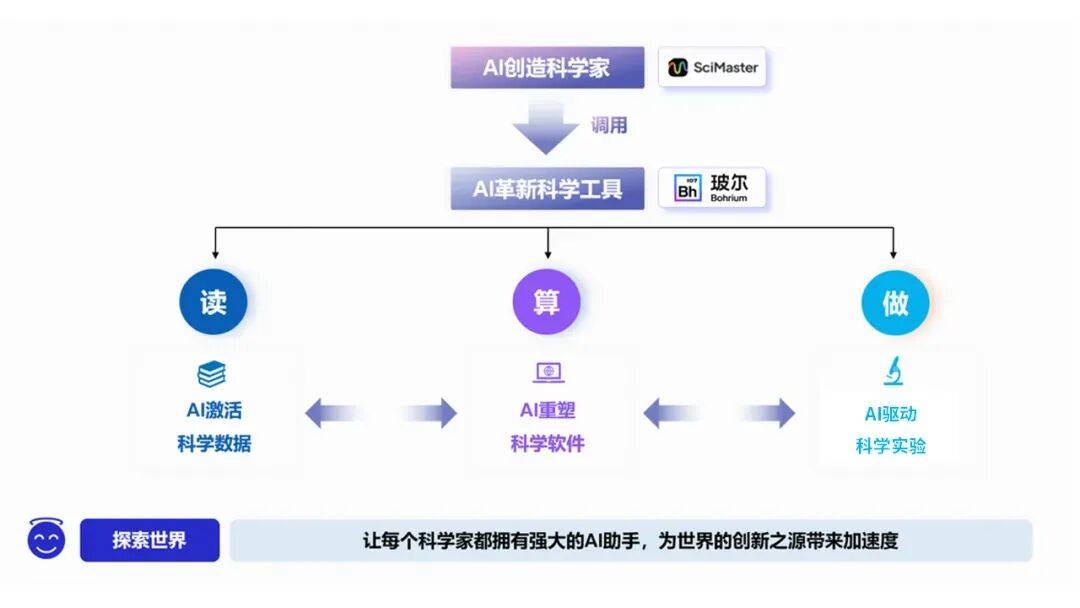
瑞财经 吴文婷12月24日,深势科技宣布完成总额超8亿人民币的C轮融资。 本轮融资由达晨财智、京国瑞基金、北京市人工智能产业投资基金、北京市医药健康产业投资基金、联 想创投、元禾璞华等机构共同出资。 据媒体报道,深势科技已累计融资数十亿元,正式跻身独角兽俱乐部。 深势科技 © 企查查 ··· | 核心人员 基本信息 直投项目 | 上榜榜 融资历程 核心人员 张林峰 张 创始人,首席科学家 张林峰,深势科技创始人、首席科学家,毕业于北京大学元 培学院,后前往普林斯顿大学继续深造,获应用数学博士学 位。 据了解,本轮融资资金将主要用于持续吸引和培养行业内顶尖人才,进一步进化迭代深势科技的 "科学 发现智能引擎",持续夯实从原始技术创新到智能科研工具产品及行业解决方案的全栈能力,加速围绕 科学发现的智能产品与服务在基础科研、生命科学与物质科学等领域的市场拓展与规模化应用。 公开资料显示,深势科技成立于2018年,作为全球AI for Science的开拓者,其依托在领域的多年深耕, 以及对产业的深刻理解,构建了以"玻尔·科研空间站"为枢纽的"读、算、做、智"的能力体系,打造了 Science as a Servic ...
深势科技8亿融资背后:从科研作坊到中国版DeepMind
暗涌Waves· 2025-12-24 05:59
Core Viewpoint - DeepMind's documentary "The Thinking Game" parallels the journey of DeepMind and DeepSense Technology, highlighting the intersection of AI and biological research, while emphasizing the company's recent C-round financing of over 800 million RMB, leading to a valuation exceeding 6 billion RMB [3][4]. Group 1: Company Background and Development - DeepSense Technology was founded in 2017, initially funded by a 12 million RMB award from a national innovation competition, which laid the groundwork for its future success [6][5]. - The company gained recognition in 2020 by winning the Gordon Bell Award for breakthroughs in "deep potential" molecular simulations, marking a significant milestone in its development [6][7]. - The founder, Zhang Linfeng, turned down an offer from DeepMind to lead DeepSense, emphasizing a commitment to innovation in China [7]. Group 2: Key Technological Achievements - The company successfully replicated Google DeepMind's AlphaFold 2, a significant achievement in protein modeling, under limited resources, showcasing the team's dedication and expertise [11][12]. - DeepSense chose to focus on being a software platform rather than a biotech company, aiming to establish itself as a "micro-world Dassault System," which can be applied across various industries beyond pharmaceuticals [14][15]. Group 3: Strategic Decisions and Market Position - The decision to avoid direct drug development was driven by the need to maintain trust with pharmaceutical clients, allowing DeepSense to act as a neutral third party [15]. - The establishment of a "super laboratory" aims to bridge the gap between AI predictions and practical applications, addressing the challenge of data scarcity in AI for Science [17][18]. Group 4: Funding and Market Dynamics - The recent C-round financing included state-backed institutions, indicating that AI for Science is now viewed as a strategic national research infrastructure [21][20]. - Despite the potential, Chinese AI for Science companies face valuation pressures compared to their U.S. counterparts, with a need for a breakthrough project akin to AlphaFold to gain investor confidence [23][22]. Group 5: Philosophical Considerations - The founders of DeepSense reflect on the ethical implications of AI, recognizing the potential for AI to surpass human intelligence and the importance of maintaining human values in the face of technological advancement [25][26].

国产AI4S创业头雁再获8亿投资!深势科技完成C轮,产品已服务300万科学家
量子位· 2025-12-24 05:14
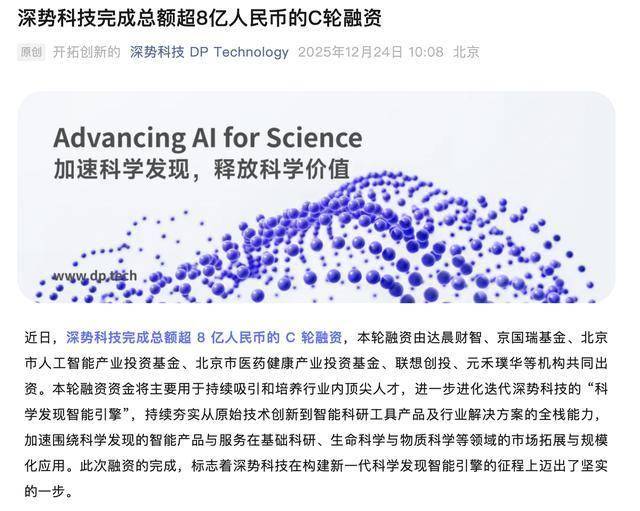
允中 发自 凹非寺 量子位 | 公众号 QbitAI 近日, 深势科技完成总额超8亿人民币的C轮融资 ,本轮融资由达晨财智、京国瑞基金、北京市人工智能产业投资基金、北京市医药健康产业 投资基金、联想创投、元禾璞华等机构共同出资。 本轮融资资金将主要用于持续吸引和培养行业内顶尖人才,进一步进化迭代深势科技的"科学发现智能引擎",持续夯实从原始技术创新、到智 能科研工具产品及行业解决方案的全栈能力,加速围绕科学发现的智能产品与服务在 基础科研、生命科学与物质科学 等领域的市场拓展与规 模化应用。 此次融资的完成,标志着深势科技在构建新一代科学发现智能引擎的征程上,迈出了坚实的一步。 AI for Science成为全球共识,科学发现范式正在重构 我们正站在一个历史性的时点,AI for Science已成为全球性的共识,其目标在于从根本上变革人类探索未知、发现全新科学知识并将其系统 沉淀为可复用科学资产的模式。 2025年8月,国务院发布关于深入实施"人工智能+"行动的意见,意见将 "人工智能+科学研究" 放在首位,其中特别强调了加速科学发现进 程,驱动技术研发模式创新和效能提升。 此外,欧洲的"地平线"计划中重 ...

国产AI4S创业头雁再获8亿投资!深势科技完成C轮,产品已服务300万科学家
Sou Hu Cai Jing· 2025-12-24 04:23
允中 发自 凹非寺 量子位 | 公众号 QbitAI 近日,深势科技完成总额超8亿人民币的C轮融资,本轮融资由达晨财智、京国瑞基金、北京市人工智能产业投资基金、北京市医药健康产业投资基金、 联想创投、元禾璞华等机构共同出资。 本轮融资资金将主要用于持续吸引和培养行业内顶尖人才,进一步进化迭代深势科技的"科学发现智能引擎",持续夯实从原始技术创新、到智能科研工具 产品及行业解决方案的全栈能力,加速围绕科学发现的智能产品与服务在基础科研、生命科学与物质科学等领域的市场拓展与规模化应用。 此次融资的完成,标志着深势科技在构建新一代科学发现智能引擎的征程上,迈出了坚实的一步。 AI for Science成为全球共识,科学发现范式正在重构 我们正站在一个历史性的时点,AI for Science已成为全球性的共识,其目标在于从根本上变革人类探索未知、发现全新科学知识并将其系统沉淀为可复用 科学资产的模式。 此外,欧洲的"地平线"计划中重点布局AI赋能的科学研究;美国更是启动创世纪计划(Genesis Mission),核心是加速利用AI推动科学突破,提高AI驱动 科学发现以及工业应用转化的效率,此计划也被上升到与"曼 ...