
人民币国际化

Search documents
供需两旺驱动市场扩容 点心债成中资科技企业融资新选择
Zhong Guo Zheng Quan Bao· 2025-11-18 22:15
Core Insights - The offshore RMB bond market, known as "dim sum bonds," is experiencing significant growth, with issuance nearing 1 trillion yuan this year, driven by demand from major tech companies like Tencent and Alibaba [1][2]. Group 1: Market Overview - As of November 18, 2025, the issuance scale of dim sum bonds has surpassed 980 billion yuan, establishing itself as a crucial channel for overseas financing for Chinese enterprises and a key driver for RMB internationalization [2]. - The market has seen a diversification of issuers, with sovereign and government entities accounting for 18.1% of the issuance in the first three quarters of 2025, reflecting a strategic mission to support RMB internationalization and enhance Hong Kong's status as a financial center [2]. Group 2: Factors Driving Growth - The continuous development of the dim sum bond market is attributed to multiple factors, including policy support, market demand, and improved asset quality, which collectively drive market expansion [3]. - Policy measures, such as the optimization of outbound investment channels and the enhancement of the offshore RMB bond repurchase mechanism, have significantly bolstered market liquidity and demand for dim sum bonds [3]. Group 3: Economic Impact - The growth of the dim sum bond market is not only beneficial for the market itself but also plays a vital role in supporting the real economy, promoting RMB internationalization, and advancing the bond market [4]. - The expansion of the dim sum bond market enhances the breadth and depth of the offshore bond market, providing more RMB asset options for international investors and facilitating a closed-loop flow of RMB in trade settlements and offshore investments [4].
点心债成中资科技企业融资新选择
Zhong Guo Zheng Quan Bao· 2025-11-18 20:05
Core Insights - The offshore RMB bond market, known as "dim sum bonds," is experiencing significant growth, with issuance nearing 1 trillion yuan in 2023, driven by demand from major tech companies like Tencent and Alibaba [1][2] - The diversification of issuers, including sovereign and government entities, is enhancing the market's role in supporting the internationalization of the RMB and solidifying Hong Kong's status as a financial hub [1][2] Group 1: Market Dynamics - As of November 18, 2023, the issuance of dim sum bonds has surpassed 980 billion yuan since 2025, establishing it as a crucial channel for overseas financing for Chinese enterprises [1] - Major tech firms are increasingly utilizing dim sum bonds to fund global expansion and investments in AI, with total issuance exceeding 47 billion yuan and a subscription amount reaching approximately 150 billion yuan, 3.2 times the issuance [2] Group 2: Contributing Factors - The growth of the dim sum bond market is attributed to a combination of policy support, market demand, and improved asset quality, which together drive market expansion [2][3] - The optimization of domestic capital outflow channels, such as the "Southbound Trading" initiative, has broadened the investor base and enhanced market liquidity, stimulating demand for dim sum bonds [2] Group 3: Investment Appeal - Dim sum bonds offer attractive yields compared to onshore credit bonds while remaining lower than offshore USD bonds, appealing to both issuers and investors [3] - The expansion of green and tech-related issuers is improving the asset quality of dim sum bonds, increasing their attractiveness to international investors [3] Group 4: Future Outlook - Analysts are optimistic about the dim sum bond market's prospects, anticipating strong growth driven by local government bonds, foreign financial bonds, and TMT bonds [4] - The ongoing expansion of the "Southbound Trading" initiative is expected to enhance market liquidity, creating a favorable environment for investment opportunities [4]
独特优势将助力香港打造全球航运之都——专访香港船东会主席班加
Xin Hua She· 2025-11-18 16:43
Core Viewpoint - The Hong Kong shipping industry is poised to become a global shipping hub, leveraging its unique position under "One Country, Two Systems" and its status as an international financial center [1][2]. Group 1: Industry Development - The Hong Kong Shipowners Association is focused on creating a fair and orderly industry environment, aligning with the vision of developing a commodity trading ecosystem as outlined in the Chief Executive's policy address [2]. - Hong Kong has 1,200 port and shipping-related companies employing over 90,000 people, indicating a robust industry presence [2]. - The Hong Kong Maritime and Port Development Council was established on July 1, enhancing collaboration between the government and the industry [2]. Group 2: Strategic Initiatives - A memorandum of cooperation was signed to establish a rail-sea intermodal route connecting Sichuan, Chongqing, Guangxi, and Hong Kong, facilitating better logistics and trade connections [1]. - The Chief Executive of Hong Kong highlighted the formation of leading industry clusters in ship management, financing, and insurance, with Hong Kong ranking fourth globally in the International Shipping Centre Development Index for six consecutive years [2]. Group 3: Financial Ecosystem - Hong Kong's thriving financial ecosystem is seen as foundational for the shipping industry's growth, particularly in supporting capital-intensive projects related to energy transition and decarbonization [2]. - The city continues to strengthen its position as an offshore RMB center, with the smooth operation of the linked exchange rate system and the expansion of the digital RMB pilot, which benefits global trade [2]. Group 4: Global Context - Despite facing challenges from rising protectionism and global trade tensions, Hong Kong is encouraged to enhance its advantages and evolve from a resilient international shipping center to a thriving global shipping hub [3].
阿里腾讯抢发 点心债市场扩容
Bei Jing Shang Bao· 2025-11-18 15:54
Core Viewpoint - The recent issuance of dim sum bonds by major Chinese tech companies signifies a significant step in the internationalization of the Renminbi, with a total issuance exceeding 47 billion yuan, reflecting a growing market and diverse issuance entities [1][4]. Group 1: Market Growth and Dynamics - The dim sum bond market, also known as offshore Renminbi bonds, has seen a rapid increase in issuance, with 9,675.31 billion yuan issued in 2023 and an expected rise to 12,786.98 billion yuan in 2024, marking the first annual issuance exceeding 10 trillion yuan [4][6]. - The average issuance rate of dim sum bonds is over 2 percentage points lower than that of comparable US dollar bonds, driven by the divergence in monetary policies between China and the US [5][6]. Group 2: Issuance Entities and Trends - The diversity of issuance entities has expanded from traditional local government financing vehicles to include major tech companies like Tencent, Baidu, and Alibaba, which are now significant players in the dim sum bond market [7][8]. - The share of non-local government and non-financial entities in the issuance has increased, enhancing market vitality and attracting long-term capital [7][8]. Group 3: Policy Support and Future Outlook - The expansion of the "Southbound Pass" policy has facilitated greater participation of domestic investors in the offshore bond market, significantly boosting market activity [8][9]. - Projections indicate that the dim sum bond market could reach an outstanding scale of over 3 trillion yuan by 2030, with international investors' holdings expected to exceed 40% [12].

债券通“北向通”10月成交5723亿元 互换通名义本金突破4100亿元
Xin Hua Cai Jing· 2025-11-18 14:52
Core Insights - The bond market in China is experiencing deepening foreign investment channels, with the "Northbound Trading" under Bond Connect showing active trading and strong confidence from international investors [1][2]. Group 1: Trading Activity - In October, the "Northbound Trading" recorded a total of 5,994 transactions, with 839 foreign investors entering the market [2]. - Government bonds and policy financial bonds were the most traded, accounting for 58% and 29% of the total trading volume, respectively [2]. - The highest proportion of bonds traded were in the 7-10 year maturity range at 31%, indicating a preference for medium to long-term investments by foreign investors [2]. Group 2: Transaction Characteristics - Transactions with a single volume of less than 100 million yuan accounted for 45% of total trades, while large transactions over 200 million yuan made up 10% [2]. - The T+1 settlement mechanism was prevalent, comprising 67% of transactions, reflecting an efficient and convenient settlement process [2]. Group 3: Issuance and International Collaboration - The Bond Connect ePrime system supported 9 offshore bond issuances in October, totaling an equivalent of 10.367 billion yuan, with participation from 14 domestic and foreign financial institutions [2]. - The "Northbound Swap Connect" also showed activity with 775 interest rate swap transactions totaling 4.104 billion yuan, indicating a growing demand from foreign investors for managing interest rate risks [3]. Group 4: International Outreach and RMB Internationalization - The Bond Connect company has been actively engaging with international investors through roadshows in Europe, discussing the progress of RMB internationalization and the development of Bond Connect and Swap Connect [4]. - The "New Bond Information Connect" platform published information on 67 bond issuances in October, enhancing market transparency and aiding global investors in understanding the dynamics of the Chinese bond market [4]. - Continuous optimization of China's financial market opening policies is expected to attract more foreign investors, enhancing the international appeal of RMB assets and positioning China's bond market as a more significant player in the global financial system [4].
获批全省首家法人银行直参CIPS资格并上线运行,推出17条举措服务青岛高水平开放
Di Yi Cai Jing· 2025-11-18 13:22
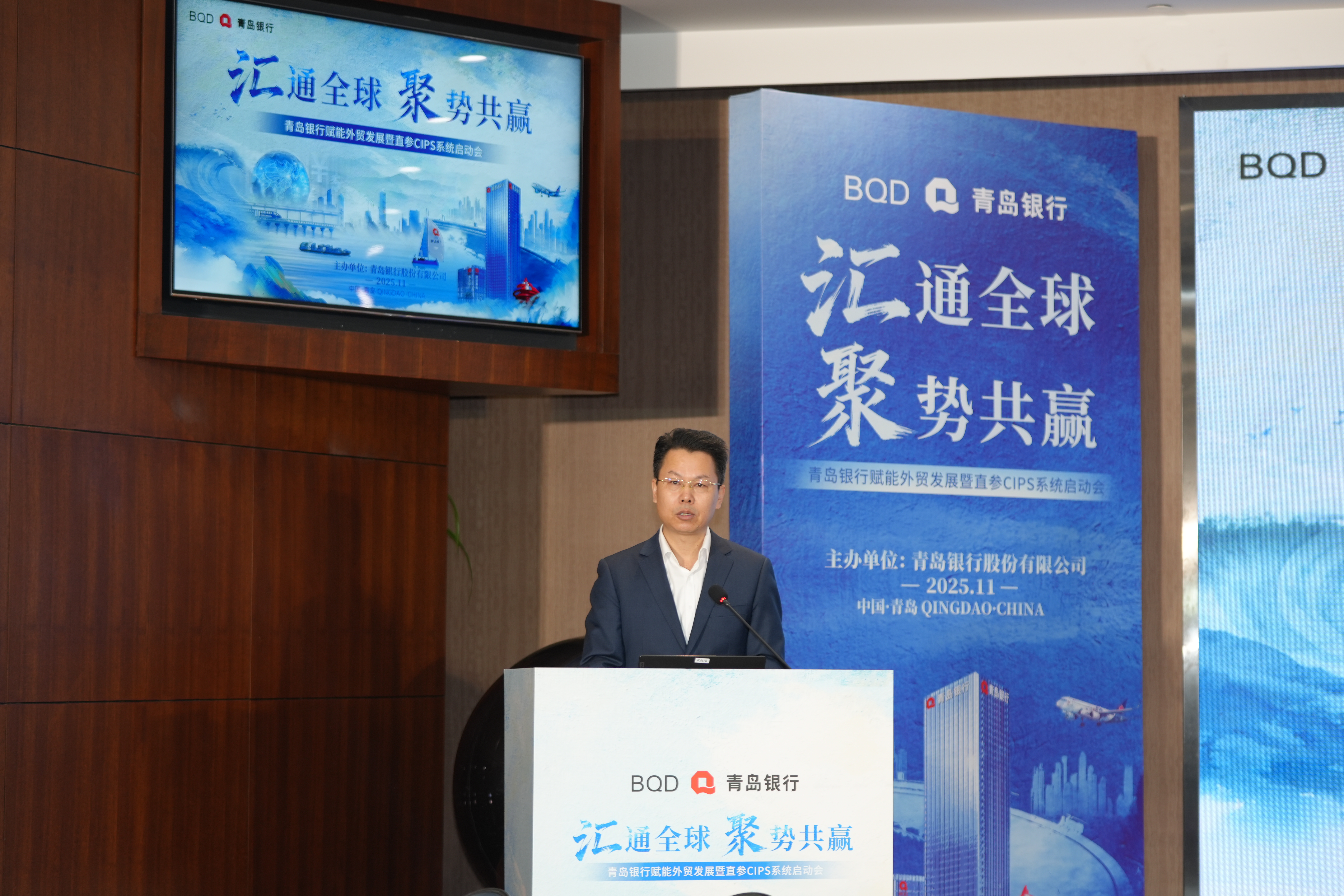
Core Viewpoint - Qingdao Bank successfully launched the CIPS direct participation system, aiming to enhance support for foreign trade development and facilitate local brands' international expansion [1][6]. Group 1: International Business Development - Qingdao Bank's international business is projected to exceed $20 billion by 2025, representing a 40% year-on-year growth, serving over 5,000 enterprises [5]. - The cross-border RMB settlement volume is expected to surpass 50 billion yuan, with a year-on-year increase of 52% [5]. Group 2: CIPS System Launch - The CIPS system is a crucial infrastructure for RMB cross-border payment, providing secure, efficient, and low-cost settlement services [6]. - Qingdao Bank is the first legal entity bank in Shandong to obtain direct participation in the CIPS system, enabling point-to-point cross-border RMB clearing [6]. Group 3: Financial Products and Services - Qingdao Bank has developed a comprehensive service system for foreign trade enterprises, including products like "Qingyin Huaitong," "Qingyin Maodai," "Qingyin Huiying," and "Qingyin Chuhaitong" [5]. - The bank launched a white paper outlining 17 key measures to support foreign trade, addressing challenges such as financing difficulties and slow settlements [10]. Group 4: Collaborative Efforts - Qingdao Bank signed a joint action declaration with the Shandong branch of China Export & Credit Insurance Corporation and Qingdao Financing Guarantee Group to support high-quality development of foreign trade enterprises [10]. - The event was supported by CIPS and various financial institutions, highlighting a collaborative approach to enhance cross-border financial services [13]. Group 5: Future Outlook - Qingdao Bank plans to optimize cross-border financial products and services, leveraging the CIPS system to contribute to RMB internationalization and high-level opening-up [16].
阿里、腾讯抢发!点心债市场扩容,人民币国际化加速
Bei Jing Shang Bao· 2025-11-18 12:31
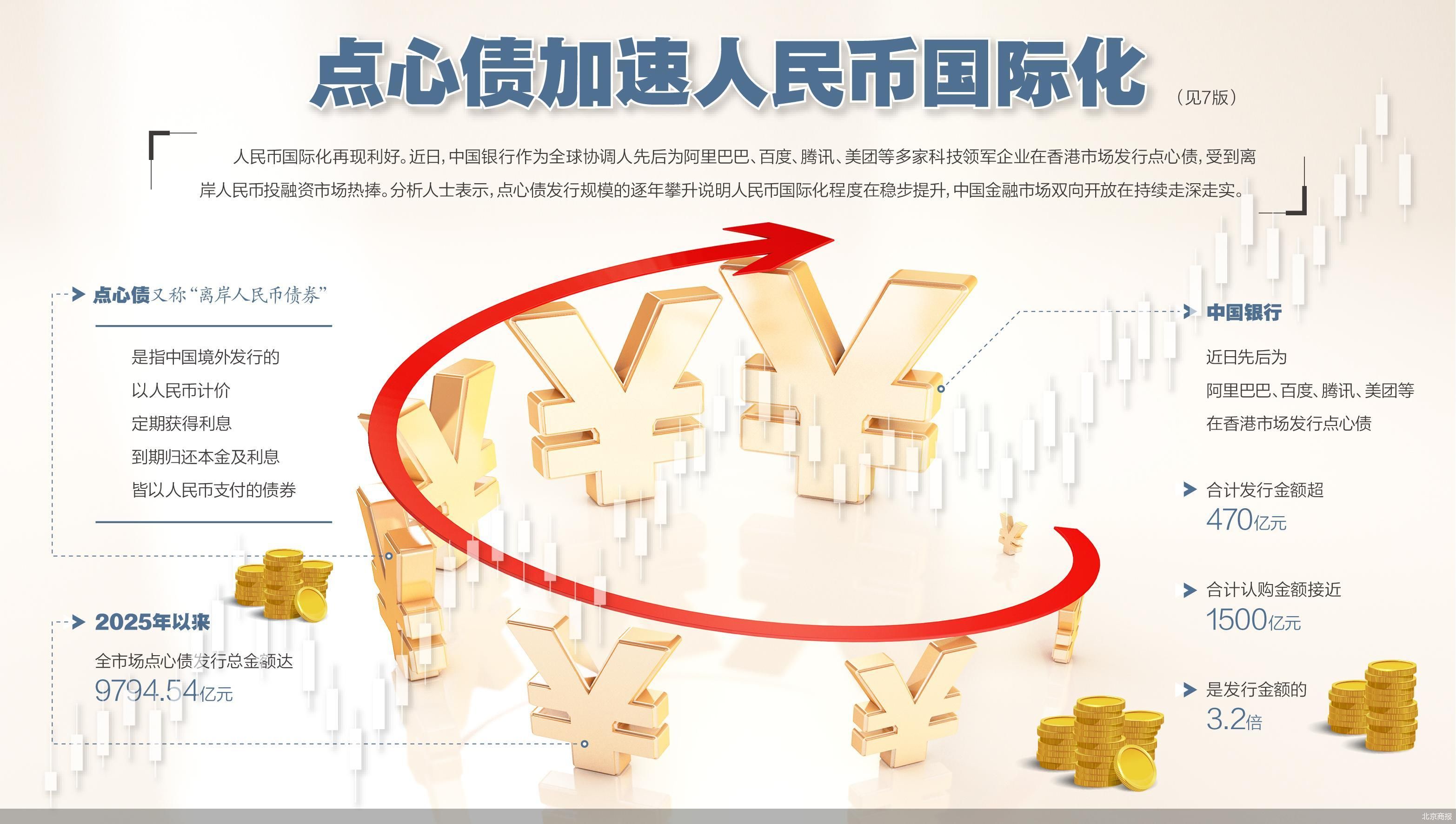
Core Viewpoint - The recent issuance of dim sum bonds by major Chinese tech companies signifies a significant boost for the internationalization of the Renminbi, reflecting a growing market and diverse issuance entities [1][4]. Group 1: Dim Sum Bond Market Growth - The total issuance of dim sum bonds has exceeded 470 billion RMB, with a strong demand reflected in a subscription amount of nearly 1,500 billion RMB, 3.2 times the issuance amount [1][3]. - In 2023, the total issuance of dim sum bonds reached 9,675.31 billion RMB, and in 2024, it is projected to exceed 12,786.98 billion RMB, marking the first annual issuance scale to surpass 10 trillion RMB [3][4]. - The market has seen a continuous growth trend over the past three years, with a total issuance of 9,794.54 billion RMB since 2025 [3]. Group 2: Factors Driving Market Activity - The significant financing cost advantage of dim sum bonds, combined with the strategic push for Renminbi internationalization, is a core driver of market activity [4]. - The divergence in monetary policies between China and the U.S. has led to a lower average issuance rate for dim sum bonds compared to U.S. dollar bonds, providing a favorable environment for issuers [4]. - The expansion of offshore Renminbi liquidity and the increasing role of Hong Kong as a major offshore center for Renminbi transactions have further stimulated the market [4][8]. Group 3: Diversification of Issuers and Products - The issuer base for dim sum bonds has diversified significantly, with a notable increase in participation from tech giants like Tencent, Baidu, and Alibaba, moving away from traditional issuers [6][7]. - The introduction of various bond types, including green and sustainable dim sum bonds, caters to different financing needs and investor preferences [7]. - The policy support from the People's Bank of China and the Hong Kong Monetary Authority has facilitated a more active market by broadening the scope of domestic investors [7][8]. Group 4: Future Projections and Market Dynamics - Projections indicate that the issuance of dim sum bonds could reach 1.2 to 1.3 trillion RMB in 2025, with potential growth to 1.5 trillion RMB in 2026 [5]. - The market is expected to see an increase in the issuance of long-term bonds, enhancing the yield curve and attracting long-term capital [6]. - The internationalization of the Renminbi is entering a new phase characterized by both quantitative and qualitative improvements, with the currency's role in global trade and finance continuing to expand [8][10].





中国进出口银行签署多项合作协议共促“一带一路”高质量发展
Zheng Quan Shi Bao Wang· 2025-11-18 09:44
Core Points - The China Export-Import Bank and China Galaxy Securities held a forum focused on promoting high-quality development of the Belt and Road Initiative [1][2] - Multiple cooperation agreements were signed during the forum to enhance collaboration and support for the Belt and Road Initiative [1] Group 1: Cooperation Agreements - A cooperation agreement was signed with the Uzbekistan National Bank for Foreign Economic Activity to establish a more robust interbank cooperation channel [1] - A financing conditions agreement was signed with the Kazakhstan Development Bank for a loan of 2 billion RMB, marking the first cooperation in RMB liquidity loans, which is significant for promoting RMB internationalization [1] - A memorandum of cooperation was signed with the Bosnia and Herzegovina Republika Srpska Highway Company for the construction of the Posavina Highway project, aimed at improving transportation efficiency and connectivity in Central and Eastern Europe [1] - A strategic cooperation agreement was signed with Beijing Urban Construction Group to enhance collaboration in credit business, consulting services, trade financing, and fund operations [1] Group 2: Future Plans - The China Export-Import Bank plans to actively participate in the implementation of the national 14th Five-Year Plan, focusing on high-level opening up and promoting trade innovation and bilateral investment cooperation [2]
中德金融界在法兰克福共话合作机遇
Xin Hua Cai Jing· 2025-11-18 09:36
Group 1 - The "China Day" event during the Euro Finance Week highlights the importance of open dialogue and pragmatic cooperation between China and Germany amidst global economic uncertainties [1][6] - Key factors for the stable development of China-Germany relations include mutual understanding, deepening cooperation in financial sectors, and aligning long-term development philosophies towards innovation, openness, and sustainability [1][2] Group 2 - Institutionalized communication mechanisms are a shared concern, emphasizing the need for continued dialogue to strengthen cooperation in the face of geopolitical changes and technological innovations [2] - The significance of sustainable finance is underscored, with both countries having a strong foundation for cooperation in addressing climate risks and promoting green finance [2][3] Group 3 - The internationalization of the Renminbi (RMB) is identified as a crucial aspect of financial connectivity, with increasing demand for RMB in cross-border settlements and risk management [3] - German companies show a steady investment interest in the Chinese market, indicating the long-term importance of China for German businesses [3][4] Group 4 - Local and industrial-level cooperation between China and Germany is accelerating, with significant potential in investment, technology, and industrial upgrades [4] - Financial institutions are expanding their service networks, with the Industrial and Commercial Bank of China actively enhancing RMB business and green financial services in Europe [4] Group 5 - Establishing a stable and transparent bilateral investment environment is a mutual expectation, with both sides needing predictable investment rules to facilitate business operations [5]
土耳其人民币清算行业务正式启动
Xin Hua Wang· 2025-11-18 08:25
Core Viewpoint - The establishment of the Renminbi clearing bank in Turkey marks the official launch of Renminbi clearing services, enhancing bilateral trade and financial cooperation between China and Turkey [1][2]. Group 1: Financial Cooperation - The Renminbi clearing bank will facilitate the use of Renminbi in local settlements, financing, and transactions, promoting higher levels of economic and financial connectivity between the two countries [1][2]. - The People's Bank of China emphasizes that the use of Renminbi provides a reliable new option for global trade and investment activities, with a commitment to market-oriented, legal, and international practices [1]. Group 2: Business Opportunities - The clearing bank is expected to lower trade risks and reduce transaction costs, creating new business opportunities for Turkish enterprises in trade, investment, and long-term financing [2]. - The establishment of the clearing bank is seen as a milestone in China-Turkey financial cooperation, aimed at enriching the offshore cross-border application scenarios of Renminbi [1][2]. Group 3: Institutional Collaboration - The Industrial and Commercial Bank of China (ICBC) aims to deepen cooperation with local Turkish banks, policy institutions, and Chinese financial institutions to create a mutually beneficial Renminbi usage ecosystem [1]. - The opening ceremony was attended by nearly 400 representatives from financial institutions and the business community, highlighting the significance of this initiative [2].
