Workflow
AI芯片
icon
Search documents
国内AI芯片的出货量、供需关系
傅里叶的猫· 2025-07-21 15:42
Core Viewpoint - The article discusses the impact of recent restrictions on AI chip sales in China, particularly focusing on the market dynamics for Nvidia and local manufacturers, and the projected growth of the AI accelerator market in the coming years [2][3]. Group 1: Market Projections - Bernstein estimates that the Chinese AI accelerator market will reach $39.5 billion by 2025, primarily driven by Nvidia H20 ($22.9 billion), AMD MI308 ($2 billion), and local manufacturers ($14.6 billion) [2]. - Following the sales ban, Nvidia is expected to lose $1.68 billion in H20 sales, while AMD may lose $150 million, with some orders shifting to local manufacturers, potentially increasing their revenue by about 10% [2]. - Despite local manufacturers' growth, Bernstein believes they cannot fully cover the $18.3 billion gap due to production bottlenecks in 7nm wafers and CoWoS technology [2]. Group 2: Nvidia's Strategy - Nvidia plans to apply for the resumption of H20 sales and introduce a compliant NVIDIA RTX PRO GPU, with initial demand projected at $10.5 billion, although it will not meet the initial demand of $16.8 billion [2][3]. - The anticipated shipment of B30 chips to China is expected to reach 400,000 units, generating $2.8 billion in revenue, while local manufacturers may only gain an additional $1.5 billion due to new restrictions [3]. Group 3: Competitive Landscape - Major cloud service providers in China, including ByteDance, Alibaba, Tencent, and Baidu, are the primary buyers of H20, accounting for 87% of total sales [5]. - By 2027, local manufacturers are projected to capture 55% of the market share, while global competitors may face technological stagnation and lose their competitive edge [3]. Group 4: Supply and Demand Dynamics - The article highlights discrepancies between GPU shipment data from Bernstein and IDC, noting that Huawei holds a 23% market share, while Nvidia's share is overstated by IDC by 7 percentage points [16][20]. - The supply-demand relationship indicates that aside from Alibaba and Baidu, other major companies are purchasing Huawei's AI chips, raising questions about the accuracy of reported data [23]. Group 5: Local Manufacturers - The report identifies local GPU manufacturers, with Huawei leading the market, followed by Cambricon, Haiguang, and Tianshu [20][21]. - The revenue of local manufacturers is expected to increase significantly, with Moore Threads projected to boost its revenue through substantial AI computing GPU shipments in 2024 [36][38].
电子行业周报:英伟达H20恢复对华供应,台积电中期业绩超预期-20250721
Donghai Securities· 2025-07-21 15:22
Investment Rating - The report suggests a positive outlook for the electronics sector, indicating a gradual recovery in demand and price stabilization, with a recommendation to gradually accumulate positions in the market [6][7]. Core Insights - Nvidia has announced the resumption of sales for its H20 chip to China, alongside AMD's MI308, which is expected to alleviate the domestic market's computing power shortage in the short term. The long-term trend remains focused on the acceleration of domestic AI chip self-sufficiency [6][12]. - TSMC reported a Q2 2025 revenue of approximately $30.07 billion, a year-on-year increase of 44.4%, with a net profit surge of 60.7%. The revenue from 7nm and below process nodes accounted for 74% of total revenue, driven primarily by AI and high-performance computing demand [6][12]. - Global smartphone shipments grew by 1% year-on-year in Q2 2025, while shipments in China declined by 4%, marking the end of a six-quarter growth streak. The growth in the global market is attributed to innovations in AI technology and new product launches [6][14]. Summary by Sections Industry Overview - The electronics sector is experiencing a mild recovery in demand, with a focus on four main investment themes: AIOT, AI-driven technologies, equipment materials, and consumer electronics [6][7]. Company Performance - Nvidia's H20 and AMD's MI308 chips are set to resume sales to China, indicating a potential easing of geopolitical tensions and a boost for domestic AI chip development [6][12]. - TSMC's Q2 2025 financial results exceeded expectations, with significant contributions from AI and HPC-related demands, projecting a nearly 30% revenue growth for the full year [6][12]. Market Trends - The report highlights a 1% year-on-year increase in global smartphone shipments, with a notable decline in the Chinese market, reflecting a shift in consumer demand and market dynamics [6][14]. - The electronics industry outperformed the broader market, with the semiconductor sector showing positive growth, particularly in electronic components and consumer electronics [21][23].
又一家国产GPU独角兽启动A股IPO,阿里、快手都投了
Sou Hu Cai Jing· 2025-07-21 13:21
Core Viewpoint - Shanghai-based GPU unicorn Hanbo Semiconductor has officially initiated its A-share IPO process, marking a significant step in its capital market journey [2] Company Overview - Hanbo Semiconductor was founded in December 2018 with a registered capital of 543 million yuan and is co-controlled by its founders Qian Jun and Zhang Lei, who collectively hold 42.1465% of the voting rights through 17 employee stock ownership platforms [2][5] - The company is in a "no controlling shareholder" state, indicating a diversified ownership structure [2] Market Context - The GPU sector is critical for high-performance computing and artificial intelligence, with applications in gaming, cloud computing, big data, and AI training and inference [2] - Hanbo Semiconductor is one of five domestic GPU companies that have started the A-share IPO process in the past year, alongside Biran Technology, Moore Threads, Muxi Co., and Granfi [2] Financial Highlights - Hanbo Semiconductor is valued at 10.5 billion yuan, making it one of the highest-valued companies in the GPU sector according to the 2025 Hurun Global Unicorn List [2] Product Development - The company has developed three core product lines: graphics rendering GPUs, data center AI GPUs, and edge AI inference GPUs, targeting high-performance computing fields such as intelligent computing centers, industrial simulation, autonomous driving, and smart cities [5] - Hanbo Semiconductor has released two generations of GPU chips: the first generation SV100 and the second generation SG100, with the latter completing its tape-out in 2023 [5] Recent Innovations - In 2022, Hanbo Semiconductor launched two significant inference card products: the VA10 for data centers and the VE1 for edge computing [6] - In 2023, the company introduced the Nanyu series GPU acceleration cards and six new products aimed at large models and generative AI, including the VA1L large model AI acceleration card and the VA12 high-performance generative AI acceleration card [6] Industry Outlook - According to Gartner's latest forecast, the global AI chip market, which includes GPUs, ASICs, and FPGAs, is expected to reach approximately $94-95 billion by 2025, representing a growth of about 30% from the estimated $71-73 billion in 2024, making it one of the fastest-growing segments in the semiconductor industry [6]
HBM3E,超出预期
半导体芯闻· 2025-07-21 10:44
如果您希望可以时常见面,欢迎标星收藏哦~ 来 源: 内容 编译自 zdnet 。 SK海力士有望将其第五代高带宽内存(HBM3E)8层堆叠产品的出货量提升至超出原先预期的水 平,这得益于近期美国对英伟达面向中国市场的AI芯片"H20"所施加的出口限制被解除。H20原本 采用HBM3,但从今年起,已主要搭载SK海力士的HBM3E 8层产品。 据悉,SK海力士计划首先在今年第三季度之前完成面向H20的HBM3E 8层产品的量产。考虑到可 能出现的新增需求,公司正评估扩大该HBM产品产量所需的材料与零部件的采购方案。 据业界21日消息,SK海力士正在讨论将HBM3E 8层产品的生产规模提升至超出原先预期的方案。 此前,英伟达于本月15日通过官方博客宣布,计划重启其H20 GPU在中国市场的销售。英伟达首 席执行官黄仁勋当时表示:"我们正在重新提交H20的销售申请,美国政府已承诺向英伟达发放相 关许可证,我们希望尽快启动产品供应。" H20是英伟达基于其主力产品调降性能而推出的AI加速器,目的是规避美国对中国AI芯片的出口 管制。然而,今年4月美国政府宣布对H20实施无限期出口限制,英伟达由此预计将承担约55亿美 元 ...
NPU还是GPGPU?
傅里叶的猫· 2025-07-20 14:40
Core Viewpoint - The article discusses the transition of a major company from NPU to GPGPU, emphasizing the evolution of NVIDIA's GPU architecture and the strategic decisions made by domestic companies in response to industry challenges [1][2]. Group 1: GPU and NPU Architecture - NVIDIA's GPU development has shown a clear cycle, evolving from fixed pipeline DSA architecture to unified Shader architecture, and now to Tensor Core for AI, maintaining its industry position through continuous optimization of the CUDA ecosystem [1]. - NPU is designed specifically for AI computations, offering advantages in energy efficiency and speed compared to traditional CPUs and GPUs, making it suitable for mobile, edge computing, and embedded AI scenarios [3]. - The complexity of general-purpose CPUs is significantly higher than that of GPUs and NPUs, with NPU design being simpler, focusing mainly on matrix multiplication and convolution operations [4]. Group 2: Software and Ecosystem Challenges - The software complexity of NPU exceeds that of its hardware, making it crucial to evaluate software usability rather than just comparing computational power [5]. - NPU's multi-level memory architecture presents challenges, such as limited L1 cache size and storage conflicts, requiring precise data segmentation to maximize performance [5]. - The fragmented ecosystem of NPU poses a barrier to optimization, as software developed for one NPU may not be easily transferable to another, increasing application deployment costs [5]. Group 3: Evolution and Future Directions - The evolution of GPUs from simple dedicated calculators to complex systems with independent control units highlights the need for NPUs to develop similar capabilities to handle the increasing complexity of AI tasks [6][7]. - The shift in AI tasks from inference to a combination of training and inference necessitates a move towards architectures that support efficient computation and flexible control [7]. - The rise of NPU is seen as a natural progression in AI computing, with a trend towards integrating SIMT front-end capabilities to enhance control units, aligning more closely with GPU architectures [7].
GPU企业瀚博半导体启动IPO辅导
又一家国内GPU企业筹备IPO。 成立至今,瀚博半导体已完成了多轮融资,其他股东还包含中国互联网投资基金、快手、阿里巴巴、经 纬中国、招商局资本、五源资本、真格基金、耀途资本、联发科、基石资本、天狼星资本等知名机构。 据证券时报记者观察,目前国内头部GPU或AI芯片企业均已陆续启动A股IPO。从进展来看,今年6月30 日,摩尔线程与沐曦股份科创板IPO申请已获受理,两家公司拟分别募资80亿元和39.04亿元。壁仞科技 与燧原科技则处于辅导阶段。 7月18日,证监会官网披露瀚博半导体首次公开发行股票并上市辅导备案报告,辅导机构为中信证券。 公司官网显示,瀚博半导体是一家高端GPU芯片提供商,成立于2018年12月,注册地在上海。瀚博半导 体为智能核心算力和图形渲染提供全栈式芯片解决方案。公司目前拥有自主研发的核心IP以及两代GPU 芯片,提供适用于通用计算和图形渲染的GPU产品。并且,公司两代芯片现已量产并商业化落地,助力 大模型、智算中心、智慧工业、智慧交通、数字孪生、工业软件、云渲染等应用落地。 瀚博半导体拥有500人以上的资深研发团队,研发人员占比80%以上,硕士及以上学历占比超70%。其 中,公司创始人 ...
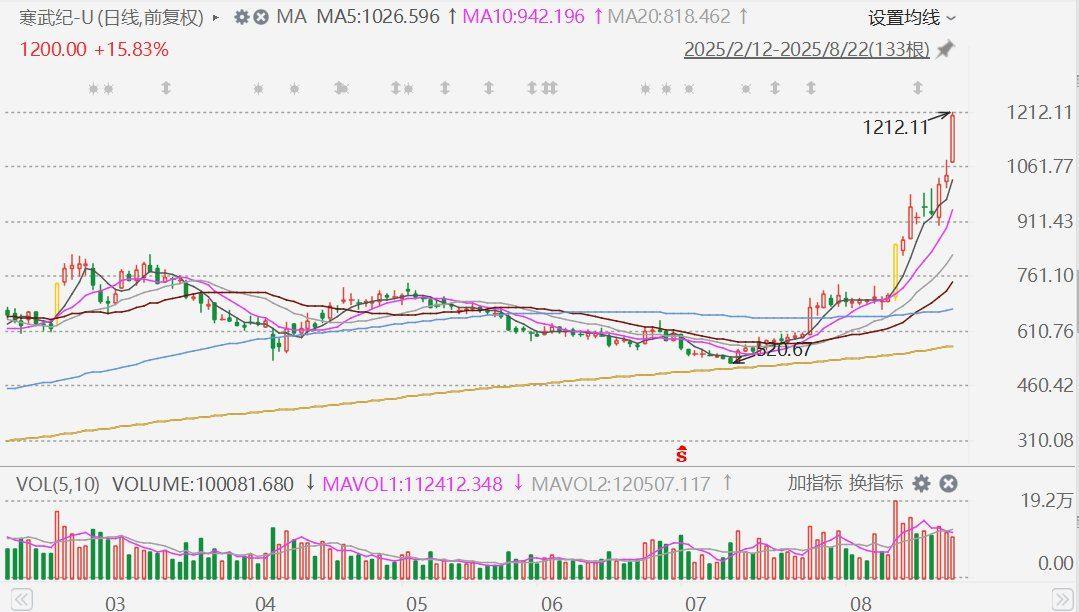
寒武纪的问询函
是说芯语· 2025-07-20 01:28
Core Viewpoint - The article discusses the upcoming fundraising by Cambrian and highlights the company's focus on cloud-based revenue growth, which is expected to see significant increases starting from Q4 2024 [1]. Group 1: Cambrian's Financial Projections - Cambrian's cloud product line revenue is projected to reach approximately 110.9 million in Q1 2025, accounting for 99.94% of total revenue, compared to 9.1 million in 2022, which was only 12.80% of total revenue [1]. - The company anticipates a substantial increase in revenue due to alleviated supply chain issues, with a total revenue of 110.97 million expected in Q1 2025 [1]. Group 2: Market Dynamics and Competitors - Morgan Stanley estimates that the domestic cloud AI chip market will reach 48 billion by 2027, with the majority of the market share held by a leading competitor [3]. - Goldman Sachs has a more optimistic view on Cambrian, predicting revenues of 5.5 billion this year and 24.7 billion by 2027, which surpasses the combined revenue of all other GPU companies as estimated by Morgan Stanley [6]. Group 3: Production Capacity and Supply Chain - Cambrian's production capacity is currently limited, primarily serving a major client, with rumors of a significant order of 100,000 units from this client [9]. - The company is expected to see an increase in production capacity as supply chain issues are resolved, leading to improved revenue and profit margins [9]. - Inventory levels are a key focus, with an anticipated turning point in Q3 2024, after which revenue is expected to surge [9].
中国连续3个月减持美债,以旧换新带动消费2.9万亿 | 财经日日评
吴晓波频道· 2025-07-19 00:04
Group 1: Foreign Investment Policies - The Chinese government is encouraging foreign investors to reinvest in China by implementing tax support policies and simplifying investment processes [1][2] - The new measures allow foreign investment enterprises to reinvest profits without needing to register for domestic reinvestment, thus reducing currency and tax costs [1] Group 2: Domestic Consumption and Economic Policies - The "old-for-new" policy has significantly boosted domestic consumption, with sales reaching 2.9 trillion yuan, benefiting around 400 million people [3][4] - The government plans to continue supporting this policy to stimulate domestic demand, although the effectiveness may diminish without additional supportive measures [4] Group 3: U.S. Treasury Holdings - China has continued to reduce its holdings of U.S. Treasury bonds for three consecutive months, with a total holding of 756.3 billion USD as of May [5][6] - This trend reflects a strategic move to decrease reliance on the U.S. dollar and promote the internationalization of the yuan [6] Group 4: Central Enterprises Performance - Central enterprises reported a value-added output of 5.2 trillion yuan and a profit total of 1.4 trillion yuan in the first half of the year, indicating stable performance amid external challenges [7][8] - Investment in strategic emerging industries remains high, showcasing a shift in focus towards enhancing future competitiveness [8] Group 5: Automotive Tax Policy Changes - The threshold for luxury car consumption tax has been lowered from 1.3 million yuan to 900,000 yuan, which will increase costs for certain vehicle buyers [9][10] - This policy aims to boost tax revenue while potentially dampening luxury car sales, although the overall impact is expected to be manageable [10] Group 6: Semiconductor Industry Insights - TSMC reported a 61% increase in net profit for Q2 2025, driven by strong demand for advanced semiconductor processes, particularly in AI applications [11][12] - The company maintains a leading position in the market, with advanced processes accounting for 74% of total revenue, indicating robust customer demand for cutting-edge technology [11] Group 7: Volvo's Financial Challenges - Volvo reported its first quarterly loss since going public, with a 10 billion SEK operating loss due to high one-time costs related to U.S. tariffs [13][14] - The company is exploring options to establish manufacturing in the U.S. to mitigate tariff impacts, reflecting broader challenges faced by global automakers [14] Group 8: Stock Market Trends - The stock market showed mixed performance, with the Shanghai Composite Index reaching a new high for the year, indicating a recovery in trading enthusiasm [15][16] - Market dynamics are influenced by various sectors, with energy and metal prices showing upward trends, although the sustainability of these price increases remains uncertain [15]
光模块、PCB板块火爆,已经走出十倍股!高手看好这些新赛道!
Mei Ri Jing Ji Xin Wen· 2025-07-18 10:29
Market Performance - The Shanghai Composite Index has been rising, with significant volume increases on Thursday and Friday, challenging recent highs of 3555 points [1] - The strong performance of the semiconductor sector, particularly related to Nvidia's H20 chip sales resuming to China, has driven interest in technology growth stocks [1][4] - The rare earth, lithium, and RDA concepts have also shown strong performance this week [1] Competition Highlights - The 66th round of the stock simulation competition concluded with the top three participants achieving returns of 32.83%, 31.48%, and 26.98% respectively [1] - A total of 688 participants reported positive returns and will receive cash rewards [1] Upcoming Events - The 67th round of the competition will start on July 21, with registration open from July 19 to July 31 [3][11] - Participants can win cash rewards based on their performance, with the first place receiving 688 yuan and additional rewards for subsequent ranks [3][11] Investment Insights - Participants have identified strong opportunities in the optical module stocks within Nvidia's supply chain, with notable gains in stocks like Zhongji Xuchuang and Xinyisheng [4][6] - The AI chip market is projected to exceed $150 billion by 2025 and grow to $400 billion by 2027, indicating significant growth potential in this sector [6] - The market sentiment is shifting towards sectors with strong earnings elasticity, moving from defensive to offensive stock selections [10]
交银国际每日晨报-20250718
BOCOM International· 2025-07-18 02:13
Group 1: Company Overview - TSMC's management has raised its full-year revenue growth guidance from approximately 25% to 30% year-on-year, indicating strong resilience in gross margin at 58.6%, surpassing previous expectations [1][2] - The company anticipates that the demand for AI chips will increase due to the U.S. government's relaxation of export restrictions, which is expected to drive the demand for advanced process technologies [2] - TSMC plans to ramp up production of its 2nm process technology in the second half of 2025, with expectations that the volume of 2nm wafers will exceed that of 3nm and 5nm wafers during the same period [2] Group 2: Financial Projections - The target price for TSMC has been raised to $280, reflecting a potential upside of 17.9% from the closing price of $237.56, based on a 26x average P/E ratio for 2025/26 [1][2] - Adjustments to earnings per share (EPS) estimates have been made, with new projections set at 59.5 and 65.5 New Taiwan Dollars, down from previous estimates of 60.8 and 69.6 New Taiwan Dollars [2] Group 3: Market Context - The report highlights that the recovery in consumer electronics is expected to be moderate due to trade uncertainties, but the high demand for AI is likely to sustain TSMC's pricing for 3nm and 5nm technologies [2] - The global semiconductor market is projected to see 30% of its capacity in processes below 2nm being produced in the U.S. in the long term [2]