半导体

Search documents
英诺激光(301021) - 301021英诺激光投资者关系管理信息20251120
2025-11-21 07:44
Financial Performance - The company's net profit for 2025 increased by 2464.79% year-on-year, with new business revenue (semiconductors and renewable energy) growing by 54.66% [1] - Cumulative cash dividends since listing amount to 48.4984 million, accounting for 40.65% of total net profit [4][8] - The gross profit margin for the laser business reached 54.38% in the first half of 2024, primarily due to the ramp-up of high-end products [3][8] Business Operations - Revenue from new businesses (semiconductors and renewable energy) in the first half of 2025 was approximately 54.66% higher than the previous year, totaling about 54.6727 million [3] - The company currently has sufficient production capacity to meet existing order demands [3] - The company has completed the layout for new businesses in semiconductors, renewable energy, next-generation displays, and biomedicine [7][8] Strategic Focus - The company is focusing on five core areas: consumer electronics, semiconductors, renewable energy, next-generation displays, and biomedicine [7][8] - The company aims to enhance its core competitiveness through technological iteration and market channel expansion [8] Shareholder Engagement - The company has implemented three cash dividend distributions and two share buybacks since its listing [4] - Future profit distribution plans will be announced in subsequent company announcements [4][8] Product Development - The company has made significant advancements in diamond cutting technology, achieving a revenue of over 30 million in 2024 from this segment [4] - The company is one of the few globally capable of mass-producing industrial deep ultraviolet nanosecond lasers, maintaining a leading position in domestic sales [6]
日本政府批准21.3万亿日元经济刺激对策
日经中文网· 2025-11-21 07:43
Economic Measures - The Japanese government approved a comprehensive economic measure with a scale of 21.3 trillion yen, which includes tax reductions such as the abolition of the temporary gasoline tax [2][4] - The economic measures are expected to increase Japan's real GDP by approximately 24 trillion yen and raise the annual growth rate by about 1.4% [2][4] Budget Allocation - The general account expenditure for the supplementary budget for the fiscal year 2025 is set at 17.7 trillion yen, which is an increase of 4 trillion yen compared to the fiscal year 2024 [4] - Total fiscal expenditure, including special accounts, amounts to 21.3 trillion yen, with a total project scale encompassing central government, local governments, and private funds reaching 42.8 trillion yen [4] Economic Strategy Pillars - The economic strategy is built on three pillars: (1) ensuring living security and addressing rising prices, (2) achieving a "strong economy" through crisis management investments and growth investments, and (3) strengthening defense and diplomatic capabilities [4]


收盘丨A股三大指数放量调整,市场近5100只个股下跌
Di Yi Cai Jing· 2025-11-21 07:16
沪深两市成交额1.97万亿,较上一个交易日放量2575亿。 11月21日,A股三大指数集体下挫,个股呈现普跌态势。截至收盘,沪指跌2.45%,深成指跌3.41%,创业板指跌4.02%。 | 代码 | 名称 | 两日图 | 现价 | 涨跌 | 涨跌幅 | | --- | --- | --- | --- | --- | --- | | 000001 | 上证指数 | 1 Wm | 3834.89 | -96.16 | -2.45% | | 399001 | 深证成指 | WW | 12538.07 | -442.75 | -3.41% | | 399006 | 创业板指 | 1 mon | 2920.08 | -122.26 | -4.02% | 盘面上,锂电池产业链领跌,锂矿方向掀跌停潮;算力硬件题材大幅走低,存储器方向跌幅靠前;半导体、消费电子、光伏、金融科技 概念股跌幅明显。 具体来看,军工板块表现活跃,品高股份、龙溪股份、特发信息涨停,久之洋、江龙船艇涨超10%。 沪深两市成交额1.97万亿,较上一个交易日放量2575亿。全市场近5100只个股下跌。 | | | 【资金流向】 主力资金全天净流入传媒、农林 ...



金海通跌2.10%,成交额1.94亿元,主力资金净流入998.17万元
Xin Lang Cai Jing· 2025-11-21 06:48
Company Overview - Jin Haitong Semiconductor Equipment Co., Ltd. is located in Qingpu District, Shanghai, established on December 24, 2012, and listed on March 3, 2023. The company specializes in the research, production, and sales of semiconductor chip testing equipment [1][2]. Financial Performance - For the period from January to September 2025, Jin Haitong achieved operating revenue of 482 million yuan, representing a year-on-year growth of 87.88%. The net profit attributable to shareholders was 125 million yuan, showing a year-on-year increase of 178.18% [2]. - Since its A-share listing, Jin Haitong has distributed a total of 35.6963 million yuan in dividends [3]. Stock Performance - As of November 21, Jin Haitong's stock price decreased by 2.10%, trading at 121.45 yuan per share, with a total market capitalization of 7.287 billion yuan. The stock has increased by 68.89% year-to-date, but has seen a decline of 2.85% over the last five trading days and 9.64% over the last twenty days [1]. - The stock has appeared on the "Dragon and Tiger List" once this year, with the most recent occurrence on October 14, where it recorded a net purchase of 6.0002 million yuan [1]. Shareholder Information - As of September 30, 2025, the number of Jin Haitong's shareholders was 10,600, an increase of 10.28% from the previous period. The average number of circulating shares per shareholder was 3,927, a decrease of 9.32% [2]. - Among the top ten circulating shareholders, Guoshou Anbao Smart Life Stock A (001672) is the ninth largest shareholder, holding 632,800 shares as a new investor [3]. Market Position - Jin Haitong operates within the electronic semiconductor equipment industry, with its business segments including testing sorting machines (86.69% of revenue), spare parts (12.43%), and other supplementary services (0.88%) [1][2].

华源控股3亿成立半导体公司
Xin Lang Cai Jing· 2025-11-21 06:45
Core Viewpoint - Suzhou Huayuan Semiconductor Co., Ltd. has been established with a registered capital of 300 million RMB, focusing on semiconductor device manufacturing and related equipment [1] Company Summary - The legal representative of Suzhou Huayuan Semiconductor is Zhang Jian [1] - The company is wholly owned by Huayuan Holdings (002787) [1] - The business scope includes manufacturing and sales of semiconductor device specialized equipment, manufacturing of electronic specialized materials, and manufacturing of industrial automatic control system devices [1]

中芯国际跌2.02%,成交额7.06亿元,主力资金净流出7180.91万元
Xin Lang Cai Jing· 2025-11-21 04:34
Core Viewpoint - SMIC's stock price has shown volatility, with a year-to-date increase of 20.93% but a recent decline of 3.18% over the last five trading days and 14.65% over the last twenty days [2] Financial Performance - For the period from January to September 2025, SMIC reported revenue of 49.51 billion yuan, representing a year-on-year growth of 18.22%, and a net profit attributable to shareholders of 3.82 billion yuan, which is a 41.09% increase year-on-year [3] Stock Market Activity - As of November 21, SMIC's stock price was 114.42 yuan per share, with a market capitalization of 915.37 billion yuan. The stock experienced a net outflow of 71.81 million yuan in principal funds, with significant selling pressure [1] - SMIC has appeared on the stock market's "Dragon and Tiger List" once this year, with the last occurrence on August 28, where it recorded a net buy of -422 million yuan [2] Shareholder Structure - As of September 30, 2025, SMIC had 336,200 shareholders, an increase of 33.27% from the previous period. The average number of circulating shares per shareholder decreased by 25.41% to 6,134 shares [3] - Notable changes in institutional holdings include a decrease in shares held by major ETFs, with the top ten circulating shareholders reflecting significant reductions in holdings [3]

盛美上海跌2.11%,成交额8676.99万元,主力资金净流出756.59万元
Xin Lang Cai Jing· 2025-11-21 02:09
Core Insights - The stock price of Shengmei Shanghai has decreased by 2.11% on November 21, trading at 157.51 CNY per share with a market capitalization of 75.631 billion CNY [1] - Year-to-date, Shengmei Shanghai's stock has increased by 58.55%, but it has seen a decline of 5.15% in the last five trading days and 18.09% over the past 20 days [2] Financial Performance - For the period from January to September 2025, Shengmei Shanghai reported a revenue of 5.146 billion CNY, representing a year-on-year growth of 29.42%, and a net profit attributable to shareholders of 1.266 billion CNY, which is a 66.99% increase year-on-year [2] - Since its A-share listing, Shengmei Shanghai has distributed a total of 0.723 billion CNY in dividends [3] Shareholder Information - As of September 30, 2025, the number of shareholders for Shengmei Shanghai has increased by 85.89% to 21,700, while the average circulating shares per person have decreased by 46.20% to 20,098 shares [2] - The top ten circulating shareholders have seen a reduction in holdings, with significant decreases noted for major institutional investors [3]

华虹公司跌2.01%,成交额2.04亿元,主力资金净流出4331.07万元
Xin Lang Cai Jing· 2025-11-21 02:01
Core Viewpoint - Huahong Semiconductor has experienced a significant stock price increase of 138.09% year-to-date, but recent trading shows a decline in the short term, indicating potential volatility in the stock performance [1][2]. Financial Performance - For the period from January to September 2025, Huahong Semiconductor achieved a revenue of 12.583 billion yuan, representing a year-on-year growth of 19.82%. However, the net profit attributable to shareholders decreased by 56.52% to 251 million yuan [2]. - The company has distributed a total of 258 million yuan in dividends since its A-share listing [3]. Stock Market Activity - As of November 21, the stock price of Huahong Semiconductor was 110.64 yuan per share, with a market capitalization of 192.054 billion yuan. The stock has seen a trading volume of 204 million yuan and a turnover rate of 0.45% [1]. - The stock has appeared on the "龙虎榜" (a list of stocks with significant trading activity) three times this year, with the most recent appearance on October 13, where it recorded a net buying of 52.2506 million yuan [1]. Shareholder Structure - As of September 30, 2025, the number of shareholders for Huahong Semiconductor increased by 30.97% to 49,000. The top ten circulating shareholders include new entrants such as Galaxy Innovation Mixed A and Noan Growth Mixed A [2][3].
上海新阳涨2.18%,成交额9975.55万元,主力资金净流入37.81万元
Xin Lang Cai Jing· 2025-11-21 01:53
Core Viewpoint - Shanghai Xinyang's stock price has shown significant volatility, with a year-to-date increase of 55.53% and a recent 8.33% rise over the last five trading days, indicating strong market interest and potential growth in the semiconductor materials sector [2]. Company Overview - Shanghai Xinyang Semiconductor Materials Co., Ltd. was established on May 12, 2004, and went public on June 29, 2011. The company specializes in the research, production, sales, and service of key process materials and equipment for integrated circuit manufacturing and advanced packaging, as well as environmentally friendly functional coatings [2]. - The company's revenue composition includes 74.93% from integrated circuit materials, 20.86% from coatings, 2.76% from supporting equipment and accessories, 1.34% from integrated circuit plating processing, and 0.11% from other sources [2]. Financial Performance - For the period from January to September 2025, Shanghai Xinyang achieved a revenue of 1.394 billion yuan, representing a year-on-year growth of 30.62%. The net profit attributable to the parent company was 211 million yuan, reflecting a substantial increase of 62.70% [2]. - The company has distributed a total of 458 million yuan in dividends since its A-share listing, with 189 million yuan distributed over the past three years [3]. Shareholder Information - As of October 31, 2025, the number of shareholders for Shanghai Xinyang was 39,500, a decrease of 0.40% from the previous period. The average number of tradable shares per shareholder increased by 0.40% to 7,054 shares [2]. - Among the top ten circulating shareholders, Hong Kong Central Clearing Limited held 3.3845 million shares, a decrease of 19,000 shares from the previous period [3].

ETF日报-A股三大股指全线收跌,半导体ETF(159813)昨日获逆市净申购达5000万元
Xin Lang Cai Jing· 2025-11-21 01:28
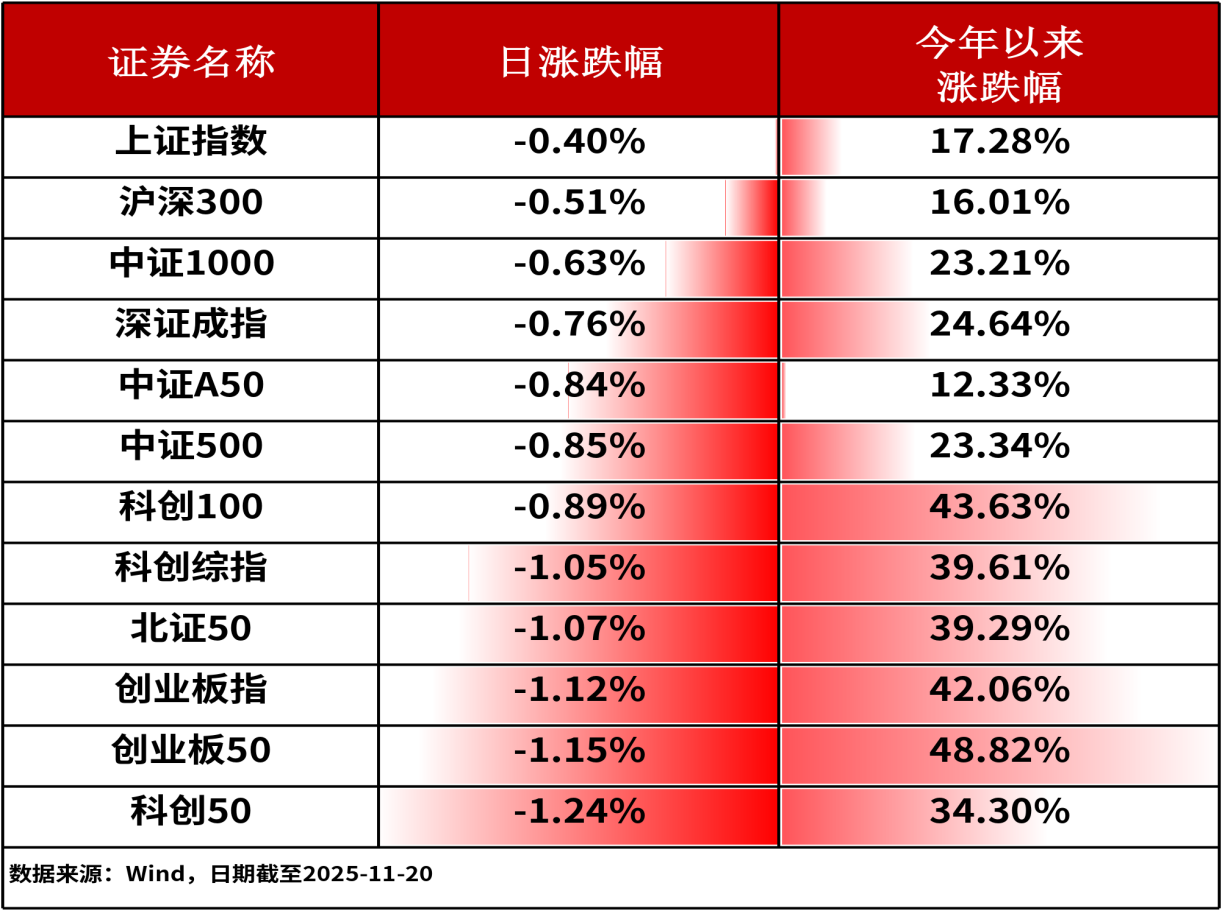
Market Overview - On November 20, A-shares experienced a decline across all major indices, with the Shanghai Composite Index falling by 0.40%, the Shenzhen Component Index down by 0.76%, and the ChiNext Index decreasing by 1.12% [1] - The overall market showed a correction trend, with only 1,453 stocks rising [1] - The total trading volume in the Shanghai and Shenzhen markets was 17,082 billion RMB, slightly lower than the previous trading day [1] Index Performance - The following indices showed daily and year-to-date performance: - Shanghai Composite Index: -0.40% (YTD: +17.28%) - Shenzhen Component Index: -0.76% (YTD: +24.64%) - ChiNext Index: -1.12% (YTD: +42.06%) - STAR Market 50 Index: -1.24% (YTD: +34.30%) [2] Sector Performance - The construction materials sector led with a gain of 1.40%, followed by the comprehensive sector at 0.87% and the banking sector at 0.86% [6] - Conversely, the beauty and personal care sector saw a decline of 2.39%, coal fell by 2.10%, and electrical equipment dropped by 1.96% [6] Fund Flows - In terms of ETF categories, significant net inflows were observed in: - Hong Kong Technology (+2.954 billion) - Semiconductor Chips (+1.164 billion) - STAR Market 50 (+1.082 billion) - Notable net outflows included: - CSI 300 (-1.208 billion) - Battery Storage (-0.660 billion) - Banking sector (-0.597 billion) [7] Industry Insights - In the chemical sector, the phosphate iron lithium industry is facing significant losses, prompting the China Chemical and Physical Power Industry Association to release a notification to regulate industry development and pricing [8] - The lithium battery industry is projected to see a 26.75% year-on-year increase in exports, with a total industry output value expected to exceed 3 trillion RMB [8] - In the new energy vehicle sector, a draft for government procurement standards has been proposed to ensure fair treatment of suppliers [9] AI and Semiconductor Developments - The U.S. government is set to launch an initiative named "Genesis Mission" to advance AI development, which is considered as significant as the Manhattan Project [10] - NVIDIA plans to adopt 12-inch silicon carbide substrates in its next-generation GPU chips to enhance performance [11]