元宇宙

Search documents
Meta2025年Q4营收598.9亿美元同比增长24%,元宇宙业务仍亏损
Jin Rong Jie· 2026-01-29 05:22
与此同时,负责元宇宙与硬件研发的 Reality Labs 部门在第四季度录得 60.2 亿美元经营亏损,全年累计 亏损接近 192 亿美元(现汇率约合 1335.57 亿元人民币),显示出其尖端技术研发仍处于高投入、低回 报的阵痛期。尽管该部门第四季度实现销售额 9.55 亿美元(现汇率约合 66.43 亿元人民币),但持续亏 损态势未改。 1 月 29 日,Meta 今天公布了 2025 财年第四季度及全年财报,各项核心指标均显著超越华尔街此前预 期。 财报显示,受益于 AI 驱动的广告效率提升,Meta 该季度实现营收 598.9 亿美元(现汇率约合 4166 亿 元人民币),同比大幅增长 24%; 每股收益 (EPS) 达到 8.88 美元(IT之家注:现汇率约合 61.8 元人民 币),优于市场一致预期的 8.21 美元(现汇率约合 57.1 元人民币)。2025 年全年营收规模首次突破 2000 亿美元大关,达到 2009.7 亿美元(现汇率约合 1.4 万亿元人民币)。该公司 2025 年全年资本支出 高达 722 亿美元(现汇率约合 5022.29 亿元人民币)。 核心业务方面,Meta 旗下 ...

小扎搞元宇宙,巨亏1335亿元
3 6 Ke· 2026-01-29 02:28
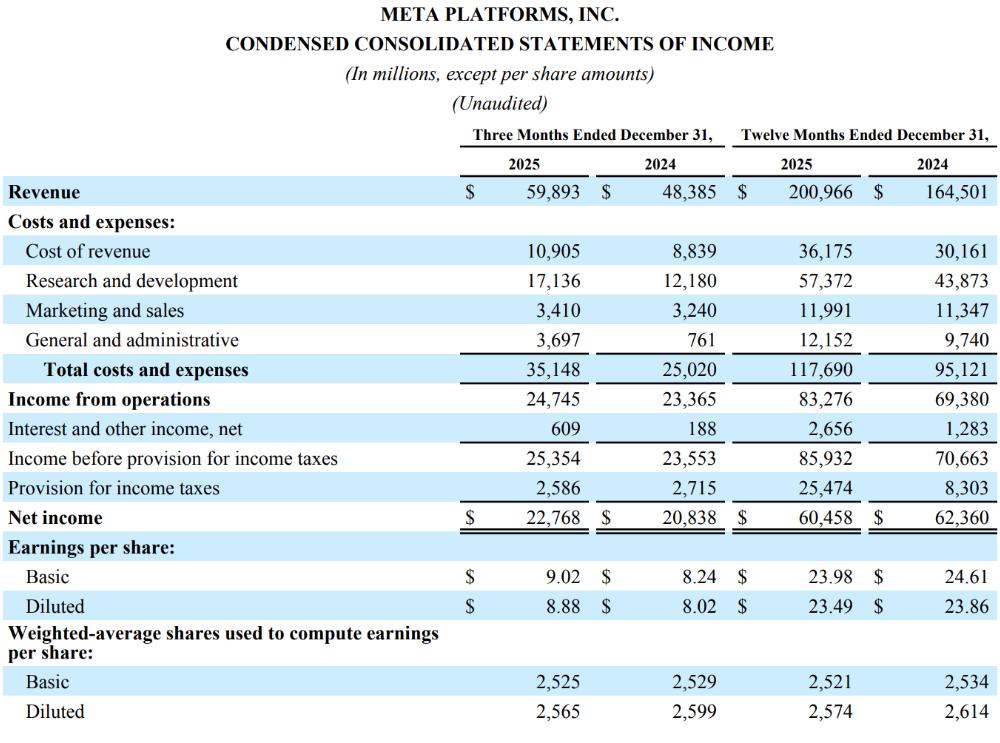
智东西1月29日报道,今天,Meta公布了其2025年四季度及年度财报,2025年第四季度其营收为598.93亿美元(约合人民币4165.35亿元),全 年营收为2009.66亿美元(约合人民币1.4万亿元),分别同比增长24%和22%。其中,超过98%的收入来自Family of Apps业务的广告收入,即 Facebook、Instagram、WhatsApp等应用的收入。 | | | | Three Months Ended December 31, | | | | Twelve Months Ended December 31, | | | --- | --- | --- | --- | --- | --- | --- | --- | --- | | | 2025 | | | 2024 | | 2025 | | 2024 | | Revenue | S | 59,893 | S | 48,385 | $ | 200,966 | $ | 164,501 | | Costs and expenses: | | | | | | | | | | Cost of revenue | | 10,905 | | 8 ...

扎克伯格回应收购Manus:整合技术至现有平台
Sou Hu Cai Jing· 2026-01-29 01:01
Core Viewpoint - Meta's Q4 2025 financial results exceeded analyst expectations, driven by strong online advertising performance and AI-driven enhancements [3][4]. Financial Performance - Meta reported Q4 2025 revenue of $59.89 billion, a 25% year-over-year increase, surpassing the analyst consensus of $58.42 billion [3]. - The company's net profit for the quarter was $22.8 billion, up 9% from the previous year, also exceeding the expected $21 billion [3]. Advertising Revenue - Online advertising revenue grew by 24% to $58.1 billion, accounting for 97% of total revenue [3]. - CEO Mark Zuckerberg attributed the growth to record holiday demand and improvements from AI investments [3]. Future Revenue Projections - For Q1 2026, Meta anticipates revenue between $53.5 billion and $56.5 billion, higher than the analyst forecast of $51.27 billion [4]. Capital Expenditure - Meta expects capital expenditures for 2026 to range from $115 billion to $135 billion, a significant increase of 59.7% to 87.5% compared to $72 billion in 2025 [4]. - Total expenditures are projected to be between $162 billion and $169 billion, up from $117.69 billion in 2025 [4]. AI Development and Strategy - Meta is focusing on developing top-tier AI models and plans to release a preview of a new model in Q1 2026, with broader deployment expected in Q2 [6]. - The company aims to integrate AI models into its products, including WhatsApp and Instagram, to enhance functionality and meet market demands [7]. Market Sentiment and Stock Performance - Following the Q4 earnings report, Meta's stock rose over 11% in after-hours trading, reflecting improved market sentiment towards its AI strategy [5]. - Despite previous concerns regarding aggressive capital spending and its impact on profit margins, recent developments in AI have alleviated some market anxieties [5]. Reality Labs Performance - Meta's Reality Labs division reported Q4 sales of $955 million, with a net loss exceeding $6 billion, and is expected to incur losses of over $19 billion for the full year 2025 [8]. - The company has initiated layoffs of approximately 10% in this division to refocus resources on AI projects [8].

无视元宇宙巨亏!Meta激进布局AI,Q4财报传递关键信号:高投入=高增长?
Zhi Tong Cai Jing· 2026-01-29 00:26
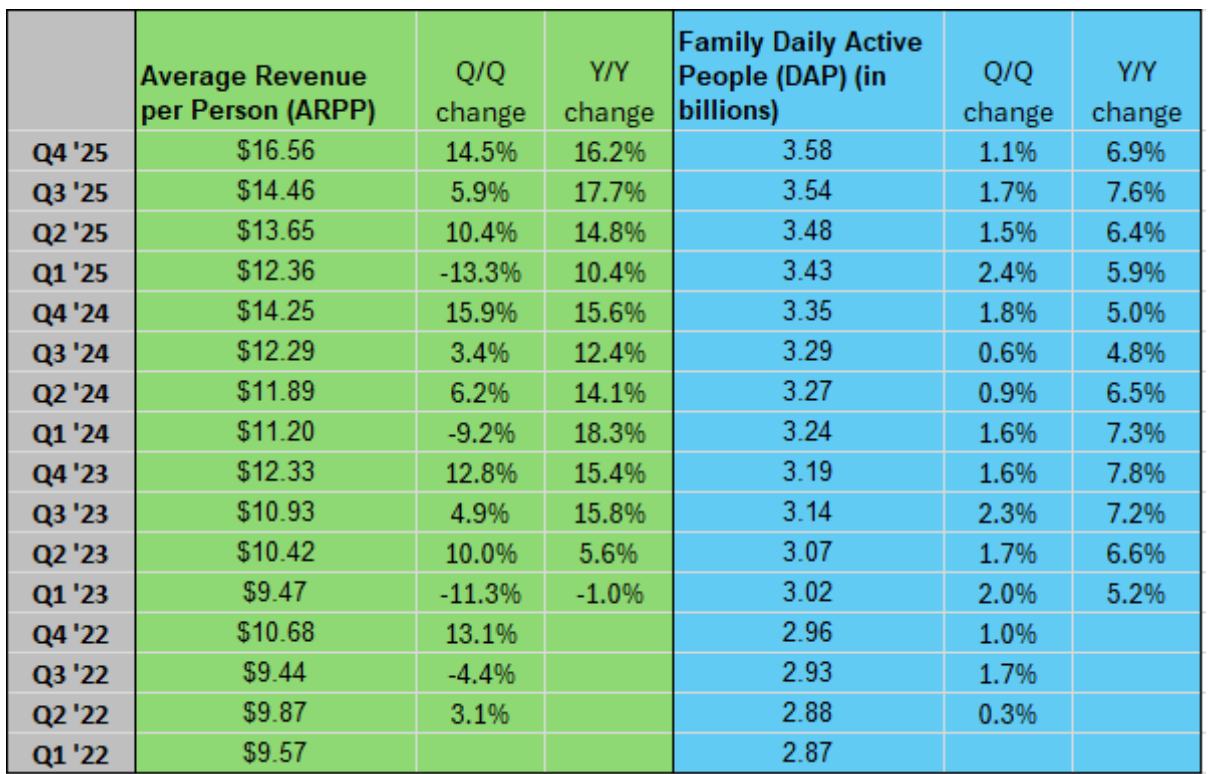
Core Insights - Meta Platforms reported Q4 and full-year results for FY2025, significantly exceeding Wall Street expectations, driven by AI-enhanced advertising efficiency [1] - The company achieved Q4 revenue of $59.89 billion, a 24% year-over-year increase, with EPS of $8.88, surpassing the consensus estimate of $8.21 [1] - For the full year, Meta's revenue exceeded $200 billion for the first time, reaching $200.97 billion, with capital expenditures of $72.2 billion [1] Financial Performance - Daily Active Users (DAU) for Meta's Family of Apps rose to 3.58 billion, a 7% year-over-year increase, while ad impressions grew by 18% and unit prices increased by 6% [1] - Meta's CEO, Mark Zuckerberg, emphasized the company's transition towards a "super-intelligent" era, integrating generative AI into advertising systems and wearable devices [1] Capital Expenditure and Future Outlook - Meta's capital expenditure guidance for 2026 is projected to be between $115 billion and $135 billion, significantly higher than the market expectation of approximately $110.6 billion [2] - The funds will primarily support the expansion of large-scale data centers and high-performance chip procurement for AI model training and inference [2] - Zuckerberg has committed to investing $600 billion in the U.S. by 2028 for AI technology, infrastructure, and workforce expansion [2] Challenges and Market Reactions - Concerns persist among investors regarding the tangible returns from Meta's substantial investments, particularly in AI capabilities compared to competitors [3] - The Reality Labs division reported an operating loss of $6.02 billion in Q4, with total annual losses nearing $19.2 billion, indicating ongoing high investment with low returns [3] - Despite concerns over high spending, Meta's stock rose over 7% in after-hours trading due to strong revenue performance and optimistic guidance for 2026 [4]
无视元宇宙巨亏!Meta(META.US)激进布局AI,Q4财报传递关键信号:高投入=高增长?
Zhi Tong Cai Jing· 2026-01-28 23:53
Core Insights - Meta Platforms reported Q4 and full-year results for FY2025, exceeding Wall Street expectations with Q4 revenue of $59.89 billion, a 24% year-over-year increase, and EPS of $8.88, surpassing the consensus estimate of $8.21 [1] - The company achieved a full-year revenue of $200.97 billion for 2025, marking its first time surpassing the $200 billion threshold, with capital expenditures reaching $72.2 billion [1] Financial Performance - Average Revenue Per Person (ARPPU) for Q4 2025 was $16.56, reflecting a 14.5% quarter-over-quarter increase and a 16.2% year-over-year increase [2] - Daily Active People (DAP) across Meta's family of apps reached 3.58 billion, a 7% year-over-year growth, with ad impressions increasing by 18% and unit prices rising by 6% [2] Strategic Initiatives - CEO Mark Zuckerberg emphasized the transition towards a "super-intelligent" era, integrating generative AI into advertising systems and wearable devices, aiming to convert technological investments into revenue growth [5] - The strategy includes "front-loading" computing capabilities to prepare for achieving superintelligence, a theoretical milestone where AI surpasses human-level performance [5] Operating Expenses - Operating expenses for Q4 2025 included $17.134 billion in Research and Development, a 40.7% year-over-year increase, and $3.410 billion in Marketing and Sales, a 5.2% year-over-year increase [6] - The company anticipates capital expenditures to rise significantly in 2026, projected between $115 billion and $135 billion, exceeding market expectations of approximately $110.6 billion [6][7] AI and Infrastructure Investments - Investments will primarily focus on expanding large-scale data centers and procuring high-end computing chips to support AI model training and inference needs [7] - Zuckerberg has committed to investing $600 billion in the U.S. by 2028 to support AI technology, infrastructure, and workforce expansion [7] Reality Labs Performance - The Reality Labs division reported an operating loss of $6.02 billion in Q4, with total annual losses nearing $19.2 billion, indicating ongoing high investment with low returns [8] - Despite generating $955 million in sales during Q4, the division continues to face significant losses, with expectations of similar challenges in 2026 [8] Market Reaction - Following the earnings report, Meta's stock rose over 7% in after-hours trading, driven by strong revenue performance and optimistic guidance for continued operating profit growth in 2026 [8] - The company is currently in a "profit-fueled computing power" cycle, leveraging cash flow from its core advertising business to keep pace with the AI wave [8]
股价盘后大涨逾8% !Meta四季度业绩、一季度指引、全年资本支出超预期
美股IPO· 2026-01-28 23:17
Core Viewpoint - Meta's financial performance in Q4 and guidance for Q1 2026 exceeded market expectations, driven by AI-enhanced advertising business, leading to a significant increase in stock price [1][3][8] Financial Highlights - Q4 Revenue: $59.893 billion, surpassing analyst expectations of $58.42 billion; 2024 full-year revenue projected at $48.385 billion, a 24% year-on-year increase [4] - Costs and Expenses: $35.148 billion in Q4, with 2024 projected at $25.020 billion, a 40% increase [4] - Operating Profit: $24.745 billion in Q4, with 2024 expected at $23.365 billion, a 6% increase [4] - Net Profit: $22.768 billion in Q4, with 2024 projected at $20.838 billion, a 9% increase [4] - Diluted EPS: $8.88 in Q4, with 2024 expected at $8.02, an 11% increase [4] Capital Expenditure and Guidance - 2026 Capital Expenditure: Expected to reach between $115 billion and $135 billion, significantly higher than the analyst average of $110.6 billion [6][10] - Total Expenses for 2026: Projected to be between $162 billion and $169 billion [11] AI and Advertising Business - AI investments are enhancing the precision and effectiveness of Meta's advertising, contributing to strong revenue performance [14] - The company is focusing on building infrastructure and talent to support its AI initiatives, which are seen as essential for competing in the AI landscape [7][10] Reality Labs and Metaverse Costs - Reality Labs reported an operating loss of $6.02 billion in Q4, with cumulative losses nearing $80 billion since late 2020 [19][20] - The company is reallocating resources from virtual reality to AI and wearable devices, indicating a strategic shift in focus [20]

多点“懂我所需”的创新(纵横)
Ren Min Ri Bao· 2026-01-28 23:10
Core Viewpoint - The article critiques the trend of "labeling innovation" in technology, particularly in AI products that fail to meet real user needs, emphasizing the importance of genuine innovation that addresses consumer demands rather than superficial technological gimmicks [1][2]. Group 1: Industry Trends - At the 2026 International Consumer Electronics Show in Las Vegas, numerous AI-driven products were showcased, including smart hair clippers and AI-controlled microwaves, which sparked discussions about their practicality and relevance to user needs [1]. - Many companies are engaging in "labeling innovation," where products are marketed with advanced technology but do not align with actual consumer requirements, leading to criticism and a reevaluation of innovation's essence [1][2]. Group 2: Consumer Insights - Consumers are increasingly aware of the gap between technological claims and actual product performance, leading to a potential erosion of trust in brands that prioritize flashy features over user experience [2]. - Products that claim advanced functionalities, such as smart refrigerators with food recognition or smart pillows that monitor sleep, often fail to deliver on their promises, resulting in user dissatisfaction [1][2]. Group 3: Future Directions - The article advocates for a balance between "AI thinking" and "human-centered awareness" in product development, suggesting that true innovation should focus on solving real user problems rather than merely showcasing technology [2]. - The expectation for future innovations is that they should enhance quality of life, with successful products emerging from a deep understanding of user needs and pain points [2].
解读媒体关注:世纪华通用游戏打开未来世界的大门
Xin Lang Cai Jing· 2026-01-28 10:13
Core Insights - Century Huatong's investment strategy extends beyond gaming, focusing on long-term value creation through technology integration and innovation [1][10] - The gaming industry is increasingly recognized for its economic and technological contributions, with China's core gaming industry nearing a trillion yuan in scale [3][12] - The company emphasizes the dual role of gaming as both an entertainment medium and a technological incubator, facilitating advancements in AI and other high-tech fields [4][13] Investment Philosophy - Chairman Wang Ji advocates for a vision of using technology to change the world, positioning gaming as a platform for technological experimentation and application [5][14] - The company's investment approach is characterized by a long-term perspective, focusing on core technological trends rather than short-term profits [6][15] Technological Integration - Century Huatong's technology investments span multiple sectors, including AI, robotics, and aerospace, with projects aimed at enhancing infrastructure and driving innovation [7][15] - The company has achieved significant returns from its investments, such as over 600 million yuan in gains from its stake in Moer Thread [6][15] Future Outlook - The convergence of gaming and technology is expected to create new opportunities, with gaming serving as a critical entry point into the virtual world [9][18] - As AI and semiconductor technologies advance, gaming is poised to play a central role in connecting various industries and applications, potentially unlocking new growth avenues for Century Huatong [9][18]

香港元宇宙平台Dbim Holdings(DBIM.US)赴美IPO募资额上调88% 拟筹资1700万美元
Zhi Tong Cai Jing· 2026-01-28 07:13
Core Viewpoint - Dbim Holdings, a metaverse market service provider, has significantly increased its IPO fundraising target to approximately $17 million, up from an initial plan of $10 million, reflecting an 88% increase in the fundraising amount [1][1][1] Company Overview - Dbim Holdings is a comprehensive metaverse market service provider based in Hong Kong, established in 2017 [1][1][1] - The company operates primarily in two segments: virtual goods services through its trading platform and metaverse scene construction services, utilizing technologies such as VR, AR, 3D modeling, and artificial intelligence [1][1][1] IPO Details - The company plans to issue 3.8 million shares at a price range of $4 to $5 per share, with a post-listing market capitalization estimated at approximately $129 million [1][1][1] - The exclusive bookrunner for this issuance is the American Trust Investment Services [1][1][1]
(经济观察)成渝双城低空经济走廊如何“起飞”?
Zhong Guo Xin Wen Wang· 2026-01-28 06:40
Core Viewpoint - The Chongqing and Sichuan regions are collaboratively developing the Chengdu-Chongqing low-altitude economic corridor, transitioning from initial cooperation in "opening routes" to deeper integration in "industrial ecosystem co-construction" [1] Group 1: Low-altitude Economic Development - The first general aviation short-haul transport routes connecting Chongqing and Sichuan successfully launched on December 27, 2024, marking the official opening of the first batch of routes [3] - The trial flight of the Sichuan Anyue to Chongqing Dazhu low-altitude route in December 2025 opened a low-altitude corridor for the Sichuan Stone Carving Temple National Park [3] - The "low-altitude sky road" is forming, with multiple cross-province low-altitude routes already opened, involving various locations in Chongqing [3] Group 2: Industrial Parks and Ecosystems - The Bishan District is constructing the "Dream Space" digital economy industrial park, focusing on low-altitude economy and attracting leading companies in the industry [4] - Dazhu is accelerating the planning and construction of a low-altitude economic industrial park, aiming to create a comprehensive industrial base integrating manufacturing, operation, and services [5] - The Liangping District is developing a low-altitude economic industrial park with a focus on the drone industry and related supply chains [5] Group 3: Future Prospects and Challenges - The Chongqing Liangjiang New Area is leveraging the Chengdu-Chongqing economic circle to establish a leading demonstration area for low-altitude economy in Western China [5] - The future development of low-altitude economy will require closer integration with various industries and cross-regional collaboration [9] - Current airspace management, legal frameworks, and infrastructure are becoming inadequate to meet the demands of the growing low-altitude economy, necessitating collaborative governance and unified technical standards [9]