
受贿罪

Search documents
检察机关依法分别对薛建华、赵队家、黄兴海提起公诉
Yang Shi Wang· 2025-07-09 08:08
Group 1 - The prosecution has been initiated against three individuals: Xue Jianhua, Zhao Duijia, and Huang Xinghai for alleged bribery offenses [1][2][3][4] - Xue Jianhua, former director of the Social Construction Committee of the Qinghai Provincial People's Congress, is accused of accepting bribes amounting to a particularly large sum while holding various positions from 2006 to 2017 [2] - Zhao Duijia, former deputy general manager and chief engineer of Shanxi Transportation Holding Group, is also accused of accepting bribes while leveraging his official positions to benefit others [3] - Huang Xinghai, former party secretary and chairman of Hainan Transportation Investment Holding Company, is charged with using his official capacity to solicit bribes and provide improper benefits to others [4] Group 2 - The cases against these individuals have been investigated by their respective provincial supervisory commissions and have now been transferred to the prosecution stage [2][3][4] - Each accused has been informed of their legal rights and has undergone questioning, with their defense opinions being considered during the prosecution process [2][3][4] - The prosecution emphasizes the particularly large amounts involved in the alleged bribery, indicating the severity of the charges against each individual [2][3][4]
以案明纪释法丨准确认定以购买原始股为名受贿行为
Zhong Yang Ji Wei Guo Jia Jian Wei Wang Zhan· 2025-07-09 00:07
Core Viewpoint - The article discusses a case of potential bribery involving state officials and private companies, highlighting the complexities of identifying corrupt practices disguised as legitimate transactions [1][4]. Basic Case Facts - A state employee, referred to as A, was involved in facilitating the IPO of a private company, B, through his relative, C, who was the legal representative of another private company [2]. - B's actual controller approached C to leverage A's position to expedite the IPO process, leading to a series of actions that benefited B [2]. Key Events - In June 2013, as B was preparing for its IPO, the controller of B promised to gift shares to C as a thank-you for the assistance provided by A and C [3]. - C made a nominal investment of 540,000 yuan for shares valued significantly higher at the time of the IPO, with the understanding that there would be no risk involved [3]. Diverging Opinions - Three differing opinions exist regarding the classification of A and C's actions, ranging from not constituting bribery to being classified as joint bribery due to the nature of the transactions [4][5][6]. Analysis of Opinions - The third opinion, which views the actions of A and C as a form of bribery, is supported by the argument that C's investment was merely a facade for receiving substantial profits from the IPO [7][8]. - The nature of C's investment and the subsequent profits are analyzed, indicating that the transaction was not a legitimate investment but rather a means to facilitate a corrupt exchange [9][10]. Conclusion on Criminality - A and C are deemed to have committed joint bribery, as A utilized his position to benefit B, while C received shares under the guise of investment, ultimately profiting significantly from the IPO [11][12][13]. - The total amount of bribes is suggested to be the entire profit C received from the shares, amounting to 26 million yuan, rather than just the nominal investment [14][15][16].
正部级齐同生被公诉,71岁退休1年后落马
证券时报· 2025-07-03 04:09
打虎。 据最高人民检察院消息,宁夏回族自治区政协原党组书记、主席齐同生涉嫌受贿一案,由国家监察委员会 调查终结,经最高人民检察院依法指定,由广西壮族自治区南宁市人民检察院审查起诉。近日,南宁市人 民检察院已向南宁市中级人民法院提起公诉。 检察机关在审查起诉阶段,依法告知了被告人齐同生享有的诉讼权利,并讯问了被告人,听取了辩护人的 意见。检察机关起诉指控:被告人齐同生利用担任宁夏回族自治区发展和改革委员会党组书记、主任,自 治区政府副主席,自治区党委常委、政府副主席,自治区政协党组书记、主席,全国政协民族和宗教委员 会副主任等职务上的便利,以及职权或者地位形成的便利条件,为他人谋取利益,非法收受他人财物,数 额特别巨大,依法应当以受贿罪追究其刑事责任。 2024年10月8日消息,齐同生被查;2025年3月14日消息,齐同生被开除党籍。 经查,齐同生丧失理想信念,背弃初心使命,长期搞迷信活动;无视中央八项规定精神,违规接受宴请; 违规收受礼金;贪婪腐化,恣意妄为,将公权力作为谋取私利的工具,搞权钱交易,利用职务便利为他人 在采矿权证办理、工程承揽等方面谋利,并非法收受巨额财物。 齐同生严重违反党的政治纪律和廉洁纪 ...


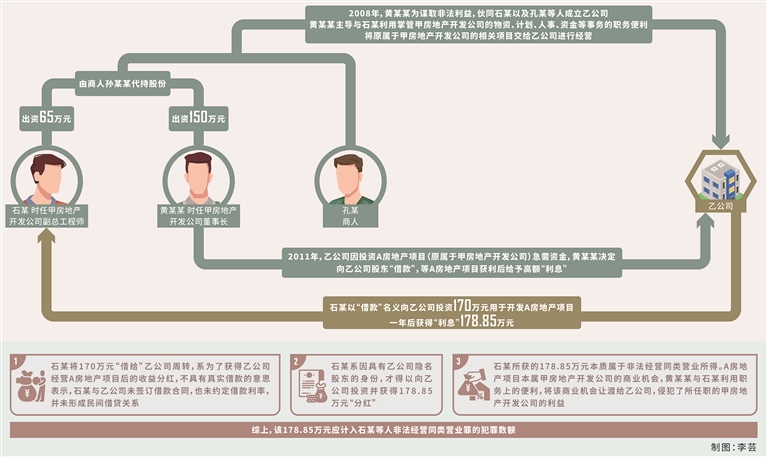
三堂会审丨借款收息还是非法经营同类营业
Zhong Yang Ji Wei Guo Jia Jian Wei Wang Zhan· 2025-07-02 01:06
Core Viewpoint - The case involves the investigation and prosecution of Shi for bribery and illegal business operations, highlighting the misuse of public office for personal gain and the legal implications of such actions [5][8][23]. Group 1: Case Background - Shi held multiple positions in a state-owned real estate development company, utilizing his role to facilitate business for others while receiving bribes totaling over 2.44 million yuan [5][23]. - A specific incident involved Shi receiving a property worth 793,000 yuan as a bribe, which was later sold by his son for 2.7 million yuan, raising questions about the proper assessment of the bribe amount [9][11]. Group 2: Legal Proceedings - The investigation began in January 2022, leading to Shi's detention and subsequent charges of bribery and illegal business operations [7][8]. - In March 2023, the court sentenced Shi to six years in prison and imposed fines totaling 550,000 yuan for his crimes, which included both bribery and illegal business activities [8][24]. Group 3: Legal Interpretations - The court determined that the bribe amount should be based on the market value of the property at the time of receipt, rather than the sale price, establishing a precedent for similar cases [11][12]. - The actions of Shi and his co-conspirators were classified as illegal business operations, as they exploited their positions to divert projects from the state-owned company to a private entity, resulting in significant illegal profits [12][13][20]. Group 4: Sentencing Considerations - The court considered mitigating factors such as Shi's confession and cooperation with the investigation, which influenced the final sentencing decision [22][24]. - The ruling emphasized the importance of accountability for public officials and the legal consequences of corruption within state-owned enterprises [23][24].
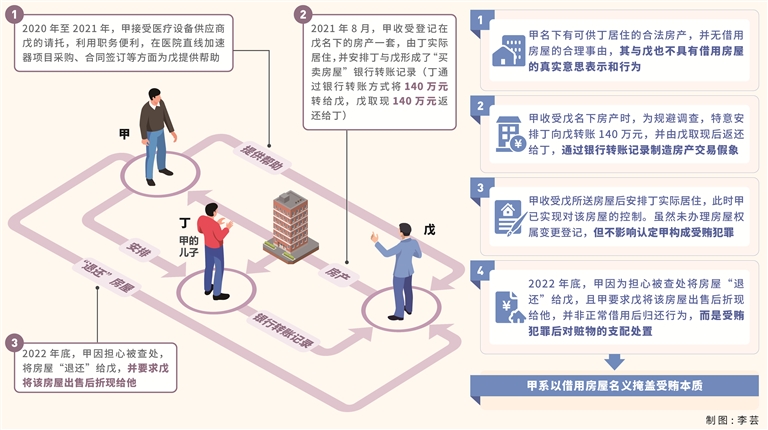
三堂会审丨借用房屋还是受贿
Zhong Yang Ji Wei Guo Jia Jian Wei Wang Zhan· 2025-06-25 00:34
Core Viewpoint - The case involves a former hospital executive, referred to as "甲," who engaged in corrupt practices, including accepting bribes and misusing his position to benefit others, leading to significant legal consequences [4][5][10]. Summary by Sections Basic Case Facts - "甲" held multiple senior positions at a public hospital and violated organizational discipline by accepting a bribe of 10,000 yuan from a subordinate, "乙," in exchange for helping "乙's" daughter secure a job, which he ultimately failed to do [4][5]. - Over the years, "甲" received over 4.75 million yuan in bribes while leveraging his authority in procurement and project contracts [5][10]. Investigation Process - The investigation began on May 10, 2024, leading to "甲" being placed under detention on May 13, 2024, and subsequently expelled from the Party and public office in August and October 2024, respectively [7][8]. - On September 18, 2024, the case was formally prosecuted, resulting in a conviction for bribery with a sentence of eleven years in prison and a fine of 1.5 million yuan [9][20]. Legal Analysis - The actions of "甲" were classified as a violation of organizational discipline and bribery, as he accepted money and facilitated a promotion for "乙" based on the bribe received [11][12]. - The court determined that "甲's" acceptance of a property from a supplier, "戊," constituted bribery, despite the property not being formally registered in his name [13][15]. - The court rejected arguments that "甲's" return of the property indicated a cessation of criminal activity, affirming that the bribery was complete upon acceptance and use of the property [14][16]. Sentencing Considerations - "甲" argued for a lighter sentence based on claims of self-reporting and cooperation, but the court found these claims unsubstantiated, as the investigation had already uncovered his actions prior to any self-reporting [20][21]. - The court concluded that "甲's" actions constituted a particularly large amount of bribery, justifying the eleven-year sentence and fine [21].
非法收受财物1.21亿余元 刘跃进一审被判死缓
第一财经· 2025-06-23 10:02
微信编辑 | 格蕾丝 2025.06. 23 本文字数:439,阅读时长大约1分钟 封面图来源 | 央视新闻客户端 据 央视新闻客户端, 2025年6月23日,福建省福州市中级人民法院一审公开宣判十三届全国政协委 员刘跃进(副部长级)受贿案,对被告人刘跃进以受贿罪判处死刑,缓期二年执行,剥夺政治权利终 身,并处没收个人全部财产;对刘跃进犯罪所得财物及孳息依法予以追缴,上缴国库。 经审理查明:1992年至2020年,被告人刘跃进利用担任天津市公安局塘沽分局副局长,公安部禁毒 局局长、党委委员、部长助理,国家禁毒委员会副主任兼办公室主任等职务上的便利,为有关单位和 个人在企业经营、融资借款等方面提供帮助,直接或通过他人非法收受财物共计折合人民币1.21亿余 元。 福州市中级人民法院认为,被告人刘跃进的行为构成受贿罪,受贿数额特别巨大,并使国家和人民利 益遭受特别重大损失,应依法惩处。鉴于其到案后如实供述自己罪行,主动交代办案机关尚未掌握的 大部分受贿犯罪事实;认罪悔罪,积极退赃,受贿赃款赃物已全部追缴,依法可以对其从轻处罚。法 庭遂作出上述判决。 ...
教育局副局长索贿炒股,听信“内幕消息”巨亏逾60%
Hua Xia Shi Bao· 2025-06-20 23:22
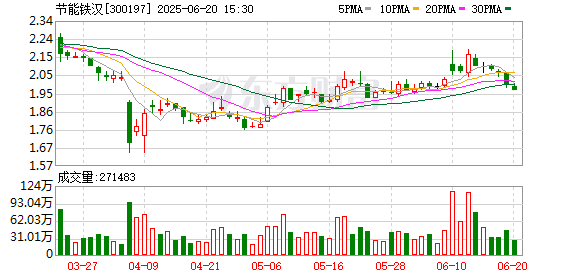
Core Points - The article discusses the sentencing of Yang, a former deputy director of the Education Bureau in Hubei, for accepting bribes totaling approximately 1.95 million yuan, leading to a ten-year prison sentence and a fine of 500,000 yuan [2][5] - Yang misused his position to benefit his brother-in-law, Huang, in operating a campus supermarket, which generated significant profits [3][4] - Yang's investment in stocks, particularly in Tiexin Ecological (now known as "Energy Tiexin"), resulted in substantial losses, exceeding 210,000 yuan, due to reliance on insider information [7][8] Summary by Sections Bribery and Sentencing - Yang utilized his official capacity to secure advantages for Huang in establishing a campus supermarket, which was initially denied to other competitors [3][4] - The court found that Yang's actions constituted bribery, leading to a conviction and a ten-year sentence [5][6] Financial Misconduct - Yang invested a total of 3.4 million yuan in Tiexin Ecological using borrowed accounts, resulting in a loss of over 210,000 yuan, which is more than 60% of his investment [7][8] - The stock price of Tiexin Ecological fell significantly during Yang's investment period, dropping from around 10 yuan to less than 3 yuan, indicating a decline of over 70% [8][10] Legal and Ethical Implications - The case highlights the legal ramifications of insider trading and the ethical concerns surrounding the use of public office for personal gain [10] - Legal experts emphasize the importance of distinguishing between familial financial interactions and corrupt practices, particularly in the context of public officials [6][10]

以案明纪释法丨职务犯罪案件中发现“自洗钱”问题后的监检衔接程序解析
Zhong Yang Ji Wei Guo Jia Jian Wei Wang Zhan· 2025-06-18 00:16
Core Viewpoint - The article discusses the procedures and opinions regarding the handling of "self-laundering" issues discovered during the investigation of职务犯罪 (职务犯罪) cases by supervisory and prosecutorial authorities, emphasizing the need for coordination between these entities in both the investigation and prosecution phases [1][5]. Group 1: Case Summaries - Case 1 involves Zhang, who accepted bribes totaling 10 million yuan and subsequently laundered the money through multiple bank transfers and property purchases [2]. - Case 2 involves Liu, who accepted 3 million yuan in bribes and laundered part of it through transfers to family members' accounts and then to an overseas account, amounting to 1 million yuan [2]. Group 2: Divergent Opinions - The first opinion suggests that evidence collected during the investigation can be shared to save resources, allowing for simultaneous prosecution of both bribery and money laundering [3]. - The second opinion argues that since money laundering falls under police jurisdiction, evidence should be transferred to the police for further investigation before prosecution [4]. - The third opinion supports the idea that if evidence of money laundering is clear and sufficient, it can be included in the prosecution submission for both crimes [4]. Group 3: Evidence Collection and Use - Evidence related to "self-laundering" collected by supervisory authorities can be used in court as it meets criminal trial standards [10]. - If the prosecutorial authority finds the evidence from supervisory authorities insufficient, it can either supplement the evidence or transfer the case to the police for further investigation [11][12]. Group 4: Prosecution Procedures - If the supervisory authority has established the facts of "self-laundering" and believes it meets prosecution conditions, it can include these facts in the prosecution submission [13]. - The prosecutorial authority can directly add charges of money laundering if it finds sufficient evidence and has consulted with the supervisory and police authorities [14][15].
三堂会审丨贪污伴随的滥用职权行为是否应单独评价
Zhong Yang Ji Wei Guo Jia Jian Wei Wang Zhan· 2025-06-18 00:16
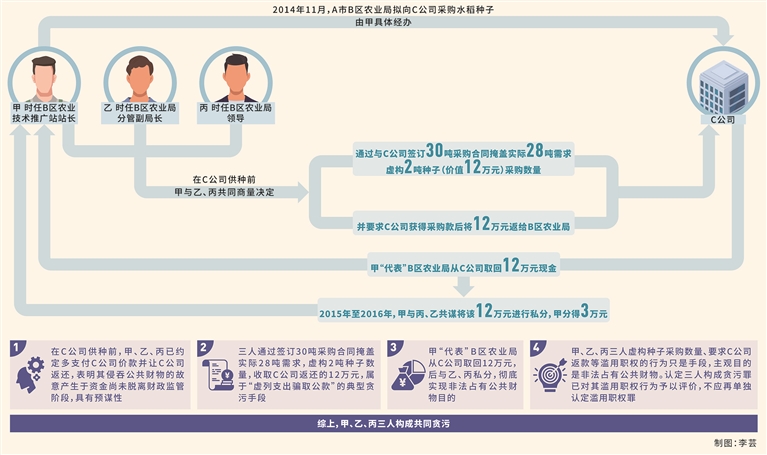
Core Points - The case involves three individuals (A, B, C) conspiring to falsely inflate seed procurement quantities, resulting in an overpayment of 120,000 yuan to Company C, which they later divided among themselves [5][9][10] - A, while serving as the head of the Agricultural Technology Promotion Station, engaged in corrupt practices, including embezzlement and bribery, totaling 2.08 million yuan in bribes and 460,000 yuan in collusion with another employee [6][12][14] - The investigation led to A being expelled from the party and public office, with subsequent criminal charges filed for embezzlement, bribery, and collusion [7][18][20] Summary by Sections Basic Case Facts - A was responsible for a seed procurement contract, where he, along with B and C, conspired to create a false procurement quantity, leading to an illegal return of 120,000 yuan [4][5] - A's actions included receiving bribes from multiple suppliers, totaling 2.08 million yuan over a decade [6][12] Investigation Process - The investigation began on September 25, 2023, with A being placed under detention, followed by disciplinary actions and criminal charges [7][19] - A was convicted on April 30, 2025, receiving a combined sentence of seven years in prison and a fine of 550,000 yuan [7][18] Legal Interpretations - The actions of A, B, and C were classified as joint embezzlement rather than bribery, as they involved the illegal appropriation of public funds [8][9] - The court determined that A and another employee, D, engaged in joint bribery, with A being the principal actor and D playing a secondary role [15][16]
国有控股企业中监察对象认定问题辨析
Zhong Yang Ji Wei Guo Jia Jian Wei Wang Zhan· 2025-06-11 00:10
Core Viewpoint - The article discusses the interpretation of the scope of supervisory objects under the Supervision Law, particularly focusing on whether certain management personnel in state-owned enterprises (SOEs) should be considered as supervisory objects based on their appointment processes and the nature of their roles [1][2][3]. Group 1: Legal Framework and Definitions - The Supervision Law specifies that supervisory objects include "management personnel of state-owned enterprises" [1]. - The implementation regulations clarify that management personnel in state-owned enterprises are those who perform organizational, leadership, management, and supervisory duties, either in wholly state-owned enterprises or in state-controlled enterprises [3][4]. - There are two categories of supervisory objects: those in wholly state-owned enterprises and those in state-controlled or joint-stock enterprises, with distinctions based on the nature of the enterprise [3][4]. Group 2: Case Analysis - In the case of Company A, which is 51% state-owned, the company’s party branch has decision-making authority over significant matters, including personnel appointments [2][6]. - There are differing opinions on whether the appointed procurement manager, Huang, qualifies as a supervisory object; one view argues he does not due to the lack of formal appointment by a state body, while the other view supports his classification based on the party branch's authority [2][6]. - The article supports the view that Huang should be considered a supervisory object due to the party branch's decision-making role and the nature of his appointment [2][6][7]. Group 3: Implications of the Case - Huang's actions, which involved using his position to benefit a private individual and accepting bribes, constitute a violation of the law, confirming his status as a state worker under the relevant legal framework [7]. - The case highlights the complexities in determining the supervisory status of personnel in state-controlled enterprises, particularly regarding the authority of party branches in such organizations [6][7].