
循环经济

Search documents
LABUBU、Switch,不买只租真香? 3亿人上头“体验经济”,信用免押激活万亿新租赁市场
Mei Ri Jing Ji Xin Wen· 2025-07-29 23:49
Core Insights - The article highlights the rapid growth and transformation of the rental market, particularly among younger consumers who prefer experiences over ownership [2][4][5] - The new rental economy is projected to reach nearly 1 trillion yuan by 2030, driven by a shift in consumer behavior towards experience-based consumption [4][8] Group 1: Market Trends - The rental market has evolved from addressing basic needs to offering diverse experiences, with consumers now able to make quick decisions, such as renting a bike within 30 minutes [3][5] - The Z generation (born between 1995 and 2009) constitutes over 60% of active users in the rental market, with orders from "post-00s" consumers doubling in the past year [2][4] - The new rental model emphasizes rational consumption, social recognition, instant gratification, and self-pleasure, reflecting a shift in consumer logic [3][4] Group 2: Economic Impact - The new rental economy is expected to surpass 1 trillion yuan by 2026, indicating significant market potential [4][8] - The integration of credit systems into the rental process has lowered barriers for consumers, enabling them to rent without upfront deposits, thus expanding the market [6][7] Group 3: Challenges and Solutions - The rental industry faces challenges such as high deposit requirements and poor user experience, which hinder further market penetration [8][9] - A white paper suggests that standardizing processes and improving transparency can address consumer pain points, such as unclear product conditions and pricing [8][9] Group 4: Future Outlook - The rental ecosystem is expected to achieve a win-win scenario for users, businesses, and society, with enhanced efficiency and sustainability [9][10] - As foundational rules are established, the potential for the trillion-yuan rental market is anticipated to be further unlocked [10]


实体二手店,悄然热起来
Ren Min Ri Bao Hai Wai Ban· 2025-07-29 23:07
Core Insights - The rise of second-hand stores is driven by consumer preferences for affordability, uniqueness, and sustainability [1][3][6] - The second-hand market is experiencing significant growth, with a projected transaction scale of 645 billion yuan in 2024, reflecting a year-on-year increase of 17.56% [9] Consumer Preferences - Price is the primary factor influencing consumers to choose second-hand goods, with many finding luxury items at significantly lower prices compared to new ones [3][6] - The uniqueness of second-hand items appeals to consumers seeking personalized products, as many are discontinued or rare [3][6] - Environmental consciousness is a growing trend, with consumers viewing second-hand purchases as a way to promote sustainability and reduce waste [3][6] Market Dynamics - The shift from online to offline sales is evident, with platforms like "Super Zhuangzhuang" and "Xianyu" opening physical stores to enhance consumer experience [4][6] - Second-hand stores generate revenue through buying low and selling high, as well as charging consignment fees [5][7] - The integration of online and offline sales channels has improved operational efficiency and reduced return rates for second-hand goods [8] Growth Potential - The second-hand market is expected to continue expanding, supported by government policies promoting green consumption and the increasing popularity of unique goods [6][9] - There is a need for improved standards in product circulation, transaction regulations, and authentication methods to enhance consumer trust and market growth [9][11] Consumer Experience - Consumers express a desire for better product display and verification in second-hand stores, indicating that store aesthetics and organization are crucial for attracting buyers [10][11] - The demand for high-quality second-hand goods is rising, with consumers willing to invest in durable products that have been previously owned [11]
凯美特气: 2025年半年度报告
Zheng Quan Zhi Xing· 2025-07-29 16:09
Core Viewpoint - The report highlights the financial performance and operational strategies of Hunan Kaimeite Gases Co., Ltd. for the first half of 2025, showcasing a significant increase in revenue and net profit, alongside a focus on expanding its market presence in electronic specialty gases and maintaining high product quality standards [1][2]. Financial Performance - The company's operating revenue for the reporting period reached approximately CNY 310.36 million, representing a year-on-year increase of 10.52% compared to CNY 280.81 million in the same period last year [2][9]. - The net profit attributable to shareholders was approximately CNY 49.71 million, a substantial increase of 9,426.33% from a loss of CNY 61.49 million in the previous year [2][9]. - Basic and diluted earnings per share improved to CNY 0.0803, compared to a loss of CNY 0.0805 in the previous year, marking a 199.75% increase [2][9]. - The total assets at the end of the reporting period were approximately CNY 2.83 billion, a decrease of 1.13% from CNY 2.86 billion at the end of the previous year [2][9]. Business Overview - The company specializes in high-purity gases such as carbon dioxide, hydrogen, liquefied gas, and electronic specialty gases, which are widely used in various industries including electronics, chemicals, food and beverage, tobacco, and metallurgy [3][4]. - Hunan Kaimeite has established long-term partnerships with major clients, including Coca-Cola and PepsiCo, and has been recognized as a strategic supplier in China [3][4]. Competitive Advantages - The company holds 179 patents, including 40 invention patents, and has been recognized as a national-level "little giant" enterprise, emphasizing its commitment to technological innovation and resource utilization [4][5]. - Hunan Kaimeite has implemented advanced production technologies and strict quality control measures, ensuring that all products meet national standards and customer requirements [5][6]. - The logistics and distribution capabilities are enhanced by a fleet equipped with GPS tracking, ensuring safe and efficient transportation of gases [6][7]. Market Strategy - The company is focused on expanding its market share in electronic specialty gases, aiming to reduce reliance on imports and establish itself as a significant player in the domestic market [4][6]. - Hunan Kaimeite is actively pursuing high-end customers both domestically and internationally, leveraging its established marketing network to enhance its competitive edge [4][6]. Revenue Composition - The revenue breakdown shows that carbon dioxide contributed approximately CNY 98.45 million (31.72%), hydrogen CNY 103.85 million (33.46%), and fuel products CNY 88.46 million (28.50%) to the total revenue [9][10]. - The company experienced significant growth in the East and South China regions, with revenues increasing by 17.10% and 25.70%, respectively [9][10].

刘煜辉重磅研判:反内卷促A股跃升新台阶,4000点可期!一文汇总
Xin Lang Zheng Quan· 2025-07-29 10:17
Group 1 - The core task of the highest decision-making meeting has elevated the goal of anti-involution, which is expected to enhance market confidence through effective policy execution [2] - The current market sentiment is rapidly warming, with investors showing significant confidence in the return of "pro-cyclical style" as the anti-involution policy becomes clearer [4] - The annual investment in the childcare subsidy program has exceeded 100 billion, indicating strong fiscal support for young families and potential for stimulating domestic demand [3] Group 2 - The pro-cyclical sectors, which are highly represented in the A-share market, are expected to gain significant relative advantages as policies shift [2] - The institutionalization and circulation of data assets are seen as key directions for constructing a new factor system, which may drive the digital economy transformation [5] - High-end manufacturing, particularly in robotics and solid-state battery industries, is anticipated to achieve rapid breakthroughs in commercialization and industrialization [6] Group 3 - The current capital market in China is nurturing a "low wavelength flow" new bull market, driven by trust accumulation rather than emotional outbursts [7] - The market's main trend is determined by investor confidence and risk appetite, rather than sustained profit growth [7] - The expectation of a policy shift towards pro-cyclical assets may lead to a revaluation of the bond market as a "deflation asset" [4]
惠城环保2025中报的“言外之意”:黎明前的黑暗,还是深渊?
Zhong Jin Zai Xian· 2025-07-29 02:08
Core Viewpoint - The company, Huicheng Environmental Protection, is undergoing a significant transformation, marked by a successful trial of its innovative 200,000 tons/year mixed waste plastic deep catalytic cracking (CPDCC) project, juxtaposed with a drastic decline in net profit and cash flow issues [1][5]. Financial Performance - The company's net profit attributable to shareholders for the first half of 2025 was 5.02 million, a staggering decline of 85.6% year-on-year; after deducting non-recurring items, the profit plummeted to 760,000, down 97.5% year-on-year [1]. - The traditional business of waste catalyst treatment and resource products is described as entering a "post-growth" phase, with intensified competition leading to declining revenues and profitability [2]. Operational Challenges - The high-sulfur petroleum coke hydrogen ash treatment project, once considered a cash cow, has seen reduced profitability due to lower steam procurement prices from a key client, exposing the company's over-reliance on a single customer [2]. - The cash flow statement reveals a net cash flow from operating activities of -108 million, a significant deterioration from a positive 34.53 million in the previous year, indicating severe cash outflows for new project preparations and increased personnel costs [4]. Debt and Leverage - The company has seen a 77% year-on-year increase in net cash flow from financing activities, amounting to 776 million, primarily due to increased loan receipts [4]. - Total assets grew by 20%, driven by construction in progress (from 1.14 billion to 1.82 billion) and long-term borrowings (from 1.49 billion to 2.21 billion), with the debt-to-asset ratio rising from 69.4% at the beginning of the year to 73.94% [4]. Strategic Initiatives - The CPDCC project represents a significant opportunity in the trillion-dollar circular economy sector, with the potential for a "Davis Double" effect, but the transition from trial success to stable profitability is fraught with challenges [5]. - The company is actively expanding its waste plastic recycling operations across the country to secure raw materials, indicating a long and complex operational strategy [5]. Future Outlook - The company is in a critical transitional phase, with old revenue streams declining and new projects yet to deliver results, relying heavily on high leverage to navigate this period [6]. - Key performance indicators to monitor include the ramp-up speed of the plastic project’s capacity, product gross margins, and the timeline for operational cash flow to turn positive [6].
研判2025!中国三氯乙烯行业产量、消费量及出口分析:制造业景气度下行叠加环保政策趋严,供给端呈现“以销定产”主动收缩特征[图]
Chan Ye Xin Xi Wang· 2025-07-29 01:24
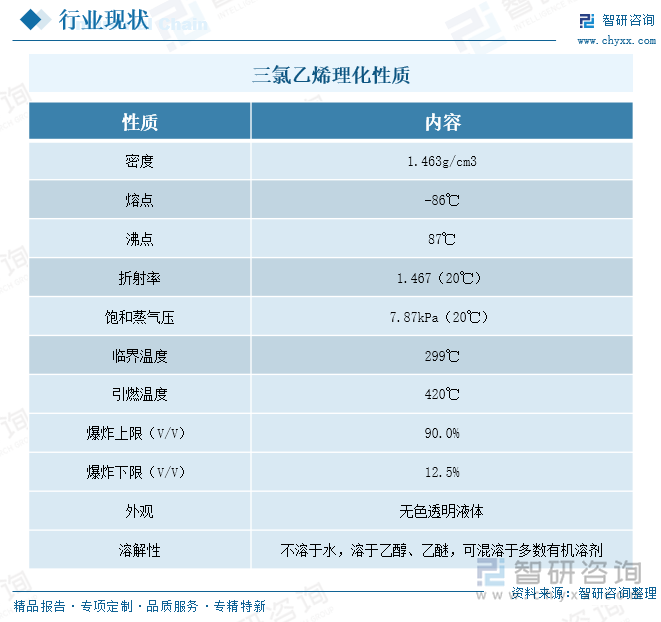
Industry Overview - The trichloroethylene (TCE) industry in China has formed a complete industrial chain system, with a production of 103,800 tons from January to May 2025, a year-on-year decrease of 2.52%, and a consumption of 87,900 tons, down 8.92% year-on-year [1][6] - As of the end of May 2025, the inventory of TCE in China was 1,200 tons, an increase of 14.29% year-on-year, indicating a proactive contraction in supply under the "production based on sales" approach [1][6] - The decline in demand is attributed to the downturn in the domestic manufacturing sector, which has reduced cleaning needs in the metal processing industry, and stricter environmental policies in the pesticide sector, leading to a gradual decrease in reliance on TCE [1][6] Industry Chain - The upstream of the TCE industry includes raw materials such as acetylene, chlorine, and catalysts, as well as production equipment like drying equipment, chlorination towers, and distillation towers [4] - The midstream involves the production and manufacturing of TCE, while the downstream applications include metal degreasing/cleaning, pharmaceutical intermediates, pesticide/dye solvents, and coatings [4] Key Enterprises - The industry is characterized by a competitive landscape dominated by leading companies, with a high market concentration and increasing technical barriers. Jilin Chemical and Hangjin Technology are the two major players, with Jilin Chemical's production capacity expected to reach 150,000 tons/year by 2025 [12][13] - Hangjin Technology focuses on the high-end market, with the proportion of electronic-grade products expected to increase to 18% by 2025, benefiting from a higher profit margin compared to industrial-grade products [12][13] - Binhua Group, another key player, has a production capacity of 80,000 tons/year and has achieved a 100% quality compliance rate for its TCE products [16] Industry Trends - Market demand remains stable, particularly in the metal processing and electronic cleaning sectors, driven by the upgrading and precision development of manufacturing [18] - Environmental regulations are pushing for the development of safer and more eco-friendly alternatives to TCE, such as hydrofluoroethers (HFEs) and d-limonene [19][20] - The industry is expected to see increased concentration, with larger companies leveraging their technological, financial, and brand advantages to capture a larger market share [21]


二手小店、商品寄卖店、二手平台线下店 实体二手店悄然热起来
Ren Min Ri Bao· 2025-07-28 21:35
Core Viewpoint - The rise of second-hand stores in China is driven by consumer preferences for affordability, uniqueness, and environmental sustainability, leading to a growing market for second-hand goods [1][3][9]. Consumer Preferences - Consumers are increasingly choosing second-hand products due to their relatively lower prices, with some able to purchase two second-hand items for the price of one new item [3][5]. - The uniqueness of second-hand items appeals to younger consumers, who seek personalized and distinctive products that are often no longer in production [3][9]. - Environmental consciousness is influencing purchasing decisions, as buying second-hand is seen as a way to promote sustainable living and reduce waste [3][9]. Market Growth - The second-hand e-commerce market in China is projected to reach a transaction scale of 645.02 billion yuan in 2024, reflecting a year-on-year growth of 17.56% [9]. - The user base for second-hand e-commerce is expected to grow to 660 million, marking a 13.79% increase [9]. Business Models - Second-hand stores generate revenue through buying low and selling high, as well as charging consignment fees for items sold on behalf of others [5][7]. - The integration of online and offline sales channels enhances customer experience and reduces return rates, with some stores reporting a drop in return rates from double digits to single digits after adopting this model [8][9]. Operational Challenges - Despite the growth, second-hand stores face challenges such as higher operational costs associated with physical locations and the need for improved product display and authenticity verification [10][11]. - Consumers express a desire for better shopping experiences in second-hand stores, emphasizing the importance of cleanliness, organization, and product presentation [10][11]. Regulatory Environment - The development of the second-hand market is supported by government policies promoting green consumption and the circular economy, which have increased consumer awareness and acceptance of second-hand goods [6][11].
杭州湾上虞经开区:蹚出绿色低碳发展新路
Zhong Guo Hua Gong Bao· 2025-07-28 05:51
Core Viewpoint - The article emphasizes the transformation of chemical parks in China towards green, low-carbon, and zero-carbon development, highlighting the achievements and practices in energy conservation, resource recycling, and ecological protection. Group 1: Green Transformation of Chemical Parks - As of now, 37 chemical parks in China have been recognized for their efforts in promoting resource utilization and sustainable development, showcasing significant demonstration effects [1] - The Hangzhou Bay Shangyu Economic Development Zone has integrated ecological priorities and green development into its planning and production processes, achieving recognition as a national ecological industrial demonstration park and a green chemical park [1] Group 2: Industrial Upgrading and New Economic Structure - Since 2017, the Hangzhou Bay Shangyu Economic Development Zone has eliminated 93 low-efficiency chemical enterprises, freeing up 3,000 acres of land and investing 6.4 billion yuan in smart upgrades for 98 enterprises [2] - The industrial structure is evolving from a single focus on fine chemicals to a modern industrial system characterized by three strategic emerging industries: advanced materials, intelligent equipment, and life health [2] Group 3: Innovative Ecological Governance - The Hangzhou Bay Shangyu Economic Development Zone has developed a new ecological governance model, creating a green ecological paradise that supports biodiversity [3] - A major project by Kang En Bei Group will process over 200,000 tons of hazardous waste annually, saving 100,000 tons of coal and reducing carbon emissions by 400,000 tons [3] Group 4: Resource Recycling and Waste Utilization - The Shaoxing Green Exhibition Environmental Protection Co., Ltd. has successfully transformed solid waste into new building materials, addressing the demand for sustainable construction resources [4] - The economic zone has implemented a point-to-point management approach for hazardous waste utilization, promoting resource recycling and reducing carbon emissions by 70,000 tons annually [4] Group 5: Technological Innovation and Green Production - The establishment of a new research and development base for high-end polyolefin elastomer catalysts marks a significant step in the full-chain transformation from research to industrialization [6] - The economic zone has fostered a collaborative innovation ecosystem involving government, industry, academia, and research institutions to support technological advancements and green production [6] Group 6: Environmental Measures and Competitive Edge - Companies in the economic zone are adopting innovative technologies and processes to enhance environmental performance, with significant reductions in waste and emissions reported [7] - For instance, Longsheng Group has achieved over 80% reduction in wastewater and organic waste emissions through advanced purification techniques [7]
恒誉环保: “设备+运营”双轮驱动 深耕热裂解全产业链
Zhong Guo Zheng Quan Bao· 2025-07-27 21:06
Core Insights - The article highlights the growing importance of the circular economy in the context of "dual carbon" goals, emphasizing the advantages of low consumption, low emissions, and high efficiency [1] - The company Hengyu Environmental has evolved into a global leader in the thermal pyrolysis industry, focusing on technology research, equipment manufacturing, and operational services [1] - Hengyu Environmental has successfully transitioned from being an equipment supplier to a comprehensive service provider, enhancing its business model and achieving significant revenue and profit growth in Q1 2025 [1][6] Market Potential - The European Union has set a target for 55% of plastic packaging to be recycled by 2030, with over 40 multinational companies committing $1.5 billion to eliminate plastic waste [2] - In the waste tire recycling sector, major tire manufacturers are prioritizing sustainability, with Bridgestone planning to establish a production line for processing 100,000 tons of waste tires annually by 2027-2030 [2] - China's emphasis on the circular economy is increasing, with companies like Linglong Tire and China Chemical entering the waste tire thermal pyrolysis market [2] Technological Advancements - Continuous stable operation is a recognized challenge in the thermal pyrolysis industry, with many existing technologies unable to meet industrial demands [3] - Hengyu Environmental has developed proprietary technologies that address common issues such as coking, sealing difficulties, and product aggregation, achieving a mineral oil content of less than 0.05% and a cracking rate exceeding 99% [3] - The company's technology has been certified as domestically innovative and meets international advanced standards [3] Global Reach - Hengyu Environmental has made significant strides in waste treatment across various sectors, receiving accolades for its projects and achieving multiple international certifications for its products [4] - The company exports its products to numerous countries, including Germany, the UK, and Brazil, positioning itself as one of the few domestic suppliers capable of meeting stringent international technical requirements [4] Business Model Innovation - To enhance operational stability and sustainability, Hengyu Environmental is actively exploring a "equipment + operation" dual-driven model, focusing on downstream operational services [5] - The company has signed contracts for significant projects, including a $1.48 billion BOO project for hazardous waste treatment in Enshi, which has already commenced operations [5] Future Prospects - In 2024, Hengyu Environmental plans to launch a comprehensive waste tire utilization project with a processing capacity of 200,000 tons, potentially becoming one of the largest projects globally [6] - The company's Q1 2025 performance showed a revenue of 61.43 million yuan, marking a 274.69% year-on-year increase, and a net profit of 8.27 million yuan, reflecting a 150.38% increase [6]

扬州天富龙集团股份有限公司首次公开发行股票并在主板上市网上投资者交流会精彩回放
Shang Hai Zheng Quan Bao· 2025-07-27 18:51
Company Overview - The company focuses on the research, production, and sales of differentiated polyester staple fibers, expanding its product range to include recycled colored polyester staple fibers and differentiated composite fibers, covering various applications in business, travel, home, healthcare, and clothing [1][2] - The main products include high-quality, full-spectrum recycled colored polyester staple fibers and functionally rich differentiated composite fibers, with applications in household textiles, automotive interiors, construction, footwear materials, healthcare, and filtration materials [2][3] Financial Performance - The sales revenue for differentiated composite fibers during the reporting period was 1,482.9974 million yuan, 1,793.3054 million yuan, and 2,477.6362 million yuan for 2022, 2023, and 2024 respectively, showing consistent growth [4] - The revenue from recycled colored polyester staple fibers was 996.6470 million yuan, 1,070.2534 million yuan, and 1,170.8439 million yuan for the same years, indicating a steady increase due to a focus on customized products in the automotive interior sector [5] - The company's gross profit from its main business was 469.2732 million yuan, 583.4238 million yuan, and 599.8650 million yuan during the reporting period [6] - The net profit attributable to the parent company after deducting non-recurring gains and losses was 338.4995 million yuan, 420.0640 million yuan, and 450.9392 million yuan, with a compound annual growth rate of 15.42% [8] - The comprehensive gross profit margin was 18.86%, 18.31%, and 16.50% for the respective years [9] - Research and development expenses were 93.2640 million yuan, 117.3403 million yuan, and 136.1955 million yuan, maintaining a stable proportion of revenue [10] Development Strategy - The company has established a development plan centered on differentiated polyester staple fiber business, aiming for high-quality development, enhanced enterprise value, and efficient growth through digital manufacturing, global sales, and green development [11] - Future technology development will focus on building research centers and advanced equipment, enhancing technical capabilities, and developing new products, particularly in chemical recycling methods for polyester [12] - The company plans to expand its market presence by leveraging existing manufacturing bases and developing new production facilities in Zhuhai to target both domestic and Southeast Asian markets [13] - A talent development strategy will be implemented to attract high-quality personnel and enhance the human resource management system [14] Industry Context - The company operates within the "C28 Chemical Fiber Manufacturing" industry, specifically in "C2822 Polyester Fiber Manufacturing," with regulatory oversight from various government bodies [16] - The demand for differentiated polyester staple fibers is driven by diverse applications in non-woven fabric industries, including automotive interiors and healthcare [17] - China is a major global supplier of polyester staple fibers, accounting for 61.62% of the world's production in 2022, with production increasing from 9.1489 million tons in 2016 to 11.93 million tons in 2023 [18] - The export volume of polyester staple fibers has shown recovery, reaching 1.2306 million tons in 2023 [19] - Competition in the industry is centered around production scale, cost advantages, R&D capabilities, and brand reputation [20] - The domestic polyester staple fiber industry is highly concentrated, with the top four companies accounting for approximately 43% of total capacity as of the end of 2023 [21] - The company has established a stable operational foundation through customized production and long-term partnerships with key clients in various sectors [22][23] IPO and Funding - The purpose of the IPO is to enhance technological innovation, optimize business layout, and improve capital structure while increasing brand visibility and attracting talent [24] - The actual controller of the company holds 61.81% of the shares, with a combined control of 93.90% of voting rights [25] - The company plans to issue 40.01 million new shares, accounting for 10% of the total post-issue share capital [27] - The raised funds will be allocated to projects including the production of low-melting-point polyester fibers and the establishment of a research center [28]