
轻资产运营

Search documents
建发国际集团:瞄准高净值人群,下半年择机拓展合适的灯塔项目丨财面儿·年报洞见
Cai Jing Wang· 2025-08-26 05:48
Group 1: Financial Performance - In the first half of 2025, the company achieved revenue of approximately 34.16 billion, a year-on-year increase of 4.3% [1] - The profit attributable to equity holders was approximately 910 million, reflecting a year-on-year growth of 11.8% [1] - The cumulative contract sales amounted to approximately 53.35 billion, with a year-on-year increase of 5% [1] Group 2: Sales Strategy - The company has implemented a sales strategy focused on strict control of new project launches and enhancing cash recovery efficiency [1] - The target for new project launches is estimated at approximately 270 billion, with an initial inventory value of around 100 billion and an additional supply of 66.7 billion in the first half of the year [2] - The company plans to add approximately 100 billion in new supply in the second half of the year, with a focus on key projects in major cities such as Beijing, Hangzhou, and Chengdu [1][2] Group 3: Investment Strategy - The company adheres to a cautious investment approach, prioritizing liquidity and has acquired 33 projects with a total value of approximately 120 billion in the first half of the year [2] - Future land acquisitions will be based on sales performance, with a focus on enhancing inventory liquidity and managing price risks [2] - The company aims to diversify its investment capabilities through urban renewal asset packages and other channels [2] Group 4: Product Development - The company is focusing on high-quality "lighthouse" projects, which are tailored to local characteristics and aimed at high-net-worth individuals [2][3] - The "lighthouse" projects are strategically located in core urban areas, ensuring high scarcity and market competitiveness [3] - The company is committed to enhancing product quality and customer satisfaction through rigorous production quality control and timely delivery [3] Group 5: Future Directions - The company is exploring light asset operations and has several practical cases in this area, with plans to further expand using group resources [3] - The company is also piloting long-term rental apartments in Shanghai and advancing trials in the elderly care sector [5] - The evolving commercial landscape is prompting the company to focus on asset operations as a significant development direction [4]

华润置地(01109) - 2025 H1 - 电话会议演示
2025-08-26 01:30
AGENDA 01. HIGHLIGHTS 04.ESG 02. FINANCIAL REVIEW 03.BUSINESS REVIEW 05. LAND BANK 06. OUTLOOK 07.APPENDIX 三亚海棠湾悦府 西安万象城 Xi'an Mixc P A R T PART ONE Results Highlights Strengthening Momentum of the Second Growth Curve for Stable Performance and Returns Revenue +19.9% YoY Recurring Income +2.5% YoY RMB 94.9bn RMB 20.6bn Weighted Average Funding Cost 2.79% -32bps from FY24 Attributable Net Profit +16.2% YoY Recurring Core Net Profit RMB 11.9 +9.6% YoY bn RMB 6.0bn Net Gearing Ratio 39.2% Core Net Profit -6.6% ...

京基智农2025年上半年实现营收23.87亿元 养殖业务营收占比达80.67%
Zheng Quan Ri Bao Zhi Sheng· 2025-08-23 03:40
Core Viewpoint - The report highlights the strong performance of Jingji Zhinong in the first half of 2025, with significant revenue growth driven by its core pig farming business, showcasing the company's confidence in future development through substantial shareholder returns [1][2]. Financial Performance - In the first half of 2025, the company achieved a revenue of 2.387 billion yuan and a net profit attributable to shareholders of 226 million yuan [1]. - The pig farming business generated 1.925 billion yuan in revenue, marking an 11.13% year-on-year increase, with a gross margin of 19.35%, up by 3.27 percentage points [1]. - The revenue contribution from the pig farming segment accounted for 80.67% of the total, reinforcing its role as the company's performance engine [1]. Profit Distribution - The company announced a profit distribution plan, proposing a cash dividend of 3.80 yuan per 10 shares (including tax), totaling 197 million yuan (including tax) to shareholders [1]. Market Position and Strategy - Jingji Zhinong's pig sales prices have consistently outperformed the industry, with an average sales price exceeding 15 yuan/kg in the first half of the year, and rising to 15.66 yuan/kg in July [2]. - The company has established a strong market presence in the Guangdong-Hong Kong-Macao Greater Bay Area, supported by various certifications and recognitions, including being designated as a "vegetable basket production base" [2]. Operational Strategy - The company is advancing a light-asset operation strategy, leveraging its feed factories in various locations to expand its "company + farmer" pig farming model, which promotes efficient resource allocation [2][3]. - Jingji Zhinong has set up over 12 service departments in the Guangdong region, providing comprehensive support to partner farmers, ensuring product quality and reducing heavy asset investments [3].

万科半年报:销售回款率超100%,商业业务客流、销售稳步增长
Ge Long Hui· 2025-08-22 12:14
Group 1 - Vanke achieved a revenue of 105.3 billion and sales income of nearly 70 billion in the first half of the year, with over 45,000 high-quality deliveries and a sales collection rate exceeding 100% [1] - The commercial business generated a revenue of 4.1 billion with an overall occupancy rate of 93%, and multiple new projects received positive market feedback, leading to steady growth in foot traffic and sales [1] - The overall foot traffic in Vanke's commercial business increased by 7.8% year-on-year, with sales rising by 7.2% and overall sales per square meter increasing by 7.6% [1] Group 2 - Vanke has established good cooperation with over 12,000 brands and has nearly 45 million digital members, showcasing its expanding brand influence [2] - The company has developed a full-chain capability in commercial operations, providing services in design development, commercial operation, asset management, and capital management, and has served notable asset owners like Blackstone and GIC [2] - Vanke's commercial REIT has shown good performance, with the underlying asset in Hangzhou achieving a foot traffic increase of over 5% and an occupancy rate of 99% [2] Group 3 - Industry analysts note that consumers are increasingly focused on quality-price ratios and have diverse and trendy demands, which Vanke's new commercial projects are effectively addressing [3] - The successful performance of Vanke's commercial REIT and recognition from well-known institutions for its light-asset operations are expected to facilitate a healthy exit path for assets, allowing for sustainable development [3]

东百集团: 东百集团2025年半年度报告
Zheng Quan Zhi Xing· 2025-08-22 08:13
Core Viewpoint - The report highlights the financial performance and operational strategies of Fujian Dongbai Group Co., Ltd. for the first half of 2025, indicating a slight increase in revenue and net profit, while emphasizing the company's dual-driven strategy of commercial retail and logistics. Financial Performance - The company achieved operating revenue of CNY 928.56 million, a year-on-year increase of 0.11% [3][4] - Total profit reached CNY 156.12 million, reflecting a growth of 7.09% compared to the previous year [3][4] - Net profit attributable to shareholders was CNY 71.56 million, up 2.40% from the same period last year [3][4] - The net cash flow from operating activities was CNY 257.14 million, an increase of 12.94% [3][4] Business Segments - The commercial retail segment generated CNY 791 million in revenue, a decrease of CNY 21 million, attributed to structural changes in the consumer market and intensified competition [3][4] - The logistics segment reported revenue of CNY 83 million, an increase of CNY 19 million, due to the completion of several logistics projects and increased rental income [3][4] - The hotel and catering segment saw revenue rise to CNY 40 million, an increase of CNY 3 million, driven by enhanced service quality and expanded capacity [3][4] Strategic Initiatives - The company continues to implement a "first store" strategy, introducing 201 new brands, including 67 first stores, enhancing customer experience and brand diversity [9][10] - The logistics division has completed 18 logistics projects, with a total area of approximately 1.8 million square meters, and has successfully attracted major clients like BYD and Xiaomi [12][13] - The company is advancing its asset securitization strategy, with plans to issue a special plan for logistics assets to enhance liquidity and operational funding [13][14] Market Environment - The domestic consumption market showed resilience, with retail sales reaching CNY 24.55 trillion, a year-on-year growth of 5.0%, indicating a positive trend for the retail sector [8][9] - The logistics sector also experienced growth, with a total logistics volume of CNY 171.3 trillion, up 5.6% year-on-year, reflecting strong demand for logistics services [8][9]

10股派66元,游戏印钞机吉比特的现金狂欢
Sou Hu Cai Jing· 2025-08-20 17:23
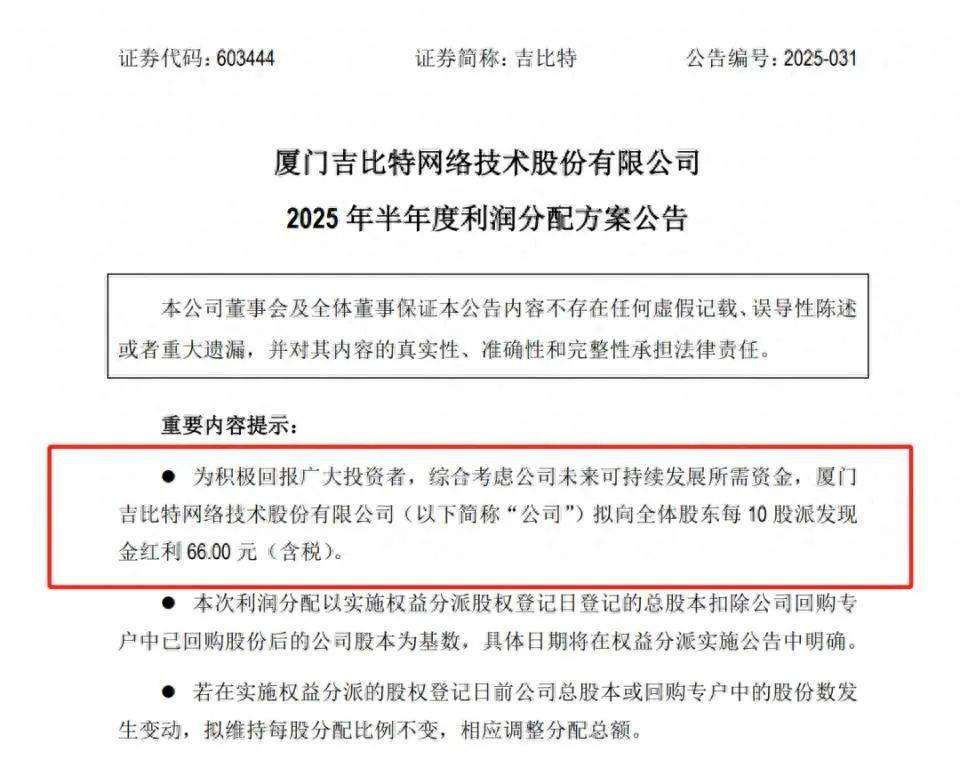
Core Viewpoint - Xiamen Gigabit Network Technology Co., Ltd. demonstrates the cash-generating ability of the gaming industry through a substantial dividend plan, announcing a net profit increase of 24.5% and a cash dividend of 66 yuan per 10 shares, totaling approximately 4.74 billion yuan, which represents 73.46% of its net profit [1][4]. Financial Performance - In the first half of 2025, the company achieved a net profit of 645 million yuan, reflecting a year-on-year growth of 24.5% [1][5]. - The company's operating revenue reached 2.518 billion yuan, marking a year-on-year increase of 28.49% [5]. - The net cash flow from operating activities surged by 81.18%, amounting to 1.077 billion yuan [5]. Dividend Strategy - Since its IPO in 2017, the company has implemented 13 cash dividend distributions, totaling over 6 billion yuan, significantly exceeding the initial fundraising of 960 million yuan [4]. - Notable past dividends include 1.15 billion yuan in 2021 and 1.006 billion yuan in 2022, showcasing the company's commitment to returning value to shareholders [4]. Cash Flow and Financial Health - As of June 30, 2025, the company's debt-to-asset ratio was approximately 32%, with cash reserves amounting to 3.493 billion yuan, providing a solid foundation for ongoing high dividends [4]. - Even after the current dividend payout, the company retains over 3 billion yuan in cash, ensuring ample resources for future R&D and business expansion [4]. Product Development and Market Position - The launch of two self-developed games, "Staff Sword Legend" and "Ask Sword Longevity," in the first half of 2025 has enriched the company's product matrix and significantly boosted performance [4]. - The longevity of classic game IPs, such as "Ask Dao," which has been operational for 19 years, highlights the company's ability to maintain a strong market presence [5]. - The company focuses its resources on three project categories: commercially successful and enjoyable projects, enjoyable projects that break even or incur minor losses, and technology exploration projects [5].


一批阿那亚业主在等一个梦继续,或者破灭
3 6 Ke· 2025-08-20 12:35
Core Viewpoint - The ongoing negotiations between Anaya and the developer of the Chongli project are critical, as a failure could lead to the loss of the Anaya brand for the properties, significantly impacting their value and the owners' investments [1][10][15] Group 1: Company Operations and Brand Value - Anaya's brand is highly trusted by its owners, who are willing to pay a premium for properties associated with the brand, reflecting a strong belief in its value [2][12] - The conflict with the developer centers around "overall operational rights," particularly concerning the management of the Courtyard by Marriott hotel and the owners' cafeteria, which are not under Anaya's control [3][4] - Anaya's operational philosophy emphasizes long-term management and quality over short-term profit, contrasting with the developer's focus on cost-cutting and self-management [4][5] Group 2: Market Position and Financial Performance - Anaya has successfully positioned itself as a premium brand in the tourism real estate market, with property prices significantly higher than surrounding developments, often three times the local average [11][12] - The company has expanded its operations through partnerships with external developers, reducing financial pressure while maintaining brand presence across multiple projects [8][14] - Anaya's revenue has seen substantial growth, with operating income projected to increase from 750 million yuan in 2021 to 2.2 billion yuan by 2024, indicating strong market demand [14] Group 3: Risks and Owner Sentiment - The potential termination of the partnership with the developer poses a risk to property values, as the Anaya brand is integral to the perceived value of the Chongli project [10][15] - Owners are currently in a state of uncertainty, awaiting the outcome of negotiations, with many expressing confidence in Anaya's ability to resolve the issues [13][15] - The complexity of ownership structures in the Chongli project complicates the balance of interests among various stakeholders, making long-term stability challenging [9][10]
IFBH(06603):首次覆盖:品类上行,高举高打
GUOTAI HAITONG SECURITIES· 2025-08-19 03:25
Investment Rating - The report assigns a cautious buy rating to the company [5]. Core Views - The company is the leader in the ready-to-drink coconut water market in mainland China, leveraging a Thai supply chain, dual-brand light asset operation, and strategic partnerships with major distributors to achieve sustained high growth [2][10]. Financial Summary - Total revenue is projected to grow from $87.44 million in 2023 to $281.96 million by 2027, reflecting a compound annual growth rate (CAGR) of 19.8% from 2025 to 2027 [4]. - Gross profit is expected to increase from $26.68 million in 2023 to $106.09 million in 2027, with a gross margin improvement from 30.5% to 37.6% [4]. - Net profit is forecasted to rise from $16.75 million in 2023 to $68.12 million in 2027, with a net profit margin increasing from 19.2% to 24.2% [4]. Market Position - The company has maintained a market share of approximately 34% in the coconut water segment in mainland China as of 2024, significantly outpacing its nearest competitor [15][62]. - It ranks as the second-largest company in the global coconut water beverage market [10][62]. Competitive Advantages - The company benefits from a strong supply chain rooted in Thailand, which provides cost advantages and product differentiation that competitors find hard to replicate [32][33]. - The light asset model allows the company to focus resources on product innovation and brand marketing, enhancing operational efficiency [42][43]. Brand Strategy - The dual-brand strategy with "if" and "Innococo" targets different consumer segments, enhancing market penetration and brand recognition [20][24]. - The company has successfully engaged high-profile brand ambassadors to boost brand visibility and sales, with significant sales increases following marketing campaigns [47][48]. Growth Potential - The coconut water market is experiencing explosive growth, driven by increasing consumer awareness of health benefits and a shift towards natural, functional beverages [56][57]. - The company is expanding its market presence beyond mainland China into other Asian markets, with a notable increase in revenue from regions like Hong Kong and Singapore [30][31].
亏损收窄的上半年,金融街要培育新的业务增长点
3 6 Ke· 2025-08-19 01:58
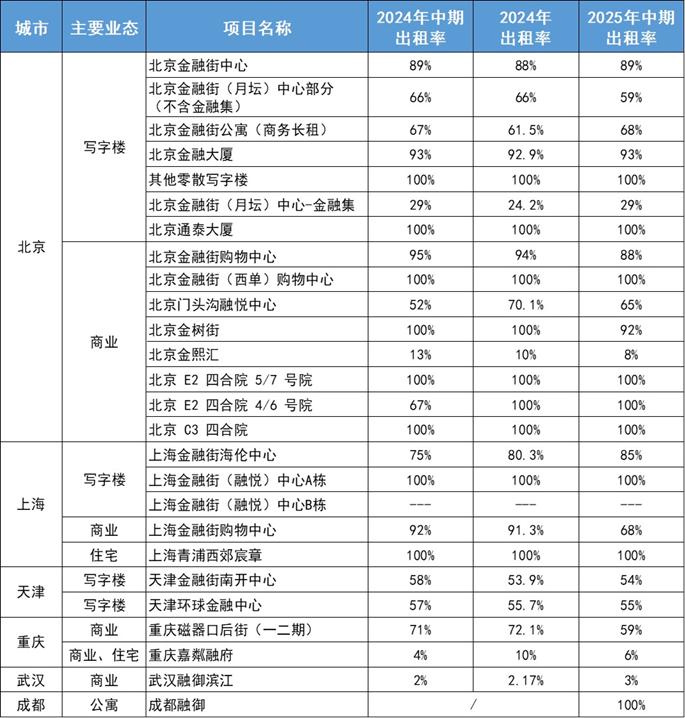
Core Viewpoint - Financial Street Holdings Co., Ltd. reported a significant decline in revenue for the first half of 2025, with total revenue of 4.655 billion yuan, a year-on-year decrease of 51.79% [1] Revenue Breakdown - The revenue primarily comes from real estate development, property leasing, and property management, with real estate development accounting for 77.8% of total revenue [1] - Real estate development revenue was 3.624 billion yuan, down 57.42% year-on-year, with residential product revenue at 3.46 billion yuan and commercial product revenue at 160 million yuan [1] - Property leasing revenue was 776 million yuan, a decrease of 9.99% year-on-year, while property management revenue was 183 million yuan, mainly due to the transfer of hotels [3] Sales Performance - In the first half of 2025, the company achieved a sales area of 324,800 square meters and a sales amount of 4.758 billion yuan, with residential products contributing 4.27 billion yuan [2] - The Beijing-Tianjin-Hebei region was the main contributor to sales, accounting for 54.62% of total sales [2] Market Conditions - The national land auction market showed signs of recovery, with residential land transaction area and amount increasing by 21.7% and 50.7% year-on-year, respectively [2] - However, Financial Street adopted a cautious approach and did not increase project reserves during this period [2] Financial Health - As of the end of June 2025, the company had a financing balance of 67.491 billion yuan, with a significant portion of long-term debt [8] - The cash and cash equivalents balance was 10.5 billion yuan, indicating manageable short-term debt pressure, but there is room for improvement [9] - The company reported a net cash outflow from financing activities of 4.239 billion yuan, a decrease of 74.74% year-on-year [9] Strategic Initiatives - Financial Street is exploring a light asset operation model and prioritizing the revitalization of inefficient assets, including urban renewal projects [7] - The company aims to enhance its asset management capabilities and diversify its resource channels to find new profit points [11]

承接长三角产业协同势能 轻资产运营商抢滩新蓝海赛道
Zhong Guo Jing Ying Bao· 2025-08-18 15:44
Core Insights - The industry is transitioning from a "growth era" to a "stock era," focusing on revitalizing existing assets and improving operational efficiency [1][2] - The current real estate sector is in a de-inventory cycle, with a significant amount of unsold commercial and office space [2] - New players, including specialized service providers and light-asset operators, are emerging to address high vacancy rates and low returns in industrial parks [1][2] Industry Trends - The Central Urban Work Conference emphasized the need for urban development to shift towards quality improvement and urban renewal [1] - Policies have been introduced to promote the revitalization of existing assets, including various government documents aimed at effective investment [2] - The market is experiencing a "quantity and price decline" trend, with increasing vacancy rates despite price reductions [4] Company Developments - BEEPLUS, founded by Jia Fan, has established 40 high-quality industrial parks in nine trillion GDP cities, serving 3,546 enterprises [5] - The company focuses on a "national enterprise + private enterprise" cooperation model to leverage state-owned resources and market agility [2][3] - BEEPLUS aims to provide tailored services and high-quality management to enhance asset value and operational efficiency [5][6] Competitive Advantages - BEEPLUS maintains a high occupancy rate of around 95% in mature projects, with rental income constituting 80%-90% of revenue [5] - The company emphasizes its ability to provide customized solutions and five-star management services, which are key to its operational success [5][6] - BEEPLUS aims to excel in light-asset operations, which are challenging but crucial for sustainable growth in the current market [6]