
开源

Search documents
创·问|PingCAP 刘松:AI 即将重塑数据库,未来为 Agent 而生
3 6 Ke· 2025-07-31 08:31
Core Insights - PingCAP, founded in 2015, is a leading open-source distributed database provider, focusing on delivering stable, efficient, and secure data services to global enterprises, thereby facilitating digital transformation [4][5][29] - The company has served over 4,000 enterprises across more than 45 countries, with its distributed database product TiDB gaining significant traction on GitHub, amassing over 37,000 stars [4][5] - AI is viewed as a transformative force in the database industry, potentially reshaping vendor valuations and competitive dynamics [4][12][40] Group 1: Company Overview - PingCAP's core offerings include open-source distributed database products, solutions, consulting, technical support, and training services [4][5] - The company emphasizes a culture of openness and democratic decision-making, attracting talent from various backgrounds, including seasoned professionals from Oracle and Alibaba [4][5] - The company aims to establish itself as a globally respected foundational software company, leveraging its experience in the highly competitive Chinese market [5][29] Group 2: AI Integration and Industry Trends - AI is perceived as a dual-edged sword, possessing disruptive capabilities while also requiring practical applications and user engagement to realize its full potential [8][9] - The integration of AI with databases is expected to fundamentally change the role of databases, shifting from serving data engineers to supporting intelligent agents [12][22] - The emergence of AI-driven agents necessitates advancements in database technology to enhance interaction and data retrieval accuracy [12][22] Group 3: Market Dynamics and Competition - The database market in China has seen a significant contraction, with a reduction of 64 companies in the past year, intensifying competition among remaining players [5][32] - PingCAP differentiates itself by focusing on product strength and ecosystem development rather than merely being a substitute for traditional database solutions [31][32] - The company has successfully transitioned clients from legacy systems like Oracle and MySQL to its TiDB platform, highlighting its competitive advantages in scalability and mixed-load processing [28][31] Group 4: Globalization and Localization Strategy - PingCAP's global expansion strategy is rooted in its open-source model and cloud capabilities, which have proven effective in building customer trust [35][36] - The company prioritizes local talent and cultural adaptation in its international operations, ensuring effective communication and service delivery [36][38] - The firm aims to leverage its experience in the demanding Chinese market to enhance its offerings and establish a strong presence in international markets [29][35] Group 5: Future Outlook and Technological Evolution - The future of databases is expected to be shaped by the convergence of AI, cloud computing, and open-source technologies, creating new opportunities for innovation [40][42] - Key technological advancements anticipated include the rise of serverless architectures and the integration of AI with database functionalities [42] - The evolving landscape will require databases to effectively support intelligent agents, enhancing their role as knowledge repositories and decision-making tools [22][40]

累计25亿装机量,这家上海张江国产操作系统企业如何靠“开源”突围?
Xin Lang Cai Jing· 2025-07-31 03:26
Core Insights - The article highlights the significant advancements and market potential of domestic operating systems in China, particularly focusing on the achievements of Shanghai Ruide Technology Co., Ltd. and its RT-Thread operating system [1][2][3]. Company Overview - Shanghai Ruide Technology Co., Ltd. has developed an operating system that has been integrated into various sectors, including aerospace, energy, industrial manufacturing, smart vehicles, and consumer electronics, achieving a cumulative installation of 2.5 billion units [1]. - The company is recognized as a leading player in the domestic embedded operating system market and is actively collaborating with major enterprises like BYD and Geely to cover critical areas such as domain controllers and autonomous driving [1][3]. Market Trends - The Chinese operating system market is projected to grow rapidly, with an estimated market size of 25 billion yuan by 2025, driven by both market and policy support [2]. - Despite the growth potential, domestic operating systems face challenges such as high R&D costs, difficulties in ecosystem development, and international competition [2]. Technological Advancements - Ruide has made significant breakthroughs in real-time operating system technology, achieving a response time of 5 microseconds, which is over 12 times faster than the industry average [4]. - The company is also developing specialized control systems for bipedal robots, integrating visual perception and motion control algorithms for enhanced navigation and balance [5]. RISC-V Architecture - The RISC-V architecture is gaining traction as a key area for domestic operating systems, offering an open-source framework that allows for free use, modification, and expansion [5][6]. - In 2024, global shipments of RISC-V chips are expected to exceed 10 billion, with 30% of these chips being used in AI acceleration scenarios [6]. Ecosystem Development - The establishment of the RISC-V Industrial Alliance in Zhangjiang, Shanghai, aims to create a comprehensive ecosystem covering chip design, manufacturing, and application scenarios [8]. - The RT-Thread open-source project has garnered contributions from developers across nearly 100 countries, emphasizing the importance of open-source as a mechanism for innovation and collaboration [9]. Strategic Initiatives - The company is pursuing a "transparent co-construction" strategy for international markets, which includes setting up joint innovation labs and real-time mirror repositories on GitHub [10]. - Emphasis is placed on strengthening the domestic market and enhancing the ecosystem to address real-world challenges faced by users [11][12].
Meta Platforms(META.O):需要严格降低超级智能的风险,并谨慎选择开源的内容。
news flash· 2025-07-30 13:06
Meta Platforms(META.O):需要严格降低超级智能的风险,并谨慎选择开源的内容。 ...
WAIC 2025:感受中国AI热度 点燃智能时代引擎
Zhong Guo Xin Wen Wang· 2025-07-29 17:43
在上海库帕思科技有限公司董事长山栋明看来,在人工智能领域,眼下"大象跳舞"和"蚂蚁雄兵"并举, 经济业态和社会业态正在发生改变。 商汤科技董事长兼CEO徐立认为,一方面人工智能快速的演进必将突破边界;另一方面,人工智能必须 抱着普惠的精神去做行业落地。 大会在上海举办8年以来,今年人气堪称最旺。展馆里,观众里三层外三层围在各式各样的机器人前; 会场间,连过道都被利用起来,成了"脑力交锋"的开放舞台。 本届大会的主题是"智能时代同球共济",吸引来自70多个国家和地区的1500余位顶尖专家参加。大会展 览面积首次突破7万平方米,展示了3000余项前沿科技成果,包括100余款"全球首发""中国首秀"产品。 上海市委常委、副市长陈杰在闭幕式上称,参加这次大会,每个人最大的收获不尽相同。"这份体验、 这份共鸣会影响着我们,也会激励我们更投入人工智能产业发展的这一波浪潮中去。" 科技企业Pokee.ai创始人朱哲清在闭幕式上称,几天展会逛下来,他直观感受到,此次大会的信息密 度、技术密度、人流密度等,"密度实在太高了"。几乎每一个展台都能看到各种新的智能体、工具链 等,每走几步就是一个首发模型。"你会感觉到一个特别强烈的 ...

拆箱开源版Coze:Agent核心三件套大公开,48小时揽下9K Star
量子位· 2025-07-28 03:25
Core Viewpoint - The article discusses the recent open-source release of Coze's products, which aims to facilitate the development and deployment of AI agents, marking a significant step towards making agent technology more accessible and practical for developers [1][45]. Group 1: Open Source Products - Coze has released two new open-source products: Coze Studio and Coze Loop, alongside the previously released Eino framework, creating a comprehensive open-source ecosystem for agent development [2][5][32]. - Coze Studio is a low-code platform designed to simplify the creation of AI workflows, while Coze Loop focuses on the development, evaluation, and monitoring of agents [12][21][25]. - The open-source products are licensed under the Apache 2.0 license, allowing for commercial use and modifications without the requirement to open-source changes [7][57]. Group 2: Market Trends and Challenges - The article highlights the growing popularity of agents, transitioning from novelty items to practical tools, as evidenced by the increasing support from major companies and the emergence of various successful agent applications [3][46]. - Despite the enthusiasm, the widespread adoption of agents faces challenges, including inconsistent user experiences and high development barriers, which Coze aims to address through its open-source offerings [47][50]. Group 3: Development and Evaluation Capabilities - Coze Studio provides a complete workflow engine, allowing developers to easily create agents by dragging and dropping functional components, thus lowering the technical barrier for entry [16][19]. - Coze Loop offers a comprehensive solution for prompt development, evaluation, and monitoring, enabling developers to assess agent performance across multiple dimensions [25][30]. - Eino, the earlier released framework, provides a unified component abstraction and flexible orchestration capabilities, enhancing the development process for AI applications [36][39]. Group 4: Future Implications - The open-source initiative is expected to accelerate the deployment of agents across various industries, particularly in internal automation, small teams, and vertical sectors like healthcare and finance [43][42]. - Coze's open-source strategy is seen as a proactive move to capitalize on the impending explosion of agent technology, aiming to create a robust ecosystem that fosters collaboration and innovation among developers [45][56].

扣子开源全家桶,Apache 2.0加持,AI Agent又一次卷到起飞
机器之心· 2025-07-28 02:47
Core Viewpoint - The company has launched two core open-source products, Coze Studio and Coze Loop, as part of its AI Agent development platform, aiming to enhance developer engagement and competition in the open-source space [4][6][39]. Group 1: Product Launch and Features - The open-source products have collectively garnered 9.5K stars on GitHub, indicating significant interest in the AI agent development field [7]. - Coze Studio is a no-code development platform that allows users to create functional AI agents through a visual interface, making it accessible even for those without coding skills [10][11]. - Coze Loop serves as a comprehensive lifecycle management tool for AI agents, facilitating development, evaluation, observation, and optimization [28][34]. Group 2: Technical Architecture and Performance - The platform's backend is built on Golang, while the frontend utilizes React and TypeScript, ensuring a robust and efficient architecture [19][21]. - The microservices architecture allows for clear responsibilities and modular development, enhancing maintainability and collaboration within the open-source community [22]. - The platform supports containerized deployment, simplifying the setup process for developers [23]. Group 3: Open Source Strategy and Community Engagement - The decision to open-source these products under the Apache 2.0 license reflects the company's commitment to fostering a developer-friendly ecosystem, allowing for commercial use without licensing fees [43][45]. - By opening up its technology, the company aims to attract a larger developer community to contribute to the ecosystem, enhancing product evolution through collaborative efforts [54][55]. - The open-source initiative is seen as a strategic move to establish a new standard in the AI agent development space, positioning the company as a leader in this emerging market [44][58].

中国互联网大会上,参展的众多AI应用企业不约而同选择这一发展模式,为什么?
Mei Ri Jing Ji Xin Wen· 2025-07-26 16:19
Core Viewpoint - The China Internet Conference held from July 23 to 25 showcased numerous AI-related technologies, with many companies opting for an open-source development model, indicating a significant shift in commercial strategies and business models in the tech industry [1][2]. Group 1: Open Source Development - Open-source represents a different technical route compared to closed-source, reflecting substantial differences in business strategies and profit distribution [2]. - Companies are choosing open-source to enhance collaboration and innovation, allowing for faster development and a more vibrant ecosystem [6]. Group 2: Robotics and AI Applications - A robotics company showcased bipedal robots that perform dynamic movements, primarily focusing on providing open interfaces for schools and developers to customize functionalities [3][5]. - The robots are designed with 3D-printed shells and electric motors, emphasizing the importance of motor torque in robotic performance [5]. - The company aims to support humanoid robot manufacturers, including notable firms like Boston Dynamics, by providing foundational technology [5]. Group 3: Xiaomi's Open Source Initiatives - Xiaomi presented its Vela operating system, which is now fully open-source, aimed at enhancing the development efficiency of other manufacturers and promoting interoperability among devices [6]. - The Xiaomi AIoT training box, also open-source, is designed for educational purposes, allowing partner institutions to implement the system as part of collaborative projects [9]. - A holographic digital human showcased at the event utilizes DeepSeek's open-source code, allowing for cost-effective deployment without licensing fees, with expenses primarily related to computational power for training [9].

聚焦人工智能等领域,工信部对“开源”作出新部署
Di Yi Cai Jing· 2025-07-25 02:52
Group 1 - The Ministry of Industry and Information Technology emphasizes that open source is a key driver for high-quality economic development and technological breakthroughs [1] - The 2025 Open Atom Open Source Ecology Conference was held in Beijing, focusing on the theme "Open Source Empowers Industry, Ecosystem Builds the Future" [1] - The Ministry plans to accelerate the construction of an open source system and release its development potential, emphasizing collaboration among government, industry, academia, research, and finance [1] Group 2 - Beijing has a strong foundation for open source, with plans to optimize public services, cultivate talent, and establish evaluation and incentive mechanisms based on open source contributions [3] - The Open Atom Open Source Foundation released the "China Open Source Development Deep Report (2024)," analyzing the overall state of open source development in China [3][4] - The report highlights that global open source contributions have surpassed 700 million for the first time, with significant contributions from the US, India, and China [4] Group 3 - Open source software is widely applied across various industries, with an average of 77% of code in critical sectors like finance, telecommunications, and energy being open source [4] - Over 150 open source project application cases were released, covering key industries such as electricity, telecommunications, healthcare, education, finance, and transportation [4] - Core cities like Beijing and Shanghai have over 500,000 active open source projects, demonstrating a strong innovation potential [4]
中国信通院:超一半金融企业积极规划内部开源的协作机制
Zhong Guo Qing Nian Bao· 2025-07-24 10:04
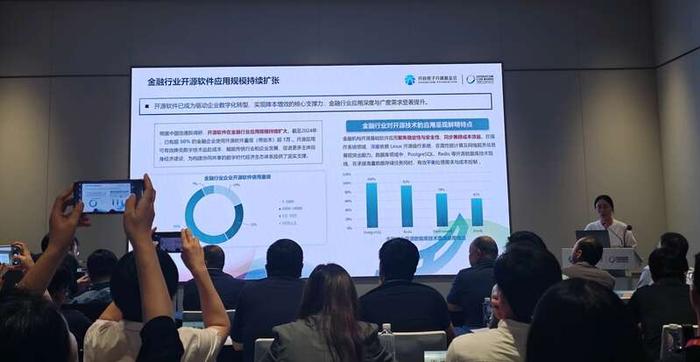
Group 1 - The "support for the development of open-source technology communities" goal outlined in the "14th Five-Year Plan" is being actively implemented across various sectors of the financial industry [1] - Over 58% of the financial sector is actively planning internal open-source collaboration mechanisms to enhance deep collaboration and sharing among technology teams, accelerating the industry's transition to intelligence and platformization [1] - The China Academy of Information and Communications Technology (CAICT) has facilitated open-source governance assessments for numerous financial institutions, including Agricultural Bank of China, Industrial and Commercial Bank of China, and China Construction Bank, creating replicable and scalable standardized practices [1] Group 2 - More than 50 financial enterprises have collaboratively established an innovation platform for technological collaboration and achievement transformation within the financial open-source community [1] - Open-source models are recognized as a new production method in the digital age, effectively reducing costs associated with technological innovation, resource allocation, and industrial transformation [1] - According to CAICT's research, the application rate of the DeepSeek series open-source models in financial enterprises is as high as 100%, while the Tongyi Qianwen series exceeds 70%, indicating that open-source is becoming the mainstream model for digital technology innovation [1] Group 3 - Representatives from China Ping An Life, Agricultural Bank of China, CAICT, China Construction Bank, and Industrial and Commercial Bank of China jointly released a roadmap for the construction of the financial open-source system and initiated a collection of excellent case studies [2] - A pilot program for assessing the innovation and development capabilities of financial open-source initiatives has also been launched [2]

报告:2024年中国开源操作系统实现关键技术突破
Zhong Guo Xin Wen Wang· 2025-07-23 15:44
Group 1 - The 2024 China Open Source Development Deep Report highlights significant breakthroughs and ecological development in five major domestic open-source operating systems, including OpenHarmony, openEuler, openKylin, OpenAnolis, and OpenCloudOS [1] - Domestic manufacturers are accelerating the optimization of technology, product promotion, and ecological layout of self-developed open-source operating systems, leading to a notable acceleration in the domestic substitution process and unprecedented growth in application scale [1] - OpenHarmony, incubated and operated by the OpenAtom Open Source Foundation, aims to create a root community for open-source operating systems for smart terminals, with over 70 co-construction units and 395 ecological partners by the end of 2024, and more than 8,100 active code contributors [1] Group 2 - In the AI sector, leading domestic companies are making significant strides in open-source AI, with Alibaba's Qwen series model representing a major breakthrough for Chinese enterprises [2] - The total global open-source contributions surpassed 700 million for the first time in 2024, with the US, India, and China being the top three contributors, accounting for 200 million contributions [2] - China leads the world in the number of active open-source developers, reaching 2.2729 million in 2024, while India ranks second with 1.9850 million active developers [2]