新型城镇化

Search documents
落户限制放宽,超90%城市落户进入“低门槛时代”
3 6 Ke· 2025-12-30 02:33
Core Viewpoint - The recent report from the State Council regarding the establishment of a sound urban-rural integration development system indicates a significant shift in the household registration system, aiming to relax residency restrictions in most cities, which is expected to support housing demand in the real estate market [1][2][10]. Group 1: Urban-Rural Integration and Residency Policy - The report sets a tone for the household registration system by proposing to relax residency restrictions in all but a few super-large cities, which will lower the barriers for residency in most cities [2][10]. - Over 90% of cities will enter a "low-threshold residency" era, with cities having a permanent population of less than 3 million essentially eliminating residency restrictions [3][4]. - The State Council's plan emphasizes the need to promote urban-rural integration over the next five years, with a clear directive to relax residency restrictions outside of the seven super-large cities [3][10]. Group 2: Impact on Real Estate Market - The reduction in residency barriers is expected to bolster housing demand, as population growth and urbanization are fundamental to real estate needs [2][5]. - The urbanization rate is projected to increase from 67% in 2024 to nearly 70% by 2028, indicating a continued influx of urban residents, although the pace of growth has slowed compared to previous decades [6][9]. - The real estate market may face challenges due to a shrinking scale of incremental urban population growth, with annual increases expected to stabilize around 10.8 million, compared to over 20 million before 2020 [9][10]. Group 3: Long-term Outlook - Despite the slowdown in urbanization growth, the process of urbanizing the agricultural population will continue, maintaining a fundamental demand for housing in the real estate sector [6][9]. - The potential for real estate development remains significant, particularly in county areas, where urbanization rates can grow rapidly, leading to substantial housing demand [9][10].

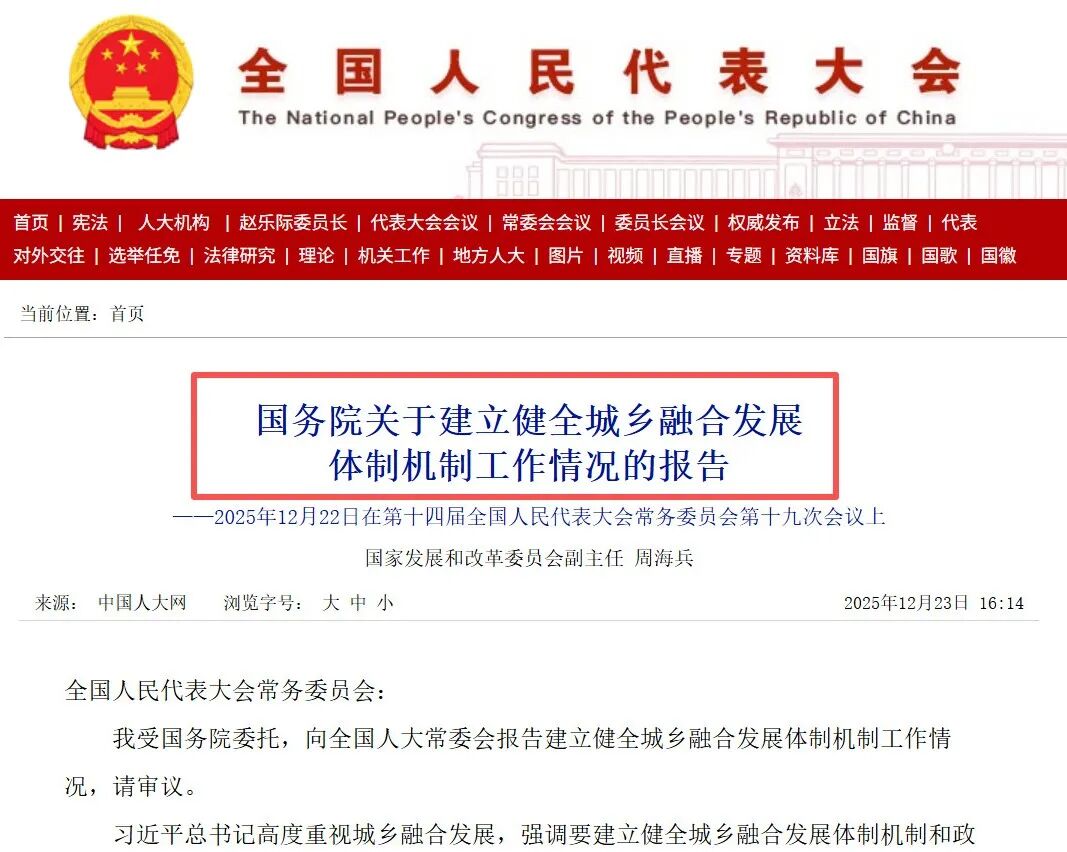
新思想引领新征程丨深入推进城乡融合发展 促进城乡共同繁荣
Yang Guang Wang· 2025-12-29 10:36
Group 1 - The core viewpoint emphasizes the integration of new urbanization and comprehensive rural revitalization to promote a new pattern of urban-rural integration and development [1][2] - Since the "14th Five-Year Plan," various regions have been planning and implementing urban and rural development as a whole, ensuring that urban and rural residents share a high-quality life [1][3] - The urbanization rate of the resident population has increased to 67%, and the income ratio between urban and rural residents has decreased from 2.56:1 in 2020 to 2.34:1 in 2024 [3] Group 2 - The government is accelerating the application of new information technologies such as 5G and big data in rural areas, optimizing the allocation of land and talent resources [2] - In Guangdong, the "Hundred Counties, Thousand Towns, and Ten Thousand Villages High-Quality Development Project" has led to GDP growth in 57 counties exceeding the provincial average for two consecutive years [3] - Nationwide, the rural water supply coverage has reached 94%, and the average reliability of rural power supply is 99.9% [3][4]
华夏幸福跌2.20%,成交额3.53亿元,主力资金净流出3011.95万元
Xin Lang Cai Jing· 2025-12-29 06:47
Group 1 - The core viewpoint of the news is that Huaxia Happiness has experienced a significant decline in stock price and financial performance, indicating potential challenges for the company in the real estate sector [1][2]. Group 2 - As of December 29, Huaxia Happiness's stock price fell by 2.20% to 2.22 CNY per share, with a total market capitalization of 8.688 billion CNY [1]. - The company has seen a year-to-date stock price decline of 17.47%, with a 5.13% drop over the last five trading days and a 5.93% drop over the last 20 days, although it has increased by 5.21% over the last 60 days [1]. - In 2025, Huaxia Happiness reported a revenue of 3.882 billion CNY, a year-on-year decrease of 72.09%, and a net profit attributable to shareholders of -9.829 billion CNY, a year-on-year decrease of 338.67% [2]. - The company's main business segments include real estate development (29.37%), property management services (22.96%), and industrial leasing services (14.61%) [2]. - Huaxia Happiness has not distributed any dividends in the last three years, with a cumulative payout of 16.075 billion CNY since its A-share listing [3]. - As of September 30, 2025, the number of shareholders decreased by 6.22% to 167,000, while the average circulating shares per person increased by 6.63% to 23,316 shares [2].

城建发展涨2.01%,成交额8426.78万元,主力资金净流出905.47万元
Xin Lang Cai Jing· 2025-12-29 02:06
Core Viewpoint - The stock price of Beijing Urban Construction Development Co., Ltd. has experienced fluctuations, with a recent increase of 2.01% but a year-to-date decline of 9.50% [1][2]. Group 1: Stock Performance - As of December 29, the stock price reached 4.57 CNY per share, with a trading volume of 84.27 million CNY and a turnover rate of 0.89%, resulting in a total market capitalization of 9.486 billion CNY [1]. - The stock has seen a 1.56% increase over the last five trading days, but a decline of 2.56% over the past 20 days and 8.60% over the last 60 days [2]. Group 2: Financial Performance - For the period from January to September 2025, the company reported a revenue of 19.311 billion CNY, reflecting a year-on-year growth of 64.20%, and a net profit attributable to shareholders of 0.765 billion CNY, up 40.24% year-on-year [2]. - Cumulative cash dividends since the company's A-share listing amount to 5.243 billion CNY, with 0.519 billion CNY distributed over the last three years [3]. Group 3: Shareholder Information - As of September 30, 2025, the number of shareholders decreased by 1.74% to 47,600, while the average circulating shares per person increased by 1.77% to 43,583 shares [2]. - The top ten circulating shareholders include Southern CSI Real Estate ETF and Hong Kong Central Clearing Limited, both of which have reduced their holdings compared to the previous period [3].

山海争辉,城乡焕新:阳西亮出“百千万工程”三年答卷
Nan Fang Nong Cun Bao· 2025-12-29 01:10
Core Viewpoint - Yangxi County has made significant progress in urban-rural coordinated development over the past three years, achieving notable results in various sectors, including industrial growth, green energy, and public services [11][12][101]. Industrial Development - Yangxi County's industrial output value has increased by an average of 9.8% annually over the past three years, with offshore wind power installed capacity ranking first among county-level regions in China, rising from 2.3 million kW in 2022 to 5.3 million kW [14][25]. - The county has established a comprehensive industrial chain, focusing on marine wind power, marine ranching, and health food industries, contributing to the local economy [21][22]. - The Yangxi industrial park has attracted over 30 billion yuan in investment, with 145 projects introduced, including major global companies, and has achieved an average annual growth of 23.3% in industrial output [39][41]. Green Energy - Yangxi County is developing a large-scale offshore energy base, with the installed capacity of offshore wind power significantly increasing, showcasing its commitment to green energy [26][28]. - The "Mingyu No. 1" deep-sea aquaculture platform has successfully integrated deep-sea fishing and aquaculture, demonstrating innovative practices in marine resource utilization [30][32]. Public Services and Quality of Life - The county has invested 203 billion yuan in urbanization projects, enhancing infrastructure and public services, including education and healthcare [48][49]. - Over the past three years, Yangxi has built or expanded 17 schools and kindergartens, increasing public school enrollment by 17,000 [50][51]. - The healthcare system has been restructured to improve service delivery, with a focus on integrating county hospitals with local clinics, resulting in increased access to medical care for residents [56][66]. Tourism and Rural Development - Yangxi County has successfully promoted rural tourism, with visitor numbers and tourism revenue increasing by 125% and 205% respectively during the recent holiday season [93][94]. - The county has implemented a village collective economic development incentive mechanism, aiming for a 1.8 times increase in collective income by 2024 [96].

明年“国补”继续!2026年财政工作,还有这些看点
Xin Hua She· 2025-12-29 00:12
Core Viewpoint - The central economic work conference emphasizes the continuation of a more proactive fiscal policy, focusing on both the scale of funding and the efficiency of fund utilization [1] Group 1: Fiscal Policy Focus - The fiscal work for 2026 will focus on five key areas: expanding the fiscal expenditure base, optimizing the government bond tool mix, enhancing the effectiveness of transfer payments, continuously optimizing expenditure structure, and strengthening fiscal-financial collaboration [1] - The six key tasks for next year's fiscal work include supporting domestic demand, promoting technological and industrial innovation, advancing urban-rural integration, reinforcing basic social security, facilitating green transformation, and enhancing international financial cooperation [2] Group 2: Social Welfare Initiatives - Initiatives to promote employment and income growth will involve coordinating various funds to support enterprises in maintaining and expanding jobs, as well as increasing residents' income through tax and social security adjustments [3] - Efforts to boost consumption will include implementing special actions to stimulate consumer spending, with funding allocated for programs like trade-in incentives for consumer goods [4] - Increased fiscal investment in education aims to establish a new funding distribution mechanism that adapts to changes in school-age population, support free preschool education, and enhance the quality of compulsory education [5] - Support for a people-centered new urbanization will involve improving the distribution mechanism of fiscal transfer payments to ensure public services are portable, addressing issues related to education and social insurance for migrant workers' children [6]
国务院报告:将放开放宽除个别超大城市外的落户限制
Xin Lang Cai Jing· 2025-12-28 09:12
Core Viewpoint - The report presented by the State Council emphasizes the progress and effectiveness of establishing a sound urban-rural integration development system, highlighting the increase in urbanization rate and the narrowing income gap between urban and rural residents from 2019 to 2024 [1][3]. Group 1: Progress and Achievements - The urbanization rate of the national resident population is projected to rise from 62.7% in 2019 to 67% by 2024, while the ratio of per capita disposable income between urban and rural residents is expected to decrease from 2.64 to 2.34 [3][4]. - The flow of urban-rural factors has become smoother, with the removal of residency restrictions in cities with a population under 3 million and relaxed conditions for cities with populations between 3 million and 5 million [4][5]. - The report indicates that the number of high-quality farmers trained has reached nearly 5 million, with over 1.43 million individuals returning to rural areas for entrepreneurship [4][7]. Group 2: Future Work Arrangements - The report outlines plans to promote the full integration of agricultural transfer populations into cities, including the relaxation of residency restrictions and the establishment of a system for providing basic public services [1][12]. - It emphasizes the need to strengthen infrastructure support for towns that absorb a large number of agricultural transfer populations and to coordinate land use indicators with the increase in permanent residents [1][12]. - The report also highlights the importance of enhancing the rural talent pool and improving the rural land system to support sustainable development [12][13]. Group 3: Challenges and Issues - Despite progress, there are still significant imbalances in urban-rural development, with some counties in central and western regions lagging in agricultural industrialization and modern service development [8][9]. - The report notes that the mechanism for equal exchange of urban-rural factors remains underdeveloped, with a need for improved public resource allocation and talent attraction to rural areas [8][9]. - There are ongoing disparities in infrastructure and public service quality between urban and rural areas, which continue to pressure the income growth of rural residents [9][10].
中国经济多长时间赶上美国,重返世界第一
Sou Hu Cai Jing· 2025-12-28 04:11
Economic Growth Comparison - In 1978, China's GDP was $147.9 billion, only 6.29% of the U.S. GDP, with a per capita income of $156, significantly lower than sub-Saharan Africa [2] - By 2025, global GDP is projected to reach $117.16 trillion, with the U.S. surpassing $30 trillion and China's GDP expected to be $19.39 trillion, approximately 63.3% of the U.S. GDP [4] Historical Context - China lost its title as the "Celestial Empire" in 1870 when its economic output was surpassed, and the U.S. took the lead from the U.K. in 1894, maintaining dominance ever since [5] Future Scenarios for Economic Growth - **Baseline Scenario (50% probability)**: If China maintains a 2% average growth rate advantage over the U.S., it could reach over 80% of the U.S. GDP in 20-30 years [8] - **Optimistic Scenario (25% probability)**: If reform benefits are realized, with China's growth at over 5% and the U.S. at 2%, the gap could close in 15-20 years [8] - **Pessimistic Scenario (25% probability)**: If China's growth slows to 3-4% while the U.S. maintains 2.5%, surpassing the U.S. could be delayed by 30 years or more [9] Internal Growth Drivers - **Industrial Upgrade**: Transitioning from a "world factory" to a "world laboratory" to capitalize on innovations in AI, quantum information, and other advanced sectors [11] - **Consumption Upgrade**: Addressing income inequality and enhancing social security to convert potential consumer demand into actual economic activity [11] - **Regional Coordination**: Leveraging growth in key regions to balance costs and unlock potential in less developed areas [11] - **New Urbanization**: Reforming urban policies to integrate rural workers into cities, driving investment and consumption [11] External Growth Constraints - **Global Demand**: Rising protectionism and shifts in supply chains may limit export growth [12] - **U.S. Policies**: Fiscal expansion and monetary tightening in the U.S. could elevate global interest rates and exacerbate technological decoupling [12] - **Financial Cycles**: Changes in capital flows and the internationalization of the RMB will be critical for maintaining growth [12] - **Geopolitical Risks**: Tensions in regions like Taiwan and the South China Sea could disrupt economic progress [12] Strategic Battles for Economic Leadership - **Industrial Leap**: Aiming for high-tech manufacturing to constitute 30% of the economy [13] - **Consumer Economy**: Increasing the final consumption rate to 70% and expanding the middle-income group [13] - **Spatial Restructuring**: Developing a multi-centered, networked economic landscape [13] - **Financial Innovation**: Establishing non-dollar financial infrastructures to enhance global resource allocation [13] - **Risk Mitigation**: Creating a safety net across technology, energy, food, and finance to sustain growth [13] Long-term Projections - China is projected to potentially surpass the U.S. in total economic output between 2045 and 2050, contingent on maintaining a high-quality growth rate of 4-5% [14]
李强再提稳楼市,这次有什么不一样?
中指研究院· 2025-12-27 08:06
Investment Rating - The report indicates a positive outlook for the real estate market, emphasizing the potential for growth driven by new urbanization initiatives and housing demand [3][4]. Core Insights - The "14th Five-Year Plan" period presents significant opportunities for urbanization, with an estimated housing demand of nearly 5 billion square meters over the next five years, translating to an average annual sales area of 7-8 million square meters for new residential properties [4][5]. - Urbanization is identified as a key driver for expanding domestic demand and promoting industrial upgrades, with a focus on improving living conditions and urban quality [4][5]. - The report highlights the importance of urban renewal as a strategy to stabilize the housing market, with various policies being implemented to enhance living conditions and property values [6][7]. Summary by Sections Urbanization and Housing Demand - The report forecasts that the urban housing demand will remain robust, with over 40% of this demand driven by improvement housing needs, supported by demographic changes such as smaller family units [5]. - The ongoing urbanization process is expected to create further opportunities for real estate development, particularly in regions with significant population inflows [5][6]. Urban Renewal Policies - Recent government initiatives emphasize urban renewal as a critical component for stabilizing the housing market, with policies aimed at improving old housing and enhancing living environments [6][7]. - The introduction of financial and land policy incentives for urban renewal projects is anticipated to attract more market participants and support the overall development of the real estate sector [9].
建科院涨2.06%,成交额4268.11万元,主力资金净流入18.91万元
Xin Lang Zheng Quan· 2025-12-26 06:20
Core Viewpoint - The stock of Shenzhen Institute of Building Science Co., Ltd. (建科院) has shown fluctuations, with a recent increase of 2.06% on December 26, 2023, despite a year-to-date decline of 1.55% [1][2]. Group 1: Stock Performance - As of December 26, 2023, the stock price reached 15.86 CNY per share, with a trading volume of 42.68 million CNY and a turnover rate of 1.87%, resulting in a total market capitalization of 2.326 billion CNY [1]. - The stock has experienced a 2.12% increase over the last five trading days, an 8.48% decline over the last 20 days, and a 4.48% increase over the last 60 days [2]. Group 2: Financial Performance - For the period from January to September 2025, the company reported a revenue of 171 million CNY, representing a year-on-year decrease of 31.35%, and a net profit attributable to shareholders of -69.91 million CNY, a decline of 102.73% year-on-year [2]. - Cumulatively, the company has distributed 91.67 million CNY in dividends since its A-share listing, with 23.47 million CNY distributed over the last three years [3]. Group 3: Shareholder Information - As of December 19, 2023, the number of shareholders decreased by 2.39% to 14,600, with an average of 10,050 circulating shares per shareholder, an increase of 2.45% [2]. - Notable institutional holdings include Noan Multi-Strategy Mixed A (320016) as the fifth largest shareholder with 1.0411 million shares, an increase of 356,100 shares from the previous period, and CITIC Prudential Multi-Strategy Mixed (LOF) A (165531) as a new tenth largest shareholder with 588,200 shares [3].