
普惠金融

Search documents
前三季度我省主要金融指标平稳较快增长
Hai Nan Ri Bao· 2025-10-26 00:24
Financial Indicators - The total balance of various loans in Hainan reached 14,106 billion yuan by the end of September, showing a year-on-year growth of 11.9%, which is 4.5 percentage points higher than the same period last year [1] - The total balance of various deposits in Hainan was 15,384 billion yuan by the end of September, with a year-on-year growth of 8.9%, an increase of 2.0 percentage points compared to the same period last year [1] Inclusive Finance - The balance of inclusive small and micro loans in Hainan reached 1,305 billion yuan by the end of September, reflecting a year-on-year increase of 12.4% [1] Technology Finance - The balance of technology loans in Hainan was 1,588 billion yuan by the end of August, with a year-on-year growth of 12.7% [2] - Hainan Natural Rubber Industry Group issued 350 million yuan in the interbank bond market, marking the first nationwide agricultural science and technology bond [2] Green Finance - The balance of green loans in Hainan reached 1,668 billion yuan by the end of September, with an increase of 274 billion yuan since the beginning of the year [2] Pension and Consumer Finance - The balance of personal consumer loans (excluding personal housing loans) grew by 9.6% year-on-year by the end of September [2] - The balance of loans for the pension industry saw a significant increase of 163.5% year-on-year by the end of August [2]
工商银行普惠金融事业部(乡村振兴办公室)总经理田哲:书写普惠金融大文章
Zhong Guo Jing Ji Wang· 2025-10-25 23:13
Core Viewpoint - The 20th Central Committee's Fourth Plenary Session has outlined a grand development blueprint for the "14th Five-Year Plan" period, emphasizing high-quality development and providing fundamental guidelines for various work areas [1] Group 1: Economic and Financial Development - During the "14th Five-Year Plan" period, China has achieved historic accomplishments in economic and social development, accelerating the pace of building a strong nation through Chinese-style modernization [1] - The inclusive finance sector has seen significant growth in loans to small and micro enterprises, expanding coverage and providing strong support for stabilizing employment, ensuring livelihoods, and promoting consumption [1] Group 2: Future Directions and Responsibilities - The inclusive finance sector is committed to embodying the political and people-oriented nature of financial work, aiming to provide essential services to the public [1] - The focus will be on online, intelligent, centralized, and ecological development, exploring high-quality development paths for inclusive finance [1] - The sector aims to enhance financial services to various business entities, supporting the construction of a modern industrial system and a robust domestic market [1]

农行莆田涵江支行为科技型企业腾飞插上“金融翅膀”
Zheng Quan Ri Bao Zhi Sheng· 2025-10-25 17:10
Core Insights - Agricultural Bank of China (ABC) has been actively supporting technology-oriented enterprises in Fujian Province, particularly through tailored financial products to address their funding challenges [1][2] Group 1: Financial Support Initiatives - ABC provided a specialized loan called "Specialized, Refined, Characteristic, and Innovative Small Giant Loan" to a CNC machine tool manufacturer, enabling them to stabilize production amid cash flow pressures [1] - The bank's quick response time, with loan approval completed in two weeks, highlights its commitment to supporting local businesses [1] - ABC has implemented a series of inclusive financial measures to eliminate information barriers and streamline financing for technology enterprises [1] Group 2: Innovative Financing Solutions - The bank utilized "Technology E-Loan + Patent Pledge" to assist a technology company in securing low-interest credit, recognizing the value of intellectual property as collateral [2] - ABC has established a comprehensive financial service network that integrates resources from government departments and industrial parks to enhance service efficiency for technology firms [2] - The bank's proactive approach has resulted in a significant increase in loans to technology enterprises, with a balance of 563 million yuan as of September, reflecting a growth of 270 million yuan since the beginning of the year [2]

国家开发银行做好“五篇大文章” 奋力书写金融高质量发展新篇章
Zheng Quan Ri Bao· 2025-10-25 16:44
Core Viewpoint - The China Development Bank (CDB) is committed to serving the real economy by enhancing its financial services across five key areas: technology finance, green finance, inclusive finance, pension finance, and digital finance, thereby contributing to the construction of a strong financial nation [1] Group 1: Technology Finance - CDB actively promotes financial services for technological innovation, providing comprehensive financial support for major national technology tasks and tech enterprises, facilitating the development of new productive forces [2][3] - CDB has issued its first batch of three "Technology Innovation Bonds" totaling 20 billion yuan, aimed at supporting technology innovation demonstration enterprises and high-tech manufacturing industries [3] Group 2: Green Finance - CDB focuses on financing for green upgrades in infrastructure, low-carbon technology innovation, and energy transitions, supporting major ecological projects and initiatives [4][5] - Since the 14th Five-Year Plan, CDB has issued 157 billion yuan in green financial bonds to support national strategies related to ecological protection and high-quality development [6] Group 3: Inclusive Finance - CDB has played a significant role in providing student loans, disbursing 246 billion yuan to support over 23 million students, accounting for over 80% of the national total [6] - The bank has supported over 1.5 million small and micro enterprises, enhancing financial services in key sectors such as technology innovation and green development [6] Group 4: Pension Finance - CDB has supported the construction of over 190,000 inclusive pension beds during the 14th Five-Year Plan, addressing the needs of the aging population [8][9] - The bank has developed personalized financing solutions to revitalize and integrate idle elderly care resources, enhancing the availability of diverse elderly care services [9] Group 5: Digital Finance - CDB is advancing digital transformation by supporting the construction of foundational networks and AI infrastructure, aiming to enhance the efficiency of financial services [10][11] - The bank is implementing innovative loan models using AI and mobile applications to improve the student loan process and overall service experience [11]
中信证券发布三季度报 资产规模首次超两万亿
Sou Hu Cai Jing· 2025-10-25 09:47
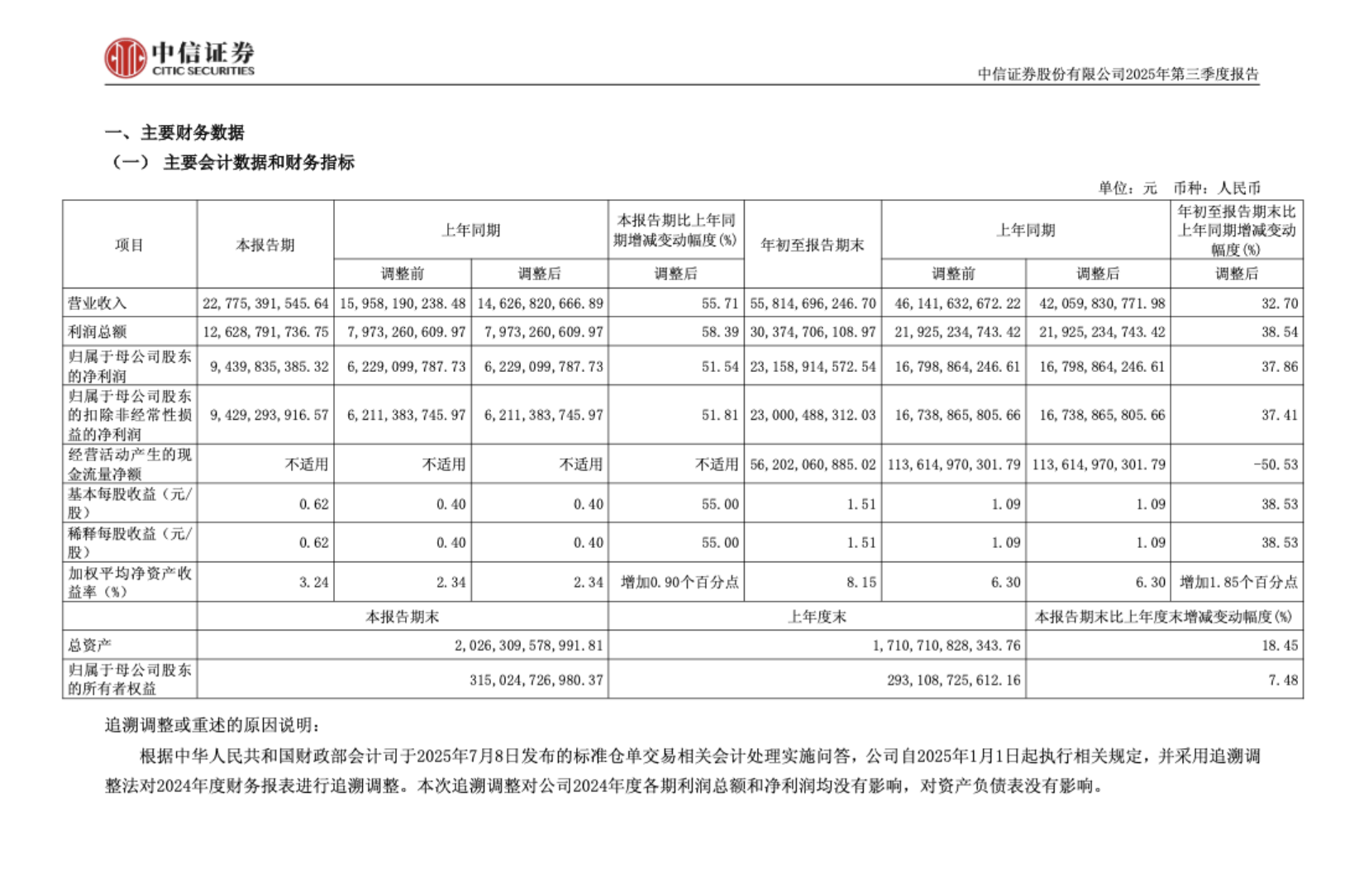
Core Points - CITIC Securities has become the first brokerage in China to exceed total assets of 2 trillion yuan, reaching 2.03 trillion yuan as of September 30, 2025 [1] - The company reported a significant increase in operating income and net profit for the third quarter of 2025, with operating income of 55.81 billion yuan, a year-on-year increase of 32.70%, and net profit attributable to shareholders of 23.16 billion yuan, a year-on-year increase of 37.86% [4] - The return on equity (ROE) reached 8.15%, an increase of 1.85 percentage points compared to the previous year [4] Financial Performance - Total assets as of the end of the reporting period were 2,026.31 billion yuan, with net assets attributable to shareholders reaching 315 billion yuan [2][4] - The basic and diluted earnings per share were both 0.62 yuan, reflecting a 55% increase compared to the same period last year [2] - The net cash flow from operating activities for the year-to-date was 56.20 billion yuan, indicating strong operational cash generation [2] Sector Contributions - In the technology finance sector, CITIC Securities completed equity underwriting of 112.3 billion yuan for the Sci-Tech Innovation Board, Growth Enterprise Market, and Beijing Stock Exchange from 2023 to the third quarter of 2025 [4] - The company assisted BYD in completing a $5.6 billion H-share placement, setting a record in the global automotive industry and Hong Kong market [4] - In green finance, CITIC Securities completed green bond underwriting amounting to 181 billion yuan from 2023 to the third quarter of 2025 [5] Other Initiatives - The company has developed a comprehensive green service system and has engaged in rural revitalization bonds totaling 1.55 billion yuan [5] - CITIC Securities has over 4.7 trillion yuan in asset management scale as of September 30, 2025, and has launched initiatives to enhance awareness of retirement planning among the youth [5] - The company is advancing its digital transformation with the development of AI digital employees, having launched 18 digital staff and 118 AI application scenarios [5]


资金流信息平台上线一周年,交出增信促融满意答卷
Jin Rong Shi Bao· 2025-10-25 04:23
Core Insights - The establishment of the National Small and Micro Enterprises Fund Flow Credit Information Sharing Platform aims to enhance the financing accessibility for small and micro enterprises by improving credit information sharing and addressing the challenges of traditional credit assessment methods [1][2][4] Group 1: Platform Overview - The Fund Flow Information Platform is designed to provide financial institutions with critical credit information beyond traditional credit history, enabling better assessment of small and micro enterprises' creditworthiness [2][5] - The platform aims to convert dormant credit assets of small and micro enterprises into quantifiable financing capital, facilitating a more efficient and transparent credit information exchange [2][4] Group 2: Impact on Enterprises - The platform has enabled enterprises, such as a hotel in Jiujiang, to secure significant loans without traditional collateral, demonstrating the effectiveness of data-driven credit assessments [3][6] - By utilizing the platform, financial institutions can offer lower interest rates and faster loan approvals, significantly improving the financing conditions for small and micro enterprises [3][7] Group 3: Financial Institutions' Perspective - Financial institutions have praised the platform for its extensive coverage and high-quality information, which enhances their ability to assess credit risk accurately and efficiently [5][6] - The platform allows for a comprehensive integration of transaction data across multiple banks, addressing issues of fragmented data and improving risk assessment processes [5][6] Group 4: Broader Financial Ecosystem - The platform supports the development of inclusive finance by addressing the urgent funding needs of small and micro enterprises, thereby reducing financing costs and improving efficiency [4][8] - It fosters a positive cycle of creditworthiness by encouraging enterprises to enhance their financial management and accumulate "credit wealth" [4][9] Group 5: Performance Metrics - Since its launch, the platform has facilitated over 123.41 billion yuan in financing support, with more than 4.14 million queries recorded, showcasing its effectiveness in breaking down barriers between banks and enterprises [9]
中信证券总资产突破2万亿元
Zheng Quan Ri Bao· 2025-10-24 17:51
Core Insights - CITIC Securities has demonstrated strong growth in the first three quarters of 2025, achieving record-high profits and total assets exceeding 2 trillion yuan, solidifying its leading position in the industry [1][2] Financial Performance - In the first three quarters of 2025, CITIC Securities reported operating revenue of 55.815 billion yuan, a year-on-year increase of 32.7%, and a net profit attributable to shareholders of 23.159 billion yuan, up 37.86% [1] - For Q3 2025 alone, the company achieved operating revenue of 22.775 billion yuan, a 55.71% increase year-on-year, and a net profit of 9.44 billion yuan, growing by 51.54% [1] Capital Strength - As of September 30, 2025, CITIC Securities' total assets reached 2.03 trillion yuan, marking a significant milestone as the first domestic brokerage to surpass this threshold [2] - The company's net assets attributable to shareholders amounted to 315 billion yuan, reflecting an improvement in both asset scale and quality [2] Strategic Initiatives - CITIC Securities is actively implementing the financial "Five Major Articles" strategy, enhancing its service capabilities to support high-quality development in the real economy [3] - The company has completed equity underwriting of 112.3 billion yuan for the Sci-Tech Innovation Board, Growth Enterprise Market, and Beijing Stock Exchange, leading the market [3] - In green finance, CITIC Securities has underwritten green bonds totaling 181 billion yuan, ranking first in the industry [3] Digital and Inclusive Finance - As of September 30, 2025, CITIC Securities' asset management scale exceeded 4.7 trillion yuan, addressing diverse wealth management needs [3] - The company has launched various initiatives in pension finance, with investment management scale surpassing 1 trillion yuan [4] - CITIC Securities is advancing digital transformation, having developed an AI platform with 18 digital employees and 118 AI application scenarios [4] Market Outlook - Industry experts suggest that CITIC Securities' strong performance reflects its robust comprehensive strength and risk resilience, indicating potential for further consolidation of its leading position in the market [4]
陆控(LU.US)宣布新人事任命 消金业务持续保持增长
智通财经网· 2025-10-24 12:45
Group 1 - The company announced a quarterly update regarding its resumption progress and changes in the Chief Risk Officer position, including the appointment of Cheng Jianbo as the new Chief Risk Officer [1] - The former Chief Risk Officer, Lin Yunzhen, resigned due to the expiration of her contract, and the board expressed gratitude for her contributions during her tenure [1] - The company has applied for an extension to submit its 2024 20-F annual report to the New York Stock Exchange by April 30, 2026, and is currently unable to provide a specific timeline for the earnings release [1] Group 2 - The company provides financial services primarily to small and micro enterprises and individuals, supporting inclusive finance and the real economy [2] - Business operations have remained normal since the suspension of trading, with stable performance reported [2] - Preliminary assessments for the third quarter ending September 30, 2025, indicate improved business performance compared to the same period last year, with significant growth in key metrics [2] - The total amount of new loans enabled reached RMB 56.9 billion, a year-on-year increase of 12.8%, with consumer finance loans amounting to RMB 31.7 billion, up 20.1% [2] - The cumulative number of borrowers increased from approximately 24.8 million to about 28.5 million, representing a growth rate of 15.3% [2] - The income rate from retail credit enabling business improved from 9.7% in 2024 to 13.0% [2]
陆控申请年报延期,累计借款人超2800万
Quan Jing Wang· 2025-10-24 11:57
Group 1 - The company announced a quarterly update regarding its resumption progress and changes in the Chief Risk Officer position, including an application for an extension to submit the 2024 20-F annual report by April 30, 2026 [1] - The board appointed Cheng Jianbo as the new Chief Risk Officer, who has extensive experience in risk management from various financial institutions and previously held senior positions at JD.com and Puhua Credit [1] - The former Chief Risk Officer, Lin Yunzhen, resigned due to the expiration of her contract, and the board expressed gratitude for her contributions during her tenure [1] Group 2 - The company provides financial services primarily to small and micro enterprises and individuals, supporting inclusive finance and the real economy [2] - Business operations remained normal during the suspension of trading, with stable performance reported [2] - Preliminary assessments for the third quarter ending September 30, 2025, indicate improved business performance compared to the same period last year, with total new loans reaching RMB 56.9 billion, a year-on-year increase of 12.8% [2] - Consumer finance new loans amounted to RMB 31.7 billion, reflecting a year-on-year growth of 20.1% [2] - The cumulative number of borrowers increased from approximately 24.8 million to about 28.5 million, representing a growth rate of 15.3% [2] - The income rate from retail credit empowerment business rose from 9.7% in 2024 to 13.0% [2]
三季度信贷投向显韧性 普惠、科创、消费构筑金融支持新格局
Jing Ji Guan Cha Wang· 2025-10-24 10:53
Core Insights - The People's Bank of China reported a slowdown in the growth of RMB loans, with a balance of 270.39 trillion yuan at the end of Q3 2025, reflecting a year-on-year growth of 6.6%, down from 7.1% at the end of Q2 [1] - The report highlights a significant transformation in the credit structure, with funds being directed towards key areas of the national economy and weaker sectors [1] Group 1: Inclusive Micro Loans - The balance of inclusive micro loans reached 36.09 trillion yuan by the end of Q3, showing a year-on-year growth of 12.2%, slightly down from 12.3% in Q2 [2] - In Q3, 3.15 trillion yuan was added in new inclusive micro loans, with 520 billion yuan added in Q3 alone, lower than the approximately 730 billion yuan added in Q2 [2] - The focus of inclusive micro loans is shifting from rapid expansion to stable coverage, emphasizing service depth and accessibility [2] Group 2: Technology Loans - By the end of Q3, 27.54 million technology SMEs received loan support, with a loan acquisition rate of 50.3%, up from 50% in Q2 [3] - The loan balance for technology SMEs reached 3.56 trillion yuan, with a year-on-year growth of 22.3%, slightly down from 22.9% in Q2 [3] - The number of high-tech enterprises receiving loans was 26.66 million, maintaining a stable loan acquisition rate of 57.6% [3] Group 3: Non-Housing Consumer Credit - The balance of household loans in both domestic and foreign currencies was 83.94 trillion yuan, with a year-on-year growth of 2.3%, down from 3% in Q2 [4] - Consumer loans excluding housing reached 21.29 trillion yuan, growing by 4.2% year-on-year, with 3.062 trillion yuan added in the first three quarters [4] - The balance of household operating loans was 25.21 trillion yuan, reflecting a year-on-year growth of 4.8%, indicating active financing demand from small business operators [4] Group 4: Structural Changes in Credit - The report indicates a structural differentiation in credit data, illustrating the macro picture of China's economic transformation [4] - As traditional credit engines slow down, sectors like inclusive finance, technology, and green loans are expected to take on more responsibility in supporting the real economy [4] - The transition in credit structure is seen as a result of policy guidance and a natural selection of market dynamics, moving from asset collateral logic to value creation logic [4] Group 5: Challenges and Future Outlook - The adjustment in inclusive loan growth suggests emerging sustainability boundaries, while technology loans face long-term risk pricing challenges [5] - The ongoing contraction in real estate loans and the slowdown in traditional infrastructure loans are reshaping the entire credit creation mechanism [5] - Future policy design should focus on institutional building and long-term mechanisms to ensure financial resources are efficiently directed towards the real economy [6]